What's on this page
- Before you start: what to gather
- Step 1: Confirm the problem you have is actually hardness
- Step 2: Test your water and get real numbers
- Step 3: Convert your hardness into grains per gallon
- Step 4: Add the iron and manganese compensation
- Step 5: Estimate your daily household water use
- Step 6: Multiply out your daily grain load
- Step 7: Size the resin for a sensible regeneration interval
- Step 8: Choose metered regeneration and the right tank layout
- Step 9: Decide between salt-based softening and salt-free conditioning
- Where a whole-house filter or iron filter belongs in the sequence
- Resin, tanks, and what is actually inside the unit
- Salt types: what goes in the brine tank
- Install considerations: bypass, drain, power, and placement
- Outdoor and unconditioned installs: the risks worth naming
- What a water softener costs to run
- Maintenance: the short list that keeps it working
- The sodium question, answered honestly
- A worked example: sizing for a family of four on hard well water
- Common mistakes when choosing a water softener
- Troubleshooting: when your numbers do not fit the recipe
- The water softener buyer’s checklist
- The two numbers that carry the whole decision
- The bottom line
Almost every water softener sold is chosen the same wrong way: by the number on the box. A homeowner sees 48,000 grains next to 64,000 grains, reasons that more capacity cannot hurt, and buys the bigger one. The trouble is that grain capacity is not a size in the way that square footage is a size. It is one half of a fraction whose other half is your household’s daily demand, and until you have that second number the label means nothing at all. The result is a market full of homes running units two sizes wrong in both directions, some regenerating every third day and burning salt, others sitting idle for a fortnight while the resin bed channels.
These test notes fix that by putting the arithmetic first. You will test your water and get a real hardness number, convert it into grains per gallon, add the compensation that dissolved iron demands, estimate what your household actually uses in a day, multiply the two into a daily grain load, and only then choose a resin capacity that gives you a sensible interval between regenerations. After that the technology questions get easy, because a sized unit turns metered valves, twin tanks and salt-free conditioners into decisions with obvious answers. Our lab report on choosing and sizing a whole house water filter covers the filtration that sits alongside this, and you can price your own annual salt and water figure in the cost-per-use calculator.
Key takeaways
- Grain capacity is meaningless on its own. The number that decides your purchase is grains removed per day, which is your daily gallons multiplied by your compensated hardness.
- Convert before you shop: milligrams per liter divided by 17.1 gives grains per gallon, and every softener on the shelf is rated in grains while almost every water report is printed in milligrams per liter.
- Dissolved iron eats softener capacity. A common rule of thumb adds about 4 grains per gallon of apparent hardness for every 1 part per million of iron, which is often the difference between one tank size and the next.
- Size for an interval, not for a maximum. Roughly six to ten days between regenerations is the comfortable band, and buying the biggest unit on the shelf is its own failure mode.
- Metered regeneration beats a timer for nearly every household, and a salt-free conditioner is not a softener: it changes how scale forms rather than removing hardness, which is a smaller and different promise.
Before you start: what to gather
Working through this takes about an hour of desk time and no tools beyond whatever you use to test your water. The difficulty is low, and none of the arithmetic is harder than multiplication. The discipline is in refusing to look at a single product page until you have your own numbers, because a shelf full of tanks that all look identical is designed to be chosen on price and capacity, and both of those are the wrong criteria in isolation.
Gather four things before you shop:
- A hardness number you trust, in units you know. Either from your utility’s annual water quality report, from a test kit, or from a laboratory. Write down the number and the unit, because a report reading 205 and a report reading 12 can describe exactly the same water in different units.
- An iron and manganese number if you are on a well. A private well is not monitored by anyone, and dissolved iron is the single most common reason a correctly sized softener underperforms. If you are on a municipal supply this is usually a non-issue, and the utility report will say so.
- An honest count of the people in the house and how they use water. Occupancy is the crude input; a recent water bill in gallons or cubic feet is the accurate one. Both work, and the bill is better if you have it.
- The physical facts of where the unit will go. Whether there is a drain within reach, whether there is a standard outlet nearby, whether the spot stays above freezing, and how the plumbing runs from the main into the water heater. These decide the install and occasionally rule out an otherwise sensible unit.
A word on posture before the steps. Every grain figure, salt dose, gallon estimate and dollar amount in these test notes is an illustrative planning number drawn from typical published ranges, not a measured result for any specific model or any specific house. The point is the method. Local plumbing codes differ, and some jurisdictions restrict or prohibit discharging softener brine to a septic system or a storm drain, so confirm the rules that apply where you live before you commit to an install. Keep the cost-per-use calculator open in a second tab; you will feed it real numbers at the running-cost step.
Step 1: Confirm the problem you have is actually hardness
Start with the cheapest possible check, which is whether a softener is the right appliance at all. Hardness has a recognizable signature, and it is worth matching your complaints against it before you spend, because several unrelated water problems get blamed on hardness and none of them is fixed by ion exchange.
The signature of hard water is chalky white deposits on faucets, shower doors and kettle elements, cloudy spots on glassware coming out of the dishwasher, soap and shampoo that will not lather, laundry that feels stiff, and a water heater that loses efficiency and eventually capacity as scale builds on the tank floor or the heat exchanger. That last one is the expensive symptom, which is why our walkthrough on flushing and draining a water heater matters far more in a hard-water house, and why hardness quietly shortens the service life you would otherwise expect from the numbers in our reference on how long a water heater and other gear last.
What hardness is not: a metallic taste, a rotten-egg smell, orange staining in the toilet tank, a chlorine smell, or visible grit in the aerator. Orange or brown staining points at iron, the smell at hydrogen sulfide, chlorine at your utility’s disinfection, and grit at sediment. Some of those travel with hardness on well water and are handled in the same install, but none is cured by softening on its own.
Watch out: the descaling you already do is a symptom, not a solution. If you are running vinegar through the kettle every few weeks, as in our note on descaling a kettle, and wiping scale off the shower glass constantly, that is the hardness signature confirming itself. Treat it as evidence for the test, not as a fix you can keep repeating forever.
Step 2: Test your water and get real numbers
You cannot size a softener without a hardness figure, and there are three ways to get one. They differ in cost, precision and in what else they tell you, and the right choice depends mostly on whether you are on a municipal supply or a private well.
Your utility’s annual water quality report is free, already published, and legally required of community water systems. It is the obvious first stop on a municipal supply, and it typically lists hardness alongside the regulated contaminants the utility tested for. Two caveats. Hardness can vary through the year if the utility blends sources, so a report figure is an average rather than today’s reading. And the report describes water leaving the treatment plant and moving through the mains, not water arriving at your particular tap after a run of old pipe.
A home test kit is the fast confirmation. A titration kit, where you add drops until the sample changes color and count the drops, gives a grains-per-gallon reading directly and is generally more precise than a dip strip, which reads a color band. Either one is enough to size a softener on a municipal supply where the utility report has already told you nothing exotic is present. Test the cold tap, let it run for a minute first so you are testing the main rather than the pipe.
A laboratory test is the one to use on a well. Nobody monitors a private well, so you need a certified lab panel that covers hardness, iron, manganese, pH, total dissolved solids, and the bacteriological and nitrate results that decide whether the water is safe at all before you worry about whether it is comfortable. Iron and manganese in particular change your softener sizing and possibly your equipment list, and neither shows up on a hardness strip. The fuller panel costs more than a kit and is the only sensible route on well water.

Watch out: do not test softened water and conclude you do not need a softener, which sounds absurd until you buy a house that already has one plumbed in. Test at an outside hose bib or ahead of any existing treatment, so you are measuring what enters the house rather than what some previous owner’s equipment already changed.
Step 3: Convert your hardness into grains per gallon
Here is the small unit problem that quietly derails a lot of purchases. Water softeners are rated in grains. Water reports are almost always printed in milligrams per liter, expressed as calcium carbonate equivalent, and at these concentrations milligrams per liter and parts per million are used interchangeably. If you shop with the report number in your head you are out by a factor of about seventeen, which is enough to buy something absurd.
The conversion is one division. Grains per gallon equals milligrams per liter divided by 17.1. A report reading 205 mg/L as calcium carbonate is 205 divided by 17.1, which is 11.99, so call it 12 grains per gallon. Going the other way, multiply grains by 17.1: a titration kit reading 7 grains per gallon describes water at about 120 mg/L. Keep both numbers written down, because the report speaks one language and the product page speaks the other.
It helps to know where your number sits in the bands that water-quality agencies publish and most laboratories print on their results. Soft water is roughly below 60 mg/L, or about 3.5 grains per gallon. Moderately hard runs from there to about 120 mg/L, or 7 grains. Hard runs to about 180 mg/L, or 10.5 grains. Anything above that is classed very hard, and plenty of well water sits far above the top band. Below about 3 grains per gallon there is usually nothing worth softening; between 3 and 7 it becomes a comfort and appliance-protection decision; above 7 the scale is doing real work on your plumbing and the case gets straightforward.
Watch out: confirm what your report is actually measuring. Some list calcium and magnesium separately in milligrams per liter of the element rather than as calcium carbonate equivalent, which is a different number and cannot be divided by 17.1 to get grains. If the report does not say “as CaCO3” next to the hardness line, a cheap titration kit at your own tap settles it in five minutes and is worth the certainty.
Step 4: Add the iron and manganese compensation
Dissolved iron is the reason a great many correctly sized softeners disappoint, and it is invisible in a hardness test. Softener resin will exchange iron along with calcium and magnesium, which means iron consumes capacity you thought you were spending on hardness. If you size from your raw hardness figure alone on iron-bearing well water, the unit runs out of capacity before its calculated interval, delivers hard water at the end of every cycle, and its owner concludes the sizing chart lied.
The industry handles this with a compensation added to the hardness before sizing. A commonly used rule of thumb adds about 4 grains per gallon of apparent hardness for every 1 part per million of dissolved iron, with published versions of the rule ranging from roughly 3 to 5 grains per part per million. Take our example water at 12 grains per gallon with 1.0 ppm of iron: the compensated figure is 12 plus 4, which is 16 grains per gallon, a third more than the raw number. That single adjustment is frequently the difference between one tank size and the next, which is exactly why it matters.
Manganese gets its own compensation, commonly quoted higher than iron per part per million, and it stains far more aggressively at far lower concentrations. Both minerals also have a practical ceiling above which a softener should not be asked to carry them at all. The commonly cited working limit is somewhere around 1 to 3 parts per million of clear-water iron, and the limit drops toward zero for red-water or bacterial iron, which is already oxidized into particles the resin cannot exchange and will simply foul the bed with. Above the limit, or with any oxidized or bacterial iron at all, the answer is a dedicated iron filter ahead of the softener rather than a bigger softener.
Watch out: iron fouling is often permanent rather than a temporary capacity loss. Once oxidized iron coats and plugs the resin bed, a softener’s capacity falls and does not come back on its own, and the remedies are a specialist resin cleaner, a rebedding, or a replacement. Get the iron number before you buy, add the compensation if it is low, and put a filter in front of it if it is not.
Step 5: Estimate your daily household water use
The second half of the sizing fraction is how much water your home actually moves in a day. There are two ways to get it, and one is much better than the other.
The accurate route is your water bill. Utility bills report either gallons or hundreds of cubic feet, usually abbreviated CCF, and one CCF is 748 gallons. Take a full billing period, divide by the number of days it covers, and you have a measured daily figure for your actual household with its actual habits. That number already includes your teenager’s showers, the garden hose, and the fact that nobody is home on weekdays, which is precisely the information an occupancy estimate throws away.
The estimate route is occupancy multiplied by a per-person figure. The planning default the softener trade uses is about 75 gallons per person per day, and the honest range around it runs from roughly 50 gallons in a frugal household with efficient fixtures to 100 or more in a home with long showers, frequent laundry, and irrigation on the same meter. Four people at 75 gallons is 300 gallons a day. Use the default if you have nothing better, but lean up if you have a large family, a hot tub, or a lawn on the house supply, and lean down for a household of efficient fixtures and short showers.
One refinement worth making: outdoor water usually bypasses the softener, and it should, because there is no reason to spend salt on the lawn. If your bill includes heavy irrigation and your install puts the outside taps ahead of the softener, subtract that irrigation from the figure you size with. Otherwise you will buy a tank sized to soften the garden.
Watch out: resist the urge to size for a hypothetical future. People routinely add a bedroom’s worth of occupancy to the estimate for guests, or for children who have not arrived. The metered valves in Step 8 handle a variable household by design, so size for the house you have with a little headroom, not for the house you might have in a decade.
Step 6: Multiply out your daily grain load
This is the step the whole decision turns on, and it fits on one line.
Daily grains equals daily gallons multiplied by compensated hardness in grains per gallon. Nothing else. Our example household is four people at 75 gallons each, which is 300 gallons a day, and their compensated hardness from Step 4 is 16 grains per gallon. Three hundred multiplied by sixteen is 4,800 grains per day. That is the number to write at the top of the page, because every subsequent decision refers back to it.
Notice what this figure does that a house-size chart cannot. Two identical four-bedroom homes, one on moderately hard municipal water at 6 grains per gallon and one on very hard well water with iron at a compensated 22 grains, will show daily loads of 1,800 and 6,600 grains respectively. They need units nearly four times apart in capacity, and no chart indexed on square footage or bathroom count will ever tell you that. The hardness of your particular supply dominates everything, which is why the test in Step 2 is not optional.
It is worth sanity-checking the result. A modest household on moderately hard water lands in the low thousands of grains per day. A large family on very hard water can reach into the teens of thousands. If your arithmetic produces something outside a range of, say, 1,000 to 20,000 grains a day, you have probably mixed units somewhere, most likely by using milligrams per liter where grains belong. Recheck the division by 17.1 before you go shopping.
Watch out: do not average away a spike. If your household’s water use is genuinely lumpy, a heavy laundry day, weekend guests, a home business, the daily average still sizes the resin correctly but the peak matters for flow rate, which is a separate specification from capacity. A tank with enough grains can still throttle your shower pressure if its service flow rate is too low for simultaneous fixtures, so check the flow figure separately against the same peak-demand logic our whole house water filter report uses for filter housings.
Step 7: Size the resin for a sensible regeneration interval
Now the label starts to mean something. A softener’s rated capacity is the grains of hardness its resin can remove between regenerations, and the sizing question is how many days of your daily load you want that capacity to cover.
The comfortable target is roughly six to ten days between regenerations. Shorter than that and you are consuming salt and regeneration water more often than you need to, and the valve does more cycles over its life. Much longer than about two weeks and the resin bed sits stagnant, which invites channeling, where water carves preferential paths through the bed and leaves parts of it unused, and in some water it invites bacterial growth. The mid-range is not a compromise between two goods; it is the band where a softener behaves well.
There is one more factor, and it is the one that catches people out. A softener’s headline capacity is measured at its maximum salt dose, which is its least efficient setting. Resin capacity rises with the amount of salt used to regenerate it, but not proportionally, so the last grains cost far more salt than the first. A cubic foot of standard resin is commonly published at around 32,000 grains at a heavy 15 pound salt dose, around 24,000 grains at 10 pounds, and around 20,000 grains at an efficient 6 pounds. Divide capacity by salt and the picture inverts.
Salt efficiency by regeneration dose (grains removed per pound of salt)
Commonly published capacity per cubic foot of standard resin, divided by the salt used to get it. Bars scale with the efficiency figure.
The heavy dose buys the biggest number on the box and the worst value per pound of salt. Sizing a slightly larger tank and running it at an efficient dose delivers the same grains for materially less salt. Figures illustrative.
So work in two moves. First, multiply your daily grains by your target interval to get the working capacity you need: 4,800 grains a day for seven days is 33,600 grains. Second, divide by the efficiency of the dose you intend to run. At the 6 pound setting a tank delivers about 62.5 percent of its headline rating, so 33,600 divided by 0.625 is about 53,800 grains of rated capacity. Softeners come in a ladder, commonly 32,000 grains at 1 cubic foot of resin, 48,000 at 1.5, 64,000 at 2, and 96,000 at 3, so that arithmetic lands between the 48,000 and 64,000 units.
Check both against your interval rather than rounding blindly. The 48,000 grain unit at an efficient dose gives about 30,000 working grains, which is 6.25 days at 4,800 a day: inside the band. The 64,000 grain unit gives about 40,000 working grains, or 8.3 days: also inside the band, with more headroom and a higher purchase price. Either is defensible, and the smaller one is the value pick because the salt cost per grain is identical. If you want a single rule to shop by, take the smallest unit on the standard ladder whose working capacity still clears six days, which is the rule the companion below applies to your own numbers.
Watch out: the “buy bigger, it cannot hurt” instinct is wrong twice over. An oversized unit costs more up front, and if it stretches the interval past about two weeks it lets the bed sit long enough to channel or foul, which loses you real capacity. Size for the interval, not for the maximum you can afford.
Step 8: Choose metered regeneration and the right tank layout
With a capacity in hand, the control valve is the next decision, and it is close to a foregone conclusion.
A timer valve regenerates on a clock: every third night, every Sunday at two in the morning, whatever it was set to. It does not know or care what you used. In a week you were away it regenerates anyway and throws the salt and the water down the drain. In a week with guests it does not regenerate early, so the resin exhausts and hard water arrives at your fixtures until the clock catches up. It is the cheaper valve and it is cheap for a reason.
A metered, demand-initiated valve counts the gallons that pass through it and triggers a regeneration when the capacity you programmed is used up. It adapts automatically to a household that varies, which is every household, and it stops paying for regenerations you did not earn. The salt and water saving against a timer sized for the same home is meaningful over a year, and the price difference is usually small enough that the payback is short. For essentially every buyer, this is the valve to insist on.
The second layout question is one tank or two. A single tank cannot deliver soft water while it regenerates, which is why regeneration is typically scheduled for the small hours. For most households that is a complete non-issue: nobody is drawing water at two in the morning, and the bypass simply passes untreated water for the twenty minutes to an hour the cycle takes. A twin tank alternates: one tank is in service while the other regenerates, so soft water is continuously available and the regeneration happens on demand rather than waiting for a quiet window. It costs more and takes more floor space. Buy it when continuous soft water genuinely matters, which usually means a household with round-the-clock draw, a business on the same supply, or very hard water with a demand high enough that regenerations would otherwise be frequent.

Watch out: a metered valve is only as good as the numbers programmed into it. Installers occasionally enter the raw hardness rather than the iron-compensated figure, or leave the salt dose at the factory maximum, and the unit then regenerates on the wrong schedule for years without anyone noticing. Ask what hardness and what salt setting were programmed, and keep your own compensated figure from Step 4 to check it against.
Step 9: Decide between salt-based softening and salt-free conditioning
This is where the category gets genuinely misleading, so it deserves plain language. The two products are marketed side by side and one of them is not a softener.
A salt-based ion-exchange softener removes hardness. Water passes through a bed of resin beads charged with sodium ions; calcium and magnesium have a stronger affinity for the resin, so they stick to it and sodium is released in their place. When the bed is saturated, the unit draws brine from the salt tank, floods the resin with a high concentration of sodium that displaces the captured hardness, and flushes the resulting mineral-laden water to the drain. What arrives at your tap afterward genuinely has less calcium and magnesium in it. The test result changes, the scale stops forming, soap lathers, glassware clears, and the water feels different on your skin.
A salt-free conditioner does not remove anything. The common designs pass water over a media that encourages dissolved hardness minerals to form stable microscopic crystals, so that they stay suspended and pass through your plumbing rather than depositing as adherent scale on pipe walls and heating elements. Say that plainly, because the marketing rarely does: a conditioner changes how the minerals behave, it does not lower your hardness. A hardness test after a conditioner reads the same as before. Soap will not lather better. Glassware will still spot. The slippery feel of soft water will not appear.
That is not the same as saying conditioners are useless. If your complaint is scale in the water heater and on the fixtures, and you do not want salt bags, a brine tank, a drain connection or the regeneration water, a conditioner is an honest option with a smaller and different promise. It also avoids the sodium question entirely. The right way to choose is to name your complaint. Scale only, no drain available, no salt wanted: a conditioner is reasonable. Spotting, lather, laundry feel, or a hardness number you want reduced: only ion exchange does that.
Watch out: treat any product marketed as a “salt-free water softener” as a naming problem rather than a technical claim, and ask what it does to the hardness reading. If the answer is that hardness is unchanged but scale is reduced, that is a conditioner, and the honest comparison is against doing nothing rather than against a softener.
Where a whole-house filter or iron filter belongs in the sequence
A softener rarely stands alone, and the order of the equipment matters as much as the choice of it. The governing principle is that the resin bed is the most fragile and most expensive thing in the chain, so everything that could damage it goes in front of it.
Sediment first. Sand, silt, rust flakes and grit have no business reaching the resin, where they lodge in the bed, reduce contact and are difficult to flush out. A sediment filter sized to an appropriate micron rating is the cheap first stage that protects everything downstream, and it is the same logic our whole house water filter report applies to protecting carbon.
Iron treatment next, when the numbers call for it. Below the commonly cited ceiling of roughly 1 to 3 parts per million of clear-water iron, the compensation from Step 4 lets a softener carry the load. Above it, or with any oxidized red-water iron or bacterial iron, a dedicated iron filter goes ahead of the softener. Sending oxidized iron into resin is how a bed gets permanently fouled.
Carbon before the softener too, in most builds. Chlorine and chloramine in a municipal supply shorten resin life through slow oxidative damage, so a carbon stage ahead of the softener is a common way to protect the investment as well as improve taste. Some installers argue for carbon after the softener on the grounds that it works better on softened water; the resin-protection argument is the more common one and the more consequential.
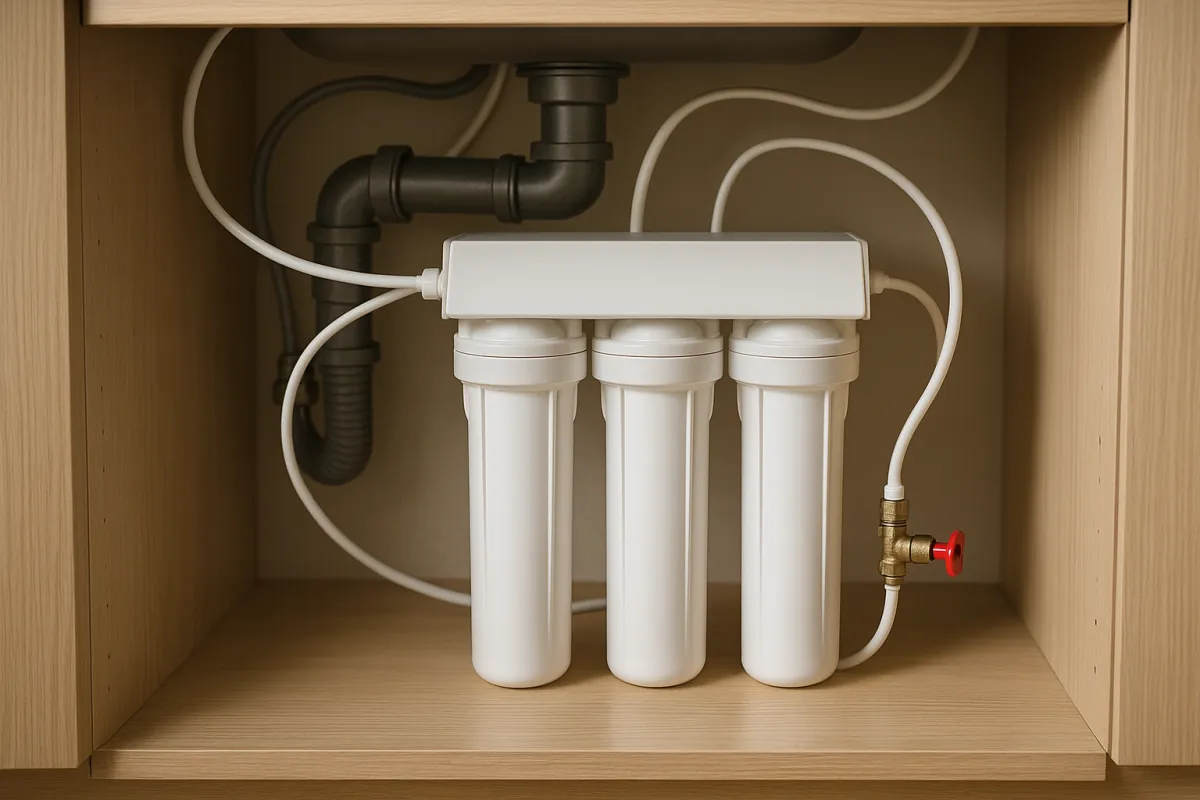
Point-of-use finishing last. A reverse osmosis unit under the kitchen sink handles anything the whole-house chain leaves, and it is also the standard answer for a household that wants softened water everywhere but unsoftened, low-sodium drinking water at one tap. Our comparison of water filters against bottled water covers the cost side of that decision.
Resin, tanks, and what is actually inside the unit
It is worth knowing what you are buying, because the two tanks sitting in the utility room do very different jobs and only one of them wears out.
The resin tank, sometimes called the mineral tank, is the pressure vessel holding the bed of small polymer beads that do the ion exchange. Standard softening resin is a polystyrene bead with sulfonate sites that hold sodium loosely and hardness tightly. The bed is what your grain rating describes, and its volume in cubic feet is what the 32,000, 48,000 and 64,000 grain labels are really encoding. Well-treated resin lasts many years, commonly a decade or more, and is replaceable rather than a reason to buy a new unit.
The brine tank is the plastic drum you tip salt into. It holds a reservoir of water that dissolves salt into a saturated brine between regenerations, and the valve draws that brine through the resin bed when a cycle starts. It has no moving parts of consequence, but it is where two common problems live: a salt bridge, where a hard crust forms above an empty cavity so the tank looks full while no brine is being made, and a salt mush at the bottom over years of use.
The control valve sits on top of the resin tank and is the actual machine: it counts gallons on a metered unit, sequences the backwash, brine draw, slow rinse, fast rinse and refill stages, and diverts water to the drain. It is the part most likely to need service, and it is worth asking whether parts and seal kits are available for a given valve before you buy, because a valve you cannot get a seal kit for turns a repairable appliance into a disposable one. That is the same durability logic our note on maintaining your appliances applies across the house.
Salt types: what goes in the brine tank
Salt is the consumable, and the choices are fewer and simpler than the aisle suggests.
Rock salt is mined, cheapest per pound, and carries the most insoluble impurity, which settles in the brine tank over time and eventually needs cleaning out. It works, and in a unit you are willing to clean it is the budget option.
Solar salt, produced by evaporating seawater or brine in ponds, is cleaner than rock salt and sits in the middle on price. It is a common default and a reasonable one.
Evaporated salt pellets, made by mechanically evaporating brine, are the purest and the most expensive per pound. They leave the least residue in the brine tank, dissolve predictably, and are the low-maintenance choice. In water with iron, pellets sold with a rust-fighting additive are a common recommendation, though they are not a substitute for actual iron treatment when your numbers exceed the ceiling.
Potassium chloride is the alternative for a household that wants softening without adding sodium at the tap. It works in the same way, exchanging potassium for hardness rather than sodium, and it costs materially more per bag. Some units need their salt dose adjusted upward when running potassium chloride, so check the manufacturer’s instructions rather than swapping bag for bag. Anyone considering it for a medical reason, and particularly anyone with a kidney condition or on medication affecting potassium, should raise it with a physician first, because swapping one mineral for another is a health question rather than a shopping preference.
Whichever you buy, keep the brine tank at least a third full and do not overfill a tank prone to bridging. Mixing salt types is generally fine but is a common route to a mushy layer at the bottom, so pick one and stay with it.
Install considerations: bypass, drain, power, and placement
A softener is a plumbing install, not an appliance you plug in, and four practical facts about your house decide how easy it will be.
The bypass loop. The unit is plumbed into the main after the meter and before the water heater, so that hot water is softened and the heater is protected from scale. A bypass valve, either integral to the control head or built as a three-valve loop in the pipework, lets you take the softener out of service without shutting off water to the house. Insist on one; servicing, salt problems and vacations all become far easier with it, and a house that already has a softener loop with stubbed connections makes the install dramatically simpler.
The drain. Regeneration flushes mineral-laden water away, so the unit needs a drain connection with an air gap to prevent backflow into the softener. That means a floor drain, a standpipe, a laundry tub, or a condensate pump if the drain sits above the unit. This is the constraint that most often rules out a preferred location. It is also where local rules bite: some jurisdictions restrict or prohibit discharging softener brine to a septic system, and some restrict it to storm drains or ban new softener installs outright during drought or salinity-management programs. Check your local code and your municipality’s rules before you buy, because they vary widely and they are not negotiable.
Power. The control valve needs a standard outlet within reach. It draws very little, but it must be continuous, and a valve on a switched or frequently tripped circuit will lose its programming.
Placement. Leave clearance to lift the head off the resin tank for service, room to swing a 40 pound bag over the brine tank, and a floor that tolerates the occasional spill. Keep the outside taps ahead of the softener so irrigation is not softened. And leave the plumbing accessible; a softener boxed into a finished wall is a future repair bill.
Outdoor and unconditioned installs: the risks worth naming
In warm regions softeners are routinely installed in a garage, a utility closet against an exterior wall, or outdoors beside the house, and each of those has a specific failure mode worth knowing before you commit.
Freezing is the serious one. A resin tank and a brine tank are full of water, and water expands when it freezes. A hard freeze in an uninsulated garage or an outdoor install can split a tank, crack the control valve body, or burst the drain line, and the failure typically presents as a flood rather than a quiet fault. If there is any realistic chance of sustained sub-freezing temperature at the install location, either move the unit inside the conditioned envelope or use an enclosure and heat trace designed for the purpose.
Sun and heat are the slower one. Ultraviolet exposure embrittles plastic tank jackets, brine tank lids and drain tubing over years, and heat accelerates it. An outdoor unit should be shaded or housed, and its exposed plastic parts should be treated as consumables inspected annually rather than assumed permanent.
Access and pests round it out. An outdoor brine tank with an imperfect lid collects debris, insects and, in some places, rodents, all of which end up in the brine draw. And a unit installed where you have to carry salt bags across a yard in the rain is a unit whose salt level gets checked less often than it should.
None of this makes an outdoor install wrong; in a mild climate with a shaded, secured location it is entirely normal. It does mean the placement decision deserves the same deliberateness as the sizing, because a split tank undoes a well-chosen appliance in a single cold night.
What a water softener costs to run
The running cost of a softener has three parts and only two of them are worth much thought. There is no expensive filter cartridge, so this is a genuinely cheap appliance to own once installed.
Salt is the dominant cost, and it scales with grains removed rather than with tank size. Our example household’s 48,000 grain unit is 1.5 cubic feet of resin, so at the efficient 6 pound per cubic foot dose it uses about 9 pounds of salt per regeneration. At 6.25 days between regenerations it cycles about 58 times a year, so it consumes roughly 525 pounds of salt, or about 13 forty-pound bags. At an illustrative $8 a bag that is near $105 a year.
Regeneration water is the cost people forget. Each cycle backwashes, rinses and refills, and a reasonable planning figure is around 35 gallons per cubic foot of resin, so about 53 gallons for our 1.5 cubic foot unit. Across 58 regenerations that is roughly 3,050 gallons a year, against the household’s 109,500 gallons of total use: under 3 percent of the water bill. At an illustrative combined water and sewer rate of $10 per 1,000 gallons, that is about $31 a year.
Electricity is close to a rounding error. A control valve draws a few watts continuously to keep its clock and meter running, which lands under $5 a year at typical rates, far below almost anything in our appliance wattage and running-cost reference.
Where a softener's annual running cost goes
Illustrative split for the worked example: about $105 in salt, $31 in regeneration water and sewer, $5 in valve electricity, near $141 a year. Shares sum to 100.
Salt dominates, which is the whole argument for the efficient dose in Step 7. Swap your own salt price, water rate and grain load into the calculator to see your version. Figures illustrative.
Against that sits the saving side, which is real but harder to pin down honestly. Softened water uses less detergent and soap, keeps scale off the heating surfaces in the water heater and the dishwasher, and extends the useful life of fixtures and appliances that scale otherwise attacks. Those are genuine benefits and we are not going to attach a fabricated dollar figure to them, because the number depends entirely on your hardness, your appliances and your habits. Run your own version in the cost-per-use calculator.
Maintenance: the short list that keeps it working
Softener upkeep is light, and neglect shows up as gradually harder water rather than a dramatic failure, which is why it goes unnoticed for years.
Check the salt level monthly. Keep the brine tank at least a third full so there is always salt to make brine with. A unit that regenerates with no salt in the tank flushes water and delivers nothing.
Break up salt bridges. A hard crust across the tank with a void beneath it is the classic fault: the tank looks full, the water level below is not touching salt, and no brine is being made. Tap the crust with a broom handle to break it, and consider a lower fill level or a cleaner salt if it recurs.
Clean the brine tank occasionally. Every couple of years, or more often with rock salt, empty and rinse out the sludge that accumulates at the bottom. It is an unpleasant hour that prevents a plugged brine line.
Watch the resin. In iron-bearing water, a periodic resin cleaner is a common recommendation to keep the bed from fouling. If capacity falls steadily over years and nothing else explains it, an aging or fouled bed is the likely culprit and rebedding is usually cheaper than replacing the unit.
Verify the settings after any service or power loss. Hardness figure, salt dose, regeneration time. These are the numbers that quietly drift wrong.
And do the downstream maintenance that hardness was damaging in the first place: our walkthroughs on flushing a water heater and cleaning a dishwasher both get easier once the softener is doing its job, and the scale you were fighting stops accumulating.
The sodium question, answered honestly
Ion exchange works by trading hardness minerals for sodium, so softened water contains more sodium than the same water did before it was treated. That is not a defect or a marketing spin; it is the mechanism. The amount added scales with the hardness removed, so a home softening very hard water adds more than a home softening moderately hard water.
Whether that addition matters for you is a medical question, and these test notes are not the place it gets answered. Anyone on a medically restricted sodium intake, anyone with a heart or kidney condition where sodium is being managed, and anyone preparing infant formula should take their own hardness number and their own softener’s specifications to a physician or a registered dietitian and ask directly. A qualified professional can weigh it against everything else in the diet, which is the comparison that actually decides the answer, and no gear review can do that.
What we can set out are the options a household has if it wants the softener and not the sodium at the tap. Leave the kitchen cold tap unsoftened, which is a standard install detail rather than an exotic request: the drinking and cooking water bypasses the softener while everything else is treated. Add a point-of-use reverse osmosis unit at the kitchen sink, which removes most of the added sodium along with much else, and is the usual answer when the water needs finishing anyway. Or run potassium chloride in the brine tank instead of sodium chloride, which trades potassium for hardness instead, costs more per bag, and is itself a question for a physician for anyone managing potassium.
The honest summary is that softened water is not sodium-free water, that the amount is a function of your hardness, and that whether it is significant for a particular person is not a decision a website should be making. Get your number, take it to a professional, and pick from the options above with their input.
A worked example: sizing for a family of four on hard well water
Run every step on one realistic household so the arithmetic is visible end to end.
The house. Four people, two and a half bathrooms, on a private well. Complaints: white scale on the shower glass and the kettle, laundry that comes out stiff, soap that will not lather, and a faint orange tint in the toilet tank after a few days.
Steps 1 and 2, confirm and test. The scale, the lather and the stiff laundry are the hardness signature, but the orange tint says iron is present too, so the strip kit is not enough. A certified laboratory panel comes back with hardness at 205 mg/L as calcium carbonate, dissolved iron at 1.0 ppm, manganese not detected, pH and bacteriological results acceptable.
Step 3, convert. 205 divided by 17.1 is 11.99, so 12 grains per gallon, which sits in the very hard band. The kit reading of “about 12” agrees, which is the confirmation worth having.
Step 4, compensate. Iron at 1.0 ppm, at the rule-of-thumb 4 grains per part per million, adds 4 grains. Compensated hardness is 16 grains per gallon. The iron is at the low end of the commonly cited ceiling, so the softener can carry it, but the household notes that a small iron filter ahead of the unit would take the load off the resin and adds it to the shortlist rather than treating it as required.
Step 5, water use. No recent bill is handy, so four people at the 75 gallon planning default gives 300 gallons a day. The outside taps will be plumbed ahead of the softener, so irrigation does not enter the figure.
Step 6, daily grains. 300 gallons multiplied by 16 grains per gallon is 4,800 grains a day. That is the number the rest of the decision refers to.
Step 7, size. Targeting seven days between regenerations needs 33,600 working grains. At the efficient 6 pound salt dose a tank delivers about 62.5 percent of its rated capacity, so the rated figure needed is about 53,800 grains, which falls between the standard 48,000 and 64,000 units. Checking both against the interval: the 48,000 grain unit gives about 30,000 working grains, or 6.25 days; the 64,000 gives about 40,000, or 8.3 days. Both sit inside the six to ten day band, so the household buys the 48,000 grain, 1.5 cubic foot unit and keeps the money.
Step 8, valve and tanks. A metered demand-initiated valve, programmed with 16 grains per gallon and a 6 pound salt setting, not the raw 12 and not the factory maximum. A single tank, because nobody in this house draws water at three in the morning.
Step 9, technology. Salt-based ion exchange, because the complaints include lather and stiff laundry, which a conditioner cannot address.
Running cost. About 9 pounds of salt per regeneration, roughly 58 regenerations a year, near 525 pounds or 13 bags, illustratively $105 a year. Regeneration water near 3,050 gallons, under 3 percent of the household’s use, illustratively $31. Valve power under $5. Total near $141 a year, before any saving on detergent or water heater life. Swap your own hardness, occupancy and salt price into the cost-per-use calculator to see your version of this figure.
Common mistakes when choosing a water softener
Nearly every disappointing softener traces back to a short list of decisions made before the unit was ever plumbed in.
- Sizing on house size instead of grain load. Charts indexed on bedrooms or square footage ignore the variable that dominates, which is your particular water. Two identical houses on different supplies can need units four times apart in capacity. Do the multiplication.
- Shopping with the report number instead of grains. Reading 205 on a water report and looking for a unit near that figure, or forgetting the division by 17.1 entirely. The units are out by a factor of about seventeen and the mistake is invisible until the unit underperforms.
- Ignoring iron on well water. Sizing from raw hardness when there is dissolved iron present, so the resin exhausts early every cycle and hard water arrives at the end of it. Worse, sending oxidized iron into the bed and fouling it permanently instead of putting a filter in front.
- Buying the biggest tank available. Oversizing costs money up front and, if it stretches the interval past about two weeks, leaves the bed stagnant long enough to channel or foul. There is a correct size and it is not the maximum.
- Accepting a timer valve to save money. A clock cannot know what you used, so it wastes salt and water in a quiet week and delivers hard water in a busy one. The metered valve is a small premium for a permanent improvement.
- Mistaking a conditioner for a softener. Buying a salt-free unit expecting lather, clear glassware and a lower hardness reading, none of which it delivers. Conditioners reduce scale; they do not remove hardness. Match the product to the complaint.
- Leaving the drain and code question until after the purchase. Discovering that the only viable location has no drain, or that local rules restrict brine discharge to a septic system, after the unit is bought and the plumber is booked.
Troubleshooting: when your numbers do not fit the recipe
A few situations do not fit the tidy nine-step path, so here is how to handle the common ones.
What if my hardness is right on the line at around 5 grains per gallon? Then it is a comfort and protection decision rather than a necessity. At the lower end the scale accumulates slowly enough that regular descaling and a water heater flush may be all you need. Weigh what the softener costs to buy, install and feed against how much the scale and the lather actually bother you, and be honest that below about 3 grains there is nothing worth softening.
What if my water use is wildly variable, like a vacation home or a house with long absences? A metered valve handles variability by design, but very long idle periods are its own problem, because resin that sits unused for months can channel or grow biofilm. Some valves offer a maximum-days-between-regenerations override that forces a cycle to keep the bed refreshed, which is exactly the feature to look for. For a house empty most of the year, ask about that setting specifically.
What if my iron is above the ceiling? Then the answer is not a bigger softener. Above roughly 1 to 3 parts per million of clear-water iron, or with any oxidized red-water iron or bacterial iron, put a dedicated iron filter ahead of the softener and size the softener from your hardness with a much smaller compensation, or none, depending on what the filter leaves. Sizing extra capacity to absorb high iron is how resin beds die young.
What if I already have a softener and do not know if it is sized right? Test the water at an untreated tap for the input hardness, check what hardness figure is programmed into the valve, and count the days between regenerations over a few weeks. If the programmed figure is your raw hardness on iron-bearing water, or the interval is under four days or over two weeks, the unit is misconfigured, mis-sized, or both, and often the fix is a settings change rather than a new appliance.
What if my pressure drops after installing the softener? Capacity and flow rate are separate specifications. A tank with plenty of grains can still throttle a house if its service flow rate is below your simultaneous-fixture demand, and a plugged sediment pre-filter ahead of it produces the same symptom for a different reason. Check the pre-filter first, because it is free, then compare the unit’s rated service flow against your peak demand.
The water softener buyer’s checklist
Run any candidate past these checks. Clear them all and the unit will do real work in your house.
- Hardness measured, not assumed. A utility report, a titration kit, or a laboratory panel, tested at an untreated tap, with the units written down.
- Iron and manganese known if you are on a well. A laboratory number, not a guess, and an iron filter specified if the result exceeds the commonly cited ceiling.
- Hardness converted to grains per gallon. Milligrams per liter divided by 17.1, confirmed as calcium carbonate equivalent rather than elemental calcium and magnesium.
- Iron compensation added. Roughly 4 grains per gallon per part per million of dissolved iron, folded into the figure you size and program with.
- Daily water use estimated from a bill where possible. Gallons per day for your actual household, with outdoor irrigation excluded if it bypasses the unit.
- Daily grain load calculated. Daily gallons multiplied by compensated hardness, written at the top of the page.
- Capacity sized to a six to ten day interval at an efficient salt dose. Not the biggest tank on the shelf, and not a rating taken at the maximum salt setting.
- Metered demand-initiated valve confirmed. With the compensated hardness and the efficient salt dose actually programmed in, and checked after install.
- Technology matched to the complaint. Ion exchange if you want hardness gone; a conditioner only if scale reduction alone is genuinely what you are after.
- Install facts confirmed. Bypass loop, a drain with an air gap, a continuous outlet, freeze protection if the location is unconditioned, and local code and discharge rules checked.
- Running cost accepted. Salt, regeneration water and a trickle of electricity, priced with your own figures rather than a brochure's.
- Service parts available. Seal kits and valve parts obtainable, so the appliance is repairable rather than disposable.
The two numbers that carry the whole decision
Step back from the nine steps and notice that two figures decide almost everything: your compensated hardness and your daily gallons. Multiply them and you have the daily grain load, and from there the tank size, the salt consumption, the regeneration interval, the annual cost and even the valve programming all follow mechanically. Every other decision in these test notes refines a choice those two numbers have already made.
That is why the testing step is not a formality to rush past. A softener sized from a guessed hardness is a softener sized from nothing, and the failure is quiet: the unit runs, salt disappears, and the shower glass still spots. The homeowner concludes softeners are oversold. The real fault was a number nobody measured.
It is also why the iron compensation earns its own step despite being one addition. On well water it routinely moves the compensated figure by a quarter to a half, which is often exactly one rung on the tank ladder. Skip it and you buy a unit that was correct for water you do not have. Get those two numbers honestly, and the wall of identical tanks resolves into one obvious answer, with the metered valve, the tank layout and the salt setting following behind it.
The bottom line
Choosing a water softener is arithmetic wearing the costume of a shopping decision. Test your water so the hardness is measured rather than guessed, divide by 17.1 to get grains per gallon, add roughly 4 grains for every part per million of dissolved iron, estimate your daily gallons from a bill if you have one and from about 75 gallons per person if you do not, and multiply the two into a daily grain load. Multiply that by the six to ten day interval you want, divide by the efficiency of a sensible salt dose, and the rated capacity you should be shopping for appears. Then insist on a metered valve, choose a twin tank only if you genuinely need soft water around the clock, and treat a salt-free conditioner as a scale-control product rather than a softener, because that is what it is. Our worked household lands on a 48,000 grain unit costing near $141 a year to feed, illustratively, which is a modest price for stopping scale at the front door. The unit that disappoints is the one bought on the number on the box. The one you will be glad you chose is the one your own water asked for.
From the test bench: this walkthrough is a sizing method, not a product recommendation, a plumbing design, or professional advice of any kind. Every hardness figure, grain rating, salt dose, gallon estimate and dollar amount above is an illustrative planning number taken from typical published ranges, not a measurement of any specific model or any specific water supply, and your own test results will move the answer. Plumbing codes, backflow requirements and rules on discharging softener brine to septic systems and storm drains differ by jurisdiction and change, so confirm what applies where you live with your local authority before any install. Nothing here is medical advice: questions about sodium or potassium in softened water belong with a physician or a registered dietitian who knows your circumstances. Verify any unit’s rated capacity, service flow rate and salt settings against the manufacturer’s own documentation before it goes in your cart.
Frequently asked questions
How do I choose a water softener?
Work the arithmetic before you work the shelf. Test your water so you have a real hardness number and, on a well, a real iron number, convert that hardness into grains per gallon, add a compensation for any dissolved iron, estimate your household's daily water use, and multiply the two to get the grains your home needs removed every day. That daily grain figure, multiplied by the regeneration interval you want, is the working capacity you are shopping for, and dividing it by the efficiency of a sensible salt dose gives you the rated capacity on the label. Only then do the technology questions matter: metered rather than timed regeneration, one tank or two, and whether a salt-free conditioner is honestly doing the job you need.
What size water softener do I need?
Size it from your own daily grain load rather than from a chart of house sizes, because two homes with the same square footage can differ by a factor of three in hardness. Multiply your household's daily gallons by your compensated hardness in grains per gallon to get grains per day, then multiply by the number of days you want between regenerations. As an illustrative case, four people using about 75 gallons each per day is 300 gallons, and at a compensated 16 grains per gallon that is about 4,800 grains a day, which points at a 48,000 grain rated unit regenerating roughly every six days at an efficient salt setting. Bigger is not automatically better: a wildly oversized unit sits idle so long between regenerations that the resin bed can channel and foul.
How do I convert my water hardness from ppm to grains per gallon?
Divide the milligrams per liter, which laboratories and utility reports usually express as calcium carbonate equivalent, by 17.1. The units mg/L and ppm are used interchangeably at these concentrations, so a report reading 205 mg/L as calcium carbonate is about 12 grains per gallon. The bands most water-quality agencies publish put soft water below roughly 60 mg/L, moderately hard between about 60 and 120, hard between about 120 and 180, and very hard above 180, which works out to roughly 3.5, 7 and 10.5 grains per gallon at the break points. Getting this conversion right matters because every softener on the market is rated in grains, while almost every water report is printed in milligrams per liter.
Is a metered water softener better than a timer?
For almost every household, yes, because a metered unit regenerates when your water use says the resin is exhausted rather than when a clock says a week has passed. A timer regenerates on schedule regardless of whether you were home, which wastes salt and water in a quiet week and delivers hard water in a busy one. A demand-initiated metered valve counts gallons and triggers a regeneration only when the calculated capacity is used up, which typically cuts salt and regeneration water noticeably against a timer sized for the same household. The one place a timer still holds up is a household with an unusually flat and predictable pattern, and even there the metered valve costs little enough more to be worth it.
Does a salt-free water softener actually soften water?
No, and the naming is the problem rather than the product. A salt-free conditioner does not remove calcium and magnesium from your water; it changes their behavior so that they are less likely to deposit as hard scale on pipes and heating elements, usually by encouraging the minerals to form stable crystals that pass through. That can genuinely reduce scale, which is a real benefit if scale in the water heater is your main complaint. What it does not do is lower the hardness number on a test, restore soap lather, stop spotting on glassware, or give the slippery feel people associate with soft water, because the minerals are all still there. If you want hardness gone, you need ion exchange with salt; if you want less scale without a drain, brine, or salt bags, a conditioner is an honest alternative with a smaller promise.
How much salt does a water softener use per year?
It depends almost entirely on how many grains you remove, not on the size of the tank, because salt is consumed per regeneration and regenerations are triggered by exhausted capacity. As an illustrative case, a 1.5 cubic foot unit running an efficient dose near 6 pounds of salt per cubic foot uses about 9 pounds per regeneration, and a household needing roughly 4,800 grains a day regenerates around 58 times a year, which is somewhere near 525 pounds or about 13 forty-pound bags. At an illustrative $8 a bag that is roughly $105 a year, though salt prices vary widely by region and by the type you buy. Turning the salt dose up buys more capacity per regeneration but costs you more salt per grain removed, which is why the efficient setting on a slightly larger tank usually wins.
Does a water softener add sodium to my drinking water?
Ion exchange works by swapping hardness minerals for sodium, so yes, softened water carries more sodium than the same water did before, and the amount rises with the hardness being removed. The practical size of that addition depends on your hardness, and it is a question for a physician or a registered dietitian rather than for a gear review, particularly for anyone on a medically restricted sodium intake, for infant formula, or for someone with a relevant heart or kidney condition. Households who want the softener but not the sodium at the tap have two common routes: charge the brine tank with potassium chloride instead of sodium chloride, which costs noticeably more per bag, or leave the kitchen cold tap unsoftened and treat drinking water separately. Take the numbers from your own water test to a qualified professional and let them make the call.
Do I need a separate filter as well as a water softener?
Often yes, and the order matters more than most buyers expect. A softener is an ion-exchange appliance that handles dissolved hardness, and it does nothing for sediment, chlorine taste, or a named chemical contaminant, so any of those complaints needs filtration alongside it. Sediment and, on a well, iron above the level a softener can carry should be removed ahead of the softener so that grit and oxidized iron never reach the resin bed, since a fouled bed loses capacity permanently. Carbon for chlorine or chloramine is commonly placed ahead of the softener too, because prolonged chlorine exposure shortens resin life. Our lab report on choosing and sizing a whole house water filter covers what each stage does, and the sequence there is the one to follow.