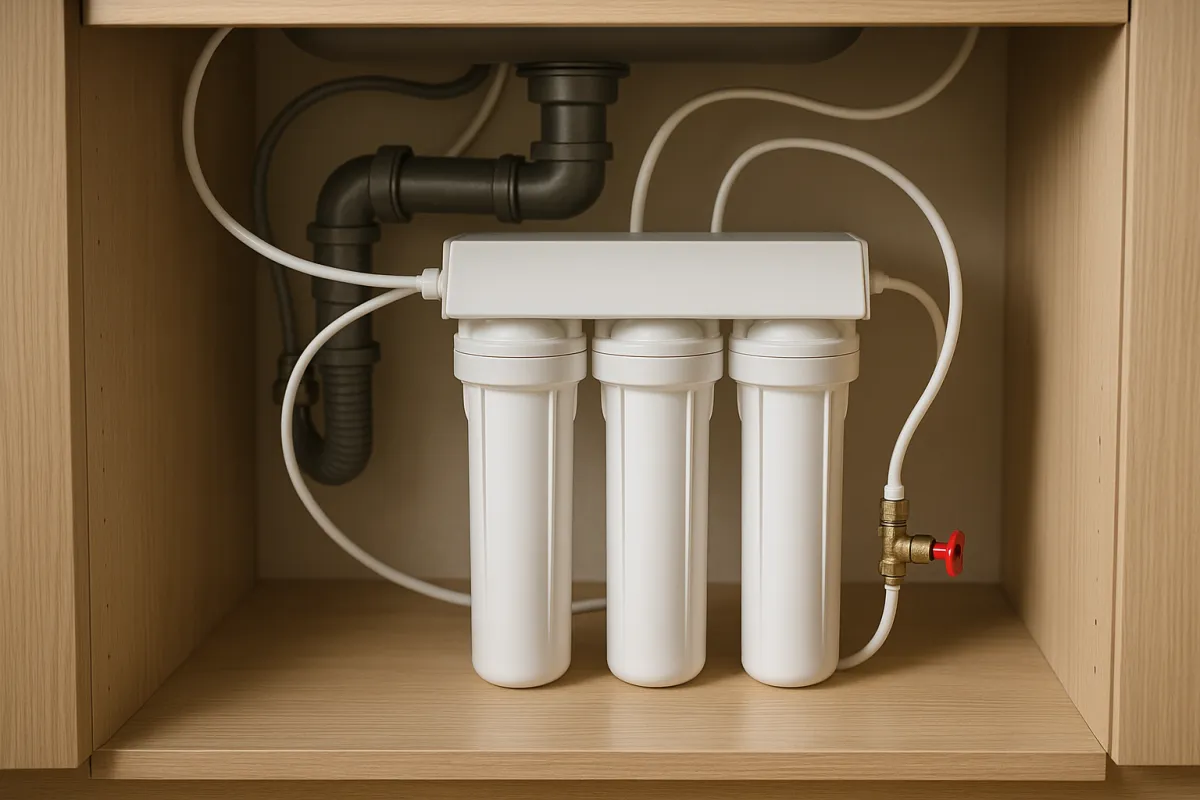
What's on this page
- What a whole-house water filter is
- What a whole-house filter removes (and what it does not)
- Test your water before you buy
- Whole-house filter types at a glance
- Whole home water filter system types
- Sediment filters: the first line of defense
- Carbon filters: chlorine, taste, and odor
- KDF and specialty media
- Salt-based softeners: hardness, not contaminants
- Reverse osmosis: a point-of-use finisher
- How many stages do you need
- Sizing by flow rate and household
- Sizing by capacity and port size
- Sizing a whole house water filter by household size
- Whole-house versus under-sink point-of-use
- Installing a point-of-entry filter
- Filter lifespan and maintenance cost
- What a whole-house filter costs to run
- Do you actually need a whole-house filter
- A worked example: sizing and cost for a family of four
- Common mistakes when choosing a whole-house filter
- The whole-house water filter buyer’s checklist
- The bottom line
Short answer: Choose a whole house water filter by testing your water first, through your utility's annual report or a certified home test, then matching the filter media to what the test found, since whole-house is a location rather than a capability. Size it by peak flow rate in gallons per minute so it feeds every fixture without cutting pressure, remember that sediment and carbon do nothing for hardness, and price the replacement cartridges before buying.
A whole house water filter, also sold as a whole home water filter and known to plumbers as a point-of-entry filter, treats every drop of water for an entire home before it reaches a single tap, shower, or appliance, which is a very different job from the pitcher on your counter or the cartridge under your kitchen sink. It installs on the main line where water enters the house, so its scope is the whole supply rather than one glass, and that scope is exactly what makes choosing one a sizing-and-matching problem rather than a shopping one. Buy the wrong media and you filter nothing you cared about; buy the wrong size and you strangle the water pressure to your own showers.
This breakdown treats the whole-house filter the way this bench treats any high-ticket appliance: it starts with what the box cannot tell you, which is what is actually in your water, then works through what each filter type removes, how the stages stack, how to size the unit to your household’s flow, where a whole-house filter ends and a point-of-use one begins, and what the cartridges will cost you every year for as long as you own it. If your interest is really the per-liter economics of drinking water, our companion piece on water filter versus bottled water runs that math, and if you want to treat just the water hitting your skin, our note on the shower-head water filter covers that narrower case. You can sanity-check any unit’s value as you read with the cost-per-use calculator.
Key takeaways
- Whole-house is a location, not a capability: what the filter removes depends entirely on the media inside it, so match the media to your water rather than assuming one cartridge does everything.
- Test your water first: read your utility's annual report or run a certified home test, because a filter aimed at the wrong problem is money spent removing nothing you cared about.
- Size by peak flow rate in gallons per minute before anything else, so the filter can feed every fixture at once without throttling your water pressure.
- A filter is not a softener: sediment and carbon do nothing to hardness and scale, which need a salt-based softener or scale-control media alongside filtration.
- Cartridges, not hardware, are the cost you live with; price the replacement media and its change schedule before you buy the housing.
What a whole-house water filter is
A whole-house water filter, more precisely a point-of-entry filter, is a housing or series of housings plumbed into the main water line just after it enters your home, usually near the meter or the pressure tank on a well system, ahead of the water heater and every branch that feeds the fixtures. Because it sits at the point of entry, every gallon that reaches any tap, shower, toilet, dishwasher, or hose bib has already passed through it. That is the whole idea, and it is what separates a whole-house unit from the point-of-use filters that treat one faucet at a time.
The physical form is straightforward. A single-stage system might be one large tank of media or one cartridge housing; a multi-stage system chains two or three housings in a row, each doing a different job, with the water flowing through them in sequence. Around the filter you will usually find shutoff valves so you can isolate it for cartridge changes, and often a bypass loop so the house still has water while you service the unit.
What matters for choosing is that the whole-house label describes only where the filter lives, not what it does. A point-of-entry housing can hold a coarse sediment cartridge, a fine carbon block, a specialty metal-reduction media, or nothing useful for your particular water at all. The location gives it reach across the whole house; the media decides what it actually accomplishes. Keep that distinction front of mind, because most disappointing purchases come from buying the location and ignoring the media.
What a whole-house filter removes (and what it does not)
Because the media does the work, the honest answer to what a whole-house filter removes is a list that changes with what you install. A sediment stage physically strains out suspended particles: sand, silt, rust and scale flakes, and other grit, down to a stated micron rating. An activated carbon stage adsorbs chlorine, reduces chloramine to a degree, and takes out many of the taste and odor compounds that make tap water unpleasant. Specialty media such as KDF or catalytic carbon can address hydrogen sulfide, the rotten-egg smell, and help with some dissolved metals.
The list of what a standard whole-house filter does not do is just as important and catches more buyers. A sediment-and-carbon filter does not soften hard water; the dissolved calcium and magnesium that cause scale and spotting pass straight through it. It does not reliably remove dissolved solids, nitrates, fluoride, or many specific chemical contaminants, which need reverse osmosis or a contaminant-specific media. It is not a disinfection system; killing bacteria or viruses is the job of ultraviolet treatment or another certified process, not a carbon block.
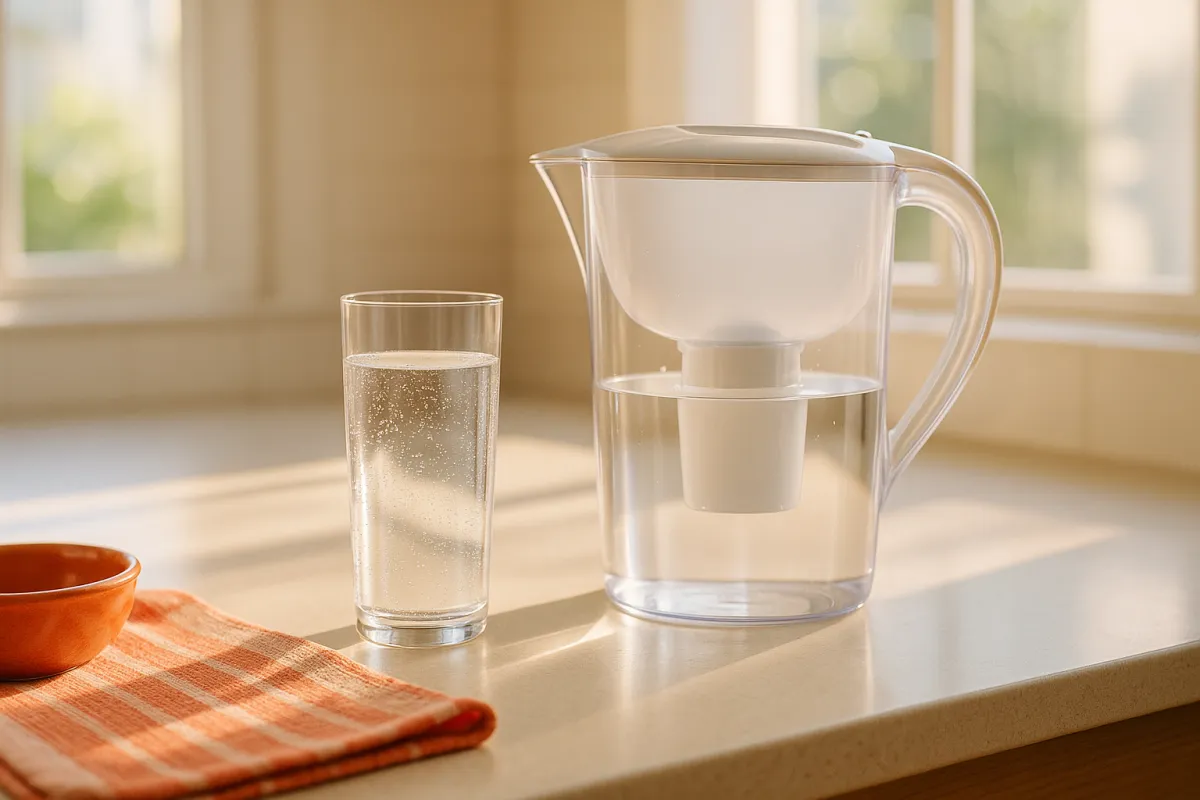
The practical takeaway is to resist the marketing shorthand that a whole-house filter makes water safe or pure. It makes water cleaner in specific, defined ways that depend on the cartridge, and the way to get the benefit you want is to name the contaminant first and then choose the media that is certified to reduce it.
Test your water before you buy
The single most valuable step in this whole decision costs little and precedes every other choice: find out what is actually in your water. Buying a filter before you know what you are filtering is like buying a wrench before you have seen the bolt, and it is the mistake behind most systems that remove nothing the owner cared about. The test tells you which media to buy, what micron rating you need, and whether a plain filter even addresses your complaint.
If you are on a municipal supply, your utility is required to publish an annual water quality report, sometimes called a consumer confidence report, listing what it tested for and the levels found. Read it. It will tell you whether your water already meets drinking standards, whether it is chlorinated or chloraminated, and how hard it is, which together decide whether you need carbon, a softener, both, or very little. For anything the report does not cover, or for a private well that no utility monitors, a certified home water test, either a lab kit or a professional visit, gives you the specifics.
Watch out: appearance and taste are unreliable guides. Clear, pleasant-tasting water can still carry dissolved contaminants you cannot see or taste, and cloudy or smelly water might be a harmless nuisance rather than a hazard. Let the report or the test, not your senses, decide what media you buy. This is the one subject on this bench with a genuine health dimension, so for any specific contaminant concern the right move is to consult your utility, an accredited testing lab, or a qualified water-treatment professional rather than a gear site, and match a certified product to the named problem.
Whole-house filter types at a glance
Before the stage-by-stage detail, it helps to see the common media side by side, because each targets a different problem and none of them covers the whole field. The table below summarizes what each type is for, what it will not do, and roughly how long its media tends to last, all as illustrative planning guidance rather than fixed specifications for any product.
| Filter type | What it targets | What it will not do | Typical media life (illustrative) |
|---|---|---|---|
| Sediment (spun or pleated) | Sand, silt, rust and scale flakes, suspended particles to a micron rating | Nothing dissolved: no chlorine, hardness, or chemicals | 1 to 3 months in dirty water, longer if clean |
| Activated carbon (GAC or carbon block) | Chlorine, many taste and odor compounds, some organics | Hardness, dissolved solids, most heavy metals, microbes | 6 to 12 months as a cartridge, years as a large tank |
| KDF or catalytic carbon | Hydrogen sulfide smell, chlorine, some dissolved metals | Hardness, nitrates, broad dissolved-solid removal | Several years for tank media, per maker rating |
| Salt-based softener | Hardness: dissolved calcium and magnesium, scale, spotting | Sediment, chlorine, chemical contaminants | Resin lasts years; consumes salt continuously |
| Reverse osmosis (point-of-use) | The broadest range of dissolved solids, many contaminants | Impractical at whole-house flow; wastes water to drain | Membrane 2 to 3 years, pre and post filters 6 to 12 months |
Read the table as a menu of jobs, not a ranking. A home with chlorinated but soft municipal water might need only sediment and carbon; a well with hard, smelly water might want sediment, KDF or catalytic carbon, and a softener; a household worried about a specific dissolved contaminant in its drinking water adds a point-of-use reverse osmosis unit at the kitchen sink. The right build is the shortest chain that covers what your water report actually flagged.
Whole home water filter system types
Shop for long enough and you will see the same hardware sold as a whole home water filter, a whole house water filtration system, and a point-of-entry system, and it helps to know that those three names describe the same location rather than three different capabilities. What separates one system from another is the media inside and, in a few cases, whether the unit is a filter at all. Five system types cover almost everything on the market, and each answers a different complaint.
Sediment systems are purely mechanical, straining suspended grit down to a stated micron rating, and they are the stage that protects everything behind them. Carbon systems, whether a loose granular bed in a tank or a compressed block cartridge, work by adsorption and are what most households are really buying, because carbon is the media that takes chlorine, many organic compounds, and the tastes and odors that come with them out of the water. KDF and catalytic carbon systems are the specialty tier, addressing the hydrogen sulfide smell that plain carbon struggles with, chloramine where a utility uses it instead of chlorine, and some dissolved metals. Those three are filters in the ordinary sense: water goes in dirty and comes out with something physically removed or held.
The fourth type is not a filter at all, and confusing it for one is the single most common buying mistake in this category. A water softener is an ion-exchange appliance that swaps dissolved calcium and magnesium for sodium and regenerates itself with brine, which is what fixes scale, spotting, and poor lather. A filter does nothing to hardness, and a softener does nothing for chlorine taste or sediment, so the softener versus filter question is not a choice between competitors but a decision about which of two separate jobs your water actually needs. Many homes plumb both in sequence, filter first so the softener resin is not fouled by grit. A salt-free scale-control unit sits between the two ideas, conditioning minerals so they are less likely to deposit rather than removing them.
The fifth type is ultraviolet treatment, which is disinfection rather than filtration. A UV unit passes water beside a lamp whose light inactivates bacteria, viruses, and protozoa, and it is the usual answer where a private well test flags a microbiological problem that no carbon block will touch. UV has its own requirements: it needs continuous power, an annual lamp change, a clean quartz sleeve, and clear water reaching it, which is why sediment and carbon stages always go ahead of it rather than behind. It also leaves no residual protection downstream, so it treats the water passing the lamp and nothing else.
Read the five as a menu of jobs to be matched against your water report. A chlorinated municipal supply with clear water usually needs only sediment and carbon. Hard water adds a softener. A sulfur smell or chloramine adds a specialty media. A well with a microbiological result adds UV. Nothing about the whole home label decides any of that, and a system built from types your water does not call for costs money and pressure for no gain.
Sediment filters: the first line of defense
The sediment filter is where almost every whole-house system should begin, because it protects everything downstream. Its job is purely mechanical: it strains suspended solids out of the water the way a sieve strains grounds out of coffee. Those solids are sand, silt, clay, rust flakes shed by old pipes, and bits of scale, and left in the water they clog fixtures, wear pump seals, and, crucially, blind the finer and more expensive media that follows.
Sediment filters are rated by micron size, the diameter of the smallest particle they reliably catch. A coarse filter around fifty microns stops only the biggest grit; a fine one around one or five microns catches much smaller particles but clogs faster and can restrict flow if your water is dirty. A common approach on well water is to stage two sediment filters, a coarser one first and a finer one behind it, so the cheap coarse cartridge takes the brunt and the fine one lasts longer.
Watch out: a sediment filter is the fastest-clogging stage in most systems, and a clogged one throttles your whole house’s water pressure before it fails outright. That is a feature, not a bug: falling pressure is the signal to change the cartridge. If you skip sediment pre-filtration to save a housing, you pay for it in shortened life of the carbon or softener behind it, so the cheap first stage is almost always worth its slot. On visibly dirty or well water, expect to change this cartridge the most often of any in the system.
Carbon filters: chlorine, taste, and odor
If sediment is the first stage, activated carbon is the one most people are really buying the system for, because it is what makes the water taste and smell better. Carbon works by adsorption: its enormous internal surface area grabs and holds chlorine, many organic compounds, and the molecules behind off-tastes and odors as water passes through. On a chlorinated municipal supply, a carbon stage is what turns pool-smelling tap water into something pleasant to drink, and it also spares your skin, hair, and rubber appliance seals the constant contact with chlorine.
Carbon comes in two broad forms for whole-house use. Granular activated carbon, loose granules in a tank or cartridge, offers high capacity and low flow resistance but can channel if packed poorly. A carbon block, compressed into a solid cartridge, filters more finely and consistently and often carries a lower micron rating, at the cost of faster clogging and more flow restriction. For chloramine, the more stable disinfectant some utilities use instead of chlorine, ordinary carbon is less effective, and a catalytic carbon rated for chloramine reduction is the better match.

Watch out: carbon has a finite capacity and gives no obvious warning when it is spent. Unlike a sediment filter that clogs and drops your pressure, an exhausted carbon cartridge keeps flowing at full rate while quietly no longer adsorbing anything, and a badly overdue one can even release some of what it previously captured. That is why carbon lives on a calendar or a gallon-capacity schedule, not on a wait-until-it-looks-bad rule. Track its life by the maker’s rated capacity and your household’s water use, and change it before the rating runs out.
KDF and specialty media
Beyond the sediment-and-carbon core, a set of specialty media handles problems those two stages cannot. The most common is KDF, a copper-zinc alloy that works by a chemical reaction rather than adsorption. It is effective against chlorine, can reduce some dissolved heavy metals, and notably helps with the hydrogen sulfide that gives well water its rotten-egg smell, a problem plain carbon struggles with. KDF is also bacteriostatic, meaning it discourages bacterial growth within the media bed, which is one reason it often appears paired with carbon in whole-house tanks.
Catalytic carbon is a modified carbon with a more reactive surface, and it earns its place where ordinary carbon falls short: chloramine reduction and hydrogen sulfide removal. If your utility uses chloramine, or your water smells of sulfur, catalytic carbon or a KDF-and-carbon combination is usually the more effective build than standard carbon alone. Other specialty resins target specific contaminants, such as media designed for iron or manganese reduction on well water, but these are matched to a named problem on your test rather than bought speculatively.
Watch out: specialty media are the stages most prone to being bought for the wrong reason. They shine when your water test names the exact problem they solve, sulfur smell, chloramine, a specific metal, and add cost and flow restriction for no benefit when your water does not have that problem. This is precisely where testing your water first pays off: the specialty stage is only worth its slot and its price if the contaminant it targets actually showed up in your report or test. Do not stack media speculatively; build the chain your water actually calls for.
Salt-based softeners: hardness, not contaminants
The most frequent mismatch in the whole category is expecting a filter to fix hard water, so it deserves its own section. Hardness is caused by dissolved calcium and magnesium, and it shows up as scale on faucets and shower glass, spots on dishes, soap that will not lather, and scale building inside your water heater and pipes. None of that is a contaminant a sediment or carbon filter touches, because those minerals are dissolved, not suspended, and pass straight through.
Removing hardness requires a salt-based ion-exchange softener, a tank of resin beads that swap the calcium and magnesium in your water for sodium, then periodically regenerate by flushing the captured minerals to the drain using a brine made from the salt you refill. A softener is a genuinely different appliance from a filter, with its own resin tank, brine tank, and regeneration cycle, and it consumes salt continuously as a running cost. An alternative, salt-free scale control, conditions the minerals so they are less likely to stick and form scale rather than removing them, which reduces scale without the salt and drain water but does not deliver the slippery soft-water feel or the same protection.
Watch out: decide whether your problem is hardness or something else before you shop, because the fixes do not overlap. If your complaint is spotting, scale, and poor lather, you need a softener or scale control, and a plain filter will not help. If your complaint is taste, chlorine, or particles, you need a filter, and a softener will not help. Many homes need both, plumbed in sequence, and hard water’s effect on your water heater is exactly why our walkthrough on flushing and draining a water heater matters more in a hard-water house. Confirm hardness on your report before assuming a softener is part of your build.
Reverse osmosis: a point-of-use finisher
Reverse osmosis is the most thorough water treatment available to a homeowner, and understanding why it usually is not a whole-house solution clarifies the whole point-of-entry versus point-of-use split. RO forces water under pressure through a semipermeable membrane whose pores are fine enough to reject the broadest range of dissolved substances, dissolved solids, many contaminants, and much of what carbon and softeners leave behind. The result is very pure water, which is why RO is the go-to when a water test flags something the coarser stages cannot handle.
The catch is that RO is slow and wasteful. The membrane produces water a trickle at a time and sends several liters to the drain for every liter it makes, so running your entire home’s supply through RO would demand a large system, a storage tank, and a lot of wasted water, and it would strip beneficial minerals from water you only bathe and flush with. For that reason RO in an ordinary home is almost always a point-of-use unit installed under the kitchen sink, treating just the small volume you drink and cook with, often with its own storage tank and a dedicated faucet.
Watch out: do not try to make reverse osmosis do the whole-house job. The economical, sensible architecture for most homes that want RO-quality drinking water is a whole-house filter handling the bulk sediment and chlorine work for every tap, plus a compact point-of-use RO unit at the kitchen sink polishing the water you actually drink. That division of labor is why the two are complements, not competitors, and why a whole-house filter and an under-sink RO unit so often appear in the same home.
How many stages do you need
With the media understood, the practical question becomes how many to chain together, and the answer is the fewest that cover what your water report flagged. More stages mean more housings to buy, more cartridges to change, and more flow restriction, so stages are a cost, not a virtue, and the goal is coverage, not maximum length. Your water test, again, is what sets the number.
A common single-stage build is one large carbon tank on clean municipal water whose only complaint is chlorine taste, sometimes with a built-in sediment layer. A two-stage build, sediment followed by carbon, is the workhorse for most homes: the sediment cartridge protects the carbon, and the carbon handles taste and chlorine, covering the two most common complaints together. A three-stage build adds a specialty stage, a finer sediment, a KDF or catalytic carbon, or a contaminant-specific media, for water that a test showed needs it, such as well water with sulfur smell or a metal to reduce.
Watch out: resist the temptation to over-build for insurance. Every extra stage you add for a contaminant you do not actually have costs cartridges and pressure for no benefit, and a needlessly long chain is more likely to be neglected than a short one you can maintain. Build the chain your report calls for, leave room to add a stage later if a future test flags something new, and remember that a two-stage system you actually service beats a five-stage system whose cartridges you never change. Coverage matched to your water, then maintainability, decides the count.
Sizing by flow rate and household
Once the stages are decided, the sizing question is what separates a filter that works from one that ruins your water pressure, and it starts with flow rate. Flow rate, measured in gallons per minute, is how much water the filter can pass without becoming a bottleneck, and it must be large enough to feed every fixture that might run at the same time. Undersize it and running the dishwasher while someone showers turns the shower to a dribble, because the filter cannot pass water fast enough for both.
The way to size is by peak simultaneous demand, not average use. Think about the worst realistic moment: two showers running while the washing machine fills, say. A rough planning approach is to allow a few gallons per minute per bathroom and add for large tubs and simultaneous appliances, which for a typical two-bathroom household lands somewhere around ten gallons per minute as an illustrative target, and climbs from there with more bathrooms and occupants. Household size feeds in too, since more people means more overlapping demand across the day.

Illustrative peak flow to size for, by number of bathrooms
Planning gallons-per-minute target rising with bathroom count, using a base plus a per-bathroom allowance. Bars scale with the flow figure.
Same allowance, four home sizes: the peak-flow target climbs with the bathroom count. Feed your own bathrooms and household size into the companion tool for the figure that fits your home.
Sizing by capacity and port size
Flow rate is only half of sizing; the other half is media capacity and the physical plumbing connection. Capacity is how much water a cartridge or tank can treat before it is spent, expressed either in gallons or in a service life, and it has to match your household’s volume so the media lasts a reasonable interval rather than needing changes every few weeks. A larger tank or higher-capacity cartridge treats more gallons between changes, which is why a big household benefits from oversizing the media even when the flow rate would allow something smaller.
Port size, the diameter of the inlet and outlet where the filter connects to your plumbing, is the detail people forget and then regret. A housing with three-quarter inch ports can bottleneck a home that needs one-inch flow no matter how good the media is, because the connection itself restricts the water. Match the port size to your main line and your peak-flow target: smaller homes often do fine on three-quarter inch, while larger homes or high peak demand call for one-inch ports or, at the top, two systems plumbed in parallel to share the flow.
Watch out: read the maker’s flow rating honestly and remember it is usually a maximum, measured clean, that drops as the cartridge loads with dirt. Size with headroom so a half-used filter still passes your peak demand, and confirm the port size and the physical dimensions of the housing before you buy, because a unit that cannot connect to your line or fit the space where your main enters the house is the wrong unit regardless of its specification. Sizing is flow, capacity, and connection together, not any one alone.
Sizing a whole house water filter by household size
Bathrooms set the peak flow, but the number of people in the house sets how fast the media is consumed, and the two questions have different answers. Flow rate is a moment: the worst realistic instant when several fixtures run at once, which is what decides whether the filter throttles your pressure. Volume is a total: the gallons your household pushes through the system in a month, which is what decides how often you are unscrewing a housing. A one-person household in a four-bathroom home needs a high flow rating and modest capacity; a family of six in a two-bathroom home needs the opposite emphasis. Size for both or you will either lose pressure or live on the cartridge-change treadmill.
Start with volume, because it is the number people skip. Household water use is often planned at an illustrative sixty gallons per person per day across all uses, showers, laundry, dishes, toilets, and outdoor taps included, so a family of four lands near two hundred and forty gallons a day and roughly ninety thousand gallons a year. Set that against a cartridge’s rated gallon capacity and the change interval falls out: media rated near an illustrative twenty thousand gallons would be spent in about four months at that use, while a large tank rated near a hundred thousand gallons would stretch past a year. Halve the household and the same media lasts about twice as long. This is why a big household usually oversizes the media even when its flow requirement would allow something smaller, and why the honest way to compare two systems is the cost per year at your volume rather than the price on the box.
Then check pressure, which is where an undersized filter announces itself. Every housing costs you some pressure, a small amount when the media is clean and a great deal more as it loads with dirt, and homes generally run somewhere in the range of forty to sixty pounds per square inch of static pressure to begin with. Sizing with headroom means choosing a flow rating comfortably above your peak target so a half-loaded cartridge still feeds the house, not one that only meets the target when brand new. If your home has high peak demand or a long fixture list, the usual remedies are a larger housing, one-inch or larger ports, or two systems plumbed in parallel so each carries part of the flow. On a private well, remember the pressure tank and pump set the pressure the filter has to work with, so a restrictive filter on a well is felt sooner than the same unit on a municipal line.
On your inputs, the companion turns your household into planning numbers: a peak flow near {peakFlow} to size for, a household use near {dailyGal} a day, and a media budget near {annualMedia} a year, which works out to roughly {costPerKGal} per thousand gallons filtered. Change the people and bathroom fields to see the flow target and the media cost move apart, which is the whole point: they are two different sizing questions wearing one label. If pressure at a single fixture is the real complaint rather than whole-house treatment, our note on the shower-head water filter covers that much narrower case, and the running cost of any option can be pressure-tested in the cost-per-use calculator.
Whole-house versus under-sink point-of-use
The clearest way to place a whole-house filter is against its point-of-use sibling, because most homes end up choosing not one or the other but where to draw the line between them. A whole-house point-of-entry filter treats everything: every shower, tap, toilet, dishwasher, and hose, which is what you want for sediment that would otherwise reach every fixture, chlorine you would rather not shower in, and protection for your water heater and plumbing. Its scope is its strength and also its constraint: because it must pass whole-house flow, it cannot use slow, fine processes.
A point-of-use filter treats one fixture, almost always the kitchen cold tap, and its narrow scope is its freedom. Because it only has to supply a trickle for drinking and cooking, it can use reverse osmosis or very fine media that would be impractical at whole-house flow, delivering the highest drinking-water quality exactly where you drink. What it cannot do is help the other fifty taps, showers, and appliances in the house, which is why it is a finisher, not a whole-home solution.
The sensible architecture for many homes is both, in their right roles: a whole-house filter doing the bulk sediment and chlorine work for the entire supply, and a point-of-use unit at the kitchen sink polishing the small volume you drink. If your only concern is drinking-water taste and you rent or cannot plumb the main line, a point-of-use filter alone is a perfectly rational choice, and the per-liter economics of that approach are exactly what our water filter versus bottled water comparison prices out. Draw the line by what each job needs, and you avoid both over-treating the whole house and under-treating the glass.
Installing a point-of-entry filter
Installation is where a whole-house filter differs most from a pitcher or an under-sink unit, because it is plumbing on the main line rather than a screw-on cartridge. The filter goes on the main water supply after the meter or pressure tank and, importantly, ahead of the water heater so the heater gets filtered water, with shutoff valves on each side so you can isolate the unit and, ideally, a bypass loop so the house keeps water while you service it. Getting the sequence and the valves right is most of the job.
This is squarely a job to weigh doing yourself against hiring out. A handy owner comfortable with cutting into a main line, soldering or using compression or push-fit fittings, and adding shutoffs can install a simple system, and many kits are designed for it. But cutting the main line means water off to the whole house, the risk of a leak on a pressurized pipe, and in many areas plumbing that must meet code, so a professional install is money well spent for anyone not confident with the plumbing. A softener adds a drain connection for regeneration, which raises the complexity further.
Watch out: three details cause most regret. Plan for the bypass and the shutoff valves up front, because servicing a filter with no way to isolate it means shutting off the whole house every cartridge change. Leave physical clearance around the housing to unscrew it and drop the cartridge out, which is more room than the unit’s footprint suggests. And put the filter ahead of the water heater, not after it, so the heater and everything downstream get the benefit. Keeping the install serviceable is part of the same discipline as the rest of maintaining your appliances: a filter you cannot easily service is a filter you will neglect.
Filter lifespan and maintenance cost
The recurring reality of owning a whole-house filter is the cartridge change, and understanding the lifespan of each stage is how you avoid both wasted money and untreated water. Lifespans vary enormously by stage and by how dirty your water is, so every figure here is illustrative. A sediment pre-filter in dirty or well water may need changing every one to three months, while a clean municipal supply can stretch it longer. A carbon cartridge in a housing often runs six to twelve months, while a large carbon tank can be rated for several years or a stated gallon capacity. A softener’s resin lasts many years but consumes salt continuously.
The trap that catches owners is the exhausted filter that keeps flowing. A clogged sediment filter announces itself by dropping your water pressure, so you notice. A spent carbon cartridge gives no such warning: it passes water at full rate while no longer adsorbing anything, and an overdue one can shed some of what it captured back into the water. That is why carbon lives on a schedule tied to its rated capacity and your household’s water use, not on a wait-and-see basis, and why a change calendar matters more than the headline capacity number.
Watch out: budget for cartridges as the real cost of ownership before you are seduced by the hardware. The housing is a one-time spend; the media is forever. Price the specific replacement cartridges your chosen system takes, confirm they are readily available and not a proprietary orphan you will struggle to buy, and estimate how often your water will need them. A cheap system with expensive or hard-to-find cartridges costs more over five years than a dearer one with cheap, common media, so run the recurring number, which our cost-per-use calculator is built to help you do, before you commit to a housing.
What a whole-house filter costs to run
A whole-house filter’s running cost is unusual among appliances because it draws no electricity: the water pressure does the work, so the recurring cost is almost entirely replacement media, plus salt if you run a softener. That makes the math refreshingly simple. Add up the cartridges each stage needs over a year at your change interval, add salt for a softener, and you have your annual running cost, with no wattage or rate to factor in. As an illustrative planning range, a basic sediment-plus-carbon system might run somewhere near one to two hundred dollars a year in cartridges for a typical household, rising with more stages, dirtier water, or a salt-consuming softener.
The up-front cost splits into three parts worth seeing separately: the hardware itself, any professional installation, and the first year’s media. The hardware and install are the larger one-time number, but they are one-time; the media is what recurs for as long as you own the system. Spread across the thousands of gallons a household uses in a year, even a couple of hundred dollars in cartridges usually works out to a small figure per thousand gallons filtered, which is the honest way to compare the running cost against bottled water or a point-of-use unit.
Where a whole-house filter's first-year cost tends to go
Illustrative split for a mid-range two-stage system with professional install: hardware, installation, and first-year media. Shares sum to 100.
Hardware and install dominate year one, but only the media slice recurs every year after. A self-install shifts weight from the install slice toward the hardware and media. Figures illustrative.
Do you actually need a whole-house filter
Step back from the specifications and ask the honest question the whole decision rests on: does your household actually need a whole-house filter, or is a smaller tool enough? The answer is set by your water, not by a general rule, and the surest way to know is the water report or test you should have read at the start. There is no universal yes here, and a confident salesperson who has not seen your water report cannot answer it for you.
You have a strong case for a whole-house filter when your water report or test flags sediment reaching every fixture, when you are on a private well that no utility monitors, when chlorine is heavy enough that you would rather not shower in it, or when hard water is scaling your fixtures and shortening your water heater’s life, in which case a softener joins the filter. In these cases the point-of-entry scope is exactly what you need, because the problem reaches the whole house. The purchase protects plumbing and appliances as much as it improves the water.
You have a weaker case when your municipal water already meets drinking standards, your only complaint is drinking-water taste, and everything else about the supply is fine. In that situation a point-of-use filter at the kitchen sink solves the actual problem for a fraction of the cost and complexity, and a whole-house system is a comfort purchase rather than a necessity. The decision is not filter versus no filter; it is matching the scope of the tool to the scope of the problem your water actually has. It is the same diagnose-first discipline we apply to air filtration in our review of whether an air purifier is worth the money: name the problem before you buy the machine for it.
A worked example: sizing and cost for a family of four
Run the whole method on one realistic household. A family of four lives in a two-bathroom home on a chlorinated municipal supply. Their utility report shows water that meets drinking standards, moderate hardness, and the chlorine taste they dislike, with no specific contaminant flagged. What do they buy, how do they size it, and what does it cost to run?
Test first. The report does the diagnostic work: standards met, so this is a comfort and protection purchase, not a safety one. Chlorine taste is the main complaint, moderate hardness is a secondary one, and nothing exotic showed up, so the build is short.
Stages. A two-stage sediment-plus-carbon system covers the chlorine taste and protects the carbon with a sediment pre-filter. Because hardness is moderate and bothering them with scale and spots, they weigh adding a softener in sequence, and decide to plumb in a softener after the filter to cover it, making the effective build sediment, carbon, then softener.
Size. Two bathrooms and four people point to an illustrative peak flow near ten gallons per minute, so they choose a housing rated comfortably above that with one-inch ports to avoid a pressure bottleneck, and a carbon tank with enough capacity that it does not need changing every few weeks at four people’s water use.
Cost. With no electricity to price, the running cost is cartridges plus softener salt, landing in the low couple hundred dollars a year illustratively, on top of the one-time hardware and install. Spread across the household’s annual gallons, that is a small figure per thousand gallons filtered. The whole decision rested on the water report and the household’s real peak demand, not on the box, and you can pressure-test the running number for your own household in the cost-per-use calculator.
Common mistakes when choosing a whole-house filter
Most regretted whole-house filter purchases trace to a short list of avoidable errors, and recognizing them is half the method.
- Buying before testing. Installing a system without reading the water report or running a test, then removing nothing you cared about because the media did not match the actual problem. Test first, always.
- Expecting a filter to soften water. Assuming sediment and carbon will fix scale and spotting, when hardness needs a softener or scale control instead. Confirm hardness separately and add the right appliance for it.
- Undersizing the flow rate. Choosing a housing that throttles your water pressure when two fixtures run at once, because it was sized on average use rather than peak simultaneous demand. Size by the worst realistic moment, with headroom.
- Ignoring port size. Bottlenecking good media behind a three-quarter-inch connection on a home that needs one inch, so the connection restricts the flow no matter how capable the filter is. Match ports to the line and the peak flow.
- Skipping the sediment pre-filter. Sending dirty water straight into the expensive carbon or softener, which then blinds and dies early. The cheap first stage protects everything behind it and almost always earns its slot.
- Forgetting the cartridge cost and schedule. Buying on hardware price and being surprised by expensive or hard-to-find replacement media, then neglecting changes so a spent carbon cartridge quietly stops working. Price the media and put the changes on a calendar before you buy.
The whole-house water filter buyer’s checklist
Run any candidate system past these checks. Clear them all and the purchase will almost certainly do real, matched work for your household.
- Water tested and problem named. A utility report or certified test in hand, with the specific contaminants or complaints, sediment, chlorine, hardness, sulfur, a named substance, identified before any media is chosen.
- Media matched to the problem. Each stage chosen to target something your test actually flagged, with no speculative stages added for contaminants you do not have.
- Softener decided separately. A clear answer on whether hardness is part of your problem, and a softener or scale-control media added if it is, rather than expecting the filter to cover it.
- Sized by peak flow with headroom. A flow rating comfortably above your peak simultaneous demand, so a half-loaded cartridge still feeds every fixture that might run at once.
- Port size and fit confirmed. Ports matched to your main line and peak flow, and the housing’s physical dimensions checked against the space at your point of entry.
- Serviceable install planned. Shutoff valves and a bypass loop specified, clearance to drop the cartridge out, and the filter placed ahead of the water heater.
- Cartridge cost and schedule priced. The specific replacement media confirmed available and affordable, with a realistic change interval budgeted as the ongoing cost of ownership.
The bottom line
Choosing a water filter for an entire home is a matching-and-sizing problem, not a shopping one, and it is decided long before you reach a checkout. Start by testing your water so you know what you are actually removing, then choose the shortest chain of media that covers what your report flagged: sediment to protect everything downstream, carbon for chlorine and taste, specialty media only for named problems, and a softener alongside the filter if hardness is your complaint. Size the system by peak flow so it never throttles your pressure, match the port size and capacity to your household, and plan a serviceable install ahead of the water heater. Then price the cartridges, because the media, not the housing, is the cost you live with. Do that in order and the wall of look-alike systems resolves into the one that fits your water, your household, and your plumbing, which is the only one worth owning.
A note on scope: this breakdown is a buying method, not a product recommendation or professional advice, and every gallon-per-minute, capacity, lifespan, and dollar figure above is a deliberately illustrative planning number drawn from typical ranges, not a measured result for any specific system or a price we verified this week. Water is the one subject on this site with a genuine health dimension, so treat nothing here as guidance on water safety or contaminant removal: your utility’s annual report, an accredited water test, and a qualified plumber or water-treatment professional outrank anything a gear site can tell you, and any specific contaminant concern belongs with them. Confirm current flow ratings, cartridge availability, certification listings, and local plumbing code for any product on your shortlist, and run your own numbers before the money leaves your account.
Frequently asked questions
Do I really need a whole-house water filter?
It depends entirely on your water, not on a general rule. If your supply is municipal and your utility's annual water quality report shows it meets drinking standards, a whole-house filter is a comfort and hardware-protection purchase rather than a safety one, and a simple carbon stage for taste and chlorine may be all you gain from. If you are on a private well, or your report or a certified home test flags sediment, iron, or a specific contaminant, a filter matched to that problem earns its place. The honest sequence is test first, identify what you are actually removing, then buy the media that targets it, rather than installing a general filter and hoping it covers whatever is in the pipe.
What does a whole-house water filter remove?
That depends on the media inside it, because whole-house is a location, not a capability. A sediment filter catches sand, silt, rust flakes, and other suspended particles down to a stated micron size. An activated carbon stage reduces chlorine, chloramine to a degree, and many taste and odor compounds. Specialty media such as KDF or catalytic carbon can help with hydrogen sulfide smell and some metals. What a standard whole-house filter does not do is soften hard water or reliably remove dissolved solids, nitrates, or many chemical contaminants, which need a softener, a specialty resin, or reverse osmosis respectively. Match the media to the contaminant on your water report rather than assuming one cartridge covers everything.
How do I size a whole-house water filter?
Size it by peak flow rate first, measured in gallons per minute, so the filter can supply every fixture that might run at once without choking your water pressure. A rough planning rule is to allow several gallons per minute per bathroom and add for a large tub or simultaneous appliances, which for a typical two-bathroom home lands somewhere near ten gallons per minute as an illustrative target. Then match the housing port size, three-quarter inch or one inch, and the media capacity to that flow so the filter is not a bottleneck. Our companion tool turns your bathroom count and household size into an illustrative peak-flow target and a port-size suggestion, so use it for a starting figure rather than guessing.
What is the difference between a whole-house and an under-sink water filter?
The difference is where the filter sits and therefore how much water it treats. A whole-house or point-of-entry filter installs on the main line where water enters the home, so it treats every drop to every tap, shower, and appliance, which is the right scope for sediment, chlorine, and protecting your plumbing and water heater. An under-sink or point-of-use filter treats only the water at one faucet, usually the kitchen cold tap for drinking and cooking, and can therefore use slower, finer processes such as reverse osmosis that would be impractical at whole-house flow. Many households run both: a whole-house filter for the bulk work and a point-of-use unit at the kitchen sink for the final polish on drinking water.
How long do whole-house water filter cartridges last?
Lifespan varies widely by stage and by how dirty your water is, so treat any single number as illustrative. A sediment pre-filter in dirty or well water may need changing every one to three months, while a cleaner supply can stretch it. A large carbon tank is often rated for several years or a stated gallon capacity, whereas a carbon cartridge in a housing may run six to twelve months. A salt-based softener's resin can last many years, but it consumes salt continuously. The exhausted-filter trap is real: a spent carbon cartridge stops adsorbing and can shed what it caught, so the water is no longer treated even though it still flows, which is why a change schedule matters more than the headline capacity.
How much does a whole-house water filter cost to run?
The running cost is almost entirely replacement media plus, on a softener, salt, since a simple filter uses no electricity. As an illustrative planning range, a basic sediment-plus-carbon system might run somewhere near one hundred to two hundred dollars a year in cartridges for a typical household, with the figure rising for more stages, dirtier water, or a softener that also consumes salt. Spread across the thousands of gallons a household uses, that usually works out to a small figure per thousand gallons filtered. The hardware and any professional installation are the larger up-front number, but the recurring media cost is what you live with, so price the cartridges before you buy the housing.
Can a whole-house filter remove hard water and scale?
Not on its own, and this is the most common mismatch buyers make. A sediment or carbon filter improves particles, taste, and chlorine but does nothing to the dissolved calcium and magnesium that cause hardness, scale on fixtures, and spots on glassware. Softening hard water requires a salt-based ion-exchange softener, which swaps those minerals for sodium, or a salt-free scale-control media that conditions the minerals so they are less likely to deposit rather than removing them. Many whole-house setups pair a filter with a softener in sequence to cover both jobs. If your complaint is scale and spotting rather than taste or particles, a plain filter will disappoint you, so confirm hardness on your water report first.
Is reverse osmosis the same as a whole-house filter?
No, and the two usually work at different points in the home. Reverse osmosis forces water through a fine membrane that removes the broadest range of dissolved substances, which is powerful but slow and wasteful of water, sending several liters to the drain per liter produced. That makes whole-house reverse osmosis expensive and uncommon in ordinary homes; RO is instead most often installed as a point-of-use unit under the kitchen sink for drinking and cooking water. A whole-house filter handles the bulk sediment and chlorine work for the entire house, and a point-of-use RO unit polishes the small volume you actually drink, which is the combination most households land on rather than trying to run RO on the whole supply.
What is a whole home water filter?
A whole home water filter, more often called a whole house water filter and known to plumbers as a point-of-entry system, is a filter housing or tank plumbed into the main water line where the supply enters the building, ahead of the water heater and every branch that feeds a fixture. The two names describe the same thing, so a listing for a whole home water filtration system and one for a whole house system are the same category of product. Because it sits at the point of entry, every gallon reaching any tap, shower, toilet, or appliance has passed through it. What it actually accomplishes depends entirely on the media inside it, since whole home describes the location rather than the capability, which is why matching the media to your water report matters more than the label on the box.
What size whole house water filter do I need for a family of four?
Size it by peak simultaneous flow rather than by the number of people, then check that the media capacity suits your household volume. A common planning approach allows a base flow plus a few gallons per minute for each bathroom, which for a two-bathroom home lands near ten gallons per minute as an illustrative target, and a family of four in that home would look for a housing rated comfortably above it with one-inch ports. Household size then feeds the capacity question: at an illustrative sixty gallons per person per day, four people use roughly two hundred and forty gallons a day, so a cartridge rated for a modest gallon capacity would be exhausted quickly and a larger tank or higher-capacity cartridge earns its place. The companion tool on this page turns your own bathroom count and household size into an illustrative flow target, a port-size suggestion, and a media budget.
Do whole house water filters remove bacteria?
Standard sediment and carbon filters are not disinfection systems and should not be relied on to remove or kill bacteria, viruses, or other microorganisms. Filtration strains particles and adsorbs chemicals, which is a different job from inactivating living organisms, and some media beds can even support bacterial growth if left unserviced. Where microbiological safety is a genuine concern, most often on a private well, the usual answer is an ultraviolet stage installed after the filtration, which inactivates organisms as water passes a lamp, and which depends on clear water reaching it, which is why sediment and carbon go ahead of it. Ultraviolet treatment needs annual lamp replacement, continuous power, and a clean sleeve to work. Microbiological contamination is a health matter rather than a comfort one, so confirm it with an accredited laboratory test and a qualified water-treatment professional rather than any gear site, and match a certified system to the named result.