What's on this page
- What is a HEPA filter? The short answer
- The HEPA standard, and what 99.97% really means
- Why 0.3 microns is the hardest particle to catch
- How a HEPA filter actually works
- What a HEPA filter removes well
- What a HEPA filter does not remove
- Which particles HEPA catches, in one table
- True HEPA vs HEPA-type and HEPA-like
- How to tell if a filter is genuinely HEPA
- CADR: why the filter alone is not the whole story
- Room HEPA air purifier: matching CADR to room size
- Air purifier with HEPA filter: what to verify on the box
- HEPA filter lifespan and how often to replace it
- What HEPA replacement filters cost
- Do HEPA filters actually work? The honest evidence
- The limits worth stating plainly
- HEPA in vacuums versus air purifiers
- HEPA versus your furnace or HVAC filter
- Carbon versus HEPA: particles are not molecules
- Sealed HEPA versus the filter alone
- HEPA myths, corrected
- A worked example: filter cost and CADR for one room
- How to buy: a HEPA checklist
- The bottom line
Short answer: A HEPA filter is a pleated mat of fine fibers that captures at least 99.97 percent of airborne particles at 0.3 microns in a single pass, the hardest size to catch, so larger and smaller particles are trapped even more easily. It genuinely works on dust, pollen, dander, mold spores, and smoke particulate, but does nothing for gases and odors without an activated-carbon stage. HEPA-type and HEPA-like are marketing terms, not the standard.
A HEPA air purifier is a fan plus a mechanical filter held to a specific standard: the filter captures at least 99.97% of airborne particles at 0.3 microns in a single pass. That one sentence is the whole idea, and almost everything confusing about air cleaners comes from products that borrow the HEPA name without meeting the number behind it. The short version is that a genuine HEPA filter is excellent at removing fine airborne particles and does nothing at all for gases and odors on its own.
These notes take that plain definition apart so you can shop without being fooled by a box. We cover how to size a room HEPA air purifier, what to verify on the box of an air purifier with HEPA filter, what the HEPA standard actually is and why 0.3 microns is the magic number, how the filter physically works, exactly what it removes and what slips past it, the honest difference between True HEPA and the HEPA-type and HEPA-like lookalikes, CADR, filter lifespan and replacement cost, whether HEPA really works, and how HEPA in a vacuum differs from HEPA in an air purifier. For the wider buying question, our companion coverage on whether air purifiers are worth it weighs the evidence, and you can price any filter and wattage yourself with the cost helper.
Key takeaways
- HEPA is a standard, not a vibe: a true HEPA filter captures 99.97% of particles at 0.3 microns, the single hardest particle size to catch. Larger and smaller particles are caught even more easily.
- It works on particles, not molecules. Dust, pollen, dander, mold spores, and smoke particulate are trapped; gases, VOCs, and odors sail through unless the unit adds a real activated-carbon stage.
- True HEPA is the standard; HEPA-type, HEPA-like, and 99% HEPA are marketing terms that let far more fine particles slip through. If the word is hedged, treat it as not HEPA.
- The filter is a consumable. A true HEPA filter typically lasts 6 to 12 months and costs about $25 to $80, illustratively, so plan on roughly $50 to $120 a year to keep one working.
- HEPA is measurable and honest about its limits: it cleans the air that passes through it, not surfaces, odors, or the source of a moisture or mold problem.
What is a HEPA filter? The short answer
A HEPA filter is a pleated mat of extremely fine fibers that removes particles from air pushed through it. HEPA stands for high-efficiency particulate air, and the label is defined by performance rather than by a material or a brand: to earn the name, the filter must capture at least 99.97% of particles at the 0.3 micron size in a single pass. That is the entire definition, and it is worth memorizing because it is the line between a real filter and a lookalike.
The reason the standard fixes on 0.3 microns is not arbitrary. That size is the most penetrating particle size, the hardest one for a fiber filter to trap, so a filter that catches 99.97% of the hardest size catches even more of everything else. Bigger particles like pollen and dust are easy. Smaller particles, counterintuitively, are also easier. The 0.3 micron figure is the worst case, which is exactly why the standard is written around it.
Everything else in this article follows from those two facts. Because HEPA is defined by a number, a product either meets it or it does not, and the marketing hedges exist precisely to blur that yes-or-no line. And because the standard is about particles, HEPA is silent on gases and odors, which is the single most common source of buyer disappointment. Keep both in mind and the rest of the category stops being confusing.
The HEPA standard, and what 99.97% really means
The headline number, 99.97% at 0.3 microns, sounds like marketing gloss but is a real, testable specification. It means that for every ten thousand particles at that size hitting the filter, at most three get through. That is a genuinely demanding bar, and it is why a true HEPA filter can take a smoky or pollen-laden room and drop the airborne count dramatically within an hour when the fan moves enough air.
The phrase to hold onto is single pass. The 99.97% is measured for one trip through the media, not for the room over time. In a real room the air cycles through the filter again and again, so the cumulative effect is even stronger than the single-pass number implies, which is part of why a correctly sized unit can pull a room so clean. It also means airflow matters as much as the filter grade, a point that comes back when we get to CADR.
It helps to see how small the gap between grades really is. Moving from 99.97% to 99% capture does not sound like much, but 99% lets one hundred particles through per ten thousand instead of three, more than thirty times as many at the hardest size. That is the mathematical reason a HEPA-type filter rated at 99% is not a rounding-error away from true HEPA; it is in a different league of leakage. The standard is strict because at these sizes small percentage differences are large real-world differences.
Why 0.3 microns is the hardest particle to catch
The counterintuitive heart of HEPA is that mid-sized particles are harder to trap than either big or small ones. A fiber filter is not a sieve with holes smaller than the particles. The fibers are far apart compared to the particles, and the filter works by making particles collide with and stick to fibers as the air weaves through. Different sizes get caught by different mechanisms, and 0.3 microns sits in the gap where all of them are least effective at once.
Large particles are caught by impaction and interception: they have too much momentum to follow the air around a fiber, or they are wide enough to brush one as they pass. Very small particles are caught by diffusion: they are so light that they bounce around randomly, wandering into fibers rather than flowing smoothly past. Between those two regimes, around 0.3 microns, a particle is too small to reliably impact or intercept and too heavy to diffuse much, so it is the most likely to slip through. Engineers call it the most penetrating particle size.
The practical upshot is reassuring. Because 0.3 microns is the worst case, a filter certified at 99.97% there does better on everything else, including the ultrafine particles below 0.3 microns that people often worry a filter will miss. It does not miss them; diffusion catches them well. So the standard deliberately tests the hardest size and lets the easy sizes take care of themselves, which is why a single number can describe the whole filter.
How a HEPA filter actually works
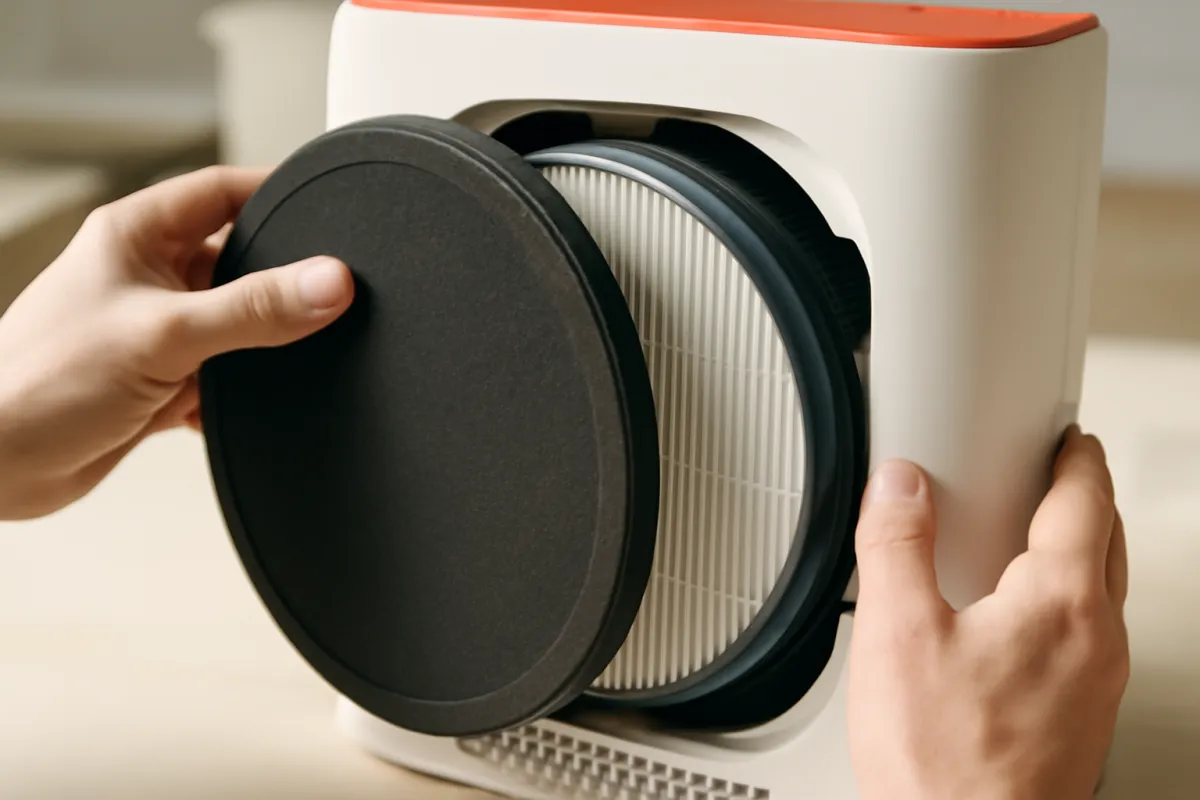
Physically, a HEPA filter is a long ribbon of fine borosilicate or synthetic fibers, folded into tight pleats to pack a large surface area into a small frame. The pleats matter: more area means the air moves through more slowly and the fan works less hard, so a well-pleated filter cleans more air per watt and lasts longer before it clogs. When you look at the cylindrical or rectangular white accordion inside a purifier, those folds are the working surface.
Air is the delivery system. A fan pulls room air into the unit, forces it through the pleated media, and pushes the cleaned air back out. As the air threads between the fibers, particles are removed by the three mechanisms already described, impaction, interception, and diffusion, working together across the size range. Nothing is charged or zapped in a plain HEPA filter; it is purely mechanical, which is why the result is predictable and repeatable rather than dependent on a room’s humidity or a marketing gimmick.
Over time the trapped particles build up inside the media, and this is the part people misunderstand. A slightly loaded filter actually captures a touch better, because the caught particles help snag new ones. But keep loading it and airflow chokes, the fan strains, and clean-air delivery falls even though the filter looks fine. That is why a HEPA filter is a consumable with a service life rather than a permanent part: it does not wear out so much as fill up.
What a HEPA filter removes well
The good news is broad. A true HEPA filter is excellent at the fine particulate that makes up most of what floats in indoor air. Household dust and the skin flakes and fibers in it, pollen, pet dander, mold spores, dust mite allergen, and the fine particulate in smoke are all comfortably within a HEPA filter’s reach, most of them well above the hard 0.3 micron size. These are the triggers behind most indoor air complaints, which is why the category is genuinely useful for allergy and smoke sufferers.
Smoke deserves a specific mention because it is the case that turns skeptics into believers. Wildfire and cigarette smoke particulate sits right in the fine-particle range a HEPA filter handles, so a correctly sized unit can keep one room markedly cleaner than hazardous outdoor air during a smoke event. The particulate is the part that reaches deep into the lungs, and it is exactly what HEPA is built to strip out of the air.
Bacteria and many other biological particles also fall within range, since most bacteria are larger than 0.3 microns. The honest framing is that HEPA removes the particle, whatever it is made of, as long as it is a particle in the right size range. It does not know or care whether a speck is pollen, dander, or a bacterium; it catches things by size and behavior, not by identity. That is what makes the standard so powerful and so easy to reason about.
What a HEPA filter does not remove
Here is the limitation that catches most buyers. A HEPA filter does nothing for gases, odors, and volatile organic compounds, because those are individual molecules, thousands of times smaller than the particles a filter is built to trap. Cooking smells, paint and solvent fumes, off-gassing from new furniture and carpet, cleaning-product vapors, radon, carbon monoxide, and the smell in smoke are all molecular, and a HEPA-only unit lets every one of them straight through.
This is why so many owners conclude their purifier does not work: they bought it to fix a smell, and a particle filter cannot. The only home tool that touches gases and odors is activated carbon, which adsorbs molecules onto its enormous internal surface area. The catch is quantity. Meaningful odor control needs a real bed of carbon measured in pounds, not the thin sprayed-on carbon sheet that many budget units include so they can print odor filtering on the box. Those token sheets saturate in weeks and then do nothing.
Two more limits are worth stating plainly. A HEPA filter cleans the air, not surfaces, so the dust already settled on your shelves still needs a cloth; the filter only lowers how much is airborne and how fast surfaces re-coat. And it is not a fix for a moisture or mold source: it will catch spores already in the air while a colony on a damp wall keeps producing more. For that whole picture, our note on improving indoor air quality covers the source-first steps that a filter cannot replace.
Which particles HEPA catches, in one table
To make the particle-versus-molecule line concrete, here is where common household culprits fall. Sizes are approximate and vary by source, and the last column is the honest yes-or-no for a genuine true HEPA filter with no carbon stage.
| Particle or substance | Typical size | Captured by a true HEPA filter? |
|---|---|---|
| Pollen | 10 to 100 microns | Yes, easily |
| Household dust | 1 to 100 microns | Yes |
| Pet dander | 0.5 to 10 microns | Yes |
| Mold spores | 1 to 30 microns | Yes |
| Dust mite allergen | 10 to 40 microns | Yes, the airborne share |
| Smoke and PM2.5 particulate | 0.1 to 1 micron | Yes, within the tested range |
| Most bacteria | 0.3 to 3 microns | Yes |
| Viruses on droplets | ride on larger particles | Yes, the carrier particle is caught |
| Bare virus particles | 0.02 to 0.3 microns | Partly, aided by diffusion |
| Cooking odors and VOCs | gas molecules | No, needs activated carbon |
| Radon, carbon monoxide, natural gas | gas molecules | No |
| Ozone | gas molecule | No |
The pattern is the same one that runs through the whole category. If it is a particle in the micron range, a true HEPA filter catches it. If it is a gas or an odor, the filter is the wrong tool and only carbon or ventilation helps. Reading the table top to bottom is the fastest way to predict whether HEPA will solve the problem you actually have.
True HEPA vs HEPA-type and HEPA-like
This is where the marketing games live, and it is the single most useful thing to understand before you spend. True HEPA, sometimes written as genuine, absolute, or medical HEPA, is a filter that actually meets the 99.97% at 0.3 microns standard, and reputable makers can point to a test result behind it. It is the version worth buying, and it is the version the whole reputation of the category rests on.
HEPA-type, HEPA-like, HEPA-style, and 99% HEPA are something else. They borrow the famous name while quietly failing the number, and they typically capture somewhere in the 85% to 99% range at the hardest size, which sounds close and is not. A HEPA-type filter can let ten, twenty, or thirty times as many fine particles through as a true HEPA filter, so it does a fraction of the work while trading on the same word. The hedge word, type or like or style, is the tell.
Fine-particle capture: true HEPA versus the lookalikes
Illustrative single-pass capture at the hard 0.3 micron size. Bars are scaled to the true-HEPA figure.
The gap between 99.97% and 90% looks small on a chart and is enormous in particles passed. Figures are illustrative, not measured for any single model.
The reason the trick works is that the difference is invisible on a spec sheet unless you know to look. Ninety-nine percent and 99.97% read almost the same to a casual shopper, yet one passes more than thirty times the particles of the other at the size that matters most. When a listing leans on the HEPA name but pairs it with a hedge or an unusually low price, assume it is the lookalike and shop accordingly.
How to tell if a filter is genuinely HEPA
You do not need lab equipment to sort real from fake, just a short checklist. First, read the exact wording. True HEPA or genuine HEPA is a good sign; HEPA-type, HEPA-like, HEPA-style, and 99% HEPA are the hedges to avoid. The word alone, with no test result or standard cited, is not enough on its own, but the presence of a hedge is a reliable warning.
Second, look for a stated figure and standard. A serious product will say 99.97% at 0.3 microns somewhere, and better ones reference the recognized test methods behind that number. If the marketing talks around performance without ever stating the capture figure, that silence is informative. Third, be suspicious of anything sold as a washable or permanent HEPA filter, because a true HEPA mat is a consumable that washing tends to damage; a rinsable filter is usually trading real capture for convenience.
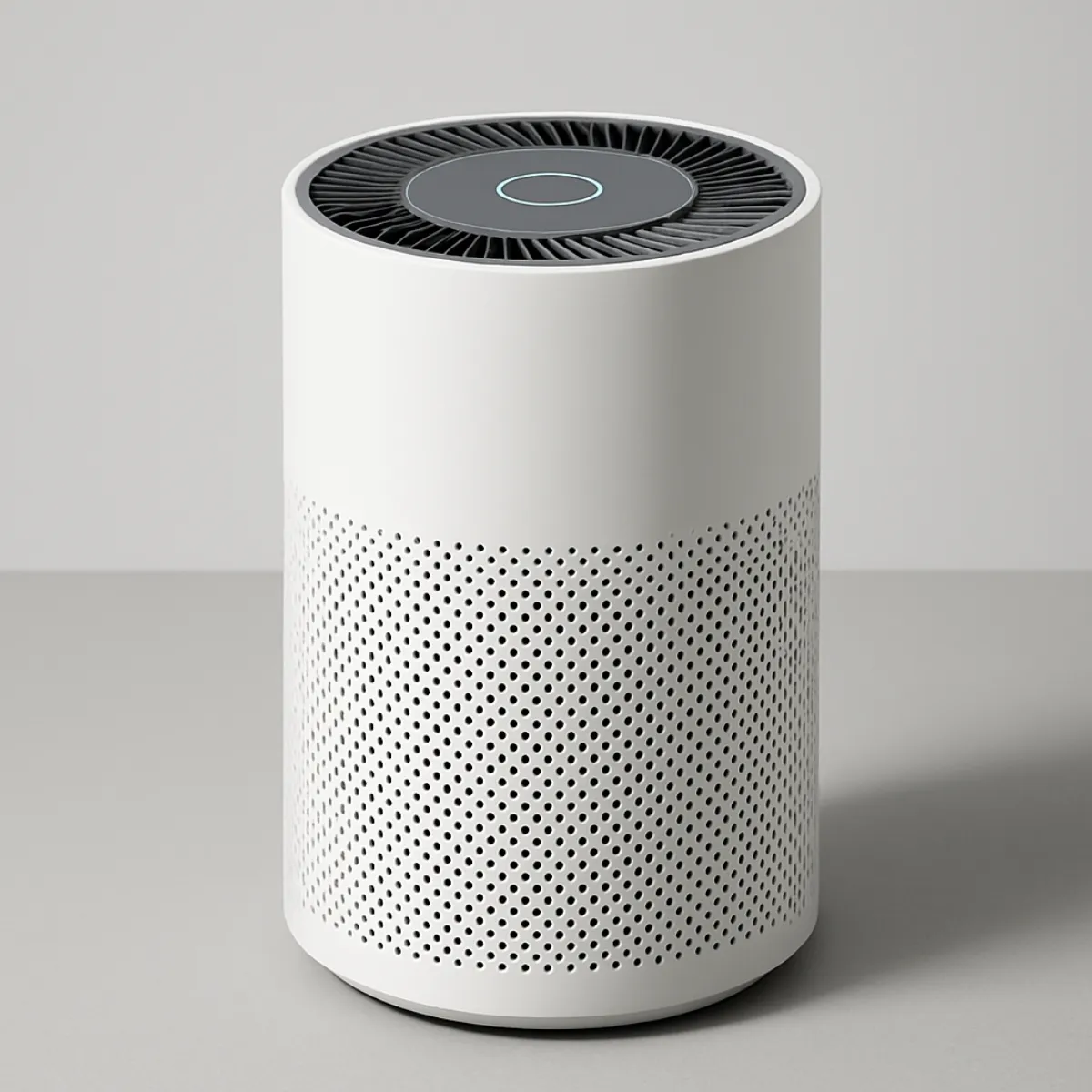
Fourth and most practical, ignore the ionizer pitch. A device whose selling point is that it never needs a filter is telling you it does not filter, and the cleaning has to come from somewhere. A real purifier has a true HEPA filter and a fan strong enough to move the room’s air through it. If you want the fuller buying walkthrough, our note on choosing an air purifier puts these checks in order alongside sizing and noise.
CADR: why the filter alone is not the whole story
A perfect filter behind a weak fan cleans a room slowly, which is why the filter grade is only half the story. The other half is airflow, and the number that captures both is CADR, the Clean Air Delivery Rate. CADR measures how much clean air the whole machine actually delivers per minute in cubic feet, combining the quality of the filter and the strength of the fan, so it predicts real-world results in a way the filter grade alone cannot.
Think of it this way. A true HEPA filter tells you how clean the air is on a single pass; CADR tells you how fast the unit can clean the whole room. Two units can both use true HEPA and clean at very different speeds because one moves far more air. That is why a genuine HEPA filter in an underpowered machine can still disappoint: the air it does clean is clean, but it cleans too little of the room, too slowly, to keep the count down.
A practical rule of thumb pairs the two. Aim for a smoke CADR in cubic feet per minute equal to about two-thirds of the room’s square footage for general use, and more for allergies or smoke, which lands you near four to five air changes an hour. Match the rated room size to your actual room and size up rather than down. For the money side of matching a unit to a room, our air purifier cost breakdown runs the full picture, and you can test your own room and rate in the cost helper.
Room HEPA air purifier: matching CADR to room size
A room HEPA air purifier is sized by airflow, not by the filter grade, because every true HEPA filter meets the same capture standard. The variable is how much air the machine pushes through that filter per minute, and the number that measures it is CADR. Sizing is the step buyers skip most often, and it explains almost every case where someone bought a genuine HEPA unit and felt nothing changed.
Start by measuring the room rather than trusting the room size printed on the box, which is often the manufacturer’s most optimistic reading. Multiply length by width for the square footage. The working rule of thumb is a smoke CADR in cubic feet per minute equal to roughly two-thirds of that square footage for general dust and pollen, and closer to one times the square footage if allergies, pets, or smoke are the reason you are buying. A 300 square foot bedroom lands near 200 cfm on the general rule and near 300 cfm on the allergy rule.
Air changes per hour is the same idea stated differently, and it is worth understanding because better listings quote it. Air changes count how many times the unit could process the room’s full volume in an hour. Two changes an hour is light background cleaning, four to five is the range most allergy advice points to, and higher only helps if the unit can hit it at a fan speed you can tolerate. That last clause carries more weight than any spec: a unit that reaches its rated CADR only on the loudest setting will end up parked on low, delivering a fraction of what you paid for.
Three practical adjustments finish the job. Add capacity for high ceilings, since CADR rules assume a standard eight foot ceiling and a vaulted room holds far more air. Treat open doorways honestly, because a bedroom that opens onto a hallway is sharing air with a larger space than the one you measured. And size up rather than down, so the unit spends its life on a quiet middle speed instead of straining at maximum. Sizing sits at the front of our walkthrough on choosing an air purifier, and you can put your own room size into the cost helper to see the CADR to shop for.
Air purifier with HEPA filter: what to verify on the box
An air purifier with HEPA filter is only as good as the wording on its packaging, because the same four letters appear on machines that meet the standard and machines that do not. Five checks, done in order, separate them, and every one of them can be made from the box or the listing without any equipment.
Check the exact phrase first. True HEPA, genuine HEPA, or a stated 99.97% at 0.3 microns is the version worth buying. HEPA-type, HEPA-like, HEPA-style, and 99% HEPA are the hedges, and they typically pass ten to thirty times as many fine particles at the hardest size while trading on the same name. If the word HEPA is qualified by type, like, or style, read it as not HEPA and move on. A box that never states a capture figure anywhere is telling you something by that silence.
Check for a sealed system next. A filter only performs to its rating if all the air is forced through it, so look for sealed system or fully sealed in the description. Then check the CADR, not just the rated room size, and match it to the room you measured with headroom. Rated room size is a marketing figure with no fixed definition behind it; CADR is a measured airflow number, and it is the one that predicts how fast the room actually gets clean.
Check the carbon claim honestly. If odors are your reason for buying, a thin carbon-coated sheet will not do it, and only a substantial carbon bed measured in pounds makes a real difference to gases and smells. Finally, price the replacement filter and its schedule before the machine’s sticker price, since the consumable commonly runs about $25 to $80 every 6 to 12 months, illustratively, and outweighs the purchase price over five years. Our air purifier cost breakdown runs that math in full, and our evidence-first take on whether air purifiers are worth it covers when the whole purchase makes sense.
HEPA filter lifespan and how often to replace it
A HEPA filter does not last forever because it fills up rather than wears out, and a clogged filter is the most common reason a good machine quietly stops cleaning. As particles pack the media, airflow drops, the fan strains, and clean-air delivery falls even though the filter still looks intact from the outside. A purifier with a neglected filter is really just an expensive fan pushing air past a wall of dust.
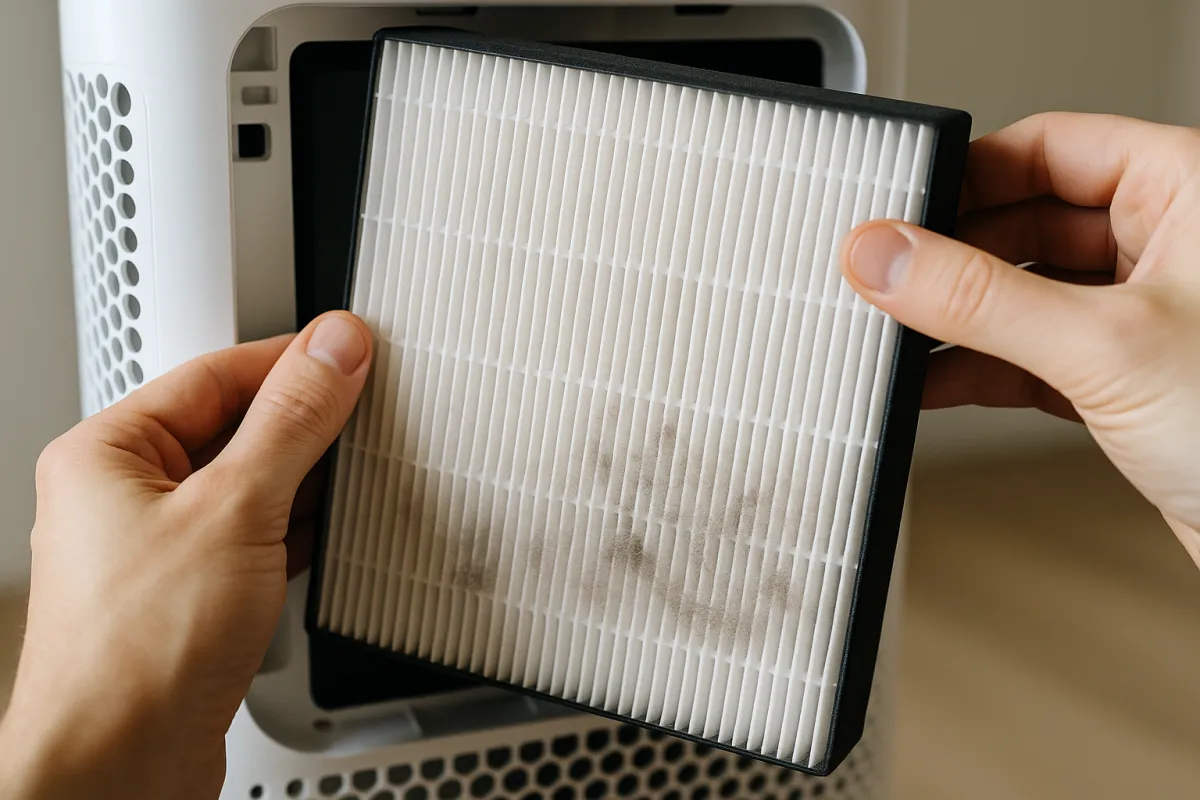
The typical schedule for a home purifier is 6 to 12 months for the true HEPA stage, and more often for any carbon or pre-filter stage, which may want attention every few months. Those are starting points, not promises. Running the unit on high all the time, in a smoky or very dusty space, or in a home with pets loads the media faster and shortens the interval, so adjust to your conditions rather than the box’s optimistic estimate. Many units have a washable pre-filter that catches hair and large debris; vacuuming it every few weeks protects the expensive HEPA stage and stretches its life.
The one thing you should not do is wash the true HEPA filter itself. The captured particles are held deep in the fiber mat, and rinsing or aggressive vacuuming damages the fibers and opens leak paths, ruining the capture you paid for. Treat the HEPA stage as a replaceable consumable and clean only the separate pre-filter. The same load-up-and-replace logic applies to the furnace filter in your HVAC system, which is a different filter doing a related job on a schedule of its own.
What HEPA replacement filters cost
The filter, not the machine, is where the recurring money lives, and it is the cost buyers most often overlook. A replacement true HEPA filter for a mid-range home purifier commonly runs about $25 to $80 each, illustratively, and units that combine HEPA with a real carbon stage sit toward the higher end because carbon adds bulk and cost. At a 6 to 12 month life, that works out to roughly $50 to $120 a year to keep a typical unit doing its job, every year you own it.
Power is the smaller slice and the one people wrongly fixate on. A typical HEPA purifier draws only about 10 to 50 watts depending on fan speed, closer to a couple of light bulbs than a real appliance, so running one most of the day costs only a few dollars a month in electricity at a typical rate, illustratively. To see how tiny that is next to everything else you plug in, our appliance wattage and running-cost reference lists typical draws side by side.
Where a HEPA unit's five-year cost goes
Illustrative split of the total cost of owning a mid-range purifier over five years: the machine, its filters, and its power.
Filters are the largest slice of lifetime cost, ahead of both the machine and the power. Figures are illustrative; price the exact replacement filter before you buy.
The buying lesson is to price the replacement filter and its schedule before you fall for a design, not after. A striking unit with an $80 filter due twice a year costs far more to keep running than a plain one with a $40 filter due yearly, and the machine’s sticker price hides that entirely. Because the consumable dominates the five-year number, the filter should drive your decision as much as the purifier does. Drop your own filter price, life, and wattage into the cost helper to see your figure.
Do HEPA filters actually work? The honest evidence
Yes, on particles, and the reason to trust it is that the effect is measurable rather than promised. Point an inexpensive particle counter at a dusty or smoky room, switch on a correctly sized true HEPA unit, and you can watch the fine-particle count fall over the next half hour. The mechanism is simple physics, the standard is a real number, and the result shows up on an instrument, which is what separates HEPA from the wellness gadgets that ask you to take their word for it.
The honesty comes in scoping the claim. HEPA works on airborne particles that pass through the filter, and it works well; it does not work on gases and odors, it does not clean surfaces, and it does not cure the source of a problem. A filter that removes 99.97% of particles from the air moving through it is doing real, verifiable work, but only on the share of the problem that is both particulate and airborne. Keep the claim inside those lines and it holds up completely.
The disappointment cases are almost always a mismatch, not a failure of the technology. Someone buys HEPA to kill a cooking smell (wrong tool, needs carbon), or buys a HEPA-type lookalike (never met the standard), or sizes a small unit for a large room (too little CADR to keep up), and concludes HEPA does not work. In each case the filter did exactly what a particle filter does; the expectation was aimed at the wrong target. Our evidence-first take on whether air purifiers earn their keep walks through those cases in detail.
The limits worth stating plainly
Because HEPA works so well on its own job, it is worth being blunt about the jobs it does not do, so the machine is not blamed for missing what it was never built to catch. It does not remove gases or odors without a substantial carbon stage. It does not clean the dust already sitting on your surfaces. It does not fix damp or mold at the source; it only catches the spores already airborne while the colony keeps producing more.
On viruses, the honest answer is partly and with caveats. Many virus particles are smaller than the 0.3 micron test size, but they rarely travel bare, they ride on larger respiratory droplets and particles that a HEPA filter catches well, and diffusion makes filters more efficient below 0.3 microns than at it. So a HEPA unit does reduce the airborne particles that can carry a virus, but it only cleans air that actually passes through it, and it is one layer of protection rather than a standalone shield. Anyone making a health decision should treat it that way and consult a qualified professional.
There is also the ozone trap at the edge of the category. Some devices marketed near HEPA products are ozone generators or ionizers that produce ozone as a byproduct, and ozone is a lung irritant that health authorities warn against in occupied spaces. A plain HEPA filter produces none, which is a point in its favor. If a device brags about producing ozone or an activated-oxygen scrub, that is a reason to walk away, not a feature.
HEPA in vacuums versus air purifiers
HEPA shows up in two very different appliances, and it does a different job in each. In an air purifier, the HEPA filter is the whole point: a fan continuously pulls room air through it and pushes clean air back, scrubbing the space around the clock. In a vacuum, the HEPA filter sits on the exhaust to stop the fine dust and allergen the vacuum stirs up from blowing straight back into the room. Same grade of media, different mission.
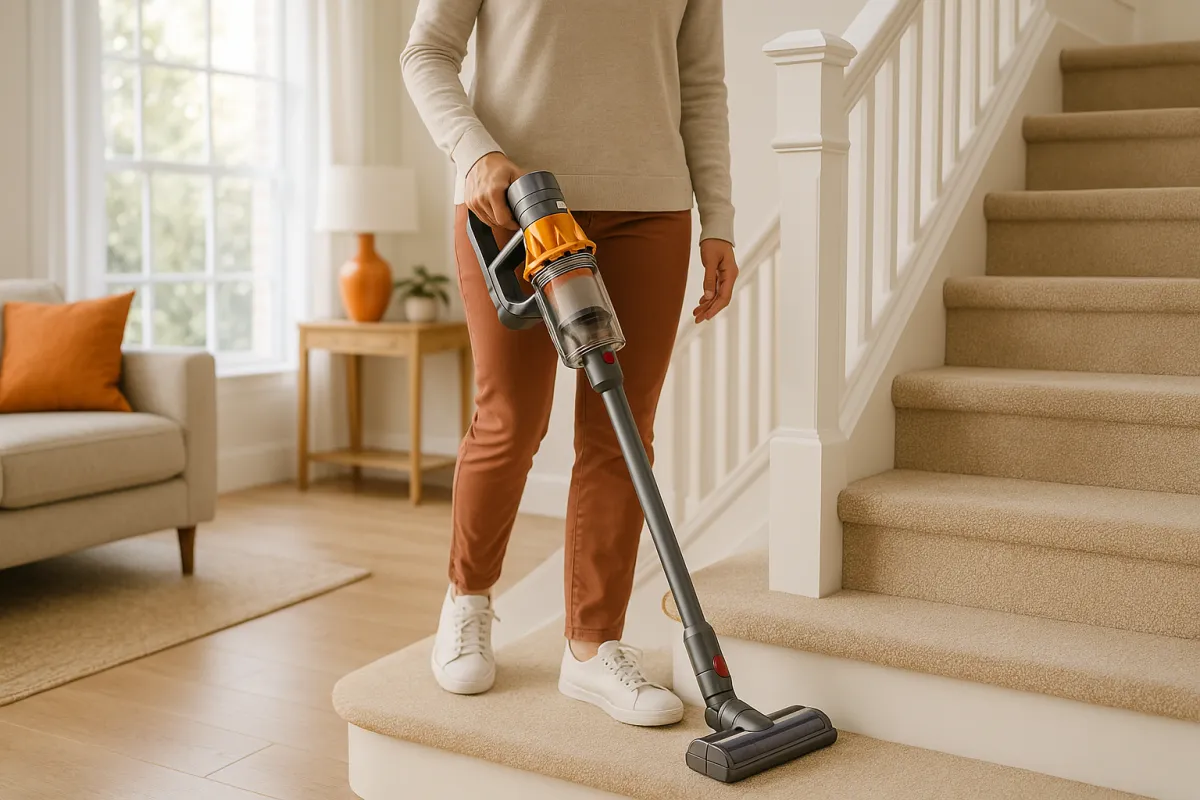
The phrase that separates a real allergy vacuum from a marketing one is sealed HEPA, or fully sealed system. A HEPA filter only helps if all the air is forced through it, and a cheaply built vacuum leaks air, and dust, through gaps around the filter and along the seams while it runs. So a vacuum can carry a genuine HEPA filter and still spray fine particles back into the room because the path is not sealed. For an allergy household the sealed system matters as much as the filter grade, which is a theme our robot versus cordless vacuum comparison keeps returning to.
The honest way to picture the two together is complementary, not competing. A vacuum with sealed HEPA keeps cleaning from making the air worse; a purifier with true HEPA keeps the ambient air clean between cleanings. Neither replaces the other, and in a dusty or allergic home both earn their place. What they share is the same underlying truth: the HEPA grade is necessary but not sufficient, and the delivery around it, the fan in a purifier, the seal in a vacuum, decides whether the filter’s rating turns into clean air.
HEPA versus your furnace or HVAC filter
People often assume the filter in their furnace or air handler is a HEPA filter, and it almost never is. Whole-house HVAC filters are rated on the MERV scale, and true HEPA is far denser than a typical furnace filter. That density is the problem: a real HEPA filter creates so much airflow resistance that a standard residential blower cannot push enough air through it, so dropping true HEPA into a normal furnace slot can starve the system rather than clean the house.
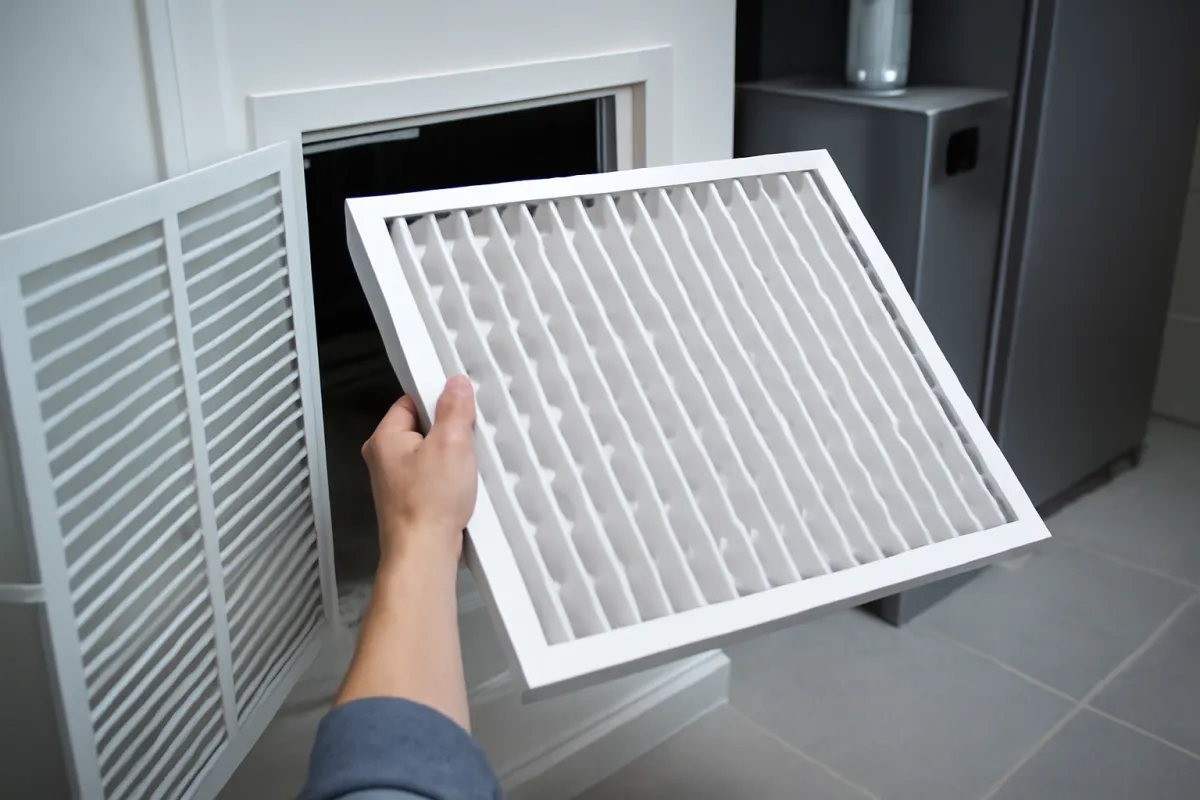
What home HVAC systems use instead are higher-MERV filters that improve capture without choking the blower, and true whole-house HEPA usually means a separate bypass unit added alongside the system rather than a filter you slot into the return. The everyday takeaway is that the disposable filter you change in the furnace is doing a related but different job on a different standard, and it is worth keeping on schedule for airflow and dust reasons even though it is not HEPA. Our note on how often to change a furnace filter covers that routine.
So if your goal is HEPA-grade cleaning of the air you breathe, a standalone HEPA air purifier in the rooms you use is the straightforward answer, not a filter swap in the furnace. The furnace filter protects the equipment and captures the coarser dust across the whole house; the purifier delivers the fine-particle capture in the room that matters. Matching the tool to the job, again, is the whole game.
Carbon versus HEPA: particles are not molecules
Because odor complaints are so common, it is worth spelling out the division of labor between HEPA and activated carbon, since a good unit uses both and they are not interchangeable. HEPA is a mechanical particle filter: it physically traps specks in a fiber mat. Activated carbon is a chemical adsorber: its vast internal surface area grabs gas molecules and holds them. One catches particles, the other catches gases, and neither does the other’s job.
That is why the order of your priorities should follow your problem. If your issue is dust, pollen, dander, or smoke haze, HEPA is the star and carbon is optional. If your issue is cooking smells, paint fumes, or the odor in smoke, carbon is the star and HEPA is the bonus, which is the reverse of how most units are marketed. Crucially, the thin sprayed-on carbon sheets in budget units are close to decorative; real odor control needs a substantial carbon bed measured in pounds, and its absence is why so many owners say their purifier does nothing for smells.
Even with carbon, keep expectations grounded: ventilation often does more than any filter for gases. Opening a window or running a range hood clears cooking fumes faster and cheaper than a purifier, so a machine is not always the right answer to an odor problem in the first place. The clean mental model is HEPA for particles, carbon for gases, and fresh air for both, and knowing which of the three your problem needs saves you from buying the wrong box.
Sealed HEPA versus the filter alone
A rating on the filter only matters if the air is actually forced through it, and this is the quiet caveat behind both purifiers and vacuums. A true HEPA filter in a machine that leaks air around the filter delivers less than its rating, because some of the air takes the easy path through the gaps instead of the hard path through the media. That is why serious products advertise a sealed system, meaning the housing is built so all the air must pass through the filter with nowhere to bypass it.
In a purifier, a poor seal shows up as air-quality readings that never drop as far as the filter grade suggests they should. In a vacuum, it shows up as that faint dusty smell and the fine particles that hang in a sunbeam after you finish cleaning. In both cases the fix is the same design idea: gaskets and a tight airway that route every bit of moving air through the HEPA media. When you compare two units with identical filter ratings and different results, the sealing is often the hidden difference.
The buying lesson is to weigh the whole air path, not just the filter sticker. A genuine HEPA filter is necessary but not sufficient; the fan has to move enough air, the housing has to force that air through the filter, and the pre-filter has to protect the HEPA stage so it lasts. A machine that gets all three right turns the filter’s 99.97% into clean room air; a machine that nails the filter and fumbles the seal leaves performance on the table you already paid for.
HEPA myths, corrected
A handful of persistent myths cause most of the bad purchases, so here they are with the honest correction. The first is that HEPA removes odors and smoke smell. It removes smoke particulate, the haze, but not the smell, which is gas that needs carbon. Buying HEPA to fix a cooking or pet odor and expecting the smell to vanish is the single most common disappointment in the category.
The second myth is that a higher price buys a higher grade of HEPA. It does not. True HEPA is a fixed standard, so a $500 unit does not filter cleaner than a $120 one; it filters faster or in a bigger room, which only helps if your room demands it. Paying premium money for capacity you will not use is as much a mismatch as underbuying. The third myth is that a washable or permanent HEPA filter saves money forever. Genuine HEPA is a consumable, and washing usually degrades it, so a filter marketed as rinsable has typically traded real capture for the convenience.
The fourth myth is that filterless ionic devices do the same job without the running cost. They move far less air and clean far less effectively than a HEPA-and-fan unit, and some emit a little ozone as a byproduct, so the saved filter cost buys a machine that does much less work. The through-line across all four is the same: the filter is where the cleaning happens, the standard is fixed, and any pitch that promises the HEPA result while dodging a real HEPA filter is promising something it cannot deliver.
A worked example: filter cost and CADR for one room
Put the pieces together on a single realistic room, a 300 square foot bedroom for an allergy sufferer running the unit most of the day. The sizing and the money are the two decisions, and they are easy once the concepts are clear.
The size you need. At the two-thirds rule, 300 square feet points to a smoke CADR around 200 cubic feet per minute for general use, and you would size up from there for allergies, so a unit rated near 220 to 250 CADR gives the headroom to hit five air changes an hour. Confirm the box says true HEPA and states 99.97% at 0.3 microns, and you have matched a real filter to the room at a fan strength that can keep it clean.
The cost to keep it running. Assume a mid-range unit whose true HEPA filter costs about $60 and lasts nine months, so filters run roughly $80 a year, illustratively. Add power at about 25 watts run most of the day, a few dollars a month, and the running cost lands somewhere near $100 a year, with the filter the larger slice by far. Over five years, the consumables outweigh the machine’s sticker price, which is why the filter deserves as much attention as the purifier when you buy. Swap your own room size, filter price, life, and wattage into the cost helper to see your version of these numbers.
How to buy: a HEPA checklist
Before you spend, run any unit past these five checks. Clear all five and the filter will do real work on a problem you actually have.
- True HEPA, stated plainly. Look for true or genuine HEPA and, ideally, 99.97% at 0.3 microns. If the word is hedged with type, like, or style, treat it as not HEPA.
- A CADR that fits your room, with headroom. Match the rated room size to your space and size up, aiming for four to five air changes an hour, more for allergies or smoke. The filter grade and the airflow both have to be right.
- A sealed air path. Favor a sealed-system design so all the air is forced through the filter rather than leaking around it, in a vacuum as much as a purifier.
- A filter you can afford to replace. Price the replacement true HEPA filter and its schedule, and multiply it over five years before you decide the machine is cheap. The consumable, not the sticker, is the real cost.
- Carbon only if you need odors, and no ozone. Add a substantial carbon stage only if gases and smells are your goal, skip token carbon sheets, and avoid ozone generators entirely.
Pass all five and you have matched a genuine standard to a real problem at a running cost you chose on purpose. That is a more useful test than any star rating, and it is the whole reason to understand what the HEPA label means before a box talks you out of it.
The bottom line
A HEPA filter is a mechanical air filter that captures 99.97% of particles at 0.3 microns, the hardest size to catch, which is why one number can describe how well it removes dust, pollen, dander, mold spores, and smoke particulate. It works, and the effect is measurable rather than a marketing promise, but only on particles: gases and odors need activated carbon, surfaces still need cleaning, and a moisture or mold source still needs fixing. The traps are all around the name, True HEPA meets the standard while HEPA-type and HEPA-like quietly do not, filters are a consumable that costs more over time than buyers expect, and the airflow and seal around the filter decide whether its rating becomes clean air. Match a genuine true HEPA unit to your room, keep it in filters, and be honest about what it can and cannot do, and it is one of the few air-cleaning claims that holds up to a particle counter.
A note on scope: these notes exist to explain how a HEPA filter works and to cut through the label games, not to sell you a machine. Every dollar figure here is an illustrative planning number rather than a quote or a measured result for any specific model, and filter prices, service lives, and wattages shift faster than any article can track, so confirm the current replacement-filter cost and schedule for the exact unit you are considering. Nothing here is medical advice, and a HEPA filter is not a treatment for any health condition or a standalone defense against illness, so anyone weighing one for allergies, asthma, mold, or infection risk should speak with a qualified professional about their own situation before relying on it.
Frequently asked questions
What is a HEPA filter?
A HEPA filter is a mechanical air filter built to a specific performance standard: it captures at least 99.97% of airborne particles at 0.3 microns in a single pass. The name stands for high-efficiency particulate air. It is a dense mat of fine fibers that traps particles as air is forced through it, and the 0.3 micron figure matters because that size is the hardest one to catch. Anything larger or smaller is captured even more easily, so a genuine HEPA filter is very good at removing fine airborne particles like dust, pollen, dander, and smoke.
Do HEPA filters actually work?
Yes, for the job they are built to do, and it is measurable rather than a marketing claim. A true HEPA filter behind an adequate fan removes fine airborne particles, and you can watch the count fall on an inexpensive particle counter after switching a correctly sized unit on. What they do not do is remove gases, odors, or volatile organic compounds, because those are molecules far too small for a particle filter to stop. So HEPA works on particles and does essentially nothing on smells unless the unit also carries a substantial activated-carbon stage.
What is the difference between True HEPA and HEPA-type?
True HEPA (sometimes written as genuine or absolute HEPA) meets the 99.97% at 0.3 microns standard and can usually cite a test result. HEPA-type, HEPA-like, HEPA-style, and 99% HEPA are marketing terms that borrow the name without meeting the standard, and they typically let far more fine particles slip through. The difference is not trivial: a filter that catches 99% instead of 99.97% passes more than thirty times as many particles at the hardest size. If the box hedges the word HEPA with type or like, treat it as not HEPA.
Do HEPA filters remove odors and smoke smell?
HEPA removes the smoke particulate, the visible haze, but not the smell. Odors, cooking smells, paint fumes, and the gas fraction of smoke are volatile molecules, and a HEPA filter is designed to catch particles, not molecules, so it sails right past them. The only home tool that helps with odors is a substantial bed of activated carbon, measured in pounds rather than the thin sprayed-on sheet many budget units include. If odor control is your goal, shop for the carbon stage first and treat the HEPA layer as the bonus.
How often do you replace a HEPA filter and what does it cost?
A true HEPA filter in a home air purifier typically lasts 6 to 12 months, and a carbon or pre-filter stage often needs attention more often. Replacements commonly run about $25 to $80 each for a mid-range unit, illustratively, so filters land somewhere near $50 to $120 a year depending on the model and how hard it runs. Heavy smoke, pets, and running on high all the time shorten that life. Price the exact replacement filter for the model you are considering before you buy, because the filter, not the machine, is where the recurring cost lives.
Are HEPA filters in vacuums as good as in air purifiers?
The filter media can be the same grade, but a vacuum and a purifier do different jobs. A sealed-HEPA vacuum matters because it stops fine dust and allergen from blowing back out through gaps in the machine while you clean, which a cheap vacuum does. A purifier, by contrast, continuously scrubs the room air whether or not you are cleaning. The key phrase in a vacuum is sealed HEPA: without a sealed path, air can bypass the filter through leaks, so the filter grade alone does not guarantee clean exhaust.
Does a HEPA filter remove viruses?
Partly, and more than the 0.3 micron headline suggests. Many viruses are smaller than 0.3 microns on their own, but they rarely travel bare; they ride on larger respiratory droplets and particles that a HEPA filter catches well. Filters are also more efficient below 0.3 microns than at it, because tiny particles move erratically and get trapped by diffusion. That said, a purifier only cleans air that passes through it and is not a standalone defense against illness, so treat it as one layer alongside ventilation and other measures, not a cure.
Can you wash and reuse a HEPA filter?
Almost never for a true HEPA filter. The captured particles are held deep in a dense fiber mat, and washing or vigorous vacuuming tends to damage the fibers and open up paths that let particles through, which quietly ruins the very performance you paid for. Some products are sold as washable HEPA, but those usually trade real HEPA-grade capture for the convenience of rinsing. As a rule, treat a true HEPA filter as a replaceable consumable, vacuum only the separate washable pre-filter if the unit has one, and follow the maker's instructions for that specific model.
What should I check on an air purifier with HEPA filter before buying?
On an air purifier with HEPA filter, verify four things on the box before price enters the decision. First, the exact wording: true or genuine HEPA with a stated 99.97% at 0.3 microns, never HEPA-type, HEPA-like, or 99% HEPA. Second, a sealed system, so all the air is forced through the media instead of leaking around it. Third, a CADR figure, not just a rated room size, matched to your space with headroom. Fourth, the price and schedule of the replacement filter, which commonly runs about $25 to $80 every 6 to 12 months, illustratively, and usually costs more over five years than the machine itself.