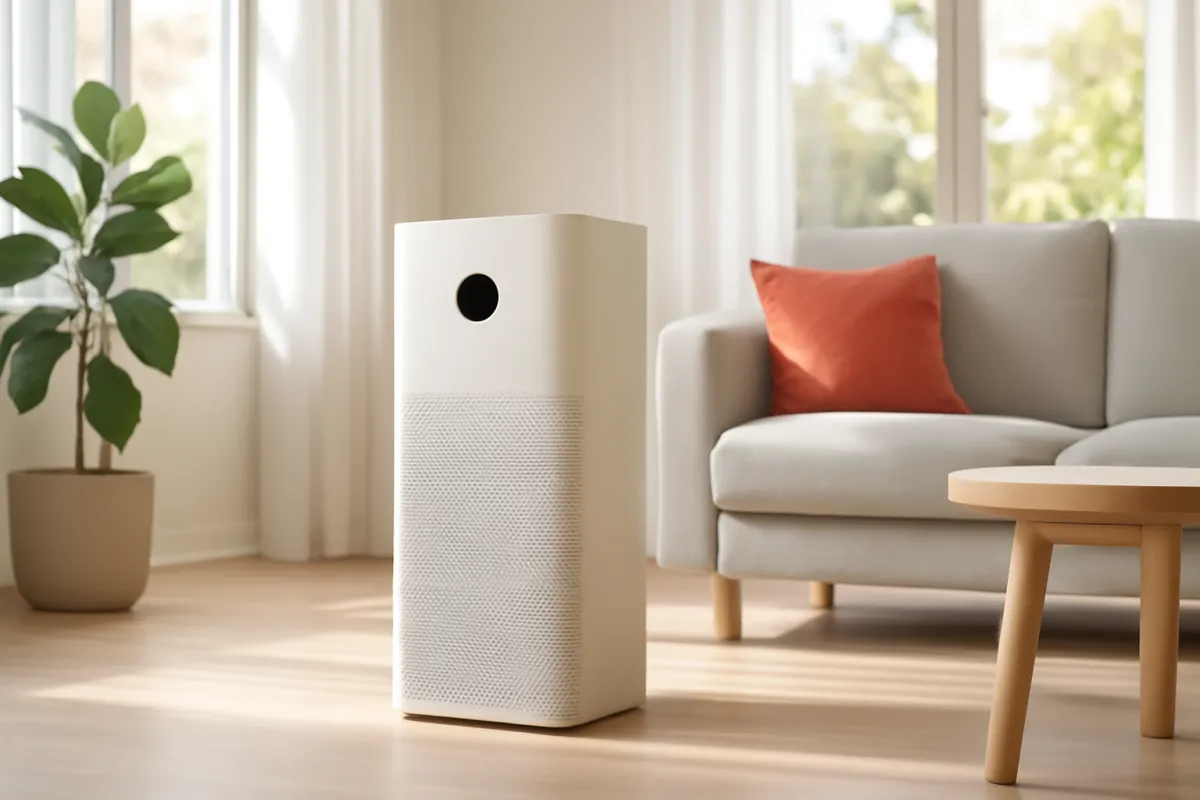
What's on this page
- Before you start: what to gather
- Step 1: Measure your room and find the square footage
- Step 2: Match the CADR to your room size (the two-thirds rule)
- Step 3: Insist on a true HEPA filter, and add carbon for odors
- Step 4: Check the air changes per hour for your use
- Step 5: Weigh the running costs, filters plus wattage
- Step 6: Avoid the traps, ozone, HEPA-type, and oversized-room claims
- The two specs that decide everything
- How your goal changes the machine
- A worked example: choosing for a 300 sq ft bedroom
- Common mistakes when choosing an air purifier
- Troubleshooting: large rooms, multiple rooms, smoke, and pets
- The air purifier buyer’s checklist
- Placement and speed: getting the CADR you paid for
- Do air purifier brands matter?
- The bottom line
Short answer: Choose an air purifier by sizing, not features: name your pollutant first, since dust, allergens, and smoke are particles a true HEPA filter catches while odors and VOCs need a real activated-carbon stage. Then match the unit's CADR to the room using the two-thirds rule, aiming for four to five air changes an hour, five or more for allergies, asthma, or wildfire smoke. Price the replacement filter before calling a unit cheap.
Learning how to choose an air purifier looks like a shopping problem and is really a sizing problem. The machine that disappoints its owner is almost never the one that lacked a feature; it is the one that was too weak for the room, carried the wrong filter for the pollutant, or hid its real cost in a consumable nobody priced. Get the size and the filter right and almost any reputable unit does its job. Get them wrong and the fanciest model on the shelf just hums.
These notes turn that into a repeatable, six-step method you can run on any unit before you spend. You will size the room, match the CADR, verify the filter, set an air-change target, weigh the running cost, and rule out the traps, in that order, so the decision is made on numbers rather than the box art. For the money side in full, our companion breakdown of how much an air purifier costs runs the five-year math, and our note on whether air purifiers are worth it covers whether you need one at all. You can size and price your own pick in about a minute with the cost-per-use calculator.
Key takeaways
- Choosing is sizing: match the unit's CADR to your room with the two-thirds rule, then size up rather than down, and confirm the box says true HEPA.
- Name your pollutant first. Dust, allergens, and smoke are particles a HEPA filter catches; odors and VOCs are gases that need a real carbon stage.
- Set an air-changes-per-hour target: four to five for general cleaning, five or more for allergies, asthma, or wildfire smoke.
- The filter, not the machine, is where the money lives. Price the replacement filter and its schedule before you decide a unit is cheap.
- The single most avoidable mistake is undersizing the CADR; the priciest is buying on brand and ignoring the yearly filter cost.
Before you start: what to gather
This walkthrough takes about thirty minutes and needs no tools beyond a tape measure and the product listing you are considering. The difficulty is low; the discipline is in doing the steps in order rather than jumping straight to reviews.
Gather three things before you shop:
- Your room dimensions. Length and width in feet for the room you actually want to clean, plus a rough ceiling height (most homes are close to eight feet). This is the single input that drives everything downstream.
- Your goal, named plainly. Pick the one that matters most: dust and general cleaning, allergies or asthma, wildfire smoke, or odors and VOCs. The goal decides whether you need a bigger fan, a bigger carbon stage, or just a right-sized basic unit.
- The candidate unit’s spec sheet. You want its stated CADR (or a rated room size), its filter type in plain words, the replacement filter price and schedule, and its wattage. If a listing hides any of these, treat that as information too.
A quick word on posture: every dollar and airflow figure in this walkthrough is an illustrative planning number, not a quote for any specific model, and the goal is to teach you the method rather than to point you at a machine. With the room measured and the goal named, the six steps below take you from a wall of near-identical white boxes to one unit you can defend on numbers. Keep the cost-per-use calculator open in another tab; you will feed it real figures at Step 5.
Step 1: Measure your room and find the square footage
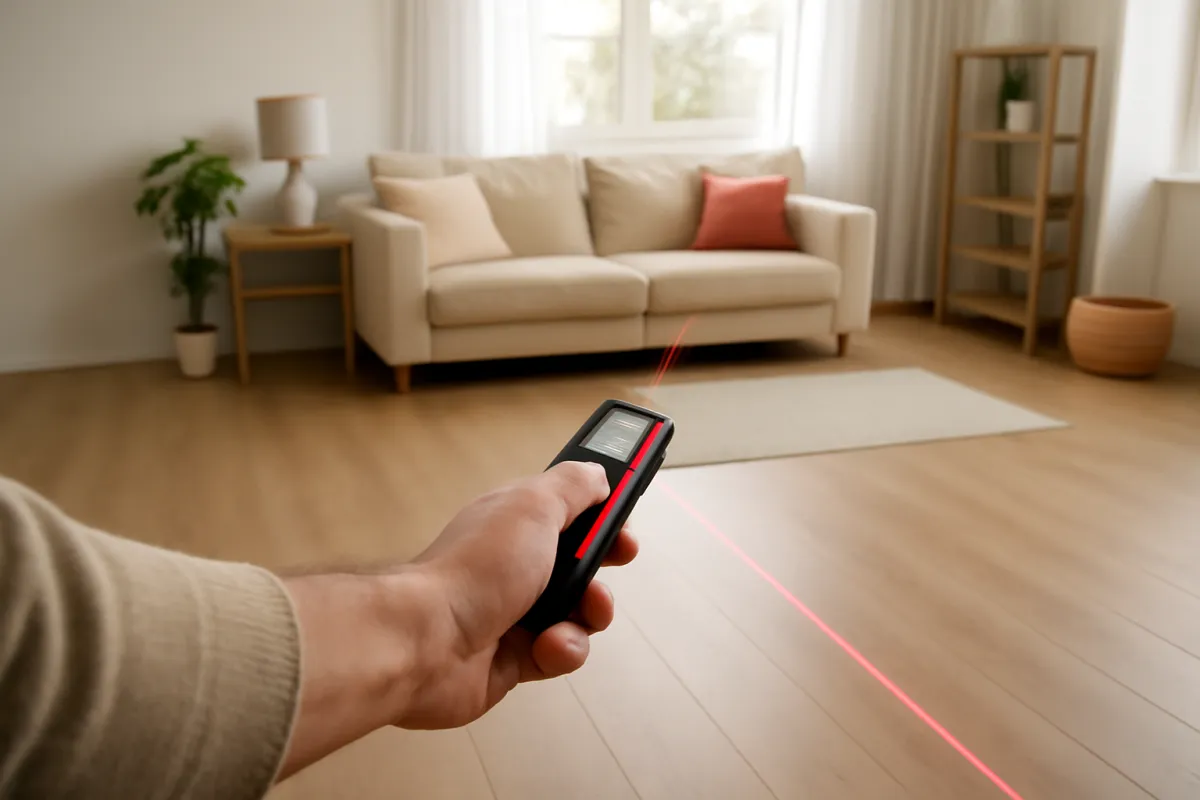
Start with the room, because its size sets the entire spec you are shopping for. Measure the length and the width of the space in feet and multiply them: a room 15 feet by 20 feet is 300 square feet. For an open-plan space with no wall between the kitchen and living room, measure the whole connected area as one room, not the piece you happen to stand in, because the air mixes across the whole volume and the purifier has to clean all of it.
Write down the square footage and the ceiling height. Most homes sit near eight feet, but a vaulted or loft ceiling of ten or twelve feet adds a large amount of air volume that a flat square-footage number hides. If your ceiling is well above eight feet, mentally bump your room up a size, because you have more cubic feet of air to clean than the floor area suggests.
The illustrative case to carry through the rest of this walkthrough is a 300 square foot bedroom with a standard eight foot ceiling, which is 2,400 cubic feet of air. That single number, 300 square feet, is what you will match a machine to in the next step.
Watch out: the room size printed on a purifier’s box is a marketing figure, not a promise, and it is often quoted at a generous air-change rate you would not actually want for allergies or smoke. Never buy on the box’s claimed room size alone. Measure your own space, keep the square footage in hand, and treat the box number as a starting point you will pressure-test against the CADR in Step 2. Rooms that open into hallways or other rooms behave larger than their footprint, so round up when in doubt rather than down.
Step 2: Match the CADR to your room size (the two-thirds rule)
CADR, the Clean Air Delivery Rate, is the number that predicts real-world results, because it combines the filter and the fan into one figure: how much clean air the whole machine delivers per minute. A perfect filter behind a weak fan produces a low CADR and cleans a room slowly, which is why CADR, not filter grade alone, decides whether a unit can keep up with your space.
The quick rule is the two-thirds rule: aim for a smoke CADR, in cubic feet per minute, equal to about two-thirds of your room’s square footage for general use. For the 300 square foot bedroom, that is roughly 200 CFM. That target lands you near four to five air changes an hour with a standard ceiling, which is the general-cleaning sweet spot. Manufacturers publish three CADR numbers, for smoke, dust, and pollen; use the smoke figure, since it is the hardest test and the most honest basis for comparison.
The chart below shows the CADR target climbing with room size, so you can find your room and read off the number to shop for.
CADR needed by room size (two-thirds rule)
Smoke CADR in cubic feet per minute, at roughly two-thirds of the floor area, for general use. Illustrative.
These are general-use targets. For allergies or smoke, aim higher, toward the full square footage. Figures are illustrative, not measured for any single model.
Watch out: size up, never down. A unit whose CADR exactly matches your room is working at its limit and has to run on high to keep pace, which is loud and burns through filters. The same machine in a room smaller than its rating cleans faster and runs quiet on a low setting. When a unit sits between two of your candidate sizes, take the bigger one.
Step 3: Insist on a true HEPA filter, and add carbon for odors
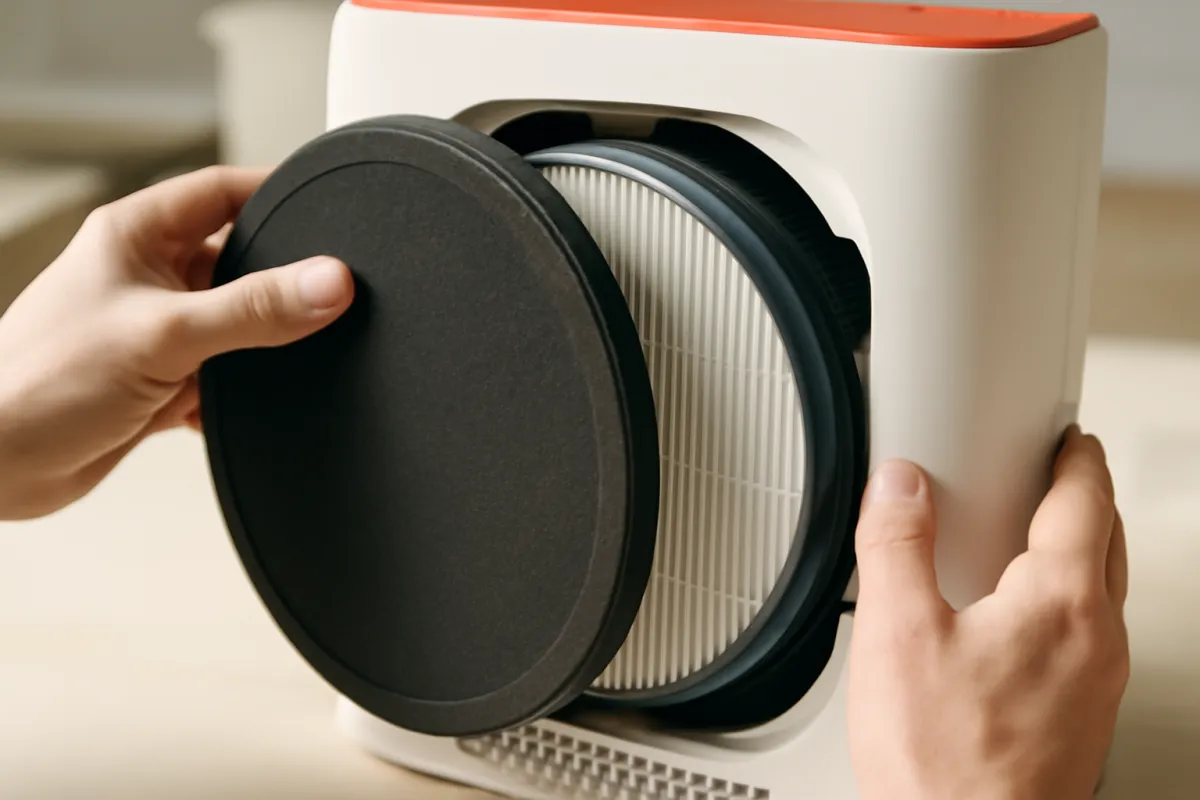
With the CADR target set, the filter is the second spec that decides whether a purifier does real work. Here the rule is strict: the box must say true HEPA, which is a defined standard that traps 99.97 percent of particles at 0.3 microns, the hardest size to catch. Larger and smaller particles are caught even more easily, so a true HEPA stage covers dust, pollen, pet dander, mold spores, and the fine particulate in smoke.
The words to distrust are the near-misses: HEPA-type, HEPA-like, 99 percent HEPA, and similar hedges. They exist precisely because they are allowed to let far more fine particles slip through than true HEPA does. If a listing dances around the phrase or buries it, assume the filter is not true HEPA and move on. This is the one spec where there is no such thing as close enough.
Carbon is the separate question, and it depends entirely on your goal from the “before you start” list. A HEPA filter does essentially nothing for gases and odors, because those are individual molecules, not particles. If cooking smells, paint fumes, off-gassing, or VOCs are your reason for buying, you need a substantial activated-carbon stage, measured in pounds of carbon, not the thin sprayed-on sheet budget units include to claim odor filtering. Those token sheets saturate in weeks and stop working, which is why so many owners conclude their purifier does nothing for smells.
Watch out: do not pay a premium for a heavy carbon stage you will never use. If your goal is dust, allergies, or smoke particulate, carbon is close to irrelevant and the money is better spent on CADR. Match the filter stack to the pollutant you named: HEPA for particles, real carbon on top only when odors and gases are the actual target. Buying a big carbon unit for an allergy problem is capacity spent in the wrong place.
Step 4: Check the air changes per hour for your use
Air changes per hour, or ACH, is how many times the purifier processes the room’s entire air volume in an hour, and it is the spec that translates a CADR number into a felt result. Two air changes an hour keeps air merely acceptable; four to five keeps it noticeably clean; five or six scrubs it fast enough to matter when the load is heavy. Your goal decides which target to aim for.
For general dust and everyday cleaning, four to five air changes an hour is plenty, which is exactly what the two-thirds CADR rule from Step 2 delivers in a standard-ceiling room. For allergies or asthma, aim higher, closer to five or six, because pulling pollen and dander out of the air faster than it resettles is the whole point, and the bedroom overnight is where that pays off. For wildfire smoke, aim higher still, since smoke keeps leaking in around doors and windows and the unit has to keep pace with a moving target.
The arithmetic ties back to the room you measured. Air changes per hour equals the CADR in cubic feet per minute, times 60, divided by the room’s air volume in cubic feet. For the 300 square foot bedroom at eight foot ceilings, that is 2,400 cubic feet, so a 200 CFM unit gives 200 times 60 divided by 2,400, which is five air changes an hour. Want six for allergies, and you back the math up to a CADR near 240 CFM, which simply means buying a unit rated for a larger room. Drop the cost-per-use calculator your room and target and it does this step for you.
Watch out: more air changes come only from a higher CADR, not from running a too-small unit on high. Pinning an undersized fan at full speed does not create air changes it does not have; it just wears the filter faster and adds noise. If you want five or six changes an hour, buy the CADR that produces them, then run the bigger unit on a lower, quieter setting.
Step 5: Weigh the running costs, filters plus wattage
A purifier you can afford to run is one you actually leave on, so price the running cost before you buy, not after. Two lines make it up: replacement filters and electricity. Filters are the one most buyers forget and the larger of the two by far. Look up the exact replacement filter for your candidate unit, note its price and how often it is due, and multiply across a year. A true HEPA filter typically runs $25 to $80 and lasts 6 to 12 months; a carbon pre-filter often adds $10 to $30 more often. For a mid-range unit, filters land around $50 to $120 a year, illustratively, every year you own it.
Electricity is the small line. A typical HEPA purifier draws only 10 to 50 watts, closer to a couple of light bulbs than an appliance, so running one around the clock costs roughly $2 to $4 a month, or near $30 a year at a typical rate. Add the two and a mid-range unit costs somewhere near $90 a year to run, with filters as the bigger slice.
The chart below splits the first-year cost of a mid-range pick, so the shape of the spend is visible before you commit.
A purifier's first-year cost (unit vs filters vs power)
Illustrative split for a mid-range 300 sq ft unit: about $250 to buy, $60 in filters, $30 in power. Shares sum to 100.
The unit dominates year one, but by year five the recurring filters and power outweigh it. Price the filter before you fall for a design. Figures illustrative.
Watch out: the shelf price hides the real number. A budget unit with a proprietary $70 filter due every six months costs more over five years than a mid-range unit with a $40 filter due yearly, even though it looks cheaper today. Some brands price the machine low and lock you into pricey filters, the razor-and-blades move, so multiply the filter cost across five years before you call anything a bargain. Our full air purifier cost breakdown runs that five-year math in detail.
Step 6: Avoid the traps, ozone, HEPA-type, and oversized-room claims
The last step is subtraction: rule out the units that cannot do the job before you compare the ones that can. Three traps account for most regretted purchases. The first is the ozone generator. Sometimes sold as an air purifier, it works by producing ozone, a lung irritant that health authorities warn against in occupied spaces. It can mask odors by chemically altering them, which fools the nose, but it does not clean the air in any healthy sense. If a device brags about producing ozone or an activated-oxygen scrub, walk away.
The second trap is the filterless promise, usually an ionizer. The pitch is seductive: no filters to buy, so no running cost. The catch is that ionizers charge particles so they stick to surfaces or a collector plate rather than trapping them, and they move far less air than a HEPA-and-fan unit, so you save on filters by owning something that does much less work. Some ionizers also emit a little ozone as a byproduct. The rule of thumb: the filter is where the cleaning happens, so be skeptical of any machine whose whole selling point is that it avoids one.
The third trap is the oversized-room claim, the inflated square-footage number on the box. A budget unit advertised for a 500 square foot room may hit that figure only at one air change an hour, which is far too slow to matter. This is exactly why Step 2 anchors on CADR rather than the box’s room rating. Convert the claim back to CADR and check it against the two-thirds rule; if the fan cannot deliver, the number is fiction.
Watch out: a low price often signals a corner cut on one of these three, HEPA swapped for HEPA-type, an ionizer standing in for a real filter, or a room claim the fan cannot back. None of the three traps is expensive to avoid, but each costs real money if you walk in blind. Screen for them first, and whatever survives is a machine that can actually clean your room.
The two specs that decide everything
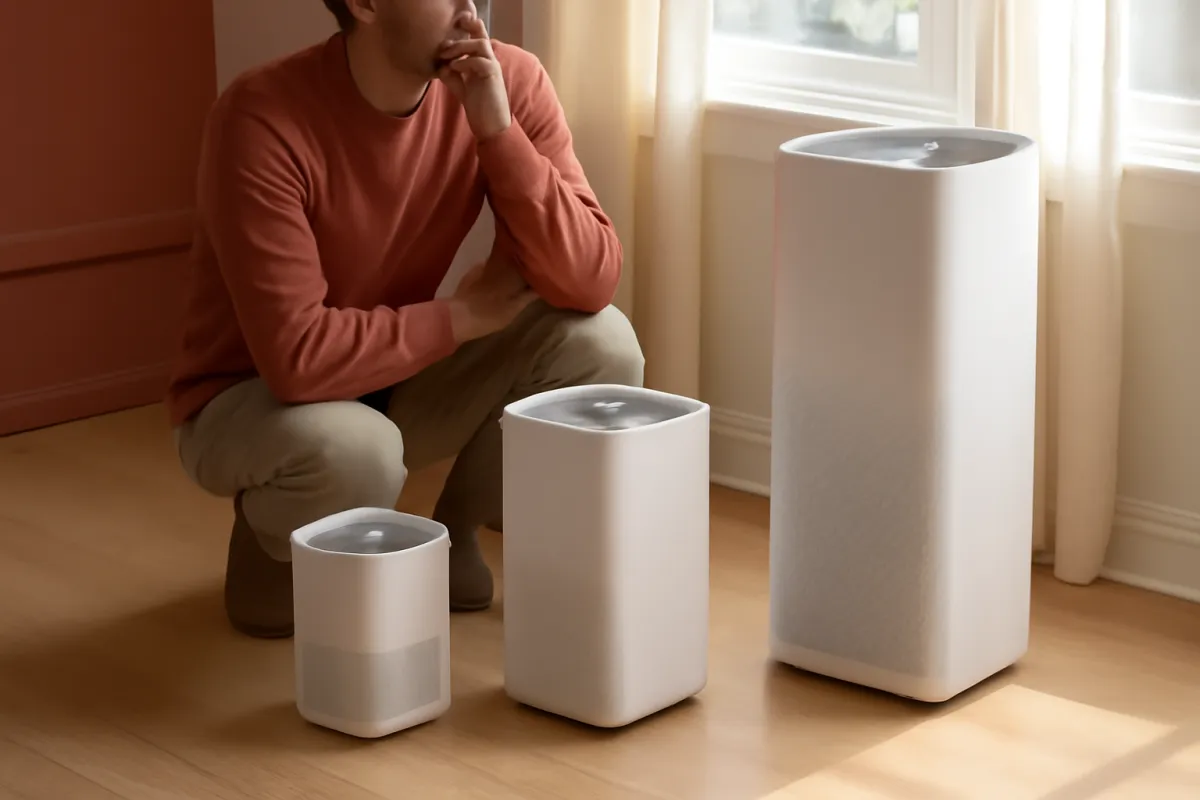
Step back from the six steps and notice that two numbers carry almost the whole decision: the CADR and the filter grade. Everything else, smart sensors, app control, a living-room-friendly shell, changes convenience and appearance, not how well the machine cleans. When you understand which specs move the result and which move the price, you can spend confidently and skip the reassurance features that add cost without adding clean air.
CADR is the honest driver of both performance and price. A higher CADR means a bigger, better fan moving more clean air per minute, which is what lets a unit clean a large room quickly, and more coverage genuinely costs more. Filter grade is the gate: true HEPA does the particle capture, and a real carbon bed does the odor work, while the near-miss labels quietly do less. Get these two right for your measured room and named goal, and the machine will do measurable work.
Auto modes deserve a mention because they are the one convenience feature that pays for itself. A unit with an air-quality sensor ramps the fan up only when the air needs it and idles low the rest of the time, which saves both power and filter life over a machine pinned on one speed. That is a genuine running-cost feature rather than a gimmick. App control, presets, and mood lighting are nice, but they do not change the two specs that decide whether your room gets clean, so weigh them last and pay for them only if the price is small.
How your goal changes the machine
The goal you named at the start quietly reshapes every step, so it is worth seeing the four common cases side by side. For dust and general cleaning, the basic recipe is enough: two-thirds CADR, true HEPA, four to five air changes an hour, and no need for a heavy carbon stage. This is the cheapest case to solve well, and overbuying here is the most common way people waste money.
For allergies or asthma, push the CADR up so you hit five or six air changes an hour, and put the unit where you spend the most continuous time, usually the bedroom. The filter is still true HEPA, but the extra airflow is what takes a real bite out of overnight pollen and dander. Our note on whether air purifiers are worth it covers the allergy case and the evidence behind it in depth.
For wildfire smoke, size up hardest of all, because smoke keeps leaking in and the filter loads fast; buy the higher CADR and keep a spare filter on hand before the season starts. A carbon stage helps with the smell, though the particulate is what matters most to your lungs. For odors and VOCs, invert the usual advice: shop the carbon stage first, measured in pounds, and treat HEPA as the bonus. And remember that ventilation often beats a purifier for cooking gases: an open window or a range hood clears them faster and cheaper than any machine.
A worked example: choosing for a 300 sq ft bedroom
Run the whole method on one realistic case. You want to clean a 300 square foot bedroom for an allergy sufferer, running the unit around the clock, and you want to choose a machine you can defend on numbers.
Step 1 and 2, size and CADR. The room measures 15 by 20 feet, so 300 square feet, with an eight foot ceiling, which is 2,400 cubic feet. The two-thirds rule points to a general-use CADR near 200 CFM. Because this is allergies, you size up, so you shop for a unit rated closer to 240 CFM to buy headroom.
Step 3 and 4, filter and air changes. You confirm the box says true HEPA, and you skip a heavy carbon stage because the goal is airborne allergens, not odors. At 240 CFM in 2,400 cubic feet, the math is 240 times 60 divided by 2,400, which is six air changes an hour, the allergy target. The higher rating also means the fan can hold that on a quieter, lower speed most of the night.
Step 5, running cost. The candidate takes a $40 true HEPA filter once a year plus a $20 carbon pre-filter twice a year, so about $60 a year in filters. At roughly 25 watts around the clock, power is near $30 a year. Call it about $90 a year to run, illustratively, with filters the larger slice. A first-year total near $340 on a $250 unit, which the stackbar above breaks down.
Step 6, traps. No ozone claim, a real HEPA filter rather than HEPA-type, and a room rating that pencils out against the CADR. It survives the screen. Swap your own room, goal, and filter price into the cost-per-use calculator to see your version, and if you are covering more than one room, our guide to how many air purifiers a home needs handles the count.
Common mistakes when choosing an air purifier
Most bad purchases in this category trace to a short list of avoidable errors. Recognizing them is half the method.
- Buying on brand and looks. A recognizable name and a handsome shell carry a premium that has nothing to do with CADR or filter grade. The prettiest unit in the showroom can be the wrong size for your room. Judge the two specs, not the design.
- Undersizing the CADR. The single most common technical error: asking a weak fan to clean a space far beyond its rating. The unit runs flat out, stays loud, and never quite catches up, so the owner concludes purifiers do not work when the real fault was the size.
- Buying an ozone unit or a filterless ionizer. Money spent on a device that either cannot clean effectively or, in the case of ozone, works against your health. The no-filter pitch saves you filters by skipping the results.
- Ignoring the filter cost. Judging a unit by its shelf price and never pricing the replacement filter. A cheap machine with a pricey, short-life filter is the classic false economy, costing more over five years than a dearer unit with a long-life filter.
- Choosing the wrong tool for the pollutant. Buying a HEPA-only unit for an odor problem, or a big carbon unit for allergens. Name the pollutant first, then match particles to HEPA and gases to carbon, and the mismatch disappears.
Troubleshooting: large rooms, multiple rooms, smoke, and pets
A few situations do not fit the simple one-room recipe, so here is how to handle the common edge cases.
What if my room is large or open-plan? Measure the entire connected area as one room and size to that total, not the corner you sit in. Very large open spaces often exceed any single portable unit’s CADR, in which case two well-placed units clean faster and more evenly than one oversized machine straining on high. Vaulted ceilings add air volume, so bump up a size for those too.
What if I want to cover several rooms? A purifier only cleans the room it sits in, so a whole home usually means one unit per main room you spend real time in, typically the bedroom and the main living space to start. Buying one for every room is the usual way people overspend. Our room-by-room purifier count works through the sizing and the combined running cost.
What if I am fighting wildfire smoke? Size up hard for the higher CADR, seal the room as best you can, and expect the filter to load fast, so keep a spare on hand. A carbon stage helps with the smell, but the particulate is the health priority, so prioritize CADR and true HEPA first.
What if I have pets? Dander is light and stays airborne, so a right-sized true-HEPA unit in the room the pet favors makes a real dent. Expect the pre-filter to clog faster in a pet home, so plan on cleaning or replacing it more often to keep the airflow up, and factor that into the yearly filter cost from Step 5.
The air purifier buyer’s checklist
Run any candidate past these seven checks. Clear all seven and the purchase will almost certainly do real work in your room.
- Room measured, square footage in hand. Length times width, whole open-plan area as one, ceiling height noted.
- Goal named. Dust, allergies, smoke, or odor, chosen before you shop so the specs follow the problem.
- CADR meets the two-thirds rule, with headroom. Smoke CADR at least two-thirds of the square footage, higher for allergies or smoke, and sized up rather than down.
- True HEPA stated plainly. The exact phrase on the box, not HEPA-type or 99 percent HEPA. If it hedges, skip it.
- Air-change target set. Four to five changes an hour for general use, five or six for allergies and smoke, delivered by the CADR you chose.
- Filter and power cost multiplied out. Replacement filter price and schedule checked, then multiplied across five years alongside the wattage, using the cost-per-use calculator.
- Traps screened out. No ozone, no filterless ionizer, and a room claim that pencils out against the CADR rather than an inflated square-footage number.
Placement and speed: getting the CADR you paid for
A rated CADR only materializes if the machine can actually move the room’s air, so where you put the unit and how you run it decide whether you receive the airflow you bought. Shoved into a corner, jammed behind a sofa, or tucked under a console, a purifier starves its own intake and short-circuits its output back into the filter, so a capable machine behaves like an undersized one. Give it clear space on the intake and outlet sides, a foot or so of breathing room, and a position with open air across the room rather than a dead pocket, and the rated numbers start to mean something.
Speed is the other half. The reason this walkthrough pushes you to size up is that headroom lets the unit hit your air-change target on a lower, quieter setting instead of running flat out on high, which is what actually happens in practice: a unit pinned on maximum is loud enough that owners turn it down or off, and a purifier switched off cleans nothing. A right-sized machine running steadily on a middle speed beats an undersized one blasting intermittently, both on comfort and on the filter and power costs from Step 5.
The takeaway folds back into the two specs that decide everything. Buy the CADR and the true HEPA filter, then protect that investment with sensible placement and a speed you will leave running, ideally an auto mode that ramps only when the air needs it. The best purifier for your room is the one that gets its rated airflow and stays on, which is a placement and habit decision as much as a purchase.
Do air purifier brands matter?
Ask what air purifier should I buy and you will meet the same handful of names again and again: Levoit, Winix, Coway, Blueair, Shark, and Dyson among them. It is tempting to shortcut the whole decision by picking a brand you trust and buying its most popular model, but the method in these notes works precisely because it ignores the badge. A brand does not have a CADR; a specific model does. A brand does not carry a true HEPA filter; the unit in front of you either states it plainly or does not. Two machines from the same maker can sit in different tiers and suit different rooms, so the label on the front tells you far less than the spec sheet inside.
What a strong brand does buy is consistency and support: filters that stay in stock for years, clear replacement schedules, and a design you are willing to leave in the living room. Those are real conveniences, and they matter for the running cost, since a filter you cannot source is a machine you cannot keep clean. But none of them changes the two specs that decide whether your room gets clean, the CADR and the filter grade. A well-known name attached to an undersized fan is still an undersized fan.
So use the brands as a starting shortlist, not a verdict. Pull two or three popular models across the makers you are considering, then run each one through the six steps: size to your room, check the CADR against the two-thirds rule, confirm true HEPA in plain words, and price the replacement filter across five years. Whichever badge survives that screen for your room is the right one, and it is often not the most advertised. Buy the machine you sized on purpose, not the name you recognized.
The bottom line
Choosing an air purifier well is a sizing decision dressed up as a shopping decision. Measure the room, match the CADR with the two-thirds rule and size up, insist on true HEPA and add carbon only if odors are the goal, set an air-change target for your use, weigh the filter and power cost across five years, and screen out the ozone, filterless, and inflated-room-claim traps. Do those six steps in order and the wall of near-identical white boxes resolves into one machine that fits your room, your problem, and your budget. Illustratively, a mid-range unit for a typical bedroom lands near $90 a year to run and does genuine, measurable work on the particles you actually breathe. The unit that disappoints is the one bought on the label; the one you will be glad you chose is the one you sized on purpose.
A note on scope: these notes are a buying method, not a product recommendation or professional advice. Every airflow figure, dollar amount, filter price, and wattage above is an illustrative planning number drawn from typical ranges, not a measured result for any specific model, and real prices, filter schedules, and electricity rates move faster than any article can track. A purifier is not a treatment for any medical condition, so anyone with allergies, asthma, or a mold concern should speak with a qualified professional about their own situation. Before you buy, measure your own room, pull up the current listing, confirm today’s filter price and schedule, and run the numbers for your space so the machine you choose is one you sized on purpose.
Frequently asked questions
How do I choose an air purifier?
Work in order rather than shopping on brand. First measure the room and find its square footage, then match the unit's CADR to that size using the two-thirds rule, and confirm the box says true HEPA rather than HEPA-type. Set an air-changes-per-hour target for your use, four to five for general cleaning and five or more for allergies or smoke, then weigh the yearly filter and power cost before you buy. Finish by ruling out the traps: ozone generators, filterless ionizers, and units that claim a room size their fan cannot actually clean.
What size air purifier do I need for my room?
Match the unit's rated room size to your actual room, then size up rather than down. In numbers, aim for a smoke CADR in cubic feet per minute equal to roughly two-thirds of the room's square footage for general use, so a 300 square foot room points to about 200 CFM, illustratively. Push higher for allergies or smoke, closer to the full square footage. An undersized unit runs flat out and never quite catches up, so headroom is always the safer error.
What CADR do I need for my room size?
The quick rule is a smoke CADR of about two-thirds of the room's square footage for general cleaning, which gives you roughly four to five air changes an hour in a room with standard eight foot ceilings. So 150 square feet points to about 100 CFM, 300 square feet to about 200 CFM, and 500 square feet to about 333 CFM, all illustrative. For allergies, asthma, or smoke, aim higher, toward the full square footage, so the air is scrubbed faster and kept cleaner.
Is a true HEPA filter necessary?
For real particle removal, yes. True HEPA is a defined standard that traps 99.97 percent of particles at 0.3 microns, which covers dust, pollen, pet dander, mold spores, and fine smoke. HEPA-type, HEPA-like, and 99 percent HEPA are marketing hedges that let far more fine particles slip through, so if the box does not say true HEPA plainly, assume it is not. The filter is where the cleaning happens, so this is the one spec worth being strict about.
How many air changes per hour do I need?
For general cleaning, four to five air changes an hour is the common target, meaning the purifier processes the room's entire air volume four to five times every hour. For allergies, asthma, or wildfire smoke, aim higher, closer to five or six, so airborne particles are pulled out faster than they resettle. More air changes come from a higher CADR, which usually means buying a unit rated for a larger room than yours. That headroom lets the machine run on a lower, quieter speed most of the time.
Do I need a carbon filter in an air purifier?
Only if odors, cooking smells, or VOCs are your actual reason for buying, because a HEPA filter does essentially nothing for gases. Odors and volatile compounds are individual molecules, far too small for HEPA to catch, and only activated carbon adsorbs them. The catch is quantity: meaningful odor control needs a substantial bed of carbon measured in pounds, not the thin sprayed-on sheet budget units include to claim odor filtering. If smells are the goal, shop for the carbon stage first and treat HEPA as the bonus.
Should I avoid ozone air purifiers and ionizers?
Avoid ozone generators outright, and be wary of filterless ionizers. Ozone is a lung irritant that health authorities warn against using in occupied spaces, and a device that brags about producing ozone or activated oxygen is working against you, not for you. Ionizers charge particles so they stick to surfaces instead of trapping them in a filter, so they move far less air and clean far less effectively than a true-HEPA-and-fan unit. The rule of thumb is simple: the filter is where the cleaning happens, so a machine whose whole pitch is that it never needs a filter usually avoids the results too.
Which air purifier brand should I buy?
No single brand wins, because a brand does not have a CADR or a filter grade, a specific model does. Popular names like Levoit, Winix, Coway, Blueair, Shark, and Dyson each span several tiers, from small desktop units to large-room machines, so the honest move is to shortlist a few popular models across the makers you trust and then run each through the same checks: match the CADR to your room with the two-thirds rule, confirm the box says true HEPA in plain words, and price the replacement filter across five years. A recognizable badge buys stock availability and a nicer shell, both worth something, but it does not clean your air. Whichever model survives the sizing and filter screen for your room is your best buy, whatever the name on the front.
What is the biggest mistake when buying an air purifier?
Buying on brand and looks instead of matching the machine to the room and the problem. The two most expensive versions are undersizing the CADR, so a weak fan is asked to clean a space it never can, and ignoring the filter cost, so a cheap unit turns out to carry a pricey, short-life filter that costs more over five years than the machine did. Naming your actual pollutant first, dust, allergens, smoke, or odor, prevents the other common error of buying the wrong tool for the job. Size, filter grade, and running cost decide value far more than the label on the front.