What's on this page
- How many air purifiers do you need? The short answer
- Why it is a per-room question, not a whole-house one
- The CADR-to-room-size math: the two-thirds rule
- Air changes per hour: why four to five is the target
- Recommended CADR by room size
- One big unit or several small ones?
- Which rooms actually need a purifier
- The bedroom-first argument
- Open floor plans need more capacity
- Whole-house filtration through your HVAC
- Sizing up for allergies, smoke, and pets
- The running-cost multiplier of several units
- Where to place your purifiers
- Placement matters as much as count
- Noise and the always-on reality
- The over-buying trap
- A worked example: one 1,300 sq ft home
- How to decide: a sizing checklist
- The bottom line
Short answer: You need one air purifier for each main room where you spend meaningful time, which for most homes means two to start: the bedroom and the main living space. Add a third only for a specific room with a specific problem, such as a home office, nursery, or a pet's room. A purifier cleans only the room it sits in, so size each by CADR at roughly two-thirds of the room's square footage.
The most common question about air purifiers is phrased as a whole-house problem: how many do I need for my home, or for my 1,300 square feet? The honest answer reframes it. A purifier is a room device, not a house device, so the real question is how many rooms you actually need to clean, and how big each of those rooms is. Answer that and the count falls out almost by itself.
For most homes, the answer is one purifier per main room you spend time in, usually two units to start: the bedroom and the main living space. This breakdown explains why it is a per-room question, gives you the CADR-to-room-size math to size each unit, and walks through a worked example for a 1,300 square foot home. You can run your own room sizes through our cost-per-use calculator as you read.
Key takeaways
- Count rooms, not the whole house. A purifier cleans the room it sits in, so the answer is one unit per main room you actually use, not one unit for your total square footage.
- Most homes start with two: the bedroom and the main living space. Add a third for an office, nursery, or a pet's room if that is where the problem lives.
- Size each unit by CADR, aiming for roughly two-thirds of the room's square footage as an illustrative rule, which gives about four to five air changes an hour.
- One big unit suits one open space; several right-sized units suit a home of separate closed rooms. Match the count to the floor plan, not a formula.
- Running cost multiplies with the count. Two or three units mean two or three sets of filters and power, so buy only for the rooms that genuinely earn one.
How many air purifiers do you need? The short answer
Plan on one purifier for each main room where you spend meaningful time, which for most homes means two to start. The bedroom is the first unit, because you breathe its air for hours with the door closed. The main living space is the second, because it is the room the household shares and where you spend most waking hours at home. Beyond those two, add a unit only for a specific room with a specific problem: a home office you sit in all day, a nursery, or the room where a pet lives.
Notice what this answer does not do: it does not divide your home’s total square footage by some coverage number and hand you a count. That approach fails because a purifier cannot clean air it never touches. The unit in your living room does almost nothing for the closed bedroom down the hall. So the count comes from rooms that matter, each sized on its own, not from the house as a whole.
The rest of this article turns that principle into a method: how to size each room’s unit, how to decide between one big purifier and several small ones, and what the whole set costs to run once it is humming.
Why it is a per-room question, not a whole-house one
A purifier is simple: a fan pulls in room air, pushes it through a filter, and sends the cleaned air back out. The catch is that it can only work on the air that reaches it. It relies on the room’s own circulation to bring dirty air to the intake, and that circulation stops at walls and slows dramatically through doorways. Clean air does not march down a hallway and turn into a bedroom on its own.
That is the whole reason “how many for my house” is the wrong frame. The house is not one body of air; it is a set of rooms, each with its own air that mixes only weakly with the rest. A single powerful unit in the living room will keep the living room clean and leave the bedrooms, behind their doors, essentially untouched. You are not cleaning a house. You are cleaning a room, and then another room, and the count is however many rooms you decide are worth cleaning.
This is also why the marketing claim of a purifier that “covers 1,500 square feet” deserves a careful read. That figure assumes one open space of that size with good circulation, not 1,500 square feet chopped into five closed rooms. In a divided home, that same unit covers only the room it is standing in. Judge coverage by the room, and the per-room logic takes care of the rest.
The CADR-to-room-size math: the two-thirds rule
To size the unit for a given room, you need one spec: CADR, the Clean Air Delivery Rate, which describes how much clean air the whole machine actually delivers per minute in cubic feet. It combines the filter and the fan, so it predicts real-world results in a way that a filter grade alone cannot. Higher CADR means faster cleaning of a larger room. We unpack the spec more fully in our breakdown on air-purifier cost-per-use.
The widely cited rule of thumb ties CADR to room area: aim for a CADR, in CFM, of roughly two-thirds the room’s floor area in square feet. A 300 square foot room points to a CADR near 200. A 150 square foot bedroom points to a CADR near 100. A 500 square foot great room points to a CADR near 335. Treat these as illustrative starting targets, then round up to the next real unit on the shelf rather than down.
The two-thirds figure is not arbitrary. It works backward from air changes per hour, the target we cover next, for a room with standard ceilings. Rooms with high or vaulted ceilings hold more air per square foot, so nudge the target up. When you feed a room’s square footage into our cost-per-use calculator, it does this arithmetic for you and shows the CADR to aim for.
Air changes per hour: why four to five is the target
Behind the two-thirds rule sits the number that actually matters for clean air: air changes per hour, or ACH. It counts how many times the machine cleans a volume equal to the whole room’s air in one hour. Four to five air changes an hour is the general-purpose target, which means the purifier processes the room’s full air volume every 12 to 15 minutes. That pace keeps particle levels low even as new dust, pollen, and dander drift back into the air.
Why not just clean the air once and stop? Because fine particles do not stay caught in a single pass. They settle out of the air, get stirred back up when you move, and blow in from outside every time a door opens. A purifier that turns the air over once an hour is always a step behind. One that turns it over four or five times holds a steady, low particle level, which is what you actually feel as clean air.
The link between ACH and CADR is just room volume. To hit four to five changes an hour in a standard-height room, you need a CADR near two-thirds of the floor area, which is where the rule of thumb comes from. Want more changes, say for allergies or smoke, and you need a proportionally higher CADR for the same room. That is the lever you pull when general-purpose cleaning is not enough, and it is why the need level, not just the room size, shapes the unit you buy.
Recommended CADR by room size
Here is the two-thirds rule drawn out across common room sizes, from a small bedroom to a large open living area. These are illustrative CADR targets for general use in standard-height rooms; bump them up for allergies, smoke, or pets.
Recommended CADR by room size
Illustrative CADR target at roughly two-thirds of floor area, for general use. Bars scale with the CADR figure.
The CADR you need scales with the room, not the house. A small bedroom needs a fifth of what a large open-plan space does, which is why one unit rarely fits every room.
Read the chart as a menu, not a ladder you climb. You do not need the 535 CFM unit unless you have an 800 square foot room to put it in. Most homes buy from the lower and middle of this range, one modest unit for the bedroom and one larger unit for the living area, because that is where the used rooms actually sit. Match each unit to its room’s line on this chart and you avoid both under-buying and over-buying.
One big unit or several small ones?
Once you know each room’s target, a real choice appears: cover a large area with one powerful unit, or split it across several smaller ones. The right answer depends entirely on whether that area is one space or several.
For a single large open space, one high-CADR unit almost always wins. It is cheaper to buy than two mid-size units of the same combined CADR, it draws less power and needs fewer filters, and it runs quieter for the same cleaning because a bigger fan moves more air at a lower speed. Splitting an open room into two purifiers just doubles your filters for no gain.
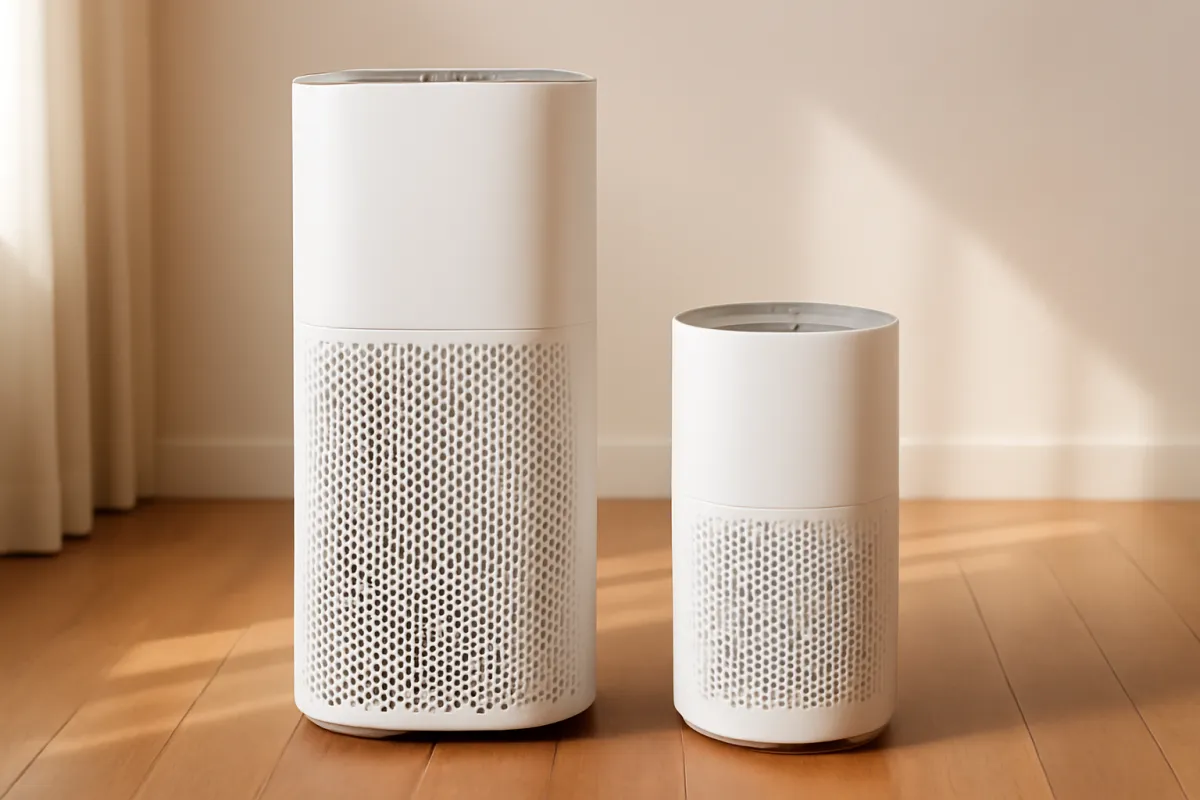
For a home of separate closed rooms, the logic flips. One big unit cannot push clean air through a wall, so its power is wasted on the room it stands in while the others stay dirty. Here, several right-sized units beat one large one, because coverage is limited by walls, not by fan power. The rule that resolves it: one unit per distinct room, sized up when that room is large or open-plan. You are not choosing big versus small in the abstract; you are matching the unit to the shape of the space.
Which rooms actually need a purifier
Not every room earns a purifier, and knowing which do keeps you from buying four when two would do. A room qualifies when two things are true at once: you spend meaningful hours in it, and its air has a problem worth solving. Fail either test and the unit is running cost with no payoff.
The bedroom comes first. You spend roughly a third of your day there with the door closed, breathing the same air for hours. That concentration of time makes it the highest-value room for anyone with allergies, asthma, or dust sensitivity. It is the one room almost every home should cover.
The main living space comes second. It is the largest shared room and where the household spends most of its waking hours at home, so it is worth a unit sized to its area. This is where the bigger, higher-CADR purifiers justify their price.
A home office or nursery can be third. If you sit at a desk eight hours a day, or a baby sleeps in a dedicated room, that room passes both tests and deserves its own unit. Beyond these, most rooms do not. A guest room used twice a year, a hallway, a room you pass through but never sit in: these are where people over-buy. Move a unit to where the time and the problem actually are.
The bedroom-first argument
If your budget or patience stretches to only one purifier, put it in the bedroom, and the reasoning is worth spelling out because it is the strongest single case in the category. Sleep is the longest continuous block you spend in one room, typically seven to nine hours, and you spend it with the door closed and your breathing slow and deep. Whatever is in that air, you are taking in a lot of it, for a long time, every night.
Filtering the bedroom air overnight lowers the pollen, dust, and dander load through exactly the hours it matters most. Many allergy sufferers notice easier mornings within a few days of running a unit by the bed, because they are no longer waking up after eight hours of breathing unfiltered air. No other room offers that combination of long, uninterrupted exposure and a closed door that lets a modest unit actually keep up.
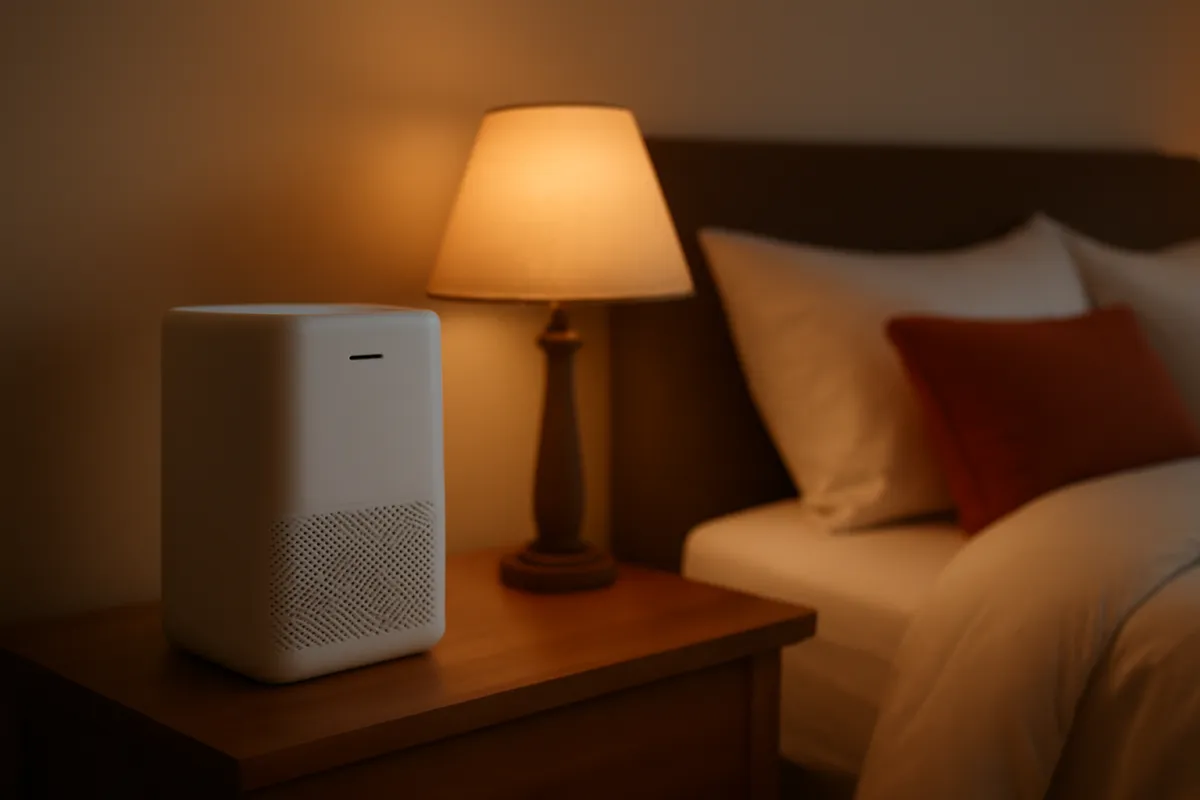
The practical upside is that the bedroom is usually a small room, so it needs only a modest CADR, often near 100 CFM for a standard bedroom. That means the highest-value unit in the house is also one of the cheapest to buy and run. Start there, add the living space as the second unit, and you have covered the two rooms that matter for a fraction of what a whole-house approach would cost.
Open floor plans need more capacity
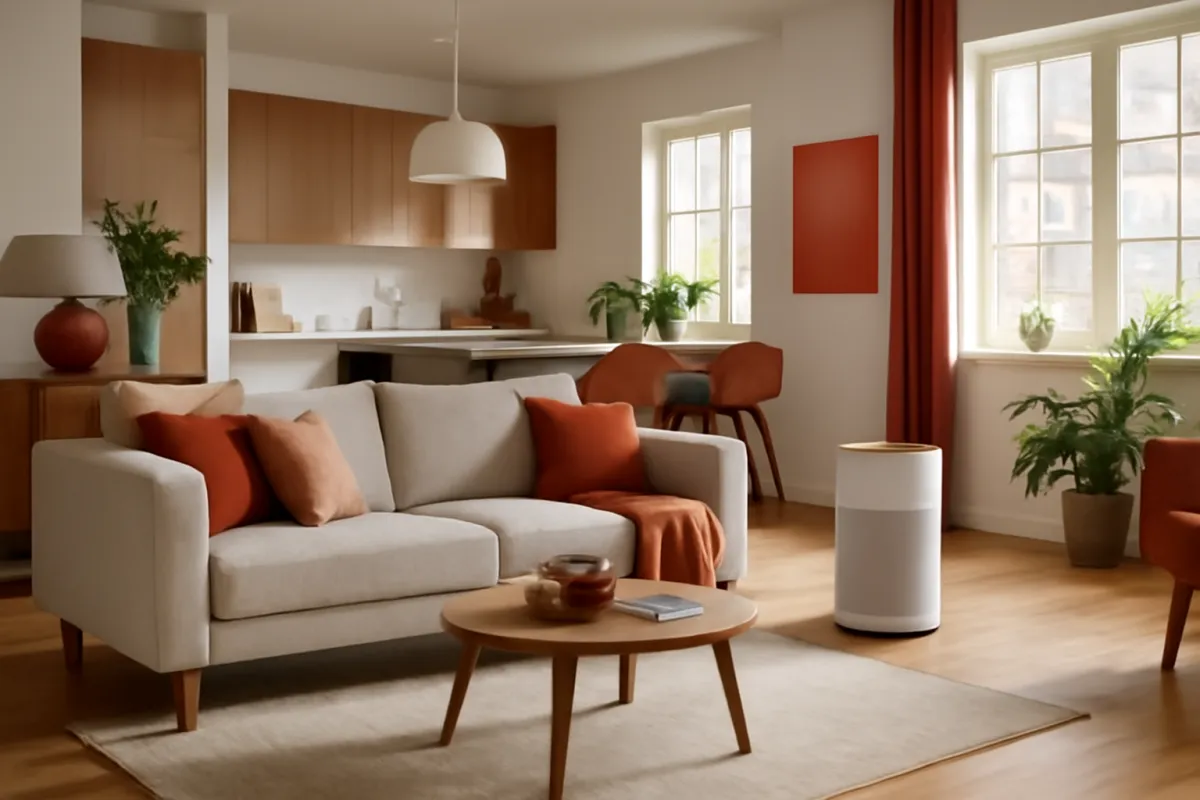
Open-plan homes flip one part of the per-room logic. When the living room, dining area, and kitchen flow together as a single connected space with no doors between them, they behave as one large room for air purposes, so they need one unit sized for the combined area, not three small ones scattered around.
The catch is that the combined area is big, often 500 to 800 square feet or more, so it calls for a high-CADR unit, the kind at the top of the chart above. A modest purifier that would keep a closed bedroom pristine is simply outmatched in an open great room, running flat out and never catching up. This is the scenario where the premium, large-room units earn their price: they exist precisely for the open floor plan.
One extra wrinkle in open plans: the kitchen is usually part of the space, and cooking throws off both fine particles and odors. A HEPA-only unit handles the particles but does little for the smell, which is a gas, so if odors bother you, look for a unit with a substantial carbon stage. Ventilation, an open window or a range hood, still does more for kitchen odor than any purifier. Size the open plan generously and place the unit toward the living end where people sit.
Whole-house filtration through your HVAC
There is one genuine way to clean a whole home’s air with a single system, and it is not a standalone purifier: it is filtration built into your central heating and cooling. Because HVAC ducting already moves air to every room, a high-efficiency filter in the return, or a dedicated media cabinet or in-duct unit, can filter air throughout the house whenever the system’s fan runs.
The tradeoffs are real. A standard one-inch furnace filter slot can only take so restrictive a filter before it chokes airflow and strains the blower, so a true high-efficiency setup often means a professionally installed deeper media cabinet. Filtration only happens when the fan is running, so you may need to run the fan more, and the system was designed for temperature, not primarily for air cleaning. It is a bigger, costlier commitment than plugging in a couple of room units, and it is best sized and installed by an HVAC professional.
For most households, the standalone per-room approach is simpler, cheaper, and more targeted: you clean the two or three rooms that matter and skip the rest. Whole-house HVAC filtration makes the most sense when you want a baseline level of filtration everywhere, have the ducted system and the fan-runtime to support it, and are willing to treat it as part of your home’s mechanical infrastructure rather than an appliance.
Sizing up for allergies, smoke, and pets
The two-thirds rule is a general-purpose baseline. When the air has a specific, heavy load, you want it scrubbed faster and kept cleaner, which means bumping the CADR target up for the same room, effectively buying more air changes per hour.
Allergies and asthma. Aim higher, closer to five or six air changes an hour rather than four, because the goal is to keep the airborne pollen and dust load consistently low, not merely to turn the air over once. In practice that means choosing a unit rated a size above the room, so it can hold a low level on a moderate speed.
Smoke. Wildfire and seasonal smoke is fine particulate, right in a HEPA filter’s wheelhouse, but it arrives in high concentrations, so you want a high CADR to clear it quickly and hold it down. During smoke events, a unit sized generously for the room can keep indoor air markedly cleaner than outdoor air. Expect the filter to load up fast and plan on an earlier replacement.
Pets. Dander is light and stays aloft, exactly what a purifier is good at, but a pet in the room means a steady source, so size up and expect the pre-filter to clog faster with hair. For any of these three cases, treat the two-thirds figure as a floor, not a target, and step up to the next unit. The calculator lets you set a need level so the recommended CADR reflects allergies or smoke rather than general use.
The running-cost multiplier of several units
Here is the part that whole-house thinking hides: every purifier you add is another machine to feed. Each one has its own filters to replace and its own watts to draw, so the running cost scales with the count, not with the single most expensive unit. Two units mean two filter budgets and two power draws; three units mean three.
The individual numbers are modest, which is what makes the multiplier easy to miss. A mid-range unit runs roughly $90 a year all in, filters and electricity together, as we break down in the air-purifier cost-per-use breakdown. That is genuinely cheap for one machine. But run three of them and you are near $270 a year, every year, which is a different conversation. This is the same running-cost discipline we apply to power-hungry gear in our breakdown on sizing and running a dehumidifier: the sticker price is the small, one-time number, and the recurring cost is what compounds.
The lesson is not to skimp on rooms that need a unit. It is to be honest about which rooms actually qualify, because each unnecessary unit adds a full year’s running cost for no benefit. Cover the bedroom and the living space, add an office or nursery if the case is real, and stop. Feed your unit count and hours into our cost-per-use calculator to see the combined annual figure before you buy the second or third machine.
Where to place your purifiers
Assuming a typical home ends up with a handful of units, where they go follows the same priority order as the count itself: the rooms with the most hours and the worst air come first. The rough split below shows where the value concentrates across a household’s purifiers.
Where to place your purifiers
Illustrative share of a household's total purifier value, by room. Sums to 100 percent.
Three-quarters of the value sits in the bedroom and the main living space, which is why two units cover most homes. Everything past those two is a smaller, situational add.
The chart makes the buying order concrete. If you buy one unit, it goes in the bedroom. Two units, add the living space. A third goes to the office or nursery only if you truly spend hours there. The long tail of “other rooms” is where over-buying lives, and it is worth only a sliver because those rooms rarely combine the hours and the problem that justify a machine.
Placement matters as much as count
Buying the right number of units is only half the job; where each unit sits inside its room decides whether it performs. A correctly sized purifier shoved into a tight corner or hidden behind a sofa cleans far less than the same unit given room to breathe, because it starves for the room air it is supposed to circulate.
Give each unit clear space around its intake and outlet so air can flow into it and away from it without immediately hitting furniture or a wall. Placing it somewhere with natural air movement, near a doorway the household uses, or in the path between where people are and where air enters the room, helps it draw in more of the room’s air rather than recirculating the same clean pocket. Keep it off the floor’s dead corners and out of deep alcoves where air stagnates.
Height and obstruction matter too. A unit tucked under a desk with its intake against a drawer front is fighting itself. In the bedroom, a spot near the bed but with clearance on the intake side lets it work on the air you are actually breathing. None of this is fussy: give the machine open space and a bit of airflow, and it delivers its rated CADR instead of a fraction of it. A well-placed smaller unit often beats a poorly placed larger one.
Noise and the always-on reality
A purifier only works if it runs, and it works best if it runs almost continuously, because fine particles resettle constantly. That means whatever unit you put in a room, you are going to live with its sound for most of the day and, in the bedroom, all night. Noise is therefore a real part of the sizing decision, not an afterthought.
This is a quiet argument for sizing up rather than down. A unit rated well above its room can hold a clean level on a low, quiet speed, while a unit sized right at its limit has to run on high to keep up, which is louder and wears the filter faster. In the bedroom especially, a slightly larger unit run on low is the difference between a soft background hush you sleep through and a fan you notice at 2 a.m. Many people find a low, steady sound easier to sleep with than silence, but that only holds if the unit is not straining.
The always-on reality also feeds back into the count. Because each unit runs most of the time, each one is a continuous, if small, presence: a low hum, a bit of power draw, a filter counting down. That is fine for the two or three rooms that earn a purifier. It is one more reason not to scatter units into rooms that do not, where a machine would run around the clock cleaning air nobody is breathing.
The over-buying trap
The single most common mistake in this category is not buying too small a unit; it is buying too many units. The whole-house framing invites it: if one purifier is good, surely one in every room is better. But a purifier in a room you do not use is pure running cost, a filter and a power draw with no one there to benefit.
The trap has a few reliable forms. Buying a unit for every bedroom in the house when only one is slept in nightly. Putting a purifier in the hallway, which is not a room anyone lingers in. Adding a third and fourth unit out of a vague sense that more coverage must help, when the first two already cover where you live. Each of these adds a full year’s running cost, every year, for air that changes nothing you would ever notice.
The discipline that avoids it is the two-part test from earlier: real hours, and a real problem. Run every candidate room through it. The bedroom passes. The main living space passes. An office you sit in all day passes. The guest room, the hallway, the rarely used formal dining room, they fail, and a unit there is money spent on a quiet hum. Buying fewer, better-placed units almost always beats buying more, which is the opposite of what the whole-house question nudges you toward.
A worked example: one 1,300 sq ft home
Put the method to work on a real question people actually search: how many purifiers for a 1,300 square foot home? The wrong move is to size one unit for all 1,300 square feet. No single room is that big, and one purifier cannot reach every room, so that number is a distraction. Instead, count the rooms that matter.
Count the rooms. Say this 1,300 square foot home has a primary bedroom around 180 square feet, an open living-and-kitchen area around 380 square feet, a home office around 120 square feet, plus a spare bedroom and bathrooms nobody sits in for long. Apply the two-part test and three rooms qualify: the bedroom, the living area, and the office. So the answer is two units to start, adding a third for the office if it sees daily use, not one unit for the whole footprint.
Size each unit. By the two-thirds rule, the 180 square foot bedroom points to a CADR near 120 CFM, the 380 square foot open living area near 250 CFM, and the 120 square foot office near 80 CFM. Round each up to the next real unit. The living area is open-plan, so if the kitchen is fully part of it, size that unit generously and consider a carbon stage for cooking odors.
Tally the running cost. Two units at roughly $90 a year each is about $180 a year all in; a third for the office pushes it near $270. That is the honest combined figure, and it is the number the whole-house framing hides. For a 1,300 square foot home, then: two purifiers cover the essentials, a third is situational, and the count came from rooms, not square footage. Run your own room sizes and unit count through our cost-per-use calculator to see your version of these figures.
How to decide: a sizing checklist
Before you buy anything, run your home through these five steps. Clear them and you will land on the right count, sized correctly, without over-buying.
- List the rooms that pass the two-part test. Real hours plus a real air problem. Usually the bedroom and the main living space, sometimes an office or nursery. That list is your unit count.
- Size each room by the two-thirds rule. Take the room’s square footage, aim for a CADR near two-thirds of it, and bump it up for allergies, smoke, or pets. Size up to the next real unit, not down.
- Treat open-plan areas as one room. If living, dining, and kitchen flow together, buy one high-CADR unit for the combined area rather than several small ones.
- Add up the running cost before the last unit. Each purifier is roughly $90 a year all in. Multiply by your count so the third unit is a decision, not a surprise.
- Place each unit with clearance and airflow. A well-placed smaller unit beats a cornered larger one. Give the intake and outlet open space in the room it serves.
Clear those five and the decision is made on rooms and numbers rather than a vague whole-house worry, which is the entire point of a breakdown.
The bottom line
How many air purifiers do you need? As many as you have rooms worth cleaning, which for most homes is two: the bedroom and the main living space, each sized on its own by CADR. Stop treating it as a whole-house problem, because a purifier only cleans the room it sits in, and start treating it as a per-room one. Size each unit to roughly two-thirds of its room’s square footage for general use, more for allergies or smoke, and round up rather than down. Use one big unit for one open space and several right-sized units for a home of separate rooms. Above all, resist the over-buying trap: each extra machine is a full year’s running cost, so buy for the rooms that genuinely earn one and skip the rest. Count rooms, size by CADR, place with care, and the honest answer is almost always fewer units than the whole-house question implies.
A note on scope: this breakdown is written to teach the room-by-room method and the sizing arithmetic, not to steer you toward any particular machine. Every CADR target, square-foot figure, and dollar amount above is an illustrative planning number drawn from common rules of thumb and typical ranges, not a measured result for any specific model, and real room shapes, ceiling heights, filter prices, and electricity rates will move your result. None of this is professional advice on indoor air quality or health. If someone in the home has a diagnosed respiratory condition, or you suspect mold or another air-quality hazard, consult a qualified specialist, and confirm any unit’s current CADR, filter schedule, and running cost against the maker’s own figures before it goes in your cart.
Frequently asked questions
How many air purifiers do I need for my house?
Think of it as one purifier for each main room where you spend real time, not one unit for the whole house. Most homes are well covered by two: one in the primary bedroom and one in the main living space, each sized by CADR to that room. Add a third for a home office, nursery, or a pet's room if that is where the problem lives. A purifier only cleans the room it is in, so counting rooms, not square footage of the whole home, is the honest way to answer the question.
Can one air purifier cover a whole house?
In almost all cases, no. A standalone purifier cleans the air in the room it sits in, and its effect drops off sharply through doorways and around corners because it relies on the room's own air circulation. One large unit can cover an open-plan living and kitchen area that behaves as a single room, but it will do little for a closed bedroom down a hall. The only true whole-house option is filtration built into your HVAC system, which is a different approach we cover below.
How many air purifiers do I need for 1,300 square feet?
Do not size one purifier for all 1,300 square feet, because no single room is that big. Instead count the rooms in that 1,300 that matter: often a bedroom around 150 to 200 square feet and a living space around 300 to 400, which points to two units. Size the bedroom unit for a CADR near 130 CFM and the living-room unit near 250 CFM as illustrative targets. A large open-plan home might need a bigger living-area unit or two, but the count still comes from rooms, not the total.
Do I need an air purifier in every room?
No, and buying one for every room is the most common way people overspend in this category. A purifier earns its keep only where two things are true: you spend meaningful hours in the room, and the air there has a problem worth solving. That usually means the bedroom and the main living area, sometimes an office. Guest rooms, hallways, and rooms you rarely enter are running cost with no benefit, so move a unit to where the people and the problem actually are instead.
Is it better to have one big air purifier or several small ones?
It depends on your floor plan. For a single large open space, one high-CADR unit is usually cheaper to buy and run than several small ones, and it is quieter for the same cleaning power. For a home with several separate closed rooms, several right-sized units beat one big one, because the big unit cannot push clean air through walls. Match the tool to the layout: one unit per distinct room, sized up when that room is large or open-plan.
Which room should I put an air purifier in first?
The bedroom, in most cases. You spend roughly a third of your day there with the door closed, breathing the same air for hours, which makes it the single highest-value room for allergy and dust sufferers. Filtering that air overnight lowers the pollen and dust load through the hours it matters most. If your budget stretches to only one unit, put it in the bedroom, then add the main living space as the second priority.
Does a bigger house need more air purifiers?
Usually yes, but through room count rather than raw area. A bigger house tends to have more separate rooms where people spend time, and since each purifier only cleans its own room, more such rooms means more units. It also tends to have larger individual rooms, which need higher-CADR units. So both levers, more rooms and bigger rooms, push the answer up. The running cost climbs with the count, which is why matching units to genuinely used rooms matters more in a large home, not less.
How do I size an air purifier to a room?
Start from the room's floor area and aim for a CADR roughly two-thirds of that number in square feet, as a widely cited rule of thumb. A 300 square foot room points to a CADR near 200 CFM, which gives you about four to five air changes an hour in a standard-height room. Bump the target higher for allergies, smoke, or pets, since you want the air scrubbed faster and kept cleaner. Then size up rather than down, because a unit working within its rating runs quieter and lasts longer.