What's on this page
- How much does an air purifier cost? The short answer
- Air Purifier Price by Room Size
- What a genuinely good purifier costs
- Replacement filter cost: the line most buyers forget
- What it costs to run an air purifier per month
- The electricity a purifier draws
- Whole house air purifier cost vs portable units per room
- What drives an air purifier’s price
- Cheap vs Expensive Air Purifiers: What the Extra Money Buys
- Five-Year Total Cost of Ownership
- Air purifier cost by room size and runtime: the five-year table
- Where an air purifier’s cost goes
- Ways to cut the cost of an air purifier
- A worked example: one mid-size purifier over five years
- What a whole home of purifiers costs
- When a cheaper unit costs more: two five-year comparisons
- Reading a purifier’s price tag before you pay it
- The bottom line
Short answer: Air purifier cost runs roughly $60 to $130 for a small room, $130 to $220 for a bedroom, $180 to $330 for a living room, and $400 to $700 for a whole floor, with a whole house air purifier built into the ductwork at $400 to $3,000 installed, all illustrative ranges. Then add about $38 to $105 a year in replacement filters and $11 to $56 in electricity at $0.16 per kilowatt-hour. Over five years those running costs usually exceed the purchase price, with totals near $340 to $1,355.
How much does an air purifier cost is a question with two answers, and the one printed on the box is the smaller of them. Upfront, a HEPA unit runs about $60 to $130 for a small room, $130 to $220 for a bedroom, $180 to $330 for a living room, and $400 to $700 for a machine sized to a whole floor, all illustrative ranges rather than any model’s quoted price. The second answer is the one that surprises people: filters and electricity, which across five years usually add up to more than the machine did.
This breakdown takes the whole number apart. It prices the machine by room size, then prices the two costs that never stop, then puts both into a five-year total you can compare between models. Along the way it covers what the extra money buys in a premium unit, what a duct-mounted whole-house system costs against a shelf full of portables, and the trap that makes a cheap purifier the expensive one. For the separate question of whether the spend is justified at all, see our companion coverage on whether air purifiers are worth it. You can run your own numbers in about a minute with our cost-per-use calculator.
Key takeaways
- Upfront price tracks room size: roughly $60 to $130 for a small room, $130 to $220 for a bedroom, $180 to $330 for a living room, and $400 to $700 for a whole floor, all illustrative.
- The purchase price is the small number. Over five years, filters plus electricity usually cost more than the machine, so compare five-year totals rather than shelf tags.
- Replacement filters are the line buyers miss: about $38 a year for a small-room unit, $60 for a living-room machine, and $105 for a whole-floor one, every year you own it.
- Electricity is the smallest cost. At an illustrative $0.16 per kilowatt-hour, a purifier run around the clock costs roughly $11 to $56 a year because it draws only 10 to 50 watts.
- Five-year totals land near $340 for a small-room unit, $535 for a bedroom, $725 for a living room, and $1,355 for a whole floor, which is $0.19 to $0.74 a day.
How much does an air purifier cost? The short answer
How much does an air purifier cost depends on room size upfront and on filters plus power over time. Expect roughly $60 to $130 for a small-room unit, $130 to $220 for a bedroom model, $180 to $330 for a living-room machine, and $400 to $700 for one sized to a whole floor, all illustrative. Then add about $38 to $105 a year in filters and $11 to $56 in electricity, which across five years typically exceeds what the machine cost.
The honest answer needs both halves because an air purifier is one of the rare appliances where the sticker is the cheap part. A bread maker costs what it costs and then sits in a cupboard. A purifier runs almost constantly, which is exactly why its running costs stack up. The machine sips only a little power, but it eats filters on a schedule, and those consumables never stop arriving. Get the upfront tier right and the running math honest, and you know the real number before you plug anything in.
Every figure in this breakdown is an illustrative planning number, and every one of them is built from the same three inputs: a purchase price, a filter bill, and an electricity rate held at $0.16 per kilowatt-hour so the arithmetic matches the rest of the bench. Swap your own rate in wherever you like. The method survives the substitution even when the totals move.
Air Purifier Price by Room Size
Upfront prices sort into four tiers, and each maps to a room rather than to a feature list. These are typical ranges, not any single model’s price, and the middle column is the figure this breakdown carries through every later calculation.
| Room it suits | Illustrative price range | Figure used here | Typical average draw |
|---|---|---|---|
| Small room or desk, under 200 sq ft | $60 to $130 | $95 | About 8 watts |
| Bedroom, 200 to 300 sq ft | $130 to $220 | $175 | About 16 watts |
| Living room, 300 to 500 sq ft | $180 to $330 | $250 | About 25 watts |
| Whole floor or open plan, 500+ sq ft | $400 to $700 | $550 | About 40 watts |
| Whole-house HVAC, the entire home | $400 to $3,000 installed | Varies by home | Runs with the air handler |
The jump between tiers buys three things: a bigger, quieter fan that moves more air, a larger filter that lasts longer between changes, and a more substantial carbon stage for odours. It does not buy a better class of HEPA filtration. A $95 machine and a $550 machine can both use true HEPA media, and our companion piece on HEPA filters covers what that grade of filter does and does not capture. The expensive one simply clears a larger room faster and needs servicing less often.
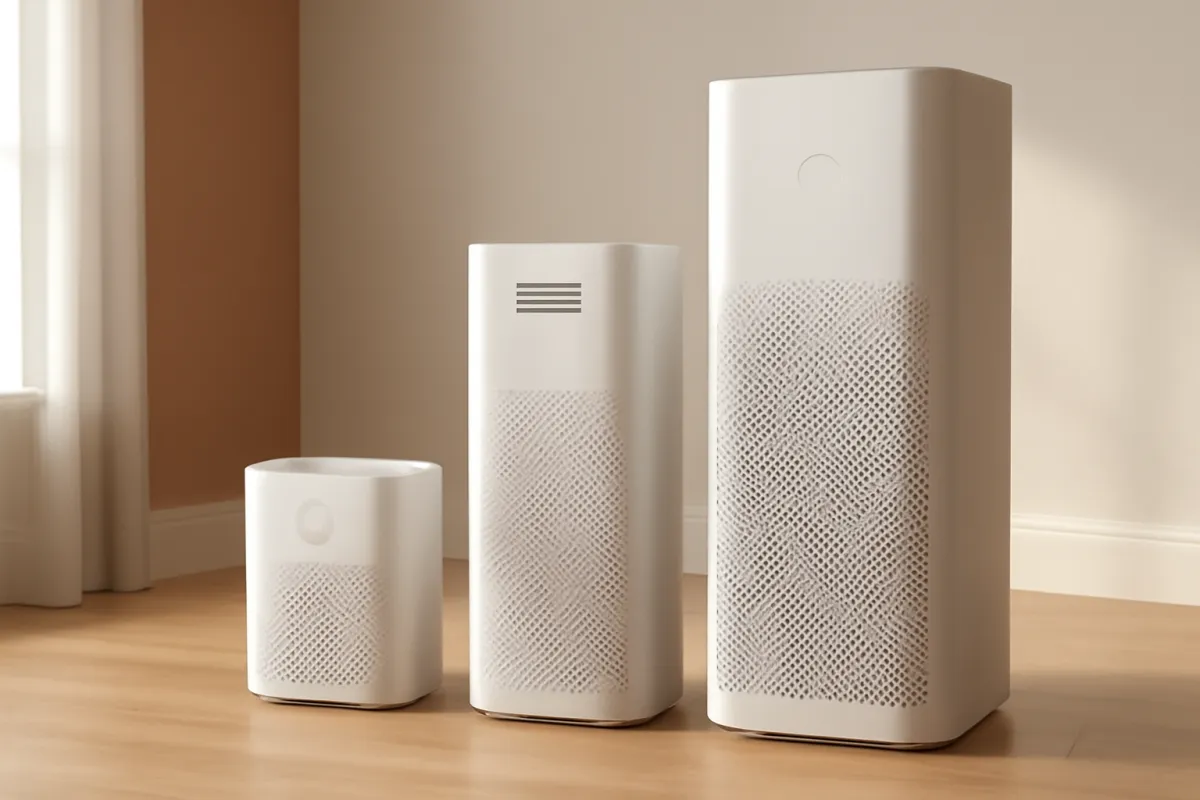
This is the first place buyers get the number wrong in both directions. Overpay, and you have bought throughput for a room you do not have, along with the larger filter bill that comes with it every year. Underpay, and the fan is too weak for the space, so you own a purifier that technically runs and practically does very little while still costing you filters. Sizing is the single decision that fixes both errors at once, and our sizing walkthrough on how many air purifiers a home needs takes it room by room.
Notice the last row behaves differently from the four above it. A duct-mounted whole-house system is not a bigger portable; it prices per house instead of per room, and its cost is dominated by installation labour rather than by the machine. That is why it sits outside the per-room tiers in every table in this report and gets its own section further down.
What a genuinely good purifier costs
A genuinely good air purifier for a main room usually lands in the living-room band, roughly $180 to $330 illustratively, and near $250 is the working figure here. You do not need to spend more than that for most homes. That money buys the three things that actually matter: a true HEPA filter stated plainly on the box, a fan whose rated clean air delivery suits the room, and a filter with a schedule closer to a year than a quarter.
What separates good from expensive is coverage, not cleanliness. The premium tier adds higher rated airflow for larger rooms and a substantial carbon stage for odours, both genuine features if you need them and dead weight if you do not. A true HEPA filter is a true HEPA filter whether it sits in a $200 machine or a $600 one. The good-value unit is the one sized right for your room, with a filter you can afford to replace on schedule, rather than the most expensive model on the shelf.
There is a floor below which cheap stops being good. Units that swap true HEPA for HEPA-type media, or lean on an ioniser instead of a real filter and a real fan, save you money by doing less work. A good purifier at any price has a real filter and enough fan to move the room’s air. Below that line, a low price buys a quiet hum and a filter bill anyway. The step-by-step checks in our companion piece on how to choose an air purifier separate the two cases before you pay.
Replacement filter cost: the line most buyers forget
Here is the number that turns a cheap purifier into an expensive one. Filters are consumable, and across the life of a machine they usually cost more than the machine did. This is the single most underestimated line in the category, and it is underestimated for a structural reason: it arrives as a lump sum once or twice a year, so it never registers as a running cost the way a monthly bill does.
The method for pricing them is the same one we use for any consumable. Find the price of the part, find how often it is due, and multiply across the years you will own the machine. A true HEPA filter typically lasts 6 to 12 months and costs $25 to $80 to replace. Many units also carry a carbon pre-filter on a shorter schedule, roughly every 3 months, at $10 to $30 a time. Two filters on two schedules is the normal case, not the exception, and both belong in the total.
Add the lines together and a living-room unit runs about $60 a year in filters on a typical schedule, every year, for as long as you own it, illustratively. A small-room unit with a modest cartridge sits lower, near $38 a year. A bedroom unit lands around $50. A whole-floor machine with a large filter and a real carbon stage runs higher, near $105 a year, especially where the carbon stage is replaced separately from the HEPA media.
Two traps hide behind those numbers. The first is the proprietary cartridge: some brands price the machine low and the filter high, knowing you are locked in once you own the unit. That is the razor-and-blades pattern applied to air. The second is skipping changes to save money, which restricts airflow, makes the fan work harder for less clean air, and turns a good purifier into an expensive one. Neither trap costs anything to avoid, and both cost real money if you walk into them blind.
The variables that push filter cost up are worth knowing before you buy rather than after. Running the unit on high all the time loads the filter faster. A smoky or dusty space, or a home with pets, shortens filter life and can turn an annual change into a twice-yearly one. Proprietary filters carry a brand premium that generic-compatible cartridges do not, though third-party compatibles vary in quality and in how well they seal against the housing, which matters more than the media grade printed on the box.
The practical move takes two minutes. Look up the exact replacement filter for the machine you are considering, note its price and its stated change interval, and multiply out for five years before you decide anything is cheap. A handsome unit taking a $70 filter every six months costs $700 in filters alone across five years, which is more than most portables cost to buy. The cost-per-use calculator does that multiplication for you if you would rather not do it on paper.
What it costs to run an air purifier per month
Ask a shop what a purifier costs and you get one number. Ask what it costs to run and you usually get the electricity, which is the smaller of the two running lines and by some distance. The complete running cost is filters plus power, and the two behave very differently, which is why quoting either one alone gives a misleading answer.
Roll both together and a living-room purifier costs somewhere around $8 a month all in, illustratively. That splits into roughly $5 a month in filters, averaged over the year, plus about $2.92 in electricity. A small-room unit runs cheaper, near $4 a month. A bedroom unit lands close to $6. A whole-floor machine run continuously reaches about $13. Annualised, the living-room figure is about $95 a year: roughly $60 in filters and $35 in power.
Electricity is the well-behaved half. It scales directly with wattage, hours and rate, and the arithmetic never changes: watts divided by 1,000, times hours run, times your rate in dollars per kilowatt-hour. A living-room unit averaging 25 watts around the clock uses about 219 kilowatt-hours a year, which is roughly $35 at the illustrative $0.16 per kilowatt-hour used throughout this bench. Our appliance wattage and running-cost reference sets that draw against everything else you plug in, and a purifier sits near the bottom of that list, closer to a couple of bulbs than to anything with a heating element in it.
Filters are the badly behaved half. They do not scale cleanly with hours, because a HEPA cartridge loads with the volume of air pushed through it while manufacturer change intervals and carbon pre-filters are partly calendar-based. Halve your runtime and the power bill halves exactly; the filter bill falls by closer to a quarter. That asymmetry is why rationing hours saves less than people hope, and why sizing the machine correctly saves more than they expect.
The monthly framing matters because it is the number people can feel against a budget, and it is the one they get wrong. Ask most buyers what a purifier costs to run and they will name only the electricity, the smaller slice. The filter cost is invisible month to month because it arrives as a lump sum once or twice a year, so it does not register as a monthly line even though that is exactly what it is. Averaged out, filters are usually the larger of the two.
The $95 annual figure is the one worth comparing between two candidate machines, because it is where a low shelf price gets undone. A machine $100 cheaper with a filter bill $40 a year higher costs you more by the third year and keeps costing more every year after. The shelf tag is a single payment; the running cost is a subscription with no cancel button short of unplugging the machine.
One more reason the running cost gets quoted badly: it is per machine, not per house. Every purifier you add carries its own filter schedule and its own draw. Two living-room units are two $95 annual commitments, not one, which is the arithmetic that turns a whole-house portable strategy into a real budget line rather than a rounding error. The cost-per-use calculator turns your own unit price, filter cost and wattage into monthly and daily figures, so you can check a candidate against the $8 benchmark before you commit rather than discovering the gap on the second filter change.
The electricity a purifier draws
A typical HEPA purifier draws roughly 10 to 50 watts depending on fan speed, closer to a couple of light bulbs than to any major appliance. On a low or automatic setting it sits near the bottom of that range, which is exactly why running one around the clock is affordable in a way that running a heater around the clock is not.
The arithmetic mirrors the method in our air conditioner running-cost breakdown: take the wattage, divide by 1,000 for kilowatts, multiply by the hours you run it, then multiply by your rate. A unit averaging 25 watts continuously uses about 18 kilowatt-hours a month and 219 a year. At the illustrative $0.16 per kilowatt-hour that is near $2.92 a month, or about $35 a year.
Across the tiers the same sum gives roughly $11 a year for a small-room unit at 8 watts, $22 for a bedroom unit at 16 watts, $35 for a living-room machine at 25 watts, and $56 for a whole-floor model at 40 watts, each run around the clock. Push any of them to high speed permanently and the figure climbs toward the top of the 10 to 50 watt band, but automatic modes exist precisely so the fan ramps only when the sensors call for it.
Electricity is the smallest of the three ownership costs, the opposite of what many buyers assume when they hesitate to leave a purifier running. The fan is small, the draw is small, and continuous running adds a few dollars a month. If you want to cut a purifier’s cost, the filter choice is the lever; the power switch barely moves the number. Our coverage on lowering your electric bill shows where the real load in a house actually sits.
Whole house air purifier cost vs portable units per room
A whole-house solution is a different animal from a portable box. Instead of a standalone unit cleaning the room it stands in, filtration is built into the HVAC system, so air is filtered as it circulates through the ductwork. The upfront cost is correspondingly higher and the recurring cost is consolidated into one filter rather than several.
A high-quality media filter cabinet, which holds a thick pleated filter in the return duct, is often $400 to $1,000 installed, illustratively. A professionally installed electronic air cleaner or a HEPA bypass system, which routes part of the airflow through a dedicated HEPA filter alongside the main ducts, can run $1,000 to $3,000 or more depending on the home and the equipment. The recurring cost is the media filter itself, roughly $40 to $100 every 6 to 12 months, plus any professional service, and our companion coverage on how often to change a furnace filter covers that schedule in detail.
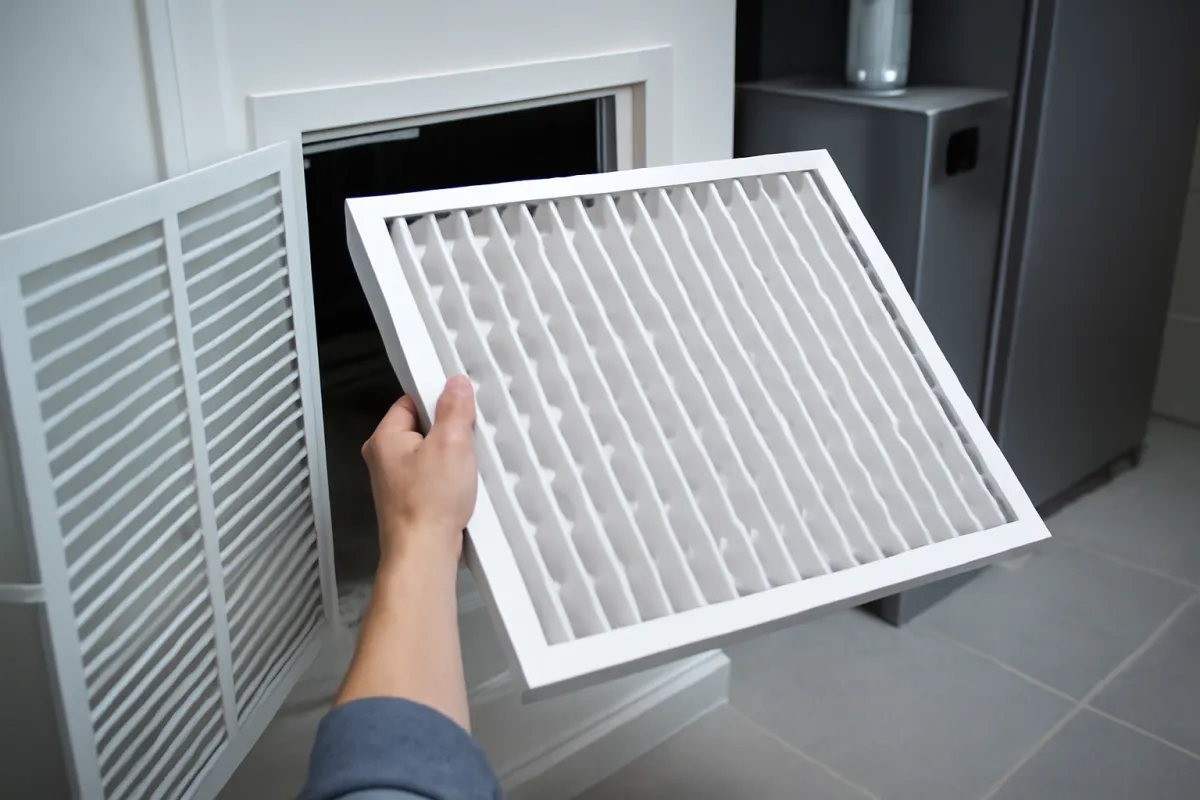
The cost of an air purification system is worth pinning down, because the phrase gets attached to three different purchases that price nowhere near each other. Sometimes it means a single portable box, which is the $95 to $550 tier table above. Sometimes it means a set of portables covering the rooms a household actually uses, which is that per-room figure multiplied by the room count: roughly $425 upfront for a bedroom plus a living room, and near $520 once a small-room unit joins them, all illustrative. And sometimes it means the duct-mounted equipment described here, which prices per house at $400 to $3,000 or more installed. When a quote or a product page says “system”, the first question is which of the three it means, because the answer moves the number by an order of magnitude.
Put the two routes side by side and the choice is a comparison of bands rather than of models. The portable route prices per room: roughly $95 for a small-room unit, $175 for a bedroom and $250 for a living room. The duct-mounted route prices per house, and its cost is dominated by installation labour rather than by the equipment, which is why it sits outside the per-room tiers in every table in this report.
The recurring lines split just as cleanly. Every portable carries its own filter bill, roughly $38 to $105 a year by tier, so three units mean three filter schedules and three draws. A duct-mounted system consolidates that into one thick media filter at roughly $40 to $100 every 6 to 12 months, which is often the cheaper recurring line for the same nominal coverage.
The catch cuts the other way, and it is the point that decides most households. A duct-mounted system only filters while the HVAC fan is running. If the furnace or air handler cycles off between heating and cooling calls, so does the filtration, unless you run the fan continuously, which adds its own power cost that a portable’s 10 to 50 watts does not. Across five years an illustrative whole-house figure lands near $2,000: call it $1,600 for a mid-range system installed plus about $80 a year in media filters, $400 across five years, dominated by installation rather than by hours run, which is more than two living-room portables at $1,450 and less than four at $2,900.
The honest way to choose is to count rooms before pricing machines. If the problem lives in a bedroom and a living room, per-room portables usually win on both cost and on filtered air where you actually are, and our breakdown on how many air purifiers a home needs does that count room by room. If you want every room treated, have solid ductwork and run the fan often anyway, the whole-house bands start to earn their keep. Either way, vet a portable candidate against the filter and airflow checks in how to choose an air purifier before you run the five-year math, because the consumable behind the machine decides the real number.
What drives an air purifier’s price
Strip away the marketing and a handful of factors explain almost every price difference between two units. Knowing them lets you spot where a higher price buys something real and where it buys a badge.
Rated airflow and coverage. Clean air delivery rate is the biggest honest driver of price. A higher rating means a bigger, better fan moving more filtered air per minute, which is what lets a machine clear a large room quickly. More coverage costs more, and it should.
Filter size and type. A larger filter lasts longer and costs more to make. A true HEPA stage plus a substantial activated-carbon stage for odours costs more than HEPA alone. The thin token carbon sheets in budget units are close to decorative, so a real carbon stage is a genuine price factor rather than a marketing one.
Smart features. Air-quality sensors, automatic modes, app control and scheduling all add cost. Auto modes are genuinely useful, because letting the fan ramp down when the sensor reads clean saves both power and filter life. App control is mostly convenience. Neither changes the filtration itself.
Noise engineering. A machine that moves the same air more quietly costs more to build, because that comes from a larger fan turning slower behind a bigger filter. It is a real difference and it is the one most likely to decide whether a bedroom unit actually gets used at night instead of switched off.
Brand and design. A recognisable name and a living-room-friendly shell carry a premium unrelated to how well the machine filters. You are sometimes paying for the look and the label as much as the engineering.
Only the first two change how much air the machine actually filters. The rest change convenience, noise and appearance. Once you can tell which is which, you can decide where your money is well spent and where it is buying reassurance.
Cheap vs Expensive Air Purifiers: What the Extra Money Buys
Set a $95 small-room unit against a $550 whole-floor machine and the honest summary is that the extra $455 buys throughput, filter size and quiet, and buys nothing at all in filtration grade. Both can carry true HEPA media. The larger machine pushes more air through a bigger cartridge with a slower fan, which is why it can clear a 600 square foot open plan while the small one would still be working on it at bedtime.
Here is what the extra money genuinely buys, in the order it matters. First, coverage: a higher rated clean air delivery, which is the only spec that decides whether the machine can keep up with the room at all. Second, filter capacity: a bigger cartridge holds more before airflow drops, which stretches the change interval even though each replacement costs more. Third, noise headroom: the ability to run at a low, quiet speed and still turn over the room’s air, rather than running pinned on high. Fourth, sensing and automation, which trim power and filter life by ramping down when the air reads clean.
Here is what it does not buy. It does not buy a finer filter grade; true HEPA is a defined media specification and a cheap cartridge meeting it filters the same particles as an expensive one. It does not buy longer machine life in any way you can verify from the price. And it does not buy a lower cost of ownership: the whole-floor machine costs about $0.74 a day across five years against $0.19 for the small-room unit, illustratively, so the premium tier is more expensive per day for as long as you own it.
That is why the cheap-versus-expensive question has no general answer, only a per-room one. In a small bedroom, the cheap true-HEPA unit is very often the best value in the category, and paying five times more there buys capacity you will never call on. In a large open-plan space or against a heavy dust or smoke load, the cheap unit runs flat out, loads its filter fast and still cannot keep pace, so the expensive machine is not a luxury, it is the only one that does the job. Where cheap goes wrong is undersizing. Where expensive goes wrong is buying a room you do not have, or paying a brand premium for a shell.
For the broader verdict on whether the category is worth owning at all, our breakdown on whether air purifiers are worth it runs the cost per day against what the machine actually does. The short version: for a real problem and a right-sized machine, the daily cost is small; for no problem at all, even the cheap unit is money spent on a quiet hum and a filter schedule.
Five-Year Total Cost of Ownership
The honest way to price any purifier is to add the machine, five years of filters and five years of power into one number. Do that and the surprise becomes obvious: the machine is usually the minority of what you spend.
Work it through for the living-room tier, the case most buyers are actually in. The machine is $250. Filters are $60 a year on a typical schedule, so $300 across five years. Power is 25 watts averaged around the clock, which is 219 kilowatt-hours a year, or $35 at $0.16 per kilowatt-hour, so $175 across five years. Add them: $250 plus $300 plus $175 is $725 over five years, illustratively. Across 1,825 days that is about $0.40 a day for around-the-clock filtered air, and the running costs at $475 already outweigh the $250 machine.
The same three-line sum applied to every tier gives the table this report uses from here on:
| Tier | Purchase | Filters, 5 yrs | Power, 5 yrs | Five-year total | Per day |
|---|---|---|---|---|---|
| Small room, under 200 sq ft | $95 | $190 | $55 | $340 | $0.19 |
| Bedroom, 200 to 300 sq ft | $175 | $250 | $110 | $535 | $0.29 |
| Living room, 300 to 500 sq ft | $250 | $300 | $175 | $725 | $0.40 |
| Whole floor, 500+ sq ft | $550 | $525 | $280 | $1,355 | $0.74 |
Read down the columns rather than across the rows and the pattern is plain. Purchase price roughly sextuples from the smallest tier to the largest. The filter column nearly triples. The power column multiplies by five, and yet it is still the smallest number in every single row. In no tier does electricity come close to being the reason a purifier is expensive.
The chart below puts those five-year totals side by side, so the shape of the spend is visible at a glance. Each bar is purchase price plus five years of filters plus five years of electricity, drawn in proportion to its dollar figure, with the duct-mounted option included for scale.
Five-year total cost of ownership, by purifier size
Purchase plus filters plus electricity over five years, at an illustrative $0.16 per kilowatt-hour.
The larger tiers cost more to own and also filter far more space. Judge value by cost per square foot of coverage rather than by the total alone.
The takeaway is not that bigger is worse. It is that the buy price alone is a poor guide to lifetime cost, and that stepping up a tier commits you to a larger recurring bill, not only a larger one-time one. The whole-house bar is dominated by installation, while every portable bar is dominated by filters. Match the size to what you actually need to filter, then own the running cost that comes with it.
This is the whole argument for reading the filter spec before you fall for a design. A budget machine with a pricey, short-life cartridge can cost more across five years than a living-room unit with a long-life filter, even though it looks cheaper on the shelf. The buy price tells you very little about lifetime cost, which is the same discipline we bring to sizing and pricing in our dehumidifier size-and-cost breakdown. Run the five-year math, not the sticker.
Air purifier cost by room size and runtime: the five-year table
Room size sets the machine you buy, and runtime sets what it costs to keep. Most cost coverage stops at the first of those, which is why two people with the same purifier report very different bills. The table below runs both variables at once. Each cell is a complete five-year cost of ownership at three realistic schedules: around the clock, the default used throughout this report; twelve hours a day, for a purifier that runs while you are home; and eight hours a day, the overnight-in-the-bedroom pattern that a large share of purifiers actually follow.
| Tier and room | 8 hrs a day | 12 hrs a day | Around the clock |
|---|---|---|---|
| Small room, under 200 sq ft | $240 | $270 | $340 |
| Bedroom, 200 to 300 sq ft | $375 | $420 | $535 |
| Living room, 300 to 500 sq ft | $510 | $565 | $725 |
| Whole floor, 500+ sq ft | $995 | $1,085 | $1,355 |
Two things stand out. First, cutting runtime by two thirds does not cut cost by two thirds, because the purchase price does not move at all and the filter bill does not fall in proportion either. A HEPA cartridge loads faster the more air passes through it, but carbon pre-filters and manufacturer change intervals are partly calendar-based, so halving your hours trims the filter line by closer to a quarter than a half. The living-room row makes the point: $725 around the clock against $510 at a third of the hours, a saving of about 30 percent for a two-thirds cut in runtime.
Second, the gap between tiers stays wide at every schedule. A whole-floor machine run only overnight still costs more across five years than a living-room unit run continuously. That is the reminder that sizing the machine to the room is a bigger lever than rationing its hours, and it is the reverse of the instinct most people have when they try to economise.
A whole-house HVAC solution does not fit this table cleanly, because it filters only while the air handler runs rather than on a schedule you set, and its roughly $2,000 five-year figure is dominated by installation rather than by hours. The practical use of these numbers is comparison, not prediction. Find your tier, find your realistic runtime, treat the cell as an honest budget line, then swap in your own filter price, wattage, hours and rate with our cost-per-use calculator to replace the illustration with your actual number.
Where an air purifier’s cost goes
Break that $725 living-room five-year figure into its parts and the reason filters matter so much becomes plain. The machine itself is not the largest of the three slices.
Where an air purifier's cost goes over five years
Split of the $725 living-room total: unit, filters, power. Shares sum to 100.
Filters are the single biggest line over five years, ahead of the machine itself. This is why the filter price and schedule should drive the buying decision as much as the unit does.
This split is the whole case for reading the filter spec first. A machine taking a $70 cartridge every six months will cost more across five years than a plainer one taking a $40 cartridge yearly, even if the plainer one costs more upfront. The consumable, not the machine, is where the money lives, and the power slice is the smallest of the three. Any purifier cost decision is really a filter decision wearing a machine’s price tag.
Ways to cut the cost of an air purifier
Because lifetime cost is purchase plus filters plus power, every saving comes from trimming one of those three. Here are the levers that actually move the number, in rough order of impact.
- Choose a machine with affordable, long-life filters. This is the single biggest lifetime saving, and it is a buying decision rather than a habit. Multiply the filter price by five years before you decide anything is cheap.
- Size the unit to the room. A purifier working well inside its rated coverage can run on a lower speed, which quietly saves both filter life and electricity compared with a too-small unit pinned on high.
- Use and clean a washable pre-filter. A washable pre-filter catches hair and large debris before it reaches the expensive HEPA cartridge, extending that cartridge’s life. Vacuum it every few weeks. Washable almost always means the pre-filter, not the HEPA stage behind it.
- Run it on auto or low. Continuous low-speed running keeps air turning over more steadily than blasting high for an hour, sips less power and loads the filter more slowly. Auto modes ramp up only when the sensor calls for it.
- Buy the right tier, not the biggest. Capacity you never use is money spent on a larger filter and a bigger machine for no return. Match the rated coverage to the room and stop there.
- Reduce what the filter has to catch. Vacuuming, wiping surfaces and controlling obvious dust sources means less loading per month, and our coverage on improving indoor air quality lists the changes that cost nothing to make.
None of these is about buying a fancier machine. The savings live in choosing the right filter economics upfront and running the unit sensibly, which is why a right-sized true-HEPA unit is usually the frugal choice at any tier.
A worked example: one mid-size purifier over five years
Put it all together on a single realistic case, and note that this one deliberately uses a heavier filter schedule than the tier average so you can see how much that single variable moves the total. You buy one living-room purifier, run it around the clock on auto, and want the true five-year cost.
The upfront cost. A living-room unit at $250, illustratively. That is the number on the shelf, and the only one most buyers weigh.
The annual running cost. This machine takes a $40 true HEPA cartridge due once a year plus a $20 carbon pre-filter due twice a year, which averages to two $40 filter purchases a year, or $80 a year in filters. The fan averages 25 watts around the clock, which is 219 kilowatt-hours a year, or $35 a year in power at $0.16 per kilowatt-hour. Annual running cost: $115.
The five-year total. $250 upfront plus five years at $115 is $250 plus $575, or roughly $825 over five years, which is about $0.45 a day. The running costs, $575, outweigh the machine, $250, well before the fifth year arrives.
Compare that to the $725 tier figure earlier in this report and the difference is instructive. Identical machine, identical wattage, identical rate. The only change is the filter schedule: $80 a year instead of $60. That single variable moved the five-year total by $100 and the daily cost by five cents, which is exactly why the filter spec deserves more attention than the shell. Swap your own unit price, filter cost, filter count, wattage and rate into the cost-per-use calculator to see your version of this example.
What a whole home of purifiers costs
The cost question multiplies the moment you think about a whole home, because a purifier only filters the room it stands in. Two or three units mean two or three sets of filters and two or three draws, so the running cost scales with the count. The honest question is not how much one purifier costs, but how many rooms genuinely need one.
For most homes the answer is one unit per main room you spend real time in, usually two to start: the bedroom and the main living space. Add a third for a home office or a room where a pet lives, if that is where the problem is. Buying one for every room is the most common way people overspend in this category, because a purifier humming in a room nobody enters is pure filter and power spend with no return. Our breakdown on how many air purifiers a home needs works through the room-by-room sizing and what several units cost to run together.
Price the common setup and the arithmetic is plain. One bedroom unit and one living-room unit, both run around the clock on auto, land near $535 and $725 across five years respectively, so the pair commits you to roughly $1,260 over five years, illustratively, with filters again the dominant slice. Add a third small-room unit for a home office and another $340 joins the total, bringing the household figure near $1,600. Across 1,825 days that is about $0.88 a day for three rooms of filtered air, which is a defensible number if all three rooms are genuinely used and a poor one if the third machine hums at an empty desk.
The lesson is not that a multi-room setup is wasteful. It is that running cost is per machine, so the honest question is how many rooms genuinely earn a unit rather than how many rooms exist. Price one unit fully across five years, then multiply by the count of rooms you will actually cover, not the count you could. Feed each machine’s own price, filter cost and wattage into the cost-per-use calculator separately, because a small-room unit and a living-room machine carry very different filter bills.
When a cheaper unit costs more: two five-year comparisons
The clearest argument for pricing the filter before the machine is a head-to-head. Unit A costs $150 on the shelf and takes a proprietary $70 cartridge due every six months. Unit B costs $250 and takes a $40 cartridge due once a year. On the tag, A looks like the bargain by a hundred dollars.
Run the five-year math and the ranking flips. Unit A’s filters run $140 a year, or $700 across five years. Unit B’s filters run $40 a year, or $200. Both draw 25 watts around the clock, so both carry $175 of power across five years. Unit A totals $150 plus $700 plus $175, or $1,025. Unit B totals $250 plus $200 plus $175, or $625. The cheaper-looking machine costs $400 more to own, illustratively, entirely because of the cartridge behind it.
Here is the second comparison, and it is the one that catches careful buyers. Unit C costs $95, is rated for a small room, and you put it in a 450 square foot living room. It cannot keep pace, so it runs on high permanently, which loads its filter roughly twice as fast: call it $76 a year instead of $38, and 14 watts instead of 8, so about $20 a year in power. Five years: $95 plus $380 plus $100, or $575, for a room it never actually clears. Unit B at $625 costs $50 more and does the job. Undersizing did not save money; it spent $575 on a machine working outside its range.
That is the razor-and-blades trap and the undersizing trap in one section, and both are invisible on a price tag. Pull up the exact replacement cartridge, note its price and schedule, check the rated coverage against your room’s square footage, and multiply across five years before you decide anything is cheap. The same discipline runs through our companion piece on how to choose an air purifier, where the filter check and the sizing check are separate steps for exactly this reason.
Reading a purifier’s price tag before you pay it
Everything above collapses into a short checklist you can run in a shop aisle or a browser tab in about three minutes. It is deliberately boring, because the expensive mistakes in this category are all made by skipping one of these four lines rather than by misjudging anything subtle.
Line one: the room. Measure the square footage of the room the machine will live in, and check it against the coverage the manufacturer states. If the machine is rated for less, it will run pinned on high, load its filter faster, and still not keep pace. Sizing is the check that makes every other number meaningful.
Line two: the filter. Find the exact replacement cartridge, its price, and its stated change interval. Multiply price by changes per year, then by five. If there is a separate carbon pre-filter on a shorter schedule, add it. This one number moves the five-year total more than anything else on the tag.
Line three: the draw. Find the wattage on the label or in the specification sheet. Multiply by hours per day, times 365, divide by 1,000, times your rate. At $0.16 per kilowatt-hour a purifier is rarely more than $56 a year, so this line is small, and its main job is to stop you overestimating it.
Line four: the total. Add purchase plus five years of filters plus five years of power. Compare that number, not the shelf price, against the alternative machine. If the cheaper machine loses on this line, it was never the cheaper machine.
Run those four lines on two candidates and the decision usually makes itself, which is the point of doing the arithmetic before the purchase rather than discovering it on the second filter change.
The bottom line
How much does an air purifier cost? Upfront, roughly $60 to $130 for a small room, $130 to $220 for a bedroom, $180 to $330 for a living room, and $400 to $700 for a whole floor, with a duct-mounted whole-house system running $400 to $3,000 installed. Those illustrative ranges are the smaller half of the answer. The bigger half is the running cost: about $38 to $105 a year in filters and $11 to $56 in electricity at $0.16 per kilowatt-hour, which across five years usually adds up to more than the machine did. A living-room unit lands near $725 across five years, or about $0.40 a day, and a heavier filter schedule pushes the same machine to $825 and $0.45. Price the cartridge before you fall for the shell, size the machine to the room rather than to the marketing, buy only for the rooms that earn one, and the true cost becomes a number you chose on purpose rather than one that arrives with the bill.
A note on scope: everything above is cost arithmetic, not a recommendation of any particular machine. Every price, filter figure, wattage and dollar amount here is an illustrative planning number built from typical ranges, not a quote and not a measured result for any specific model, and the market moves prices, filter schedules and electricity rates faster than any article can track. Before a purifier goes in your cart, pull up the current listing, confirm today’s cartridge price and change interval, check the rate on your own bill, and run the five-year math for your own rooms so the number you commit to is yours rather than ours.
Frequently asked questions
How much does an air purifier cost?
Upfront, a HEPA air purifier costs roughly $60 to $130 for a small-room unit, about $130 to $220 for a bedroom unit, $180 to $330 for a living-room machine, and $400 to $700 for a whole-floor model, all illustrative ranges rather than any model's quoted price. The upfront number is the smaller half of the answer. Replacement filters typically add $38 to $105 a year and electricity another $11 to $56, so across five years the running costs usually total more than the machine did. A living-room unit lands near $725 over five years, about $0.40 a day. Judge the purchase on the five-year figure, not the shelf tag.
How much does a good air purifier cost?
A genuinely good air purifier for a main room usually lands in the $180 to $330 band, illustratively, and near $250 is the figure this breakdown uses throughout. That money buys three things worth paying for: a true HEPA filter stated plainly on the box rather than HEPA-type wording, a fan whose rated clean air delivery suits the room's square footage, and a filter that lasts closer to a year than a few months. You rarely need to spend more for a normal home. The premium tier above it buys coverage for a bigger room and a larger carbon stage for odours, not a better grade of filtration, so a good purifier is the one sized right for the room rather than the priciest on the shelf.
Are expensive air purifiers worth it?
Only for a specific job. A premium machine earns its price in a large open-plan space or a heavy dust or smoke load, where the higher rated airflow and the bigger filter genuinely get used. In a small bedroom that same machine is capacity you will never call on, and a modest true-HEPA unit usually gives the better cost per day: about $0.19 for a small-room model against $0.74 for a whole-floor one over five years, illustratively. Money does not buy a better class of HEPA filtration, it buys throughput and filter size. Match the tier to the room and the expensive machine either justifies itself immediately or does not.
How much does it cost to run an air purifier per month?
Two lines decide it, filters and electricity, and most people count only the second. A living-room unit averaging 25 watts around the clock uses about 18 kilowatt-hours a month, which is near $2.92 at an illustrative $0.16 per kilowatt-hour. Filters averaged over the year add roughly $5 a month at $60 a year. That is about $8 a month all in for a typical living-room machine, illustratively, or roughly $4 a month for a small-room unit and $13 for a whole-floor one. Filters are usually the larger of the two, which is exactly the line buyers leave out because it arrives once or twice a year rather than monthly.
How much are replacement HEPA filters?
A true HEPA filter typically costs $25 to $80 and is due every 6 to 12 months, and a carbon pre-filter often runs $10 to $30 on a shorter schedule, roughly every 3 months. Add both and a living-room unit costs about $60 a year in filters on a typical schedule, or nearer $80 a year if it takes an annual HEPA plus a twice-yearly carbon stage. Small-room units sit closer to $38 a year and whole-floor machines closer to $105, illustratively. Because the filter is proprietary on most models, look up the exact replacement price and its change interval for your candidate machine before you buy, not after.
Do cheap air purifiers work?
A cheap purifier works if it has two things: a real HEPA filter and a fan strong enough to move the air in the room it sits in. Neither is expensive to build, which is why a small-room unit near $95 can be the best value in the category for a bedroom or an office. What does not work is a cheap unit asked to clean a room far beyond its rated airflow, where it runs flat out and still loses, or a low price achieved by dropping the real filter for HEPA-type media or an ioniser with no filter behind it. Cheap fails on sizing and on filter substitution, not on price itself.
How much electricity does an air purifier use?
Less than most people expect. A HEPA purifier draws roughly 10 to 50 watts depending on fan speed, closer to a couple of light bulbs than to a heater. A unit averaging 25 watts around the clock uses about 219 kilowatt-hours a year, which is near $35 at an illustrative $0.16 per kilowatt-hour. Across the tiers that is roughly $11 a year for a small-room unit at 8 watts and $56 for a whole-floor machine at 40 watts, running continuously. Electricity is the smallest of the three ownership costs, well behind filters and behind the machine itself, which is the reverse of what most buyers assume.
How much does a whole-house air purifier cost?
A whole-house solution means filtration built into the ductwork rather than a portable box, and it costs more upfront. A media filter cabinet in the return duct is often $400 to $1,000 installed, illustratively, and a professionally installed electronic cleaner or HEPA bypass system can run $1,000 to $3,000 or more depending on the home. The recurring cost is the thick HVAC media filter, roughly $40 to $100 every 6 to 12 months, which is cheaper per year than running several portables. The trade-off is that it only filters while the air handler fan is running, so many homes get more from two or three right-sized portable units.