
What's on this page
- What builds up inside a dishwasher
- Before you start
- Step 1: Gather your supplies and empty the racks
- Step 2: Clear and clean the filter
- Step 3: Wipe the interior, spray arms, and door seals
- Step 4: Run a vinegar cycle
- Step 5: Run a baking soda cycle
- Step 6: Maintain the exterior and set a cleaning schedule
- A worked example: a full dishwasher deep clean
- Common mistakes when cleaning a dishwasher
- Troubleshooting: harder dishwasher cleaning calls
- Your dishwasher cleaning checklist
- The bottom line
Short answer: Clean a dishwasher in six steps: empty the racks, remove and rinse the filter, wipe the interior and door seals, run a vinegar cycle, run a separate baking soda cycle, then wipe the exterior and set a schedule. Never mix vinegar and baking soda in one cycle, and never mix bleach with vinegar. The filter is the highest-value habit, so rinse it every week or two and deep clean about monthly, sooner with hard water.
A dishwasher is the one appliance we trust to clean itself, and it almost never does. Water, detergent, and food slurry cycle through it every run, but nothing scrubs the machine, so it slowly collects a greasy film on the tub, scale on the spray arms, a plug of rotting food in the filter, and a damp ring of residue around the door seal. The result creeps up on you: dishes that come out with grit or a cloudy film, a smell that hits when you open the door, and a machine that seems to have lost its edge. Almost always, that is not a failing dishwasher but a dirty one.
These notes give you a six-step method for how to clean a dishwasher properly, from the clogged filter that causes most of the trouble to a vinegar cycle and a baking soda cycle that finish the job, so it drains clear, smells clean, and washes the way it was built to. Every step is something you can do yourself in a few minutes with things already in your kitchen. For the running-cost side of the same appliance, see our dishwasher running-cost report, and for how this fits your whole-home routine, our eight-point appliance maintenance plan. Feed your loads per week and water hardness into the cleaning-schedule planner as you read, and it will tell you how often to run each step.
Key takeaways
- A dishwasher that leaves grit, film, or a smell is almost never broken, it is dirty: food in the filter, scale on the spray arms, and grease film on the tub.
- The whole job is six steps: gather supplies and empty the racks, clean the filter, wipe the interior and seals, run a vinegar cycle, run a baking soda cycle, then maintain the exterior and set a schedule.
- The filter is the highest-value habit: rinsing it every week or two prevents most of the smells and residue the other steps have to fix.
- Run vinegar and baking soda in separate cycles, never mixed, and never mix bleach with vinegar, which releases a harmful gas.
- Match the frequency to your water and loads: filter weekly, seals every couple of weeks, a full deep clean about monthly, more often with hard water.
What builds up inside a dishwasher
Before you start cleaning, it helps to know what you are actually removing, because a dishwasher collects several different kinds of grime and each responds to a different step. Knowing the mix is what tells you why one cleaner does not do everything and why the filter matters more than the fancy cycle. The stacked bar below shows an illustrative breakdown of what builds up inside a neglected home dishwasher, so you can see where the trouble concentrates and why the filter is the first thing to touch.
What builds up inside a dishwasher
An illustrative split of the grime that collects in a neglected home dishwasher. Segments sum to 100 percent. Your mix varies by water and habits.
Food in the filter and grease film are the biggest slices, which is why the filter and a degreasing vinegar cycle do most of the work. Scale grows with hard water. The split is illustrative and shifts by home.
The shape of that split is the whole strategy in one picture. The two biggest slices, food debris and grease film, are exactly what the filter clean and the vinegar cycle target, which is why those two steps do most of the heavy lifting. Hard-water scale is the wildcard: in a soft-water home it is a thin slice, but in a hard-water area it can grow large enough to clog spray arm holes and cloud your glassware, which is your cue to descale more often. The smaller slices, mold in the seal folds and undissolved detergent residue, are the finishing jobs that a wipe-down and a baking soda cycle handle. Keep that ranking in mind as you work the six steps, because it tells you where to spend your effort and why no single product cleans everything.
Before you start
This is a hands-on but genuinely low-skill task. Nothing in the six steps requires a tool you do not already own or any appliance knowledge beyond reading your manual. Plan on about an hour and a half start to finish for a full deep clean, though most of that is the two wash cycles running while you do something else, so your hands-on time is closer to twenty minutes. The difficulty is beginner: if you can rinse a strainer and wipe a surface, you can do all of it.
Gather a small, ordinary kit before you begin so you are not stopping mid-job to hunt for something.
- White vinegar and baking soda, the two workhorse cleaners, plus a commercial dishwasher cleaner if you prefer one or have very hard water.
- A soft brush or old toothbrush, for the filter mesh, the spray arm holes, and the seal folds.
- Microfiber cloths and a dishwasher-safe bowl or cup, one to wipe with and one to hold the vinegar on the top rack.
- A toothpick or thin wire, for poking clogged spray arm holes clear.
- Your appliance manual, or the model number to look it up, since the manual is the authority on whether vinegar suits your seals and what your filter looks like.
Two ground rules keep the job safe and effective. First, run the vinegar and baking soda as two separate cycles, and never mix cleaning products in the tub, especially never bleach with vinegar, which releases a harmful gas. Second, empty the dishwasher completely before you start, because you are cleaning the machine, not the dishes, and anything left inside just gets in the way. With your kit assembled and the racks empty, start at the part that causes most of the trouble: the filter.
Step 1: Gather your supplies and empty the racks
The first step is the setup that makes the rest go smoothly, and it is worth doing deliberately rather than rushing past. Empty the dishwasher completely, removing every dish, and then pull out both the lower and upper racks if your model lets them slide free, along with the utensil basket. Set them aside, because clearing them gives you clean access to the filter well, the spray arms, and the tub floor, and it lets you check the racks themselves for the food and gunk that collect in their corners and tine bases. A cluttered tub is the reason people skip the filter, so removing the obstacles first is what turns a dreaded chore into a five-minute job.
While the racks are out, wipe any loose food off the tub floor and around the filter opening with a paper towel, so you are not just pushing debris into the filter you are about to clean. Take a quick look at the bottom of the tub near the drain, since large debris like a shard of glass, a fruit sticker, or a chunk of bone can settle there and block the drain or damage the pump. Lay your vinegar cup, baking soda, brush, and cloth on the counter within reach. Watch out for one thing: check the utensil basket and rack corners for trapped food, because those hidden pockets are a common source of a smell that survives a cycle. With the machine empty and the debris wiped, you are ready for the part that matters most.
Step 2: Clear and clean the filter
The filter is the heart of the whole job, because it is where most dishwasher trouble starts. Sitting in the bottom of the tub, usually under the lower spray arm, the filter is a cylindrical or flat mesh assembly that traps food so it does not recirculate onto your dishes. When it clogs, that trapped food rots, which is the usual cause of both the smell and the grit or film on supposedly clean dishes. Most modern dishwashers let you remove the filter by hand: twist the cylindrical part counterclockwise to unlock it, then lift the whole assembly out. Check your manual if it is not obvious, since designs vary, and note how it seats so you can reseat it correctly later.
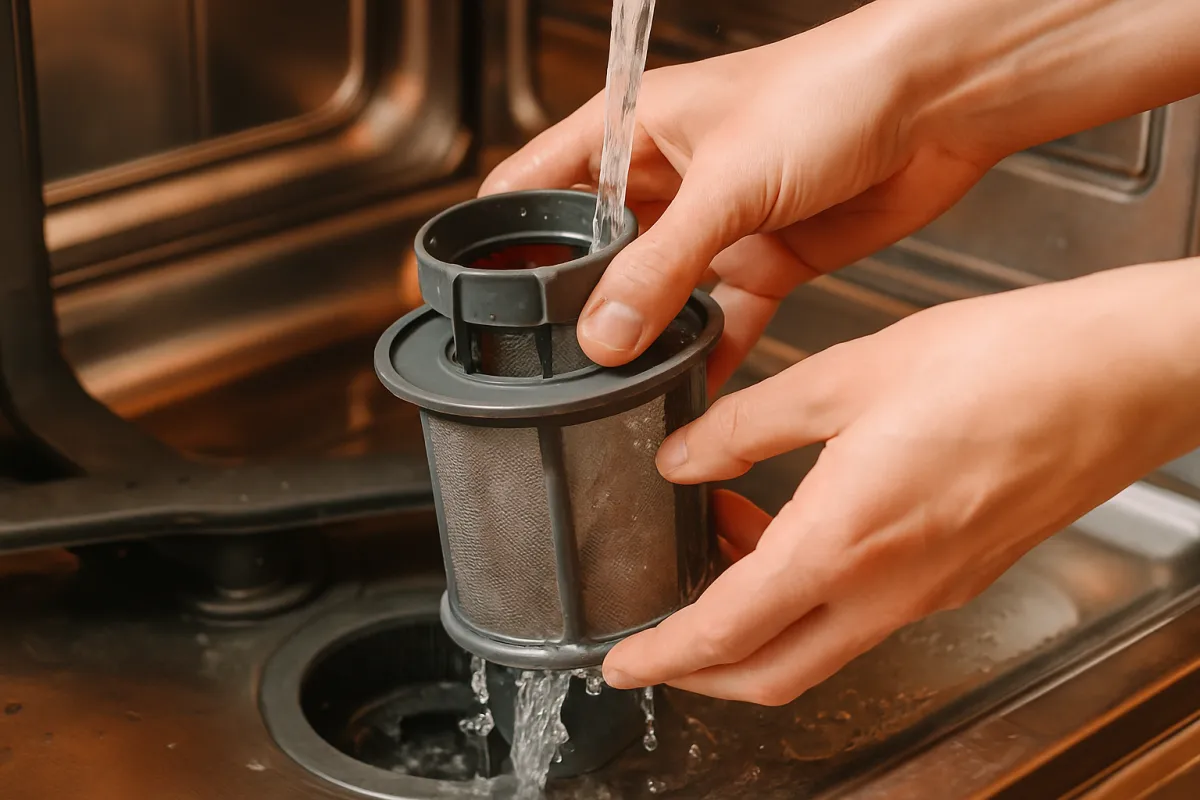
With the filter out, rinse it thoroughly under a running hot tap to flush away the loose food, then use a soft brush or old toothbrush to work the trapped grease and debris out of the fine mesh, since the mesh is where the film hides. For a badly clogged filter, let it soak in warm soapy water for a few minutes before brushing. Rinse it until the water runs clear, then seat it firmly back in place and lock it, because a loose filter lets food back into the pump. Watch out for two things: never run the machine with the filter removed, and if you find the filter caked after only a week, that is a sign to rinse it more often or to scrape plates better before loading, not a sign the machine is failing.
Step 3: Wipe the interior, spray arms, and door seals
With the filter clean, turn to the parts of the tub that the wash water never properly reaches, because these are where residue and mold quietly build. Start with the spray arms, the rotating bars above and below the racks that fling water over the dishes. Their small holes clog with mineral scale and food debris, which weakens the spray pattern and leaves dishes poorly cleaned, especially on the top rack. Lift or unscrew the arms if your model allows, hold them under the tap, and poke each blocked hole clear with a toothpick or thin wire, then check that the arms spin freely on their mounts before reseating them. Clear spray arms are what let the machine actually rinse the dishes.
Next, the door seal and the tub edge. The rubber gasket around the door and the lip of the tub above the water line sit outside the wash, so grime, mold, and a damp film collect there and cause smells that no cycle removes. Peel back the seal folds gently and wipe them out with a damp cloth dipped in a little vinegar or mild soapy water, working into the creases where the gray film hides. Wipe the interior door panel too, especially the bottom edge and the detergent dispenser, where residue cakes.
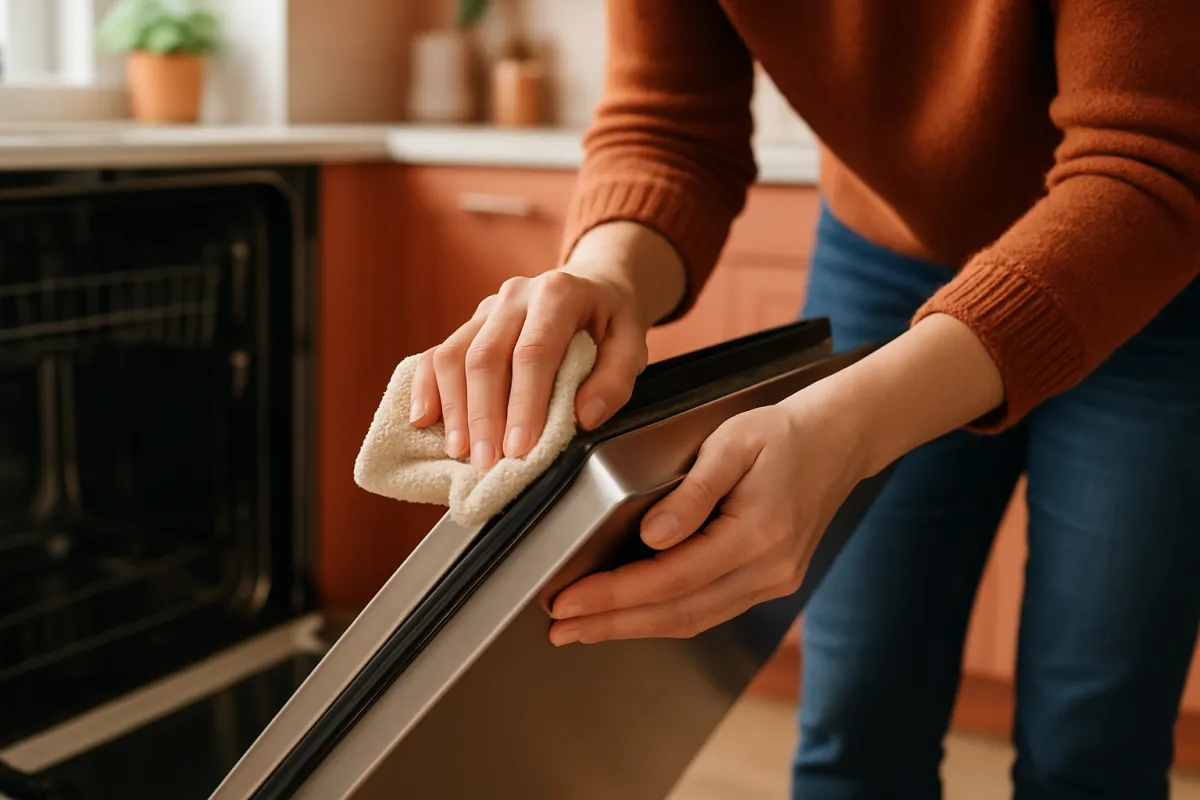
Watch out for the spots that are easy to miss: the underside of the door below the seal, the corners of the tub floor, and the dispenser flap. These sit outside the spray pattern and are exactly where a lingering smell survives an otherwise good clean. If your seal is stained with mold, a paste of baking soda and a little water scrubbed in with the toothbrush lifts it, but avoid harsh abrasives that can tear the rubber. With the interior wiped and the arms clear, the tub is ready for the cycles that finish the job.
Step 4: Run a vinegar cycle
Now that the loose grime is gone, the vinegar cycle dissolves the grease film and hard-water scale that coat the tub interior and the parts you cannot reach by hand. White vinegar is a mild acid, which is exactly what cuts the greasy film and mineral deposits that plain water leaves behind. Pour about one cup of plain white vinegar into a dishwasher-safe bowl or cup and set it upright on the top rack. Leave the rest of the machine empty, close the door, and run a normal or heavy cycle on the hottest water setting your machine offers, since heat helps the vinegar work. As the cycle runs, the vinegar disperses through the wash and rinses the interior, the spray arms, and the hidden plumbing.
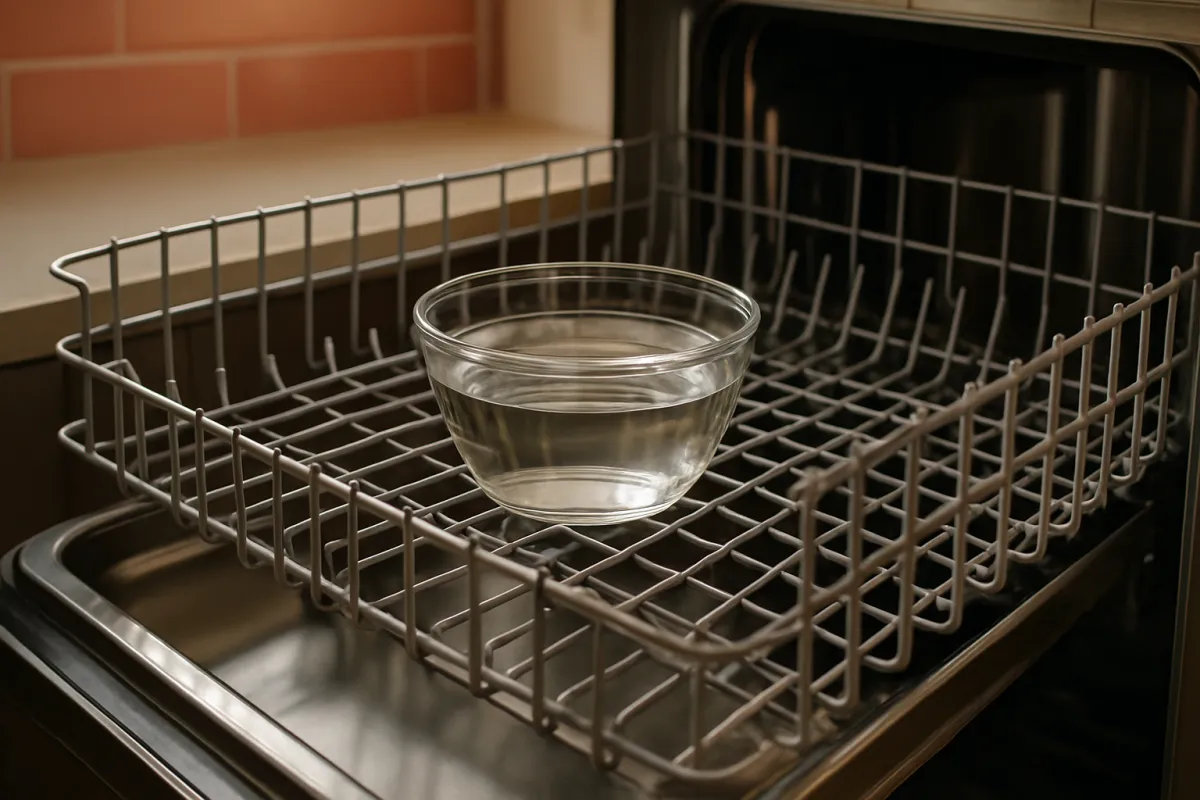
The reason the vinegar goes in a cup on the top rack rather than poured across the floor is timing: from the cup it releases gradually through the main wash, giving it time to work on the grease and scale, whereas poured into the bottom it largely drains away in the first fill. An illustrative guide is to run this cycle about once a month, and more often, perhaps every two weeks, if you have hard water or notice cloudy glassware, which is the scale telling you it is building faster than a monthly cycle can keep up. In a soft-water home you may stretch it longer. Let the water hardness and what you see on the glasses set your pace rather than a fixed rule.
Watch out for the safety point that matters most in this whole job: never add bleach or any other cleaner to the vinegar cycle. Bleach and vinegar together release chlorine gas, which is harmful to breathe, so the vinegar runs alone, full stop. Also check your appliance manual first, because a small number of manufacturers advise against vinegar on certain seals or components, and their guidance beats any general tip. If yours is one, use a commercial dishwasher cleaner made for the machine instead. For how a hot cycle affects what the machine costs to run, see our dishwasher running-cost report.
Step 5: Run a baking soda cycle
The vinegar cycle handles grease and scale; the baking soda cycle that follows handles what is left, which is odor and staining. Baking soda is a mild alkaline abrasive and a natural deodorizer, so it brightens the tub and neutralizes the smells that cling after the grease is gone. Once the vinegar cycle has finished and the tub is empty, sprinkle about one cup of baking soda evenly across the floor of the dishwasher. Run a short, hot cycle. That is the entire step: the baking soda disperses through the wash, scours lightly, and leaves the interior fresher and the tub floor cleaner and less stained than before.
Running the two as separate cycles is deliberate and important. If you put vinegar and baking soda in together, the acid and the base neutralize each other in a fizz and you lose most of the cleaning power of both, ending up with mildly salty water. Keeping them in back-to-back but separate cycles lets each do its own job: the vinegar dissolves and rinses the grease and scale first, then the baking soda deodorizes and brightens on a clean surface. For a machine that was badly neglected or has a stubborn smell, you can repeat this pair, but for routine maintenance one of each is plenty.
Watch out for overdoing the baking soda: about a cup spread across the floor is enough, and dumping in far more just leaves undissolved powder that itself becomes residue. Do not add it to the detergent dispenser; the tub floor is the right place. And as with the vinegar cycle, keep it a standalone run with no other cleaner in the tub. If a smell survives both cycles, that is your signal to go back to Step 2, because a filter you did not clear well enough, or a drainage problem, is the more likely culprit than anything a cycle can fix. Set your loads and water hardness in the cleaning-schedule planner to see how often this pair is worth running for your home.
Step 6: Maintain the exterior and set a cleaning schedule
The deep clean is done, so the last step protects it: finish the outside and turn the whole routine into a rhythm you will actually keep. Start with the exterior. Wipe the door front and the control panel with a damp microfiber cloth, since fingerprints and splashes collect there. If the front is stainless steel, wipe along the grain with a cleaner made for stainless, or just water and a soft cloth, and avoid abrasive pads that scratch it. Clean the handle and the small gap along the top of the door where crumbs and drips settle. The exterior is not about performance, but a smudge-free front is what makes the machine feel genuinely clean.
Then build the schedule, because the six steps only pay off if they happen on a rhythm rather than once a year in a panic. The trick is to sort each job by how fast the mess it fights builds up and attach it to a trigger you will not forget. The chart below groups the routine by interval so you can see that most of the work is quick and frequent while the full deep clean comes around far less often.
Dishwasher cleaning tasks by frequency
An illustrative count of dishwasher cleaning jobs that fall into each interval. Bars scale with the number of tasks. Your list varies by home and water.
Only the fast-building jobs, rinsing the filter and wiping the seal, are weekly. The vinegar and baking soda cycles come round about monthly. A deep inspection is a twice-a-year job. Counts are illustrative.
Turn that grouping into a calendar you can keep. Make rinsing the filter, wiping the seal, and clearing the tub floor a weekly habit tied to a day you already do chores. Slot the vinegar cycle and the baking soda cycle to the first of the month, or every two weeks if you have hard water. Reserve a twice-a-year deep inspection for the spray arms, the drain, and the racks, timed to a season change so it never drifts. Watch out for the classic failure, which is not the doing but the remembering, so lean on a recurring phone reminder. Set your loads per week and water hardness in the cleaning-schedule planner to get a starting read on how often your machine needs each step.
A worked example: a full dishwasher deep clean
Put the six steps together on one illustrative afternoon so you can see how the routine flows. Picture a household that runs about five loads a week in a hard-water area and has not deep-cleaned the dishwasher in over six months. The dishes have started coming out with a chalky film, and there is a faint sour smell when the door opens, the two classic signs that the filter is clogged and scale is building. This is a full catch-up clean that sweeps up every step.
The run starts with setup. The machine is emptied, both racks and the utensil basket slide out, and a paper towel wipes the loose food off the tub floor and away from the filter opening. The filter comes next and turns out to be the main culprit: twisted out and rinsed under the hot tap, it releases a plug of trapped food, and a soft brush works the greasy film out of the mesh until the water runs clear. Reseated and locked, it is already the biggest single improvement of the day. Then the spray arm holes, several blocked with scale, are poked clear with a toothpick, and the door seal folds are wiped out, lifting a gray film that was feeding the smell.
With the tub clean by hand, the two cycles finish the job. A cup of white vinegar goes on the top rack and runs through a hot heavy cycle, dissolving the grease film and the hard-water scale that the chalky glassware had been warning about. Once that finishes, a cup of baking soda is sprinkled across the tub floor and a short hot cycle deodorizes and brightens what is left. Finally the stainless front is wiped along the grain, and a monthly reminder is set for the vinegar and baking soda pair, with a weekly one for the filter. By the end, the film and the smell are gone, and the machine washes on the first try again. None of these numbers are measured on any specific home; they are an illustrative walkthrough, and your own water, loads, and buildup will differ. The value is the sequence: clear the filter first, wipe what the water misses, then let the two cycles finish.
Common mistakes when cleaning a dishwasher
Most dishwasher trouble traces back to a small number of avoidable habits rather than a failing machine. These are the pitfalls that quietly keep a dishwasher dirty or, in one case, create a real hazard.
- Never cleaning the filter. Because the filter is hidden under the lower spray arm, it is the most-skipped job, and a clogged filter is the number one cause of smells and residue. Rinse it every week or two and most of the other problems never start.
- Mixing cleaners, especially bleach and vinegar. Combining an acid and a base cancels both, and combining bleach with vinegar releases a harmful gas. Run every cleaner, vinegar, baking soda, or a commercial product, on its own separate cycle, never together.
- Pouring vinegar into the bottom of the tub. Poured onto the floor, most of it drains away on the first fill; in a cup on the top rack it releases through the main wash where it can actually work on grease and scale.
- Ignoring the door seal and tub edge. These sit outside the wash, so no cycle cleans them, and the damp film and mold there cause a smell that survives every deep clean. Wipe the seal folds and tub lip by hand.
- Overdosing detergent or baking soda. Too much of either leaves undissolved residue that becomes its own film, and in soft water excess detergent can even etch glassware permanently. Use the recommended amount, not more.
- Skipping the deep clean until something smells. Waiting for a problem means scrubbing out months of buildup at once. A quick monthly cycle keeps the machine from ever reaching that state.
Clear these six and you have removed the causes behind almost every dirty-dishwasher complaint, at the cost of a few minutes a week and one cycle a month.
Troubleshooting: harder dishwasher cleaning calls
The six steps cover routine cleaning, but some situations need a judgment call. Here is how to think through the common ones without guessing.
What if the smell survives a full deep clean? Go back to the filter first, because a filter rinsed too gently still holds rotting food in its mesh, so pull it again and scrub harder, soaking it in warm soapy water. If the filter is genuinely clean, check the door seal folds, the tub edge, and the drain area, all of which sit outside the wash. If a strong smell persists after the filter, seals, and both cycles, it points past cleaning toward drainage: a clogged or improperly high drain hose, or a garbage disposal that shares the drain and needs its own clean. That is where the problem likely lives.
What if dishes still come out with a white film? Identify the film first. A chalky deposit that wipes off dishes and the tub is hard-water scale, which calls for descaling more often with the vinegar cycle and, often, a rinse aid that helps water sheet off. A gritty or powdery residue is more likely undissolved detergent, so try less detergent and confirm your incoming water is hot enough to dissolve it. Cloudy glass that will not wipe clean may be permanent etching, which is prevented, not cured, by not overdosing detergent in soft water.
What if my manual says not to use vinegar? Follow the manual over any general tip, since a few manufacturers advise against vinegar on certain seals or components. In that case, use a commercial dishwasher cleaner formulated for the machine, which does the same descaling and degreasing job, and still run the baking soda cycle separately for odor. The method, clean the filter, wipe the interior, then run a cleaning cycle, stays the same; only the product changes.
What if the dishwasher is not draining? Standing water at the bottom after a cycle is a drainage issue, not a dirt one, though a clogged filter can contribute. Check and clean the filter and the drain area for debris, confirm the drain hose is not kinked, and look at the garbage disposal connection if the dishwasher shares it. If the water still will not clear after the obvious blockages are removed, that is a mechanical issue worth a closer look rather than more cleaning.
Your dishwasher cleaning checklist
Save this list and work it by interval. Clearing it keeps the machine washing on the first try and stops smells and film before they start.
- Weekly: rinse and brush the filter, wipe the door seal and tub edge, and clear any food off the tub floor.
- Every couple of weeks: check and clear the spray arm holes, and wipe the interior door and detergent dispenser.
- Monthly: run a vinegar cycle with a cup on the top rack, then a separate baking soda cycle across the tub floor, more often in hard water.
- Twice a year: deep-inspect the spray arms, the drain area, and the racks, and clean the exterior thoroughly.
- Every load, as prevention: scrape plates before loading and do not overdose detergent, the two habits that keep the whole machine cleaner.
- Never: run the machine with the filter out, or mix cleaners in the tub, and never combine bleach with vinegar.
Set your loads per week and water hardness in the cleaning-schedule planner to see how often your machine needs each step, then work the list one interval at a time.
The bottom line
Cleaning a dishwasher is not a specialist job or an expensive one; it is six simple steps done on a rhythm that stops a self-cleaning myth from turning into a smelly, film-leaving machine. Empty the racks and wipe the loose food, clean the filter that causes most of the trouble, wipe the spray arms and door seals the water never reaches, run a vinegar cycle to cut the grease and scale, follow it with a separate baking soda cycle for odor, then wipe the exterior and set a schedule so it all happens again. The filter is the habit that matters most, the two cycles stay separate, and bleach never meets vinegar. Do that on a weekly-and-monthly rhythm matched to your water and your loads, and the dishwasher goes back to doing the one thing you bought it for: getting the dishes clean on the first try, without a smell and without a film.
A note on scope: these notes exist to hand you a repeatable routine for cleaning a home dishwasher, not to promise any specific result, saving, or lifespan. Every interval and figure above is an illustrative planning number drawn from typical guidance rather than measured on one machine, and your own water hardness, usage, and manufacturer instructions will change what and how often you should do each job, so treat your appliance manual as the authority, especially on whether vinegar suits your model. Nothing here is professional advice. Run cleaning products one at a time and never combine bleach with vinegar or any acid, since that releases a harmful gas, and if a problem points to drainage or a mechanical fault rather than dirt, call a qualified technician.
Frequently asked questions
How often should I clean my dishwasher?
A workable rhythm is to match each job to how fast the mess it fights builds up. Rinse the filter at the bottom of the tub every week or two, because trapped food is what causes most smells and film. Wipe the door seals and the edge of the tub every couple of weeks, since that is where damp residue and mold collect. Run a full deep clean, a vinegar cycle followed by a baking soda cycle, roughly once a month, and more often if you have hard water or run heavy loads. The honest answer is that the interval depends on your water hardness, how many loads you run, and whether you rinse plates first, so treat any schedule as a starting point and shorten it if you see film or smell odor building faster. The point is regular attention, not a perfect calendar.
Can I use vinegar and baking soda to clean a dishwasher?
Yes, and they are the two most common household cleaners for the job because they target different problems. White vinegar is a mild acid that helps dissolve the grease film and hard-water scale that build up on the tub and spray arms, which is why a cup of it run through an empty hot cycle is the classic descaling step. Baking soda is a mild alkaline abrasive that helps deodorize and brighten, so a second short cycle with it sprinkled across the tub floor tackles lingering smell and staining. Use them in separate cycles rather than mixed together, since combining an acid and a base neutralizes both and leaves you with fizzy salt water. Always check your appliance manual first, because a few manufacturers advise against vinegar on certain seals or components, and follow their guidance over any general tip.
Why does my dishwasher smell bad even after cleaning it?
A persistent smell almost always traces back to the filter or a spot the deep clean missed rather than a broken machine. The filter at the bottom of the tub is the first suspect, because food packs into its mesh and rots there, so if a vinegar cycle did not fix the odor, pull the filter, rinse it under a tap, and scrub the mesh with a soft brush. The next suspects are the door seal folds, the edge of the tub above the water line, and the spray arm holes, all of which sit outside the wash and need wiping by hand. A clogged or high drain hose and a garbage disposal that shares the drain can also send smells back up. Work those spots in order, and if a strong smell persists after the filter, seals, and a deep clean, it points toward a drainage issue worth a closer look.
Do I need a commercial dishwasher cleaner or is vinegar enough?
For routine maintenance, white vinegar and baking soda handle most of what a home dishwasher needs, which is grease film, mild scale, and odor. Commercial dishwasher cleaners are formulated to cut heavier grease and limescale in one product, and some people prefer them for a deeper periodic clean or in very hard-water areas where scale builds quickly. Neither is strictly required over the other for a machine you maintain regularly. The most important variable is not the product but consistency: a filter rinsed often and a monthly cycle of any kind will keep a dishwasher far cleaner than an expensive product used once a year. Whichever you choose, follow the label directions and your appliance manual, and never mix cleaning products together, especially anything containing bleach with an acid like vinegar.
Should I clean the dishwasher filter every time?
You do not need to pull the filter after every load, but it is the single most valuable cleaning habit and deserves attention far more often than most people give it. A filter left unrinsed for months is the usual reason a dishwasher starts to smell or leave grit on clean dishes, because trapped food recirculates onto the next load. A practical rule is to rinse it every week or two, and more often if you do not scrape plates before loading or you run many loads a week. The job takes about five minutes: twist and lift the filter out, rinse it under a running tap, brush the mesh clear, and seat it back firmly. If you only adopt one habit from these notes, make it this one, because it prevents the problems the other steps have to fix.
Is it safe to mix bleach and vinegar to clean a dishwasher?
No, never mix bleach and vinegar, and this is the one hard safety rule in dishwasher cleaning. Combining bleach with an acid like vinegar releases chlorine gas, which is harmful to breathe, so the two should never be used together or even in close succession in the same enclosed tub. Beyond the safety issue, bleach is not suitable for every dishwasher, since it can damage stainless steel interiors and certain components, so many manufacturers advise against it entirely. Stick to one cleaner at a time: run a vinegar cycle, or a baking soda cycle, or a commercial dishwasher cleaner, each on its own, and never combine them. If you ever do use a bleach-based product because your manual specifically allows it, do it alone, never alongside vinegar, and ventilate the room.
Why is my dishwasher leaving a white film or residue on dishes?
A white film is usually one of two things: hard-water scale or leftover detergent, and telling them apart points to the fix. If the film is chalky and wipes off dishes and the tub interior, it is most likely mineral scale from hard water, which calls for more frequent descaling with a vinegar cycle or a rinse aid that helps water sheet off rather than spot. If the residue is more of a gritty or powdery deposit, it can be undissolved detergent from overdosing, old detergent, or a water temperature too low to dissolve it, so try less detergent and confirm the incoming water is hot. Cloudy glassware that does not wipe clean can be etching, which is permanent, so the goal is to prevent it by not overdosing detergent in soft water. Regular filter cleaning and a monthly descale keep most film problems from starting.
Can cleaning my dishwasher help it run better or last longer?
In many cases yes, because most of what makes a dishwasher underperform is buildup rather than genuine wear. A clogged filter, scale-blocked spray arm holes, and a grease-filmed interior all make the machine clean less effectively, so it has to be rerun or the dishes rewashed by hand, which wastes water and energy. Clearing those restrictions lets the machine wash the way it was designed to on the first cycle. The size of any efficiency or lifespan gain is impossible to state as a single number, since it depends on how neglected the machine was and how hard your water is, so treat any figure as illustrative rather than a promise. What is reliable is the direction: a clean, unobstructed dishwasher runs closer to its design, which is both more effective and gentler on the machine over time.