What's on this page
- How much dehumidifier do you need? The short answer
- How dehumidifiers are sized: pints per day
- The sizing table: square footage times dampness
- What size dehumidifier do I need for 500 to 3,000 sq ft?
- Reading the dampness level: what the signs mean
- The new AHAM pint ratings vs the old numbers
- Oversizing vs undersizing: short-cycling and never catching up
- What a dehumidifier costs to run
- Monthly cost by how much you run it
- Continuous drainage vs emptying the bucket
- The basement and crawlspace case
- What size dehumidifier do I need for a bedroom?
- Whole-house vs portable units
- Energy efficiency and the Energy Star angle
- Setting your humidity target: 30 to 50 percent
- Features that matter vs marketing
- Maintenance: filter, coils, and the tank
- When a dehumidifier beats fixing the moisture source
- A worked example: one 1,200 sq ft damp basement
- How to buy: a sizing and cost checklist
- Seasonal running vs year-round: what the calendar does to the bill
- Desiccant vs compressor units: a cold-room cost note
- The bottom line
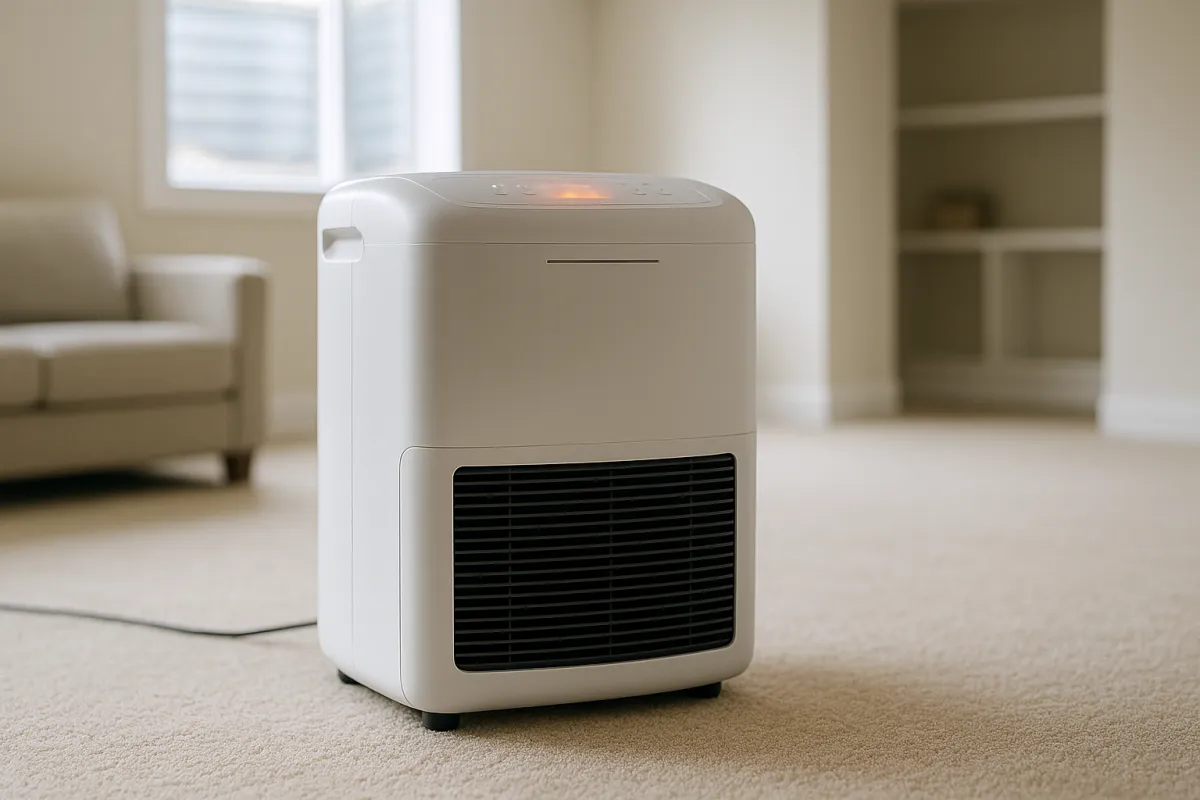
Short answer: Dehumidifier size and cost both come down to the same two inputs: the room's square footage and how damp it feels, then you round up to the next real capacity you can buy. As illustrative starting points, a moderately damp room around 1,000 square feet points to a unit in the mid-teens of pints per day, a very damp room steps up several more pints, and a big wet basement can reach the thirties. Compare like with like, since ratings changed in 2019.
What size dehumidifier do I need? That is the rare appliance question where the wrong answer costs more than the wrong brand, because a dehumidifier punishes bad sizing in both directions. Too small and it runs every hour of every day and never quite dries the room. Too large for a tiny space and it short-cycles. Get the size right, though, and it quietly holds your air where you want it, for a running cost that is mostly a line on the electricity bill rather than a filter you keep rebuying.
This breakdown does two jobs. First, it sizes the machine: how pints-per-day capacity works, how room size and dampness combine into a number, and why the pint ratings on the box are not what they were a few years ago. Second, it runs the cost math, the watts-times-hours-times-rate calculation that tells you what the thing actually costs to keep running. You can plug your own room and unit into our cost-per-use calculator as you read and watch both numbers move.
Key takeaways
- Size by two inputs: the room's square footage and how damp it feels. Both push the pint number up, and dampness matters as much as area.
- The pint rating is capacity under a lab test, not a forecast for your room. A 20-pint unit does not mean your basement gives up 20 pints a day.
- The ratings changed in 2019. A machine labeled 70 pints under the old test is often around 50 under the new one, so compare like with like.
- Unlike a purifier, electricity is the big running cost here, not consumables. A mid-size unit run hard can cost more per year in power than it did to buy.
- A dehumidifier is for ambient dampness. If there is an active leak or a drainage fault, fix the source; the machine is support, not a cure.
How much dehumidifier do you need? The short answer
Size a dehumidifier by combining the floor area of the space with how damp that space feels, then round up to the next real capacity you can actually buy. Those two inputs, area and dampness, do almost all the work. A large room needs more capacity because there is more air to keep dry. A damp room needs more capacity because there is more water in that air to remove. Change either one and the pint number moves.
The quick version: a moderately damp room around 1,000 square feet commonly points to a unit in the mid-teens of pints per day. Make that same room feel very damp, with visible moisture and a musty smell, and you step up several more pints. A big, wet basement can reach into the thirties. Those are illustrative starting points, not guarantees, and the maker’s own room chart is always worth a look before you commit.
The rest of this article turns that short answer into a method you can trust, then shows you what the machine costs once it is plugged in and working.
How dehumidifiers are sized: pints per day
Capacity on a dehumidifier is measured in pints per day, and the number describes how much water the machine can pull out of the air in 24 hours under a standard test condition. The critical word is “can.” A 30-pint unit does not remove 30 pints from your room every day. It means that under the test’s fixed temperature and humidity, that is how much it could extract. In a drier room it removes far less, simply because there is less water in the air to take.
That is why pints-per-day is best read as a comparison tool, not a forecast. It lets you line up two machines on the same yardstick and see which has more headroom. What you actually collect depends on your air: a swampy August basement will hand a unit far more water than the same room does in dry October, with no change to the machine at all.
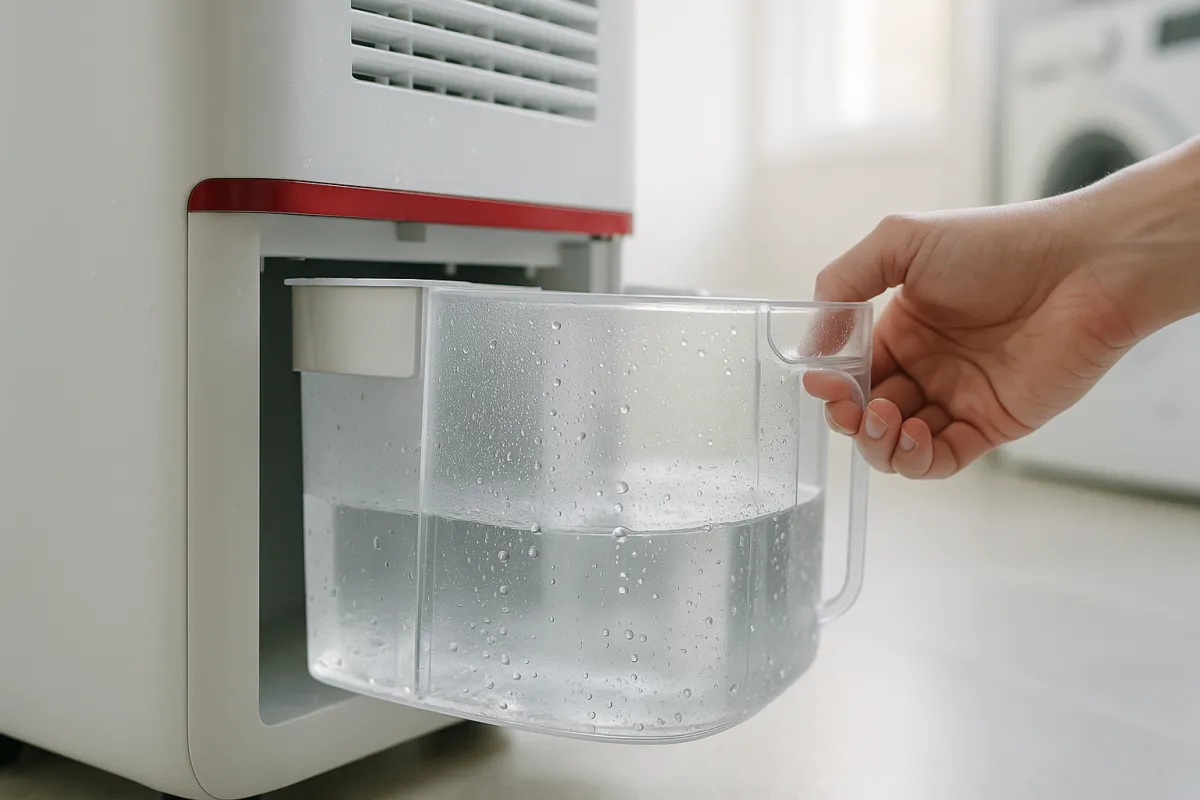
So when you see a pint number, translate it in your head to “how hard can this machine work,” not “how many pints my room makes.” The room decides the demand. The rating decides whether the machine can meet it with room to spare.
The sizing table: square footage times dampness
Here is the shape of a sizing table, expressed as illustrative figures rather than any one brand’s chart. Read down for your room size, across for how damp it feels, and the cell is a rough pint target. Round up to the next capacity sold on the shelf.
| Room size | Moderately damp | Very damp | Wet |
|---|---|---|---|
| 500 sq ft | 10 pints | 12 pints | 15 pints |
| 1,000 sq ft | 14 pints | 17 pints | 20 pints |
| 1,500 sq ft | 18 pints | 22 pints | 26 pints |
| 2,500 sq ft | 26 pints | 32 pints | 38 pints |
Two things stand out. First, moving across a row, from moderately damp to wet, adds roughly as much capacity as jumping up a room-size bracket. Dampness is not a minor tweak; it is a primary input. Second, the numbers scale with area but not in a straight line, because a bigger space also tends to have more surfaces giving off moisture and more air exchange with the outside.
Recommended pints by room size, at very damp
Illustrative capacity for a space that feels very damp. Bars scale with the pint figure.
Capacity roughly doubles from a small room to a large one at the same dampness. Feed your own square footage into our calculator to see where you land.
Use the table to get in the right range, then let the maker’s chart and your own read of the room fine-tune it. The calculator up top does the same arithmetic with your exact square footage and dampness, so you do not have to interpolate between rows.
What size dehumidifier do I need for 500 to 3,000 sq ft?
Because the question almost always arrives with a square footage attached, here is the same sizing logic laid out as a ladder, from a single room to most of a floor. The pint figures are illustrative, use the newer AHAM ratings, and follow the same area-plus-dampness arithmetic as the table above: start from the floor area, step up for the dampness band, then round up to the next capacity actually sold.
| Space | Moderately damp | Very damp | Wet |
|---|---|---|---|
| 500 sq ft | 10 pints | 12 pints | 15 pints |
| 1,000 sq ft | 14 pints | 17 pints | 20 pints |
| 1,500 sq ft | 18 pints | 22 pints | 26 pints |
| 2,000 sq ft | 22 pints | 27 pints | 32 pints |
| 3,000 sq ft | 30 pints | 37 pints | 44 pints |
Reading the rungs in plain terms: around 500 square feet, a bedroom, office, or small den, almost any modern small unit covers the job, and the deciding factors become noise and bucket size rather than raw pints. At 1,000 square feet, the classic one-room-plus problem, a 20-pint unit is the workhorse answer, covering everything up to the wet band. By 1,500 to 2,000 square feet, a large basement or an open lower floor, you are shopping the mid-thirties of pints for wet spaces, and continuous drainage starts to matter as much as capacity. At 3,000 square feet, you have reached the honest limit of a single portable: one machine can only dry the air that reaches it, so a sprawling or divided space that size is better served by two units placed where the dampness lives, or by the whole-house route covered later in this breakdown.
Two cautions carry across every rung. Capacity does not pass through closed doors, so a 2,000 square foot total spread across four shut rooms behaves like four small spaces, not one big one. And the ladder assumes normal ceilings; a tall or vaulted space holds more air than its floor area suggests, which nudges the pint figure up a band. Feed your exact square footage into the cost-per-use calculator and it will place you between the rungs.
Reading the dampness level: what the signs mean
Dampness is half the sizing equation, so it is worth pinning down rather than guessing. The industry describes spaces in rough bands, and each has telltale signs you can read without a meter.
Moderately damp. The space smells musty in humid weather and feels a little clammy, but there are no visible water marks. This is the mildest band and the most common in an average basement during summer.
Very damp. The musty smell is present most of the time, the air feels heavy, and you may see damp patches on walls or floors after wet weather. This is where a lot of basements actually sit, and it is easy to underestimate.
Wet. You can see moisture: beads on cool surfaces, damp spots that do not dry, maybe some staining. The space feels wet to the touch in places.
Extremely wet. There is standing dampness, obvious seepage after rain, or a floor that stays wet. At this point you are also looking at a possible source problem, not just ambient humidity, which we come back to later.
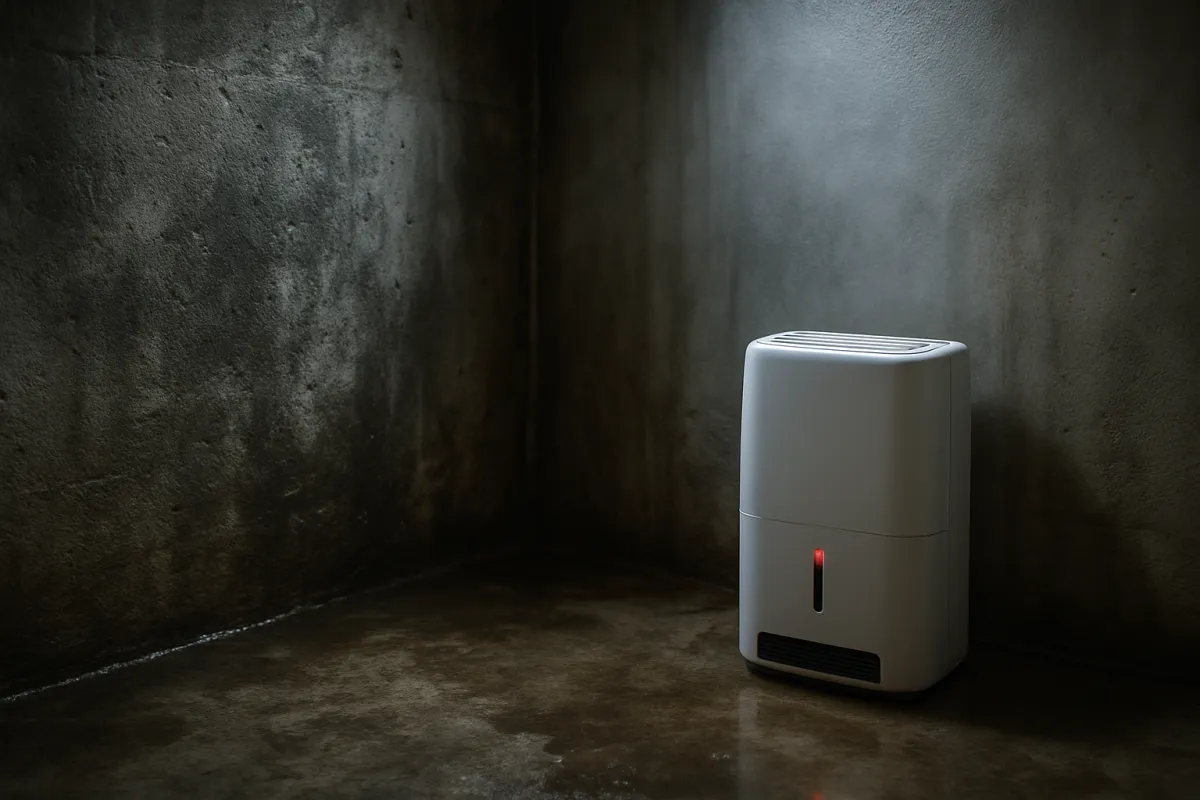
Be honest with the band you pick, and if you are between two, choose the wetter one. Undersizing because you flattered the room is the most common sizing mistake, and it is the expensive one, because the machine then runs constantly trying to catch up.
The new AHAM pint ratings vs the old numbers
If a friend tells you they run a “70-pint” unit and the machines on the shelf now top out around 50, nobody shrank the hardware. The test changed. The Association of Home Appliance Manufacturers standard, the one that produces the pint number, was updated in 2019 to measure capacity at a lower ambient temperature, closer to the cooler conditions a basement dehumidifier actually works in.
Cooler air holds less moisture, so under the new, more realistic test a given machine removes less water in 24 hours, and the printed number falls. The rough translation many people use: an old 70-pint rating maps to about 50 under the new test, and an old 50 to about 35. Same box, smaller number, because the yardstick moved.
This matters when you compare listings, especially older stock or secondhand units against new ones. If you size from an old chart that assumed old ratings and then buy a machine labeled under the new standard, you can end up under-buying. Check which rating you are reading, and when in doubt, size from the newer, lower numbers, which describe real-world performance more faithfully anyway.
Oversizing vs undersizing: short-cycling and never catching up
The two ways to get the size wrong fail differently, and one is worse than the other.
Undersize the machine and it never wins. The room makes more moisture than the unit can remove, so the compressor runs continuously, the humidity hovers above your target, and the space still feels damp despite a machine working around the clock. You pay for constant runtime and get an unsatisfying result. This is the failure mode to avoid, and it is why you round up rather than down.
Oversize modestly and the machine reaches the target quickly, then cycles off and rests. That is efficient and easy on the compressor, and it is the reason a little headroom is the safer bet. The only real downside appears when you go wildly oversized in a small room, where the unit satisfies the humidistat in minutes and short-cycles, switching on and off too frequently, which is less efficient and harder on the hardware. The sweet spot is a size that comfortably covers the space with a bit of margin, not the biggest unit you can find and not the smallest that might cope.
What a dehumidifier costs to run
Here is where a dehumidifier parts ways with something like an air purifier. On a purifier, the filters are the big lifetime cost and the electricity is a rounding error, as we laid out in our breakdown on air-purifier cost-per-use. On a dehumidifier, it is the reverse: there is no expensive consumable, but the machine draws real power, so electricity is the dominant running cost.
The math is the same watts-times-hours-times-rate calculation we use for any appliance. A mid-size dehumidifier draws somewhere around 300 to 700 watts while the compressor runs. Take 500 watts as a working figure, run it 12 hours a day, and it uses about 6 kilowatt-hours daily. At a typical rate near $0.16 per kilowatt-hour, that is roughly $0.96 a day, or about $29 a month while it runs. Push it to around the clock in a wet basement through a humid stretch and you can double that.
That is the number to hold onto. The purchase price is a one-time figure in the low hundreds. The electricity is what recurs, season after season, and it can quietly add up to more than the unit cost over a few years of heavy use. Our cost-per-use calculator will turn your own wattage, hours, and rate into a daily and annual figure in a second.
Monthly cost by how much you run it
Because runtime is the lever, the monthly cost swings widely with how hard you lean on the machine. The table below holds the unit at a 500-watt draw and a typical $0.16 rate, and varies only the hours, to show how much the schedule matters. Figures are illustrative.
| Hours per day | Daily cost | Monthly cost |
|---|---|---|
| 4 hours | $0.32 | $10 |
| 8 hours | $0.64 | $19 |
| 12 hours | $0.96 | $29 |
| 24 hours | $1.92 | $58 |
The lesson is not to run the machine less than the room needs; a damp basement that needs 12 hours will not be helped by four. The lesson is that a humidistat, which cuts the compressor once the target is reached, is worth its place precisely because it trims those hours automatically. A machine set to hold 50 percent and left to cycle costs far less than the same machine pinned on continuous, and the room ends up no wetter.
This is also why oversizing modestly saves money in practice. A unit with headroom reaches target and rests, spending fewer hours in that “hours per day” column than an undersized one grinding away without ever cycling off.
Continuous drainage vs emptying the bucket
Every dehumidifier collects water two ways, and the choice is about convenience and uptime, not running cost.
The bucket, or reservoir, catches condensate until it fills, then the machine shuts off until you empty it. In a mildly damp room that fills the bucket every day or two, that is perfectly fine. In a wet basement the bucket can fill several times a day, and every full bucket is dead time, hours when the machine sits idle because nobody was there to empty it. That is the quiet way a correctly sized unit still fails to keep up.
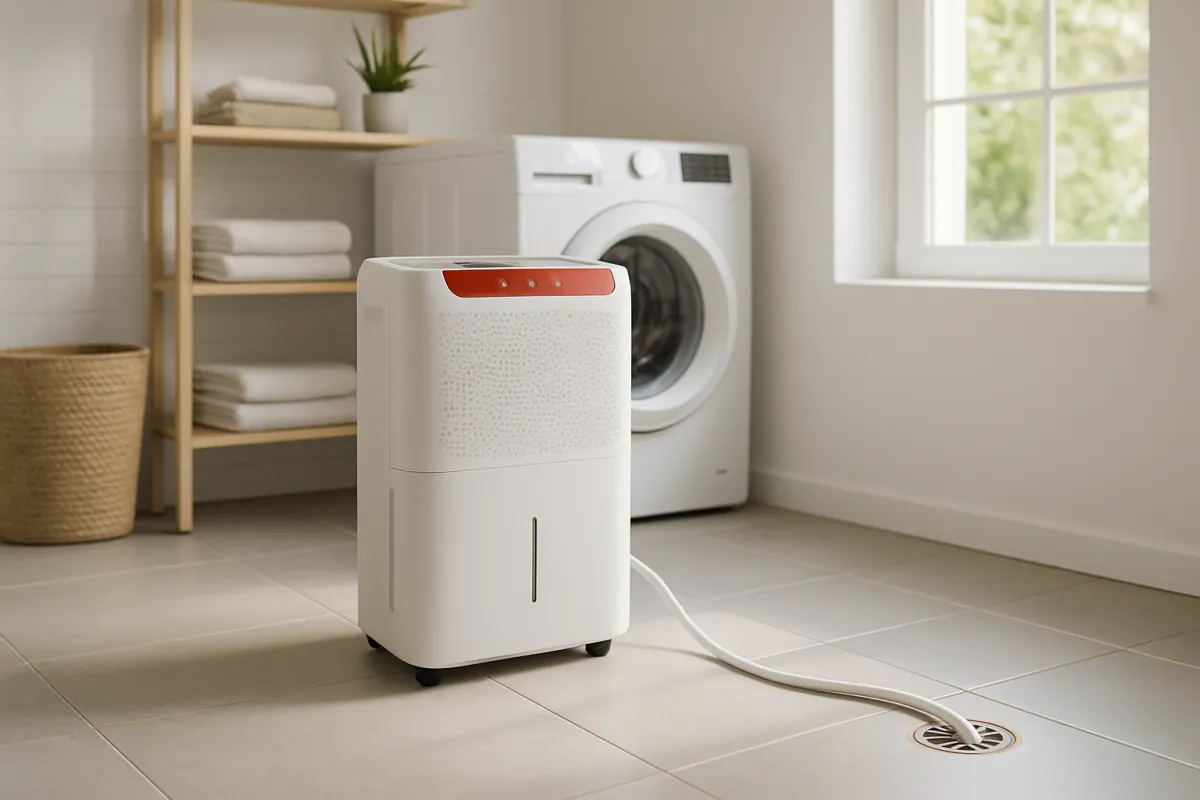
Continuous drainage solves that. Most units accept a hose on a drain port so condensate runs straight to a floor drain by gravity. If the drain is higher than the machine, or there is no nearby drain, a model with a built-in condensate pump can lift the water up to a sink or window. For any space that produces a lot of water, set up continuous drainage from day one. It is the difference between a machine that works while you are at work and one that quits mid-morning with a full tank.
The basement and crawlspace case
A dehumidifier for a basement is the classic job for the machine, and basements and crawlspaces come with their own rules. They are cool, often below grade, and naturally prone to humidity, which is exactly why they tend to read very damp or wetter and call for more capacity than their square footage alone suggests.
For a basement, size from the wetter end of the table, plan on continuous drainage because the bucket will not keep up, and put the unit where air can circulate around it rather than jammed in a corner. Crawlspaces are a special case: they are frequently handled with a dedicated low-profile unit and, ideally, encapsulation with a vapor barrier so the machine is dehumidifying a sealed space rather than fighting the open ground indefinitely. Our breakdown on crawl space dehumidifiers walks that whole setup, from sizing the low-clearance units to the encapsulation question.
The cost consequence is real. A basement unit often runs many hours a day through the humid months, which is why the annual electricity figure for these spaces climbs. It is still usually the right call, because the alternative is a musty, mold-prone basement, but go in knowing the running cost is the meaningful number, and let our cost-per-use calculator show you the annual total before you buy.
What size dehumidifier do I need for a bedroom?
A bedroom is the opposite problem from a basement: the space is small, the dampness is usually mild, and the machine has to share the room with a sleeping person. On pure arithmetic, a typical bedroom of 120 to 250 square feet sits below the bottom rung of the sizing ladder, calling for well under 10 pints of capacity even at the damp end. In practice the smallest mainstream compressor units start around 20 pints under the newer ratings, so almost any modern small dehumidifier covers any bedroom with headroom to spare. That surplus is not a problem here the way wild oversizing in a closet would be: the unit reaches the target quickly, cycles off, and rests, which is efficient and quiet.
Because capacity is essentially solved, the buying decision shifts to the things sizing charts do not show. Noise comes first, since a compressor cycling at night is the reason bedroom units get unplugged; look for a quiet mode or a low fan speed you can actually sleep near, or plan to run the machine in the daytime and let the humidistat hold the result overnight. The bucket is usually fine in a bedroom, since a mildly damp room fills it slowly, which spares you routing a hose through living space. And set the target sensibly: the same 30 to 50 percent band applies, with many people settling near 50 percent for sleeping comfort. If the bedroom dampness traces to a bathroom, drying laundry, or a humid exterior wall, treat the source first; the machine then has far less work to do, and a small unit on a gentle cycle is all the room ever needs.
Whole-house vs portable units
Most people need a portable unit, the freestanding kind you wheel into the room that needs it. It is cheaper to buy, needs no installation, and can move to where the problem is. For a single damp basement or a muggy bedroom, this is almost always the right tool.
A whole-house dehumidifier is a different animal: a larger unit that ties into your ductwork or a dedicated duct run and conditions the whole home’s air. It costs considerably more up front and usually needs professional installation, but for a large home with humidity problems across multiple floors, it can be more effective and, per pint removed, sometimes more efficient than several portables running independently. It also disappears into the mechanical room instead of sitting in your living space.
The deciding question is scope. One problem room means a portable. Whole-home humidity, or a big house where you would otherwise buy three or four portables, is where the ducted unit starts to make sense. Size a whole-house unit with a professional, since the calculation involves your ductwork and air-handling as well as floor area.
Energy efficiency and the Energy Star angle
Since electricity is the dominant running cost, efficiency is where you save real money over a dehumidifier’s life. The figure to look for is the integrated energy factor, which expresses how many liters of water the machine removes per kilowatt-hour it consumes. Higher is better, and it directly shrinks that monthly cost table above.
An Energy Star certified unit has to clear an efficiency bar, which is why the label is worth seeking out on a machine you expect to run for months at a time. The premium you pay for a more efficient model is often repaid through the electricity you do not spend, especially in a basement that runs long hours. This is the same logic as any appliance you use constantly: the sticker price is a one-time number, and efficiency compounds every day it runs.
Do the arithmetic rather than trusting the badge alone. A more efficient unit that costs a bit more up front but draws fewer watts for the same water removed will usually win over a few seasons of heavy use. Feed the two candidates’ wattages into the cost-per-use calculator and compare the annual figures side by side.
Setting your humidity target: 30 to 50 percent
A dehumidifier is only as good as the target you set it to hold. The commonly cited range for comfort and mold control is 30 to 50 percent relative humidity, and many people settle around 45 to 50 percent. That band is low enough to discourage mold, dust mites, and musty odors, and high enough that you are not wasting electricity over-drying air that is already fine.
Going lower than roughly 30 percent buys you little and costs you more, since the machine works harder to wring out air that no longer needs it. Letting the space drift above 60 percent is where the problems you bought the machine to prevent start to return. So set the humidistat to a target in the healthy band and let the unit cycle to maintain it, rather than running it flat out and hoping.
In a very wet space you may not hit target on the first day, and that is normal. Let the machine work the humidity down over a day or two, keep the doors and windows shut so you are not fighting fresh humid air, and it will settle into a rhythm of short maintenance cycles once the room is under control. Holding a target is cheaper than chasing one, which is the whole reason the humidistat exists.
Features that matter vs marketing
Strip away the marketing and only a handful of features change the ownership experience. These are the ones worth paying for, and our breakdown on how to choose a dehumidifier walks the full feature-by-feature decision if you want the long version.
A built-in humidistat. Non-negotiable. This is what lets the machine cycle to a target instead of running continuously, and it is the single biggest lever on your running cost.
A drain port, and a pump if you need lift. For any wet space, the ability to drain continuously is what keeps the unit working unattended. A built-in pump matters only if your drain is above the machine.
A sensible efficiency rating. The integrated energy factor and an Energy Star label translate directly into lower electricity bills over months of running.
Auto-restart and a defrost mode. Auto-restart brings the unit back to its setting after a power blip. Defrost lets it work in cooler spaces, like a chilly basement, without icing up the coils.
What matters less than the box suggests: app connectivity, a dozen fan speeds, and mood lighting. They are pleasant, but they do not change whether the machine holds your humidity target for a reasonable running cost. Buy the capacity and the humidistat first; treat the rest as tie-breakers.
Maintenance: filter, coils, and the tank
A dehumidifier is low-maintenance, but not no-maintenance, and neglect shows up as lost efficiency rather than a dramatic failure. There are three things to keep an eye on, and none is expensive.
The air filter is usually a simple washable mesh that catches dust before it reaches the coils. Rinse it every few weeks in a dusty space, monthly otherwise. A clogged filter chokes airflow and makes the machine work harder for less water, which quietly raises your running cost. The coils themselves should stay reasonably clean; wipe accessible dust off periodically so they can transfer heat efficiently. And the tank benefits from an occasional rinse to discourage the slime and smell that standing water invites, unless you are draining continuously, in which case the tank stays largely dry.
That is the whole routine. Unlike a purifier, there is no consumable filter you keep rebuying, which is a big reason the lifetime cost of a dehumidifier is dominated by electricity rather than parts. Keep the filter clean and the coils clear, and the machine holds its rated efficiency for years.
When a dehumidifier beats fixing the moisture source
The honest limit of any dehumidifier is that it treats humid air, not the reason the air is humid. That distinction decides whether the machine is the right buy or an expensive way to avoid a repair.
A dehumidifier is the right answer for ambient dampness with no single obvious cause: a naturally humid basement, a muggy regional climate, a laundry room that stays damp, a home that simply runs humid in summer. In those cases there is nothing to “fix” at the source, and steadily removing moisture from the air is exactly the job.
It is the wrong answer as a mask for an active problem. An ongoing leak, a grading fault that channels rainwater toward the foundation, a missing or failed vapor barrier, or a plumbing drip will keep feeding water into the space faster than you would want to pay to remove it. Running a dehumidifier against a live source means paying electricity indefinitely to chase water you could have stopped. When you see the “extremely wet” signs, seepage after every rain, standing water, treat that as a source problem first. Often the right plan is both: fix the source, then let a correctly sized dehumidifier handle the ambient humidity that remains.
A worked example: one 1,200 sq ft damp basement
Put it all together on a single realistic case. You have a 1,200 square foot basement that reads very damp: musty most of the time, damp patches after heavy rain, no standing water. What do you buy, and what does it cost to run?
Sizing. Start from the area and add for the dampness. A 1,200 square foot space at “very damp” lands around 19 to 20 pints on our illustrative table, so you round up to the next real size and buy a 20-pint modern unit, or a touch more for headroom so it cycles rather than grinds. Confirm against the maker’s chart, and make sure the pint number is the newer rating, not an old one.
Setup. Because it is a basement, you skip the bucket and run a hose to the nearby floor drain, so the unit never stops for a full tank. You set the humidistat to hold about 50 percent.
Running cost. Say the unit averages 500 watts and, through the humid season, runs about 12 hours a day. That is roughly $0.96 a day, near $29 a month while it runs, and if you keep it going at that pace across the year it works out around $350 a year in electricity. Run it hard only in the humid months and the annual figure comes down accordingly. Against a musty, mold-prone basement, most owners find that a fair trade, and our cost-per-use calculator lets you swap in your own rate and hours to see your version of the number.
The yearly cost of running one
Where a year of dehumidifier ownership goes, for a basement unit run seasonally. Illustrative shares.
The mirror image of a purifier: here electricity dominates and there is no costly consumable. Efficiency and runtime are the levers that move your total.
That split is the whole argument for buying on efficiency and running with a humidistat. Three-quarters of the annual cost is electricity, so the two things that shrink your bill are a machine that removes more water per watt and a control that stops it running once the room is dry.
How to buy: a sizing and cost checklist
Before you spend, run your candidate through these checks. Clear all five and the machine will be sized right and cost what you expect.
- Size from area and dampness, then round up. Use the table or the calculator, pick the honest dampness band, and buy the next real capacity above your target rather than the one just below it.
- Confirm which pint rating you are reading. New-standard numbers run lower than old ones. Size from the newer figures so you do not under-buy.
- Insist on a humidistat. It is the control that turns runtime, and therefore cost, from a fixed drain into a managed one.
- Plan the drainage for the space. Bucket for a mildly damp room, continuous drainage for anything wet, a pump if the drain sits above the unit.
- Check the efficiency and do the annual math. Compare integrated energy factor or Energy Star status, then run the wattages through the cost-per-use calculator and compare annual costs, not sticker prices.
Clear those and the decision is made on numbers rather than packaging, which is the whole point of a breakdown.
Seasonal running vs year-round: what the calendar does to the bill
The annual electricity figure for a dehumidifier hides a lever the monthly table does not show: how many months of the year the machine actually runs. A basement unit worked hard through a humid summer but idle through a dry winter costs a fraction of the same machine run every month. This is why a single annual number can mislead, and why the honest way to budget is to estimate the runtime season by season rather than assuming twelve identical months.
Take the worked example’s basement unit at roughly $29 a month while running. Run it flat through three humid months and rest it the other nine, and the year lands near $86, not the $350 a year-round pace would suggest. Run it hard across six damp months in a wetter climate and you are closer to $160. The machine never changed; the calendar did all the work, exactly as the hours column did in the monthly cost table.
The practical move is to match the machine to the humid season you actually have, lean on the humidistat so it cycles rather than grinds even during those months, and expect the bill to rise and fall with the weather. In a climate that runs humid most of the year, budget closer to the year-round figure and weigh efficiency harder, since every extra month of runtime magnifies the gap between an efficient unit and a thirsty one.
Desiccant vs compressor units: a cold-room cost note
Most portable dehumidifiers are compressor machines, which pull water by chilling a coil, and they work well in warm, humid air. Their weakness is the cold: as a space drops toward the low end of the range, the coil can frost and the machine spends energy defrosting rather than drying, so its efficiency falls in exactly the chilly basements and garages people most want to dry.
Desiccant dehumidifiers take a different path, absorbing moisture onto a drying material rather than condensing it, which lets them keep working in cold spaces where a compressor unit struggles. The tradeoff is running cost: desiccant models generally draw more power for the same water removed at normal temperatures, so in a warm room they lose the efficiency contest. The rule of thumb is to match the technology to the temperature, a compressor unit for a warm or normal space and a desiccant unit for a genuinely cold one, then run the wattages through the cost-per-use calculator so the choice rests on the annual figure rather than the label.
The bottom line
Sizing a dehumidifier comes down to two honest inputs, how big the space is and how damp it feels, turned into a pint number you round up to the next size on the shelf. Read the newer, lower pint ratings rather than the old ones, lean toward a little headroom rather than the smallest unit that might cope, and set a humidistat target in the 30 to 50 percent band so the machine cycles instead of grinding. Then judge the running cost the way we judge any gear: watts times hours times your rate. On a dehumidifier that electricity is the dominant cost, not a consumable, so buy for efficiency, drain it continuously in wet spaces, and fix the source when there is a source to fix. Do that, and a machine that could have run all day and lost instead holds your air exactly where you want it, for a cost you chose on purpose.
A note on scope: this breakdown is here to teach the sizing and the cost arithmetic, not to sell you a particular machine. Every pint figure, wattage, and dollar amount above is an illustrative planning number, drawn from typical ranges rather than measured on any one model, and real capacities, electricity rates, and runtimes vary enough to move your result meaningfully. None of it is professional advice on moisture, mold, or electrical work. If you see signs of an active leak, structural damp, or health-related mold, bring in a qualified specialist, and confirm any unit’s current rating and running cost against the maker’s own figures before it goes in your cart.
Frequently asked questions
What size dehumidifier do I need for a basement?
Basements read damper than their floor area alone suggests, so size a dehumidifier for a basement from the wetter end of the chart rather than the middle. As an illustrative starting point, a 1,000 square foot basement that feels very damp often points to a unit near 17 to 20 pints, and a large or wet basement can reach into the thirties. Round up to the next real capacity on the shelf, plan on continuous drainage since the bucket will not keep up, and confirm the pint figure is the newer AHAM rating rather than an old one. Treat any single number as a planning figure and check it against the maker's own room chart.
How much dehumidifier do I need for my room?
Size it by two things: the floor area of the space and how damp that space feels. A moderately damp room of about 1,000 square feet commonly calls for a unit in the mid-teens of pints per day, while the same room that feels very damp or wet steps up several pints. As an illustrative rule, start from the square footage, add capacity for the dampness level, then round up to the next real size on the shelf. A 1,200 square foot damp basement often lands around a 20-pint modern unit, but treat that as a planning figure and confirm against the maker's own room chart.
What does the pint rating on a dehumidifier mean?
The pint number is the machine's capacity: how many pints of water it can pull from the air in 24 hours under a standard test condition, not a promise of how much your room will actually give up. A 20-pint unit does not mean your basement produces 20 pints a day. It means that under the test's temperature and humidity, the machine could remove that much. Your real collection depends on how damp your air is, so the rating is a way to compare machines, not a forecast for your room.
What size dehumidifier do I need for 2,000 sq ft?
For a space around 2,000 square feet, an illustrative sizing ladder points to roughly 22 pints if the area is moderately damp, about 27 pints if it feels very damp, and near 32 pints if it is genuinely wet, all in the newer AHAM ratings. Round up to the next real capacity on the shelf, which at this size usually means a unit sold in the thirties of pints. If the area is one open space, a single larger unit is simpler and usually cheaper to run than two small ones; if it is several closed rooms, capacity does not travel through walls, so plan a unit per problem room instead. Treat every figure as a planning number and confirm against the maker's own room chart.
What size dehumidifier do I need for 1,000 sq ft?
A 1,000 square foot space commonly lands around 14 pints when moderately damp, about 17 pints when very damp, and roughly 20 pints when wet, using the newer test ratings and treating each figure as illustrative rather than a promise. That makes a modern 20-pint unit the workhorse answer for this size: it covers the moderately damp case with headroom and the very damp case comfortably, and headroom means the machine cycles off rather than grinding all day. Check that the rating on the box is the post-2019 number, pick the wetter band honestly if you are between two, and confirm the choice against the manufacturer's chart before buying.
How much does it cost to run a dehumidifier per month?
Running cost is watts times hours times your electricity rate, and dehumidifiers draw more than most people expect. A mid-size unit pulling around 500 watts, run 12 hours a day, uses roughly 6 kilowatt-hours a day. At a typical rate near $0.16 per kilowatt-hour that is close to $0.96 a day, or about $29 a month while it runs. Run it around the clock in a wet basement and the monthly figure roughly doubles. These are illustrative numbers; your own rate and runtime move them a lot.
Why did dehumidifier pint ratings change?
In 2019 the test standard the industry uses was updated to measure capacity at a lower, more realistic temperature. Because cooler air holds less moisture, machines remove less water under the new test, so the printed pint numbers dropped even though the hardware did not shrink. A unit that was labeled 70 pints under the old test is often labeled around 50 under the new one. When you compare an older listing to a newer one, check which rating you are looking at, or you will size the machine wrong.
Is it better to oversize or undersize a dehumidifier?
Modestly oversizing is usually the safer mistake. An undersized unit runs constantly and never quite pulls the humidity down to target, which costs you electricity for a room that still feels damp. A somewhat larger unit reaches the target faster, then cycles off, which can use less energy overall and puts less wear on the compressor. The one caution is going wildly oversized in a small space, where very short cycles are less efficient. Aim for a size that comfortably covers the room, with a little headroom, rather than the smallest one that might cope.
What humidity level should I set a dehumidifier to?
A target between 30 and 50 percent relative humidity is the commonly cited comfort and mold-control range, and many people settle around 45 to 50 percent. Below roughly 30 percent you gain little and just spend more electricity drying air that is already dry enough. Above 60 percent is where mold, dust mites, and that musty smell thrive. Set the humidistat to your target and let the machine cycle to hold it, rather than running it flat out. In a very wet space you may need to reach the target in stages.
Do I need continuous drainage or is the bucket fine?
It depends on how much water the space produces and how often you want to think about it. A bucket is fine for a mildly damp room that fills it every day or two. In a wet basement or crawlspace the bucket can fill several times a day, and a full bucket shuts the machine off, so you lose hours of drying every time you are not there to empty it. For those spaces, running a hose to a floor drain, or using a built-in pump to lift water to a sink, keeps the unit working unattended. That is a setup decision, not a running cost.
Is a dehumidifier cheaper than fixing the moisture problem?
Sometimes, and sometimes it is the wrong tool entirely. A dehumidifier is the right answer for ambient dampness with no single obvious cause: a naturally humid basement, a muggy climate, a laundry room. It is the wrong answer for an active leak, a grading problem that sends water toward the foundation, or a missing vapor barrier, because you would be paying electricity indefinitely to chase water you could stop at the source. Run the machine for genuine ambient humidity; fix the source when there is a source to fix. Often the honest plan is both.