What's on this page
- What a liter of water actually costs
- The filter ladder, from pitcher to whole house
- Cartridges: the recurring cost nobody budgets
- A family of four, 8 liters a day: one year, four strategies
- Where a pitcher year actually goes
- What filters actually remove
- Check your water report before you spend anything
- What bottled water actually is
- Taste, the honest reason people switch
- The convenience ledger
- The environmental line, kept in dollars
- Sparkling water: the sidebar economics
- The emergency-storage crossover
- Break-even: when each filter pays for itself
- When bottled water honestly wins
- The five-year totals
- Cost per use, the BenchNest way
- Common water-spending mistakes
- Well water and the private-supply exception
- The bottom line
Short answer: Bottled water typically costs $0.30 to $1.00 or more per liter, while the same liter through a pitcher filter runs roughly $0.05 to $0.10, through an under-sink unit roughly $0.02 to $0.05, and straight from the tap a fraction of a cent, all illustrative figures. For a typical family the filter hardware pays for itself against bottled in weeks to a few months, and the five-year saving commonly lands in the thousands of dollars.
Water is the one thing in your kitchen you buy thousands of times a year, which makes it the purest cost-per-use problem on this whole site. Bottled water typically costs somewhere between $0.30 and $1.00 or more per liter. The same liter through a pitcher filter runs roughly $0.05 to $0.10, through an under-sink unit roughly $0.02 to $0.05, and straight from the tap a fraction of a cent. No other comparison we run on this bench has gaps that wide between options that all end in the same glass.
This breakdown does what the label on the flat never will: it prices every strategy per liter, exposes the cartridge costs that quietly dominate filter ownership, runs a family of four through a full year under each option, and names the honest cases where bottled still wins. As always, the numbers here are illustrative planning figures, and you can run your own in our cost-per-use calculator as you read.
Key takeaways
- The per-liter gap is enormous: bottled typically $0.30 to $1.00+, pitcher-filtered around $0.05 to $0.10, under-sink around $0.02 to $0.05, and plain tap a fraction of a cent.
- Cartridges, not hardware, are the real cost of filtering. A pitcher's cost is mostly its replacement cartridges, and skipping changes does not save money, it just stops the filtering.
- For a typical family, filter hardware pays for itself against bottled in weeks to a few months, and the five-year saving commonly lands in the thousands of dollars.
- Check your utility's water quality report before spending anything: if your tap already meets standards and tastes fine chilled, the cheapest strategy is a $15 carafe.
- Bottled still wins honestly in a few cases: rentals, travel, contaminated-supply events, and very low consumption, plus a small emergency stock for everyone.
What a liter of water actually costs
Start with the headline arithmetic, because it frames everything else. A single-serve bottle from a convenience store can cost $1.00 or more per liter. Supermarket multipacks land closer to $0.40 to $0.80 per liter, and the big bulk flats can get down near $0.30. Call the realistic blended figure for a bottled household something like $0.60 per liter, and remember these are illustrative typical numbers, not quotes.
Now the other side of the ledger. A pitcher filter, once you amortize the pitcher and count every cartridge, typically delivers water around $0.05 to $0.10 per liter. An under-sink carbon system, with its bigger and longer-lived cartridges, gets down to roughly $0.02 to $0.05. Reverse osmosis sits a little above plain carbon because of membrane costs and reject water, often $0.04 to $0.08. And municipal tap water, untouched, costs most households a fraction of a cent per liter, commonly around $0.002.
Read those numbers again as multiples. Bottled at $0.60 is roughly 8x the pitcher, 15x the under-sink unit, and about 300x the tap. There is no other product category we test where the premium option costs two orders of magnitude more than the baseline while delivering, in many municipalities, a chemically similar product. The rest of this breakdown is about when that premium is justified and when it is just a habit with a receipt.
The filter ladder, from pitcher to whole house
Filters come in a ladder of commitment, and each rung trades more upfront cost for a lower per-liter figure. The prices below are typical illustrative ranges.
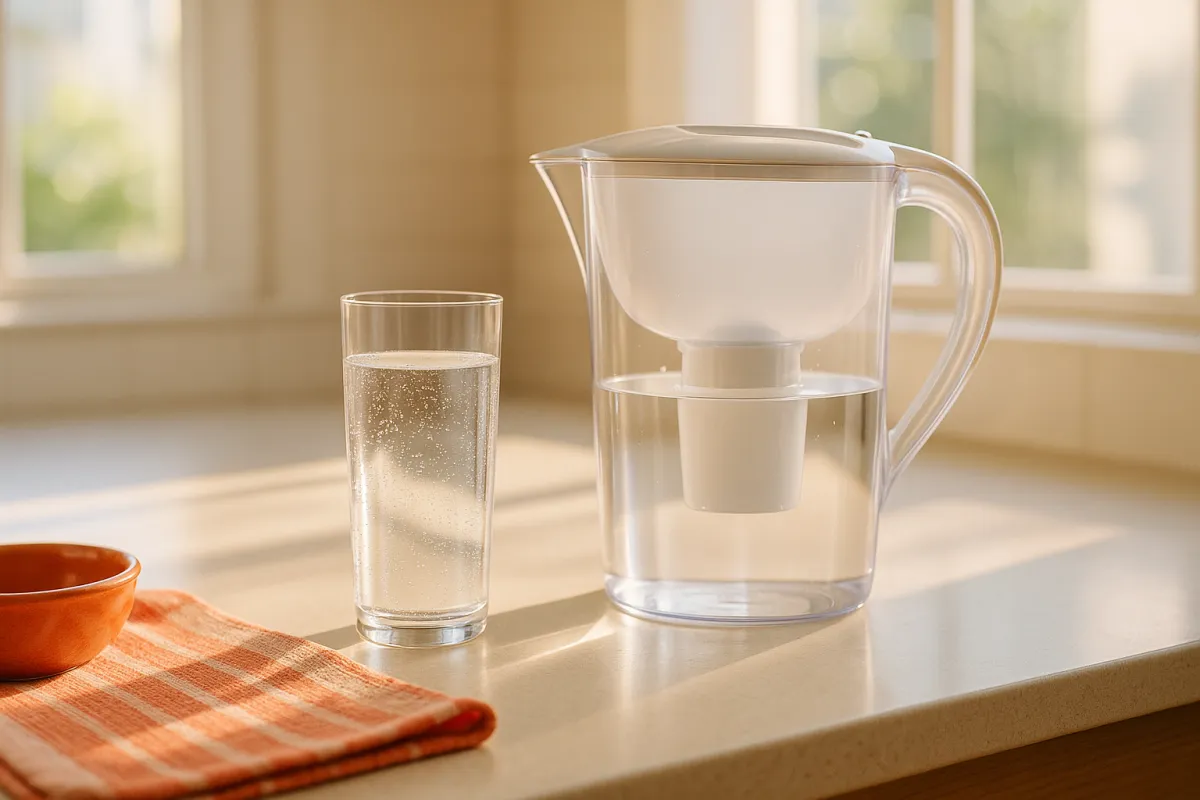
The pitcher is the entry rung: $25 to $45 to buy, zero installation, lives in the fridge. Its cartridges are small, typically rated for something like 100 to 150 liters, and cost a few dollars each, which is why the pitcher has the highest per-liter cost of any filter. It is also the slowest, a real consideration for thirsty households.
The faucet-mount screws onto the tap for roughly $20 to $50, filters on demand, and slots between the pitcher and under-sink on both cost and convenience. Cartridge economics are similar to a pitcher’s, slightly better per liter, and it removes the refill chore entirely.
The under-sink unit is the value rung for most families: typically $100 to $300 for a carbon system, an hour of simple installation or a plumber’s visit, and large cartridges rated for six to twelve months. That combination is what drives its per-liter cost down toward $0.02 to $0.05.
Reverse osmosis adds a membrane stage below the sink, typically $200 to $600 plus annual filter and membrane changes, for the broadest removal. Whole-house systems treat every tap and shower, at $500 to $2,000+ installed; they are about protecting plumbing and skin, not drinking economics, and they still usually want a drinking-stage filter at the sink.
Cartridges: the recurring cost nobody budgets
Here is the pattern this bench sees in every category with a consumable, from the HEPA filters in our air purifier breakdown to vacuum bags: the hardware is the small number and the consumable is the big one. Water filters are the most extreme case we have seen. A $35 pitcher can easily consume $500 or more in cartridges over five years of family use. The pitcher is not the product; the cartridge subscription is.
The replacement schedules are also the most ignored in the house. A pitcher cartridge rated for 150 liters lasts a family of four less than three weeks, yet plenty of pitchers run the same cartridge for months. An exhausted carbon cartridge does not politely stop pouring; the water flows fine, it just stops being treated, and a badly overrun cartridge can begin releasing some of what it captured. Paying for a filter and running it dead is the worst of both worlds: filter costs, tap results.
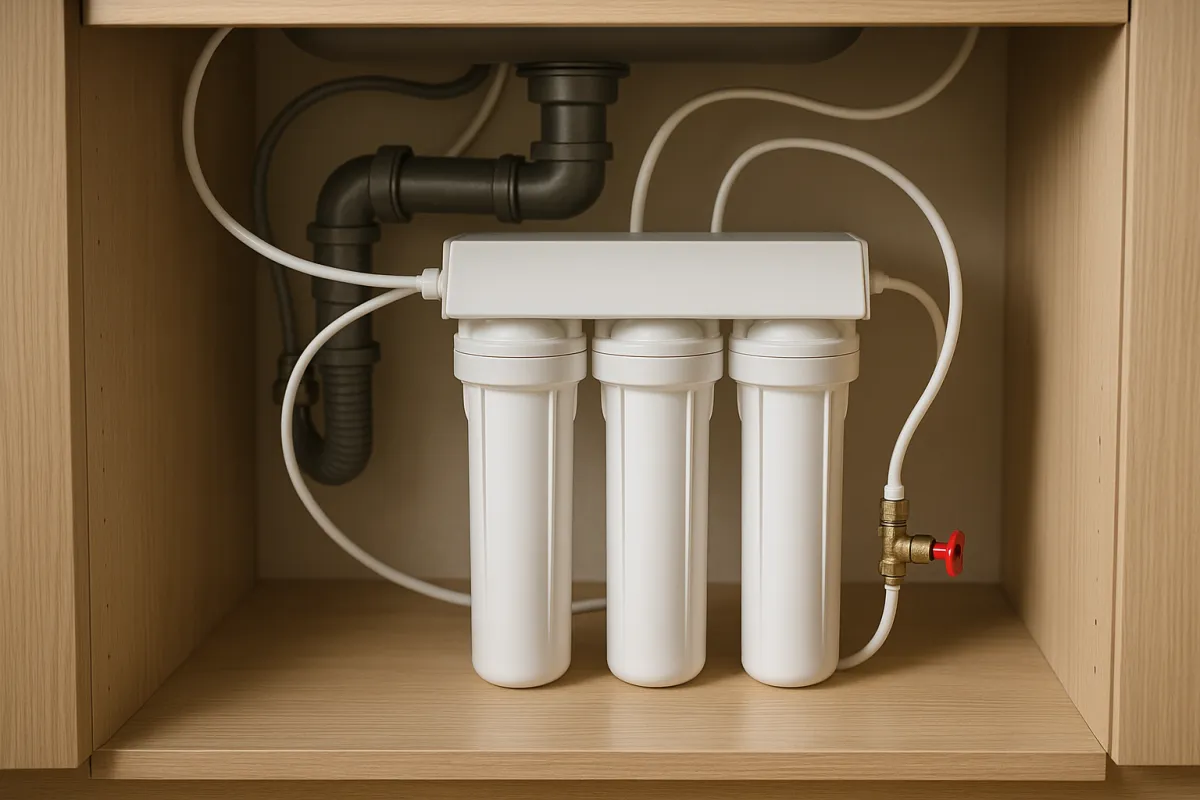
So budget cartridges the way you budget the hardware, before buying. Pitchers: a cartridge every two to four weeks at family volume, a few dollars each. Faucet mounts: every two to three months. Under-sink carbon: one or two cartridges a year, often $30 to $60 each. RO: a set of pre-filters and post-filters yearly plus a membrane every two to three years. Whichever rung you choose, put the schedule on a calendar the day you install it.
A family of four, 8 liters a day: one year, four strategies
Make it concrete. A family of four drinking a typical 8 liters a day consumes about 2,920 liters a year. Here is that year under each strategy, using the illustrative prices above.
All bottled, at a blended $0.60 per liter: about $1,750 for the year. At bargain-flat prices near $0.30, still about $875. This is the number most bottled households have never multiplied out.
Pitcher, $35 upfront: roughly 20 cartridges at $6 each is about $117, plus around $6 of tap water. Year one lands near $158, and the per-liter cost works out to about $0.05. The catch is workflow: 8 liters a day through a slow two-liter pitcher is a lot of refilling.
Under-sink carbon, $200 upfront: about $60 a year in cartridges plus the same $6 of tap water. Year one is roughly $266, and every year after that closer to $66, which is around $0.02 per liter ongoing.
Reverse osmosis, $350 upfront: roughly $100 a year in filters and membrane share, plus about $25 of water once you count the liters sent to the drain. Year one near $475, ongoing near $125.
Plain tap: about $6 for the whole year. That is the baseline every other line is paying to improve on. Against the bottled figure, every filter strategy, even RO in year one with its hardware included, costs less than four months of bottles.
Where a pitcher year actually goes
Since the pitcher is the rung most households start on, it is worth seeing where its money goes. The split is lopsided in a way the shelf price completely hides.
A year of pitcher filtering, where the money goes
Family of four at 8 liters a day. Pitcher amortized over five years, cartridges on schedule, tap water metered. Illustrative.
Nine dollars in ten go to cartridges. This is why comparing pitchers on their shelf price is pointless: compare them on cartridge price, rated liters, and how honestly you will keep the schedule.
Two lessons fall out. First, a pitcher with cheaper or longer-rated cartridges beats a prettier pitcher every time, because the hardware is 5% of the story. Second, this split is exactly why heavy-drinking households graduate to under-sink units: bigger cartridges rated for thousands of liters collapse that 90% slice, which is the entire mechanism behind the per-liter drop.
What filters actually remove
Keep this educational and tiered, because the marketing will not. Activated carbon, the media inside pitchers, faucet mounts, and most under-sink units, works by adsorption: contaminants stick to the carbon’s enormous internal surface. It is genuinely good at chlorine and its byproducts, which is most of what makes tap water taste and smell like a pool, and certified carbon units can also reduce a list of specific contaminants; the certification sheet, not the box art, tells you which ones.
What carbon does not do is remove dissolved minerals and salts. Total dissolved solids pass straight through, which is why carbon-filtered water keeps its mineral taste. Reverse osmosis is the tier above: pressure pushes water through a membrane fine enough to reject most dissolved substances, producing the flattest, most stripped-down water a home system can make. That breadth is RO’s case, and its costs are the membrane, the reject water, and sometimes a remineralizing stage because people miss the taste of minerals.
The practical rule: match the tier to a documented problem. Taste and odor complaints are carbon jobs. Specific contaminants named on a water report or a home test are certified-filter jobs, carbon or RO depending on the substance. Buying RO because it sounds maximal, with no problem on paper, is paying membrane prices to fix chlorine that a $30 cartridge handles.
Check your water report before you spend anything
Here is the step this breakdown insists on before any purchase: read your water quality report. In the US, community water systems publish one every year, listing what was found and how it compares with the standards. Most municipal supplies in developed systems meet those standards, which means the water at your tap is already, by the only definitions anyone measures, fine to drink.
That single free document can save you every dollar in this article. If the report is clean and your only complaint is a chlorine edge, the cheapest fix is not even a filter: chill a covered carafe of tap water overnight and much of the chlorine taste dissipates on its own. Cost, roughly $15 once. If the report is clean but the taste still bothers you, a carbon filter is a taste appliance, a perfectly legitimate purchase as long as you know that is what you are buying.
If the report or a home test shows something real, or you are on a private well where nobody publishes a report for you, the calculation flips: now a certified filter matched to that specific finding is not a taste appliance but the whole point, and the bottled-versus-filter math becomes a question of which certified solution is cheapest per liter. Either way, the report comes first. Spending hundreds to filter water you never checked is testing gear against a problem you never confirmed exists.
What bottled water actually is
The quiet fact of the category: a meaningful share of the bottled water on the shelf is filtered municipal water. Not spring water, not glacier melt, the same supply that feeds household taps, run through treatment such as carbon filtering and reverse osmosis, then bottled and marked up by a factor of a hundred or so over its source. The label usually discloses this in small print as something like “public water source.”
That is not a scandal, it is just worth pricing correctly: when you buy that bottle, you are paying mostly for treatment you could run at home for pennies, plus packaging and logistics. Spring and mineral waters are genuinely different products drawn from named sources with their own mineral profiles, and if you prefer one, that preference is real. But the generic purified bottle is, functionally, an under-sink filter’s output with a transport bill.
Bottled water is held to safety standards broadly comparable to tap standards, so the safety story is mostly a wash in places with well-run municipal systems. There are real exceptions, covered honestly later, but the default assumption that bottled is a categorically cleaner product does not survive contact with the label. What you are reliably buying is convenience, consistency, and portability. Those have value; price them as what they are.
Taste, the honest reason people switch
Strip away the quality claims and the environmental arguments, and taste is the honest engine of most bottled-water habits. Chlorinated tap water can genuinely taste flat, sharp, or like a swimming pool, and no one should be argued out of noticing that. Taste is also exactly what carbon filters fix best, which makes it the cheapest complaint in this whole comparison to solve.
The humbling part is what blind tastings keep showing: when the labels come off and the temperatures match, most people struggle to reliably distinguish bottled water from chilled, filtered tap, and plenty of tasters rank the tap sample first. Temperature does a surprising amount of the work; cold water suppresses most of the taste complaints people attribute to their supply. This is why our standing suggestion is to run the test at home before spending: one glass of your bottled favorite, one glass of filtered tap, both refrigerated, poured by someone else.
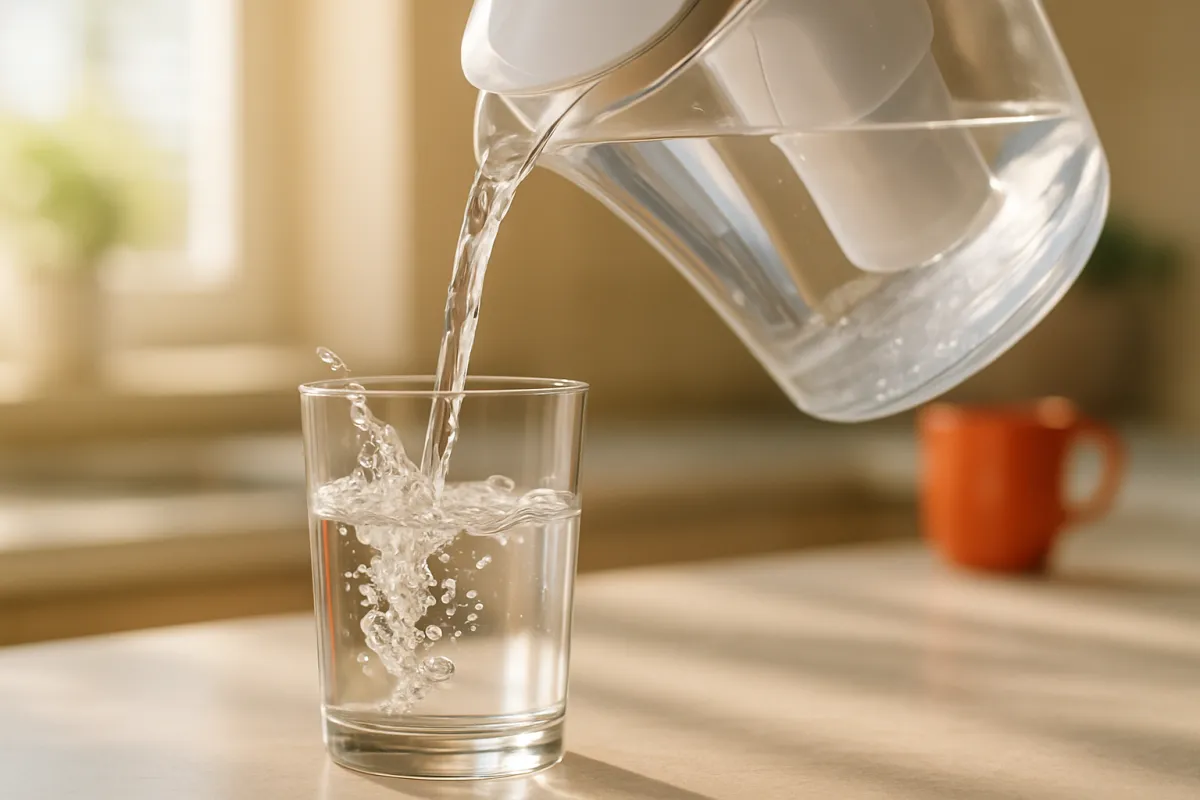
If you can tell them apart and prefer the bottle, you now know what the preference costs per liter and can decide with open eyes. If you cannot, and most households discover they cannot, the entire bottled budget was buying a label. Either result is worth more than any review, because it is measured on your own water, and it costs one flat of bottles to run.
The convenience ledger
Cost per liter is not the whole ledger; effort belongs in it too, the same way time carried real weight in our robot vacuum breakdown. Bottled water’s costs are physical: hauling flats from store to car to house, week after week, then storing them somewhere, then giving up fridge space to stock cold ones, then managing the empties. A family at 8 liters a day moves roughly three tons of water a year by hand, in awkward 10 to 15 kilogram flats.
The filter’s side of the ledger is smaller but not zero, and pretending otherwise is how filters get abandoned. A pitcher demands constant refilling and fridge space of its own, plus a cartridge change every few weeks. An under-sink unit demands an installation afternoon and then one or two cartridge swaps a year, ten minutes each. RO adds a storage tank under the sink and slightly more involved annual service.
Tallied honestly, the under-sink unit wins the convenience column outright: water appears at the tap, cold-ish, instantly, forever, with two short maintenance events a year. The pitcher roughly ties bottled on daily friction while beating it on hauling. This matters because the cheapest strategy you will not sustain is not actually cheap; the ledger predicts which system still gets used in year three.
The environmental line, kept in dollars
This bench prices things, so here is the environmental point translated into money and kept brief. Every bottled liter carries packaging costs you partly pay directly: in deposit jurisdictions, five to fifteen cents per container fronted at the register, refundable only if you do the returning; bag fees at checkout; and, invisibly, the trucking of a product that is 99% water weight, baked into the shelf price. A filter moves the same liters through pipes that already exist, which is a large part of why its per-liter number is so much smaller.
A family at 8 liters a day empties on the order of four to eight bottles daily depending on size, call it 1,500 to 3,000 containers a year. At deposit rates, that is potentially a couple hundred dollars a year cycling through the deposit system, recovered only with the ongoing chore of hauling empties back. None of this requires an opinion about the planet to enter the math; the containers are simply a cost stream the filter strategy does not have. If the environmental side does matter to you, count it as a bonus that happens to point the same direction as the arithmetic.
Sparkling water: the sidebar economics
The bubbly aisle deserves its own small ledger, because sparkling is the one segment where “just filter it” is not an answer; the tap does not carbonate. Canned and bottled sparkling water typically runs $0.50 to $1.50 per liter, comfortably above still bottled, and heavy sparkling households can quietly out-spend their still-water habit.
The home soda maker is the filter-equivalent move. Typical machine, $60 to $130; a CO2 cylinder carbonates on the order of 60 liters and swaps for roughly $15 to $20, putting the gas cost near $0.25 to $0.33 per liter. Feed it filtered tap water and the all-in figure lands around $0.30 to $0.40 per liter after the machine amortizes, roughly half the price of mid-range cans, with no flats to haul and no empties. Against premium sparkling brands, the saving is larger still.
The break-even math is friendly at real consumption: a liter-a-day sparkling habit at $1.00 per liter spends $365 a year, while the soda-maker path runs perhaps $130 to $150 including amortization, so the machine pays for itself in a few months. The honest caveats: cylinder swaps are a small recurring errand, the machines carbonate plain water best, and a rarely used machine on a countertop is the same shelf-ornament risk as any gear we test. Low or occasional sparkling drinkers should just buy the cans they actually drink.
The emergency-storage crossover
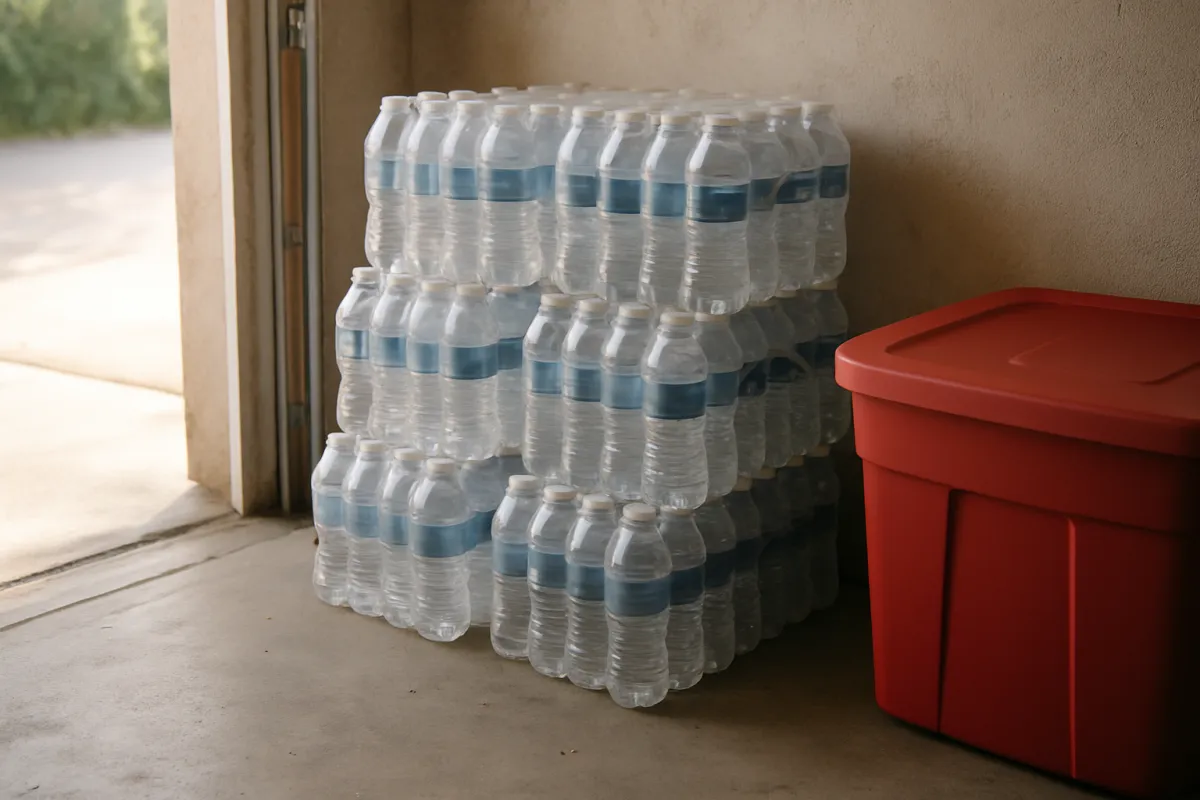
Here is where this breakdown tells you to buy some bottled water. Every filter strategy in this comparison has a single point of failure: the tap. A water main break, a boil-water notice, a contamination event, or a power outage that takes a well pump offline turns the best under-sink system into decorative plumbing. In those moments, the households that stocked a few flats calmly skip the store-shelf scramble that reliably follows every local water advisory.
Common emergency guidance suggests storing several liters per person per day for at least a few days; for a family of four, a stock in the range of 50 to 60 liters is a reasonable planning figure. At bulk-flat prices, that is roughly $15 to $30 of bottled water, sitting in a closet, rotated through normal drinking once or twice a year so it never goes stale in storage. As insurance premiums go, it is one of the cheapest this site has ever priced.
So the two strategies are not rivals at the margins; they are complements. The filter carries the daily thousands of liters where its per-liter advantage compounds, and the bottled stock covers the rare days the filter cannot work at all. A household that filters daily and stores a couple of flats is running the mathematically correct portfolio.
Break-even: when each filter pays for itself
Payback timelines are where the filter case stops being abstract. The formula is simple: hardware cost divided by what you save per month against bottled. For the family of four at 8 liters a day and a blended $0.60 bottled liter, bottled spending runs about $146 a month.
The pitcher, at $35 with roughly $10 a month of cartridges, saves about $136 a month and pays for its hardware in about a week. The under-sink carbon unit, at $200 with about $5.50 a month of cartridges, saves about $140 a month and breaks even in roughly six weeks. RO, at $350 with about $10 a month of running costs, breaks even in around ten to eleven weeks. Even a $1,500 whole-house install, if it actually displaced a full bottled habit, would pay back inside a year, though drinking economics alone rarely justify that rung.
Halve the consumption and the timelines merely double: a couple drinking 4 liters a day still pays off an under-sink unit in about three months. The variable that really stretches payback is low consumption, which is covered honestly in the next section. For everyone else, the pattern is blunt: filter hardware is one of the fastest-amortizing purchases we have ever put through the cost-per-use calculator, because the habit it replaces is so expensive per liter and so frequent.
When bottled water honestly wins
Every comparison on this bench names the losing side’s wins, and bottled has real ones. Renters and short stays: an under-sink install is somewhere between discouraged and impossible in many rentals, and if you will move in six months, hardware amortization gets ugly. A pitcher still usually beats bottles here, but the gap narrows, and for a three-month stay, flats are defensible laziness.
Travel and away-from-home drinking: the filter does not come with you. Portability is bottled water’s native advantage, and no per-liter math touches it at a trailhead or an airport. Contaminated or uncertain supply: during boil-water advisories, after floods, on unverified wells, or anywhere the municipal system is genuinely unreliable, bottled is not a premium product, it is the correct one, full stop, until the supply is fixed or a properly certified treatment system is in place.
Very low consumption: a single person drinking one liter a day spends perhaps $200 a year on bottles at bulk prices; a pitcher saves most of that, but an RO system would take years to justify itself. The lighter the habit, the lower the optimal rung on the filter ladder, and at the bottom of the consumption range, a case of bottles a month is an honest, rational choice. The mistake is not bottled water; it is high-volume bottled water at retail prices in a home with a working tap.
The five-year totals
Zoom out to the horizon this site always prices, five years, for the family of four at 8 liters a day. All bottled at a blended $0.60: roughly $8,750. Bargain-flat discipline at $0.30: about $4,375. The pitcher path: about $650, hardware and every cartridge included. Under-sink carbon: about $530 including one round of hardware. RO: about $975. Plain tap: about $30.
Put differently, the under-sink family keeps roughly $8,200 over five years versus blended bottled, and even against the most disciplined bulk-flat habit, they keep close to $3,850. Those figures are illustrative, but their scale is the point: this is not a latte-sized optimization, it is a used-car-sized one, achieved with a cartridge swap twice a year.
Cost per liter, by strategy
Illustrative typical figures; filter costs include amortized hardware and cartridges. Bar lengths are to scale.
The tap bar is drawn honestly, which is why you can barely see it: on a linear scale, tap water is a sliver next to everything else. The filter bars are small multiples of tap; the bottled bar is a different economic species.
One more way to hold the chart in your head: the filters are not competing with bottled, they are competing with each other for the right to be your small upgrade over an almost-free baseline. Bottled is the outlier, not the benchmark.
Cost per use, the BenchNest way
Everything this site tests eventually gets reduced to cost per use, and water gear produces the most extreme numbers in our archive. A $200 under-sink unit serving a family of four at 8 liters a day delivers about 14,600 liters over five years. That is 14,600 uses from one piece of hardware, a denominator no drill, kettlebell, or espresso machine will ever approach. Even loading every cartridge into the numerator, the cost per liter poured sits near four cents.
This is the same lesson our other breakdowns keep landing on, at its logical extreme: frequency is what makes gear cheap. An appliance used daily amortizes fast; one used thousands of times a day, effectively, every glass, every pot of coffee, every water bottle filled for school, amortizes almost instantly. The filter’s economics are not clever, they are just arithmetic applied to an enormous denominator.
It also means the usual failure mode of high-ticket gear, the shelf ornament, barely applies here. A filter is plumbed into a habit you already have; nobody forgets to drink water. The one behavior that can wreck the math is neglecting cartridges, which quietly converts your filter into a decorative spout. Put your own liters, bottled price, and chosen strategy into the cost-per-use calculator and the per-liter figure that comes back will make most of your other gear look expensive.
Common water-spending mistakes
The same errors run through every comment thread on this topic.
- Buying the filter and skipping the cartridges. The hardware is 5 to 10% of the cost and none of the function. An overrun cartridge means you are drinking tap water with extra steps.
- Buying RO for a taste problem. Chlorine taste is a $30 carbon job. Match the tier to a documented problem, not to the most maximal box on the shelf.
- Never reading the water report. It is free, annual, and frequently makes the whole purchase unnecessary.
- Judging pitchers by pitcher price. Cartridge price times cartridges per year is the real number; the pitcher itself is a rounding error.
- Paying single-serve prices for home drinking. If bottled genuinely fits your situation, buy flats at bulk prices; the per-liter difference is 2x to 3x.
- Keeping no bottled stock at all. The filter’s single point of failure is the tap. A couple of rotated flats are the cheap hedge.
- Ignoring the workflow. A pitcher for a six-person household fails on refill fatigue, not economics. Buy the rung your consumption actually demands.
Every one of these is the same root mistake: pricing the visible object instead of the five-year system around it.
Well water and the private-supply exception
Everything above assumes a municipal tap that publishes an annual water quality report, which is the situation for most households. A private well changes the calculation, because nobody publishes a report for you and the safety baseline you have been leaning on does not exist. The order of operations still holds, but the first step becomes a paid test rather than a free document: send a sample to a certified lab and find out what is actually in the water before you buy any hardware.
That test reframes the whole bottled-versus-filter question. If the results are clean, the same per-liter math applies and a filter matched to any taste preference is the frugal daily choice. If the test flags something specific, hardness, iron, nitrates, bacteria, or sediment, then the right filter is no longer a taste appliance but a targeted treatment matched to that finding, and the tier you need may be higher than a simple carbon cartridge. Some well issues call for a softener, a sediment pre-filter, or disinfection ahead of any drinking-stage filter, which is genuine plumbing rather than a countertop purchase.
Bottled water earns an honest role here too, as the correct bridge while a well problem is diagnosed and fixed, not as a permanent answer. Running a household indefinitely on retail bottles because the well is uncertain is the expensive path; testing, treating the specific fault, and then letting a right-sized filter carry the daily volume is the one this bench would price out every time. When the supply itself is in question, a qualified water professional outranks any per-liter chart, and the cost-per-use calculator comes in only once you know which treatment the water actually needs.
The bottom line
Water filter versus bottled water is the least close contest this bench has ever scored. For a household with a working municipal tap, a filter matched to a documented need, or honestly bought as a taste appliance, delivers the same daily product for a twentieth or less of bottled’s per-liter price, pays off its hardware in weeks, and compounds into thousands of dollars over five years. The order of operations is what matters: read your water report first, run the blind taste test second, buy the cheapest rung of the ladder that solves your actual problem third, and put the cartridge schedule on a calendar the same day.
Bottled water keeps its honest jobs: travel, rentals, supply emergencies, low-volume households, and the couple of flats everyone should keep in a closet. Pay for those without guilt, and stop paying the 15x premium on the other ten thousand liters. Few purchases we have ever tested return more money for less ongoing effort than getting this one right.
Notes, read before you shop: everything above is education, and every dollar figure is a deliberately round illustration for planning, not a price we measured on any specific pitcher, unit, or flat this week. Water itself is the one subject on this site with a health dimension, so treat nothing here as guidance on water safety: your utility’s report, a certified local test, and where needed a qualified plumber or water professional outrank anything a gear site can tell you. Verify current prices, cartridge ratings, and certification listings for any product on your shortlist, and run your own numbers before the money leaves your account.
Frequently asked questions
Is a water filter cheaper than bottled water?
Almost always, and usually by a wide margin. Bottled water typically runs $0.30 to $1.00 or more per liter, while a pitcher filter lands near $0.05 to $0.10 per liter once you count cartridges, and an under-sink unit near $0.02 to $0.05. For a household drinking several liters a day, the filter hardware typically pays for itself in weeks to a few months. The exceptions are very low consumption, short-term rentals, and places where the tap supply itself is compromised.
How much does bottled water cost per year for a family?
A family of four drinking a typical 8 liters a day gets through about 2,920 liters a year. At an illustrative $0.60 per liter, that is roughly $1,750 a year, and even bargain bulk flats at $0.30 per liter still run near $875. The same water through an under-sink filter costs on the order of $100 a year including amortized hardware. The gap is the largest recurring saving most households can capture with a single purchase.
Are water filter pitchers worth it?
For one or two people who mostly want better-tasting tap water, yes, they are the cheapest entry point. A typical pitcher costs $25 to $45 up front, and the real cost is cartridges: each one treats a modest number of liters and needs replacing every few weeks at typical consumption. That usually works out near $0.05 to $0.10 per liter, far below bottled but well above an under-sink unit for heavy drinkers. High-consumption households often outgrow the pitcher's refill pace before they outgrow its economics.
How often do you really need to replace filter cartridges?
More often than most owners do. Pitcher cartridges are typically rated for roughly 100 to 150 liters, which at family consumption is every two to four weeks, and under-sink carbon cartridges typically last six to twelve months. An exhausted carbon cartridge stops adsorbing and can even shed what it caught, so the water is no longer being treated even though it still pours. Put the schedule on a calendar and budget for it before buying, because cartridges, not hardware, are most of a filter's lifetime cost.
Do water filters actually make water safer, or just taste better?
It depends on the filter class and on your water. Basic carbon filters, pitchers and faucet mounts, mainly improve taste and odor by reducing chlorine and some contaminants, while certified under-sink carbon units address a longer list, and reverse osmosis removes the broadest range of dissolved substances. Whether any of that is needed depends on your supply: municipal tap water in most developed systems already meets drinking standards. Read your utility's annual water quality report first, and if you have a specific concern, a certified filter matched to that contaminant is the rational buy.
Is bottled water actually better quality than tap water?
Often it is simply not different in the way buyers assume. A meaningful share of bottled water sold in stores is filtered municipal water, that is, tap water that went through roughly the same treatment an under-sink unit performs at home for pennies. Spring and mineral waters are genuinely different products with their own taste profiles, and in blind tastings most people struggle to reliably pick bottled from chilled, filtered tap. Quality is a weak reason to pay a 10x to 100x per-liter premium; taste preference and portability are the honest ones.
Is a reverse osmosis system worth the extra cost?
Only when your water or your standards demand it. RO systems typically cost $200 to $600 installed plus $60 to $150 a year in filters and membranes, and they send several liters to the drain for each liter produced, which nudges the per-liter cost up. What you get is the broadest removal, including dissolved solids that carbon cannot touch. If your water report shows issues carbon does not cover, or a home test does, RO earns its keep; if not, a carbon under-sink unit delivers most of the benefit at a fraction of the running cost.
Should I still keep some bottled water at home if I have a filter?
Yes, and this is not a contradiction. A filter depends on the tap working; during a main break, a boil-water notice, or an outage, stored bottled water is the backup that keeps you off the panic-buying shelf. A few flats rotated once or twice a year cost little and cover the gap. Treat bottled as emergency stock and travel supply, and let the filter carry the daily volume, because each is the cheapest tool for its own job.