What's on this page
- Are air purifiers worth it, or a waste of money? The short answer
- Are air purifiers a waste of money? Six ways one does nothing
- What an air purifier actually does to a room
- What HEPA catches and what passes straight through
- Air changes per hour: the number the verdict rests on
- CADR and sizing a purifier to your room
- What filtering does to dust and dander
- Wildfire smoke: the clearest case for owning one
- Odors and VOCs: where a purifier needs carbon
- What an air purifier costs to buy
- What an air purifier costs to run
- The cost per hour of clean air
- Where to place it so the spend is not wasted
- How long it takes to clean a room
- Noise and the sleep question answered honestly
- Maintenance: the filter change that decides everything
- Cheap versus premium: what more money buys
- A purifier against a better furnace filter
- Ventilation and source control come first
- Ozone generators and ionizers: the one category to avoid
- Where to check a claim instead of trusting the box
- Who tends to say it was worth it
- A worked example: sizing and running cost for one room
- The worth-it checklist before you buy
- The bottom line
Short answer: Air purifiers are worth it when a room has a real airborne particle load, because a fan and a true HEPA filter reliably lower the particle count in one room while the unit runs, for roughly $95 a year in filters and power on illustrative figures. They are a waste of money with no particle problem, with a filterless ionizer or ozone gadget, or in a room far beyond the unit's rated airflow.
Are air purifiers worth it, or are air purifiers a waste of money? Both questions have the same answer, and it comes from a comparison most buying advice skips: what the machine mechanically does against what it costs to keep running. What it does is narrow and real. A fan pulls the air of one room through a filter, the filter holds the airborne particulate, and the particle count in that room falls until it balances against whatever keeps coming in. What it costs is roughly $95 a year in filters and electricity on our illustrative figures, on top of the purchase price.
These notes put those two halves side by side, and they put the skeptical case first rather than burying it. They cover the six situations where a purifier does nothing you could detect, what a HEPA filter holds and what passes straight through it, how air changes per hour decide whether a unit is doing real work or humming, how to size one to a room, and what the running cost actually splits into. For the full purchase and five-year price picture, our companion coverage on how much an air purifier costs breaks it down by room size, and you can run your own numbers in the cost-per-use calculator.
Key takeaways
- The mechanism is narrow and verifiable: a fan and a filter lower the airborne particle count in one room, for as long as the unit runs. That is the whole claim these notes will make for it.
- Air changes per hour is the number that decides whether a purifier is working. A 250 CFM unit delivers about six air changes an hour in a 300 square foot room and under two in a 1,000 square foot one.
- Running cost is modest and lopsided: near $35 a year in power at 25 watts and an illustrative $0.16 per kilowatt-hour, against roughly $60 a year in filters, so about $95 a year all in.
- It does nothing for gases and odors without a substantial activated-carbon stage, nothing for settled dust on surfaces, and nothing for a damp or mold source that needs repairing.
- It becomes a waste with no particle load to remove, with the wrong device type, or when a small unit is asked to clean a room far beyond its rated airflow.
Are air purifiers worth it, or a waste of money? The short answer
Is an air purifier worth it? Worth it is a comparison rather than a property of the category, so the honest answer has a shape instead of a yes or a no. On one side sits a machine that reliably lowers the airborne particle count in a single room while it runs. On the other sits a purchase price plus about $95 a year illustratively in filters and power. If the room has a particle load worth removing, that trade is easy. If it does not, you are paying for a change you cannot detect.
The people who regret the purchase almost always tripped on one of two things. They bought a device that was never going to do the job, usually a filterless ionizer or an ozone gadget with no real filter. Or they bought a small unit for a large room, where the airflow was never enough to move the room’s whole volume often enough to matter.
The people who keep the machine usually bought against something specific: a dog that sheds through the house, a room that goes hazy every fire season, a dusty older place where surfaces re-coat within days. In each case there was a measurable load to remove and a machine sized to remove it. That is the pattern to test yourself against before you spend, and the rest of these notes is about getting both halves of it right.
Are air purifiers a waste of money? Six ways one does nothing
Plenty of people arrive at this question expecting to be told no, and they deserve the case against before the case for. So here is the skeptical half stated plainly. A purifier can be a genuine waste of money, and when it is, the failure is almost always one of six things rather than a fault in the machine. Every one of them is checkable before you spend, which is the point of listing them first.
One: nothing in the room needs removing. If nobody is bothered, there are no pets, no smoke, no dusty room and no complaint anyone can name, the machine will run, consume filters and change nothing you can perceive. The airborne particle count will fall, and it will fall from a level that was troubling no one. That is the purest version of the waste, and it costs the same penny an hour as filtration you actually need.
Two: the source is still producing. A purifier catches what is already loose in the air. It does not stop whatever keeps putting it there. A damp wall growing mold, a woodstove that leaks, a hood that recirculates instead of venting, a hobby that throws dust: in each case the machine is emptying a bath with the tap running. It removes a share of the load and the source replaces it, so the room settles at a level set by the source rather than by the filter. Money spent here buys a delay rather than a fix, and the repair is the purchase that actually works.
Three: the unit is undersized for the room. This is the most common way a perfectly good machine looks like a scam. Airflow is what moves a room’s volume, and a small unit set against a large space simply never gets around the room often enough to hold a lower balance point. Below roughly two air changes an hour the machine is losing, and the owner sees a running purifier and no change. The chart further down these notes shows one identical unit going from twelve air changes an hour to under two purely because the room got bigger. Nothing about the filter changed. Only the arithmetic did.
Four: the filter is never changed. A loaded filter chokes the airflow, and airflow is the entire mechanism. The machine still lights up, still hums, still feels like it is working, and moves a fraction of what its rating says. Because the decline is gradual there is no moment where it obviously breaks, so a purifier can spend years as an expensive fan while its owner quietly concludes the category is oversold. On a mid-range machine the filters are already about two thirds of the running cost. Skipping them does not save that money so much as convert it into a device that no longer does the job.
Five: the door is left open. Sizing math assumes a room. Leave the door open and the machine is working on the room plus the hallway plus whatever the hallway connects to, which can easily be triple the volume you sized for. The rated airflow has not changed, so the air changes an hour collapse in exact proportion. This is the cheapest failure to fix in the whole list, because closing a door is free and it is the single largest free improvement available to any purifier.
Six: the pollutant is a gas rather than a particle. Cooking smells, paint fumes, solvent vapour and off-gassing from new furniture are molecules, and a particle filter has nothing to grip them with. Turning the fan up does not help, and no setting exists at which a HEPA stage starts holding gases. Only a substantial bed of activated carbon touches them, and most units carry a token sheet rather than a bed. Anyone buying a purifier to fix a smell is very often buying the wrong tool, which the odor section further on covers in detail.
There is a seventh case that is less a mistake than a mis-sold product: the device that was never going to filter anything, meaning an ozone generator or a filterless ionizer. That one gets its own section later, because it is a category to avoid rather than a mistake to correct.
Outside those cases the waste framing does not survive contact with the arithmetic. For a real particle load, in a room where someone spends real time, with a machine sized to the space and its filter kept fresh, roughly a penny an hour is a defensible price for a measurable change to the air. The rest of these notes is about being in that situation rather than one of the six above, and you can price your own version in the cost-per-use calculator.
What an air purifier actually does to a room
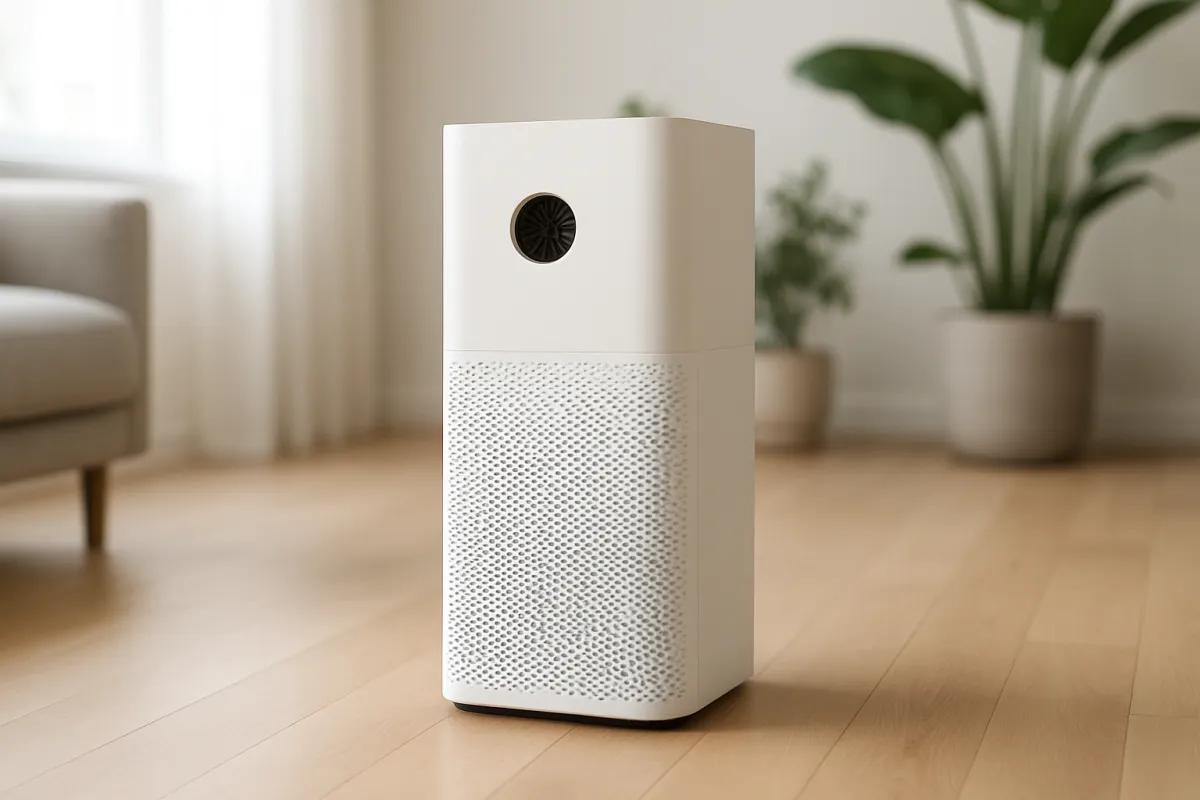
Strip the marketing away and a portable air purifier is a box fan with a good filter in front of it. Air is drawn in through a grille, passes through a pleated filter that holds particulate, and leaves through an outlet. Nothing is destroyed, nothing is neutralized, nothing happens to the air chemically. Particles that were floating end up trapped in a pleat, and the air that comes out has fewer of them in it than the air that went in.
That single-pass efficiency is only half the story, and it is the half people fixate on. The other half is how fast the machine can process the whole room. A filter that catches almost everything in one pass is useless behind a fan too weak to pull the room’s air through it. The pairing of filter and fan is what matters, which is why the sizing spec later in these notes is about airflow rather than about filter grade.
The scope is worth stating plainly too. A portable unit cleans the room it is standing in. It does not clean the house, it does not clean the hallway with the door open, and it cannot reach a room upstairs. If more than one room has a problem, that is a question about how many units a home needs, and our room-by-room purifier count works through it rather than pretending one machine stretches.
What HEPA catches and what passes straight through
True HEPA is a defined grade rather than a mood. The term is held to a specific capture figure, 99.97% of particles at 0.3 microns, which is the hardest particle size to catch. Particles larger and smaller than that are held more easily, which is why a filter meeting the definition covers the whole range of household airborne particulate: dust, pollen, dander, mold spores and the fine particulate in smoke. Wording such as HEPA-type or HEPA-like on a box is a hedge that promises none of that, and our HEPA filter explainer walks through the difference in more depth.
What passes straight through is anything that is not a particle. Gases and volatile organic compounds are individual molecules orders of magnitude smaller than the fibers of a filter mesh, so cooking smells, paint fumes and off-gassing from new furniture sail through a HEPA stage untouched. Only a bed of activated carbon adsorbs those, and the amount of carbon matters more than its presence.
Two other things sit outside the machine’s reach. Settled dust is not airborne, so a purifier lowers how fast surfaces re-coat and does nothing about the layer already there. And a live moisture or mold source keeps producing whatever the filter keeps catching, which is a repair job rather than a filtration one.
Air changes per hour: the number the verdict rests on
Everything about whether a purifier is worth owning collapses into one figure: how many times per hour it can process the whole volume of the room. That is air changes per hour, and it comes from arithmetic rather than from a marketing claim. Take the unit’s rated clean air delivery in cubic feet per minute, multiply by 60 to get an hour, and divide by the room’s volume in cubic feet, which for most homes is the floor area times an eight foot ceiling.
Run that on one machine across different rooms and the whole sizing argument becomes obvious. The same 250 CFM unit is doing serious work in a small bedroom and barely stirring a large open plan floor. Nothing about the filter changed. Only the room did.
Air changes an hour from one 250 CFM unit by room size
Arithmetic at an 8 ft ceiling: rated airflow times 60, divided by floor area times 8.
One machine, seven rooms. The unit is identical in every row; only the volume it has to process changes. Figures are arithmetic on a stated airflow, not a measurement of any model.
Four to five air changes an hour is the usual target for general household dust, and people filtering against pollen or smoke normally push higher. Below about two changes an hour the machine is losing to the room, which is exactly the setup that produces an owner convinced the whole category is a scam.
CADR and sizing a purifier to your room
The spec that feeds that arithmetic is CADR, the Clean Air Delivery Rate, which is measured under an industry standard and reported in cubic feet per minute for smoke, dust and pollen separately. It describes the filter and the fan together, which is why it predicts real behavior better than any filter claim on its own. A perfect filter behind a weak fan produces a low CADR and a room that never quite clears.
The quick rule most people use is a smoke CADR of about two thirds the room’s square footage, so 200 CFM for a 300 square foot room. That is not a magic constant. It is a shorthand that lands near five air changes an hour at a standard ceiling, which the chart above shows directly. If your ceilings are high, the shorthand undersizes you, because volume is what the machine has to move rather than floor area.
Two habits protect the purchase. Size up rather than down, because a larger unit on a low speed is quieter, gentler on its filter and still ahead of the room, while a small unit on maximum is loud, hungry and behind. And convert any room-size claim on a box back into CADR before you believe it, since a room rating is a manufacturer’s opinion while airflow is a number. Our six-step purifier picking method runs the same check in order.
What filtering does to dust and dander
Dust and dander are the everyday case, and the machine’s role in it is specific. Both are light enough to stay aloft for long stretches on the ordinary air currents in a room, and while they float they are inside the fan’s reach. So a running purifier holds the airborne fraction lower than it would otherwise sit, which is a change to the air in that room and nothing more than that.
Homes with pets get the most visible version of this and pay for it in maintenance. Hair and coarse dander load the pre-filter fast, and a clogged pre-filter chokes the airflow that the whole calculation depends on. Cleaning it every few weeks in a pet home is not optional housekeeping, it is what keeps the CADR you paid for.
The limit worth repeating is that surfaces are outside the deal. What the machine changes is how much is airborne at any moment and therefore how quickly a cleaned shelf re-coats. Dusting still happens. Anyone weighing a purifier against symptoms rather than against dust levels is asking a medical question, and that belongs with a clinician rather than with a bench that can only measure air.
Wildfire smoke: the clearest case for owning one
Smoke season is where the mechanism and the need line up most cleanly. Wildfire smoke is fine particulate, squarely inside what a HEPA filter holds, and during a smoke event the outdoor air is the source that will not stop. A well-sized unit in a closed room can hold that room’s particle count well below what is outside, which is a real and measurable difference rather than a comfort claim.
The practical setup is unglamorous. Close the windows, seal what you can, pick one room where people will actually spend the day, and put enough airflow in it. Sizing up matters more here than anywhere else, because smoke keeps leaking in around doors and window frames, so the machine is not clearing a fixed load once but holding a balance against continuous infiltration.
Two costs rise during a smoke event. Filters load far faster than the normal schedule suggests, so a spare bought before the season is worth more than one ordered during it, when everyone else is ordering too. And smoke carries odor and gases that a HEPA stage does not touch, so if the smell bothers you as much as the haze, the carbon stage is the part to shop for. On the particulate itself, this is the situation where the machine most obviously earns its price.
Odors and VOCs: where a purifier needs carbon
This is the mismatch that produces most disappointed owners. Someone buys a purifier to fix cooking smells, paint fumes or a musty room, and the machine does essentially nothing, because those are gases and the filter catches particles. Turning the fan up does not help. There is no setting at which a HEPA filter starts holding molecules.
Activated carbon is the only tool in a home unit that touches them, and it works by adsorption onto an enormous internal surface area. The catch is quantity. Meaningful odor control needs carbon measured in pounds, and many units carry a thin impregnated sheet that lets the box say carbon while saturating within weeks. Once saturated it stops working entirely, which is why so many owners report a purifier that helped with smells at first and then did not.
So if odors are the actual reason for buying, the shopping order inverts: carbon first, HEPA second. And keep the alternative in view, because ventilation beats filtration on gases every time. An open window or a running range hood clears cooking gases faster and cheaper than any purifier will, which our indoor air quality guide treats as the first move rather than the last.
What an air purifier costs to buy
Upfront price tracks room size, because what you are buying is airflow and filter area. A small-room unit sits at the bottom of the range and a machine sized to a whole floor at the top, with the bedroom and living-room tiers in between. Our companion air purifier cost breakdown prices each tier and carries it out to a five-year total, which is the number worth comparing between models rather than the shelf tag.
The single figure these notes borrow from that page is the living-room tier, around $250 illustratively, because it matches the mid-range machine used in the worked example later on. Everything else about purchase price lives on that page and is not restated here, so the two do not drift apart as prices move.
What matters for the worth-it question is the shape of the spend rather than its size. The purchase is a one-time cost you can research to death. The filter is a recurring cost that arrives every year for as long as you own the machine, and it is the one buyers underestimate. A cheaper machine with an expensive proprietary filter can cost more across five years than a dearer one with a cheap annual filter, which is why the filter part number is worth looking up before the machine goes in the cart rather than after.
What an air purifier costs to run
Running cost splits into two lines, and almost everyone worries about the smaller one. Electricity first: a HEPA purifier draws roughly 10 to 50 watts depending on fan speed, closer to a couple of light bulbs than to an appliance. A mid-range unit averaging 25 watts around the clock uses about 219 kilowatt-hours a year, which is near $35 at an illustrative $0.16 per kilowatt-hour, or about $2.92 a month.
Filters are the larger line. A true HEPA element typically runs $25 to $80 and is due every 6 to 12 months, and a carbon pre-filter often adds $10 to $30 on a shorter cycle. For a living-room machine on a normal schedule that lands near $60 a year, every year, which is where the recurring money actually goes.
Where the yearly running cost goes
Illustrative split of about $95 a year for a mid-range unit at 25 watts run around the clock.
Filters are close to two thirds of the yearly cost and power about one third. Figures are illustrative planning numbers; price the exact replacement filter for your candidate unit.
Put the two together and a mid-range purifier costs about $95 a year to keep running, illustratively, or roughly $8 a month. To see how small a 25 watt draw is against everything else plugged in, our appliance wattage and running-cost reference lists typical draws side by side, and you can substitute your own filter price and hours in the cost-per-use calculator.
The cost per hour of clean air
The yearly figure is easy to flinch at in isolation, so it helps to divide it by what it buys. A purifier that runs continuously is working 8,760 hours a year. At about $95 a year, that is roughly a penny an hour of filtered air in one room, which is a more honest framing of the spend than a lump sum that arrives as a filter order twice a year.
That per-hour view also explains why duty cycle changes the verdict so much. A machine run four hours a night costs far less to run but delivers filtration for a sixth of the time, and the particle count in the room climbs back for the other twenty hours. The cheapest way to own a purifier badly is to run it rarely, because the filter still ages on the shelf while the room spends most of its time unfiltered.
The comparison worth making is against the other things the same money buys in the same room. A hundred dollars a year is small against most appliances and large against nothing at all, which is why the honest verdict keeps returning to whether there is a load to remove. Filtration you do not need costs the same penny an hour as filtration you do.
Where to place it so the spend is not wasted
A correctly sized machine in the wrong spot quietly gives back the airflow you paid for. The unit has to draw room air in and push clean air out, so anything blocking either path costs performance that never shows on a spec sheet. Wedged behind a sofa, tucked into a cabinet or pinned under a low shelf, a purifier ends up cycling a small pocket of air it has already cleaned while the rest of the room goes untouched.
The rules are simple. Give the intake and the outlet clearance, commonly a foot or more, and check which faces those are, since some units draw from the back, some all around and a few from the front. Put it where people actually sit or sleep rather than in a far corner, because the air near you is the air that counts. Keep it off deep carpet if the intake is on the bottom, and clear of curtains that can be pulled flat against a grille.
Two placement decisions matter more than the rest. Closing the door shrinks the volume the machine has to process, which is a free increase in air changes an hour. And when the particulate has an obvious origin, a litter box, a shedding dog’s chair, a woodstove, sitting the unit between that source and the people catches more of it before it disperses through the room.
How long it takes to clean a room
The answer is a rate rather than a stopwatch. A unit delivering four to five air changes an hour is passing the room’s full volume through the filter every twelve to fifteen minutes, so a visibly hazy room usually shows a clear improvement within the first half hour rather than instantly.
The curve matters as much as the speed. Each pass removes a share of what is airborne rather than a fixed count, so the concentration drops steeply at first and then flattens. That is the shape a particle counter draws, and it is also why the room never reaches zero. The machine settles into a balance against everything still entering: an open door, a gappy window, a pet, your own movement lifting settled dust back into the air.
Three practical consequences follow. Running the machine ahead of a load beats chasing it, so it goes on before the pollen count climbs or the smoke arrives rather than after. Continuous running at a low speed generally beats an hour on maximum, because the steady rate holds the balance point lower and is quieter doing it. And if a room never seems to improve, the cause is nearly always one of three: an undersized unit, a loaded filter strangling the airflow, or an open door that made the real room twice the size you assumed.
Noise and the sleep question answered honestly
Noise is the specification most likely to decide whether a bedroom unit keeps getting used, and it is the one most buyers check last. Every purifier is quiet on its lowest setting and loud on its highest, so the number that matters is how much airflow it delivers at a speed you can sleep through. That is another argument for sizing up: a larger machine on speed one can deliver what a small machine only reaches on speed four.
On sleep itself, two different things get bundled together and they deserve separating. One is the air, where the machine lowers the airborne particle count in the room while it runs. Whether that changes anyone’s sleep is a medical question, and these notes route it to a clinician rather than answering it from a spec sheet.
The other is the sound, and that part is plain hardware. A steady fan hum at a constant speed masks intermittent noise for some sleepers, which is a genuine reason people like a unit in the bedroom, and an irritant for others. It has nothing to do with filtration. If the hum is the part you want, judge it as you would judge a fan, and buy the filtration on the air-change arithmetic instead.
Maintenance: the filter change that decides everything
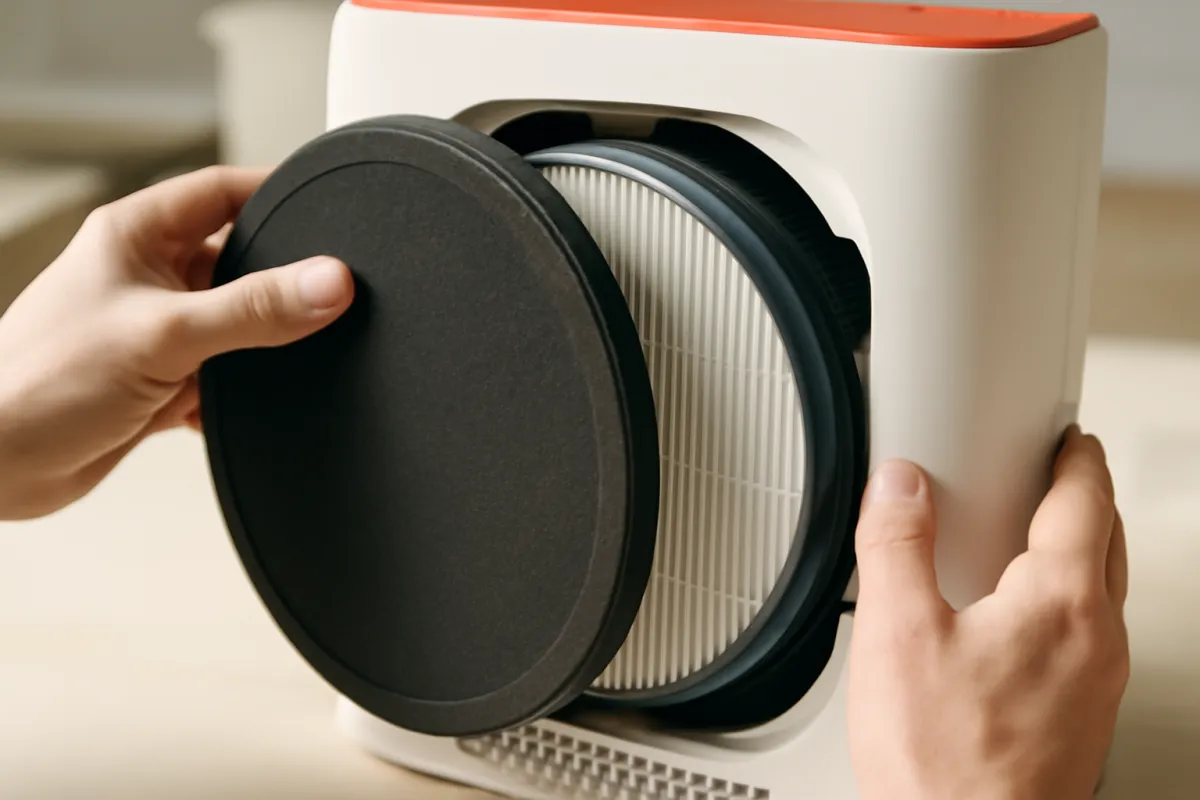
A purifier is only worth its price if the one chore gets done. A clogged HEPA filter chokes the airflow, so the machine still hums and still glows and moves almost nothing, and the owner concludes it broke. It did not break. It is starving, and a starving purifier is an expensive fan.
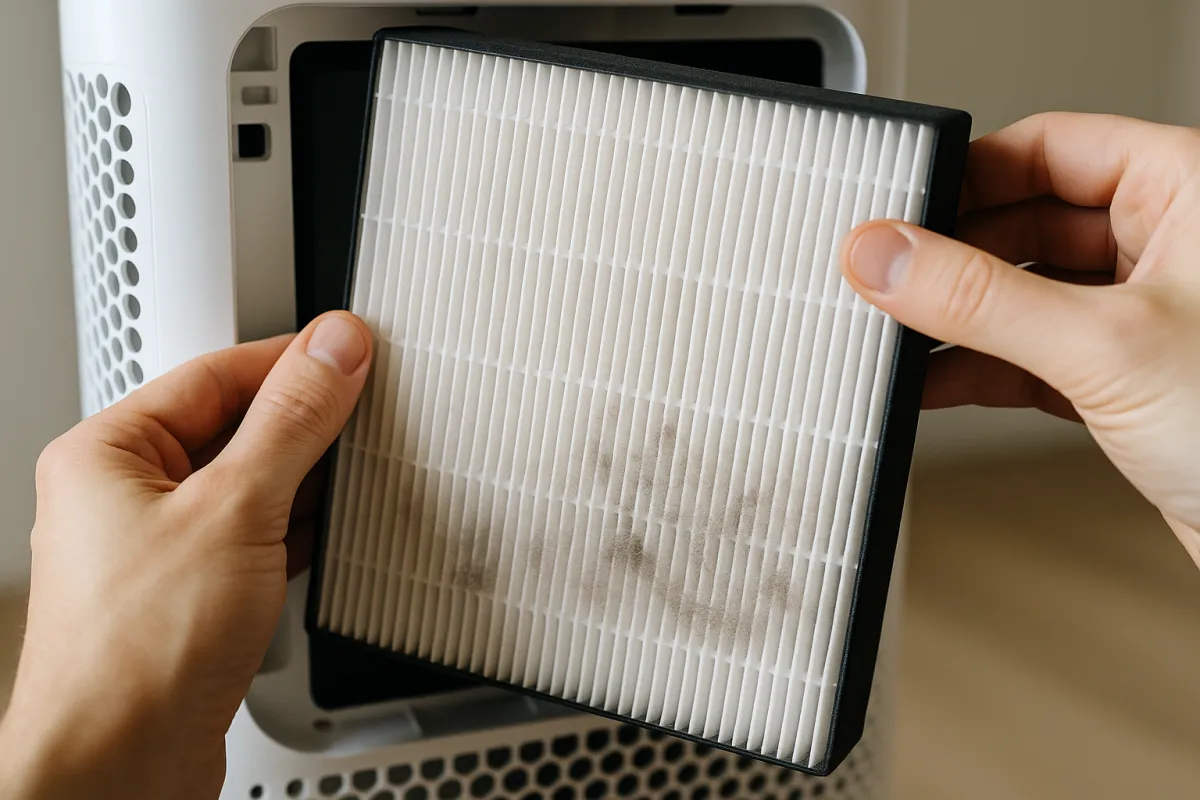
The routine is light. A true HEPA element typically lasts 6 to 12 months and a carbon pre-filter often wants changing nearer every 3 months. Heavy use, a smoky stretch, a dusty room or pets all shorten those intervals, so the schedule should follow the conditions rather than the optimistic figure on the box. Many units also carry a washable pre-filter that catches hair and coarse debris before the expensive element, and vacuuming it every few weeks buys real life on the stage that costs money.
The buying implication runs backwards from the usual advice. Price the replacement filter and its interval before you fall for a machine, because a handsome unit with a $70 filter twice a year costs more to keep than a plain one with a $40 filter annually. The filter, not the machine, is where the recurring money lives.
Cheap versus premium: what more money buys
Both ends of the price range can be smart buys, and the room decides which. A modest true-HEPA unit in a small bedroom is often the best value in the category: the volume is small, the airflow needed is modest, the filter is inexpensive and it runs on a few watts. Spending several hundred dollars on that room buys capacity that will never be called on.
The premium tier earns its money in exactly one situation, which is a large room or a continuous heavy load like a smoke season. There you genuinely need the airflow and the filter area, and the extra money also tends to buy a quieter fan at a given output, a longer-life element and a real carbon bed. Those are useful when the situation calls for them and inert when it does not. Price does not buy a better grade of HEPA, it buys throughput.
Where cheap goes wrong is at the edges. A budget machine set against a large open-plan space runs flat out and still loses, and the cheapest units often cut the corner that matters by swapping true HEPA for HEPA-type media or leaning on an ionizer with no filter behind it. That is the false economy: a low price for a device that cannot do the job at any setting.
A purifier against a better furnace filter
Before buying a box it is fair to ask whether the equipment already in the house does enough. In a forced-air home the obvious candidate is the filter in the furnace or air handler. Moving from the cheapest fiberglass panel to a decent pleated filter does capture more fine particulate, and because the system moves a large volume it works on the whole house rather than one room, at a fraction of a purifier’s price.
The catch is duty cycle and equipment limits. A furnace filter only filters while the blower runs, which in most homes is a minority of the day outside heating and cooling season. Some systems can run the fan continuously to fix that, at the cost of more electricity and more wear. There is also a ceiling on how restrictive a filter the equipment tolerates, since a filter far beyond the design spec chokes airflow and can hurt both comfort and the machinery. Our furnace filter schedule covers keeping whichever filter you choose actually working.
The realistic verdict is that these are complements. The furnace filter is the cheap whole-house baseline that works when the system works. The portable unit is the continuous room-level tool for the one room that matters. If the complaint is general household dust and the budget stretches to one, upgrade the furnace filter first. If it is one room, one season or one specific source, the portable does more.
Ventilation and source control come first
Filtration is the third move, not the first, and skipping the first two is the most expensive mistake in this category. Source control means stopping the particulate or the gas at its origin: a range hood vented outside rather than recirculating, a bathroom fan that actually reaches the exterior, shoes off at the door, a woodstove that seals, a repair to the damp wall rather than a machine parked in front of it.
Ventilation is the second move, and it does the job filtration cannot. Opening a window exchanges indoor air for outdoor air, which dilutes gases, humidity and odors in a way no particle filter can imitate. The exception is the case where the outdoor air is the problem, which is exactly why the smoke section reverses the advice and tells you to close everything.
A purifier is what remains once the source is fixed and the ventilation is doing what it can. It handles the particulate that is already airborne and keeps handling it continuously. Buying one before the first two moves usually means paying about $95 a year to partially mask something that a $30 repair or an open window would have solved outright, and our indoor air quality guide walks the order properly.
Ozone generators and ionizers: the one category to avoid
One group of devices deserves a flat warning. Ozone generators are sometimes sold as air purifiers, and they do not filter anything. They produce ozone, which is a reactive gas rather than a cleaning agent, and it can alter odors chemically so a room smells different while nothing has been removed from it. Ozone is widely treated as a respiratory irritant rather than an air cleaner, which is why the category carries public warnings from agencies such as the EPA and why California runs a certification program with an ozone emission limit that indoor air cleaning devices sold there are expected to meet. Program rules change, so look up the current requirement rather than trusting a figure in an article. If a box advertises ozone or an activated oxygen mode, walk past it.
Filterless ionizers are a milder version of the same problem. They charge particles so those particles stick to surfaces or a collector plate instead of being trapped in a filter. The pitch is appealing, because no filter means no recurring cost, but the machines move far less air than a fan-and-filter unit and the particulate ends up on your walls rather than out of the room. Some also produce ozone as a byproduct.
The rule of thumb is that the filter is where the cleaning happens. A device whose selling point is that it never needs a filter is usually avoiding the results along with the consumable.
Where to check a claim instead of trusting the box
A verdict is only as good as the sources under it, so it is worth knowing which references settle which question rather than taking a bench’s word or a box’s. Three are enough for almost any purchase decision.
For filter grade, the 99.97% at 0.3 microns figure is the definition true HEPA is held to, and it originates in a federal specification the industry adopted rather than in any manufacturer’s marketing. That is why true HEPA is a claim a maker can be held to and HEPA-type is not.
For airflow, CADR is measured under a published test standard maintained by the home appliance manufacturers’ association, which is what makes numbers comparable between brands. The two-thirds sizing shorthand used throughout these notes is the commonly cited rule attached to that standard rather than something invented here.
For safety, California’s Air Resources Board runs a certification program for indoor air cleaning devices with an ozone emission limit and publishes the list of devices that meet it. Checking a specific model against that list is a faster safety screen than reading any box. Standards documents and agency pages are revised over time, so treat all three as places to look up the current version rather than as figures to memorize from an article.
Who tends to say it was worth it
Owner satisfaction in this category follows a visible pattern, and it is a pattern about the purchase rather than about anyone’s health. The people who keep a purifier running years later almost always bought it against something specific and physical: a pet that sheds through the whole house, a room that hazes over every fire season, a workshop or a dusty older place where surfaces re-coat within days of cleaning.
What those situations share is a load the machine can actually reach, present in a room where someone spends real time, at a scale where the difference is noticeable. That is the honest common thread. It is not that the category works for some people and not others, it is that the arithmetic is favorable when there is something airborne to remove and unfavorable when there is not.
The reverse pattern is just as consistent. Regret clusters around vague motivations, general wellness, a sense that the air ought to be cleaner, a recommendation with no particular problem attached. Nothing malfunctions in those cases. The machine does exactly what the mechanism promises, and the owner cannot tell, because there was little to remove. Anyone whose reason for buying is a symptom rather than a dust level should take that reason to a clinician first, since a purifier is a filter and not a treatment.
A worked example: sizing and running cost for one room
Put both halves together on one realistic room. Take a 300 square foot bedroom with an eight foot ceiling, and assume the unit runs around the clock.
The size. At the two-thirds rule, 300 square feet points to a smoke CADR near 200 CFM. Check that against the volume: the room holds about 2,400 cubic feet, and 200 CFM moves 12,000 cubic feet an hour, which is five air changes. Buying with headroom, a unit rated nearer 250 CFM gives about six changes an hour in that room, which is the row the chart above shows, and leaves margin for a loading filter.
The cost. Assume a mid-range machine at the living-room tier, around $250 illustratively, drawing about 25 watts on its usual setting. Around the clock that is roughly 18 kilowatt-hours a month, so near $35 a year at $0.16 per kilowatt-hour. Add filters at about $60 a year and the running cost is about $95 a year, or a bit under $8 a month, which is close to a penny for each of the 8,760 hours it runs.
The verdict. For that room, the question is now concrete: is a continuously lower airborne particle count in one 300 square foot bedroom worth about $95 a year plus the machine? If the room has a load worth removing, that is a straightforward yes. Swap your own room size, filter budget and hours into the cost-per-use calculator to see your version.
The worth-it checklist before you buy
Run a candidate purchase past five checks. Clear all five and the spend is defensible on the arithmetic rather than on hope.
- Name the load. Dust, pollen, dander, smoke or a specific source. If you cannot name what needs removing from the air, that is the answer to the worth-it question.
- Do the air-change math. Rated CADR times 60, divided by floor area times ceiling height. Aim for four to five changes an hour, more for smoke or pollen, and treat anything under two as a machine that will lose to the room.
- Confirm true HEPA in plain words. True HEPA on the box, not HEPA-type or HEPA-like. If the wording hedges, the filtration hedges with it.
- Price the filter and its interval. Look up the exact replacement element, multiply by how often it is due, and carry it out five years before deciding a machine is cheap.
- Screen out ozone, and buy carbon only if odors are the goal. Skip ozone generators outright, and pay for a substantial carbon bed only when gases are the actual problem, since token carbon sheets saturate and stop.
Five checks, one purchase, and no reliance on a star rating. If a unit passes all five and the room genuinely has something in the air, the machine will do what these notes say it does, at a cost you chose deliberately.
The bottom line
Are air purifiers worth it comes down to a trade you can actually price. What the machine does is narrow and verifiable: a fan and a filter lower the airborne particle count in one room, for as long as they run, at whatever air-change rate the airflow and the room volume produce between them. What it costs is the purchase plus about $95 a year illustratively, roughly two thirds of that in filters and a third in power, which works out near a penny for every hour it runs. Where there is a real load to remove and the machine is sized for the room, that trade is easy to defend. Where the room is fine, the same machine costs the same money to change something nobody could detect.
Fix sources first, ventilate second, filter third, size on airflow rather than on price, and keep the filter fresh. The verdict follows from those five moves rather than from anything printed on a box.
A note on scope: these notes weigh a machine against its running cost, and nothing here is medical, health or professional advice. Every dollar figure is an illustrative planning number rather than a quote or a measurement of any specific model, and prices, filter intervals and wattages move faster than any article tracks. An air purifier is a filter, not a treatment for any condition, so questions about symptoms, breathing or anyone’s health belong with a qualified clinician. Before buying, pull up the current listing, check today’s replacement filter price and interval, and run the air-change math for your own room.
Frequently asked questions
Are air purifiers worth it?
It depends on two things: whether the room has a real particle load, and whether the machine is sized for the room. Mechanically a true-HEPA purifier does one job. It pulls the air of one room through a filter and pushes it back, so the airborne dust, pollen, dander and smoke particulate in that room fall while it runs. Owning one costs roughly $95 a year in filters and power on our illustrative figures, which is close to a penny an hour. That is easy to justify when a room has a particle load you can see, smell or measure, and hard to justify when nothing in the house needs fixing.
Do air purifiers actually work?
On airborne particles in one room, yes, and it is a mechanical result rather than a marketing one. A fan pulls room air through a pleated filter, the filter holds the particulate, and the concentration in the room falls until it balances against whatever keeps entering. You can watch that happen on an inexpensive particle counter. Three limits sit around that result. It works on the room it is in, not the house. It does nothing to gases and odors unless the unit carries a real activated-carbon stage. And it cleans air rather than surfaces, so the dust on the shelf is still a job for a cloth.
Are air purifiers a waste of money?
It is money wasted in six recognisable situations, and they are worth checking before you buy rather than after. One, nothing in the room needs removing: no pets, no smoke, no dusty room, no complaint anyone can name. Two, the source is still producing, so a damp wall or an unvented activity keeps making what the filter keeps catching. Three, the unit is undersized for the room, so the airflow never moves the volume often enough to matter. Four, the filter is never changed, which starves the airflow the whole calculation depends on. Five, the door stays open, so the machine is quietly filtering a much larger room than the one you sized for. Six, the pollutant is a gas rather than a particle, which a HEPA stage does not touch at all. Outside those, a running cost near a penny an hour is straightforward to defend.
Are air purifiers worth it for allergies?
A purifier is not a treatment and these notes make no claim about symptoms. What the machine does is measurable and narrow: it lowers how much pollen, dust and dander is floating in the air of the room it sits in, for as long as it runs. Whether a lower airborne particle load in one room matters for your own situation is a medical question, so put it to a clinician rather than to a spec sheet or a box. On the hardware side, a bedroom is where a purifier does the most work per dollar, because the door closes and the closed room is a smaller volume for the same machine to process.
Do air purifiers help with dust and pet dander?
They remove the airborne share, which is the share a filter can reach. Fine dust and dander stay aloft for a long time on ordinary room air currents, so a fan and filter keep pulling them through while they float. Two honest limits. Settled dust on shelves and under the bed is untouched, because the machine cleans air rather than surfaces, so it lowers how fast surfaces re-coat instead of replacing the cleaning. And in a home with pets the pre-filter loads with hair much faster, so it needs cleaning more often or the airflow drops and the machine quietly stops keeping up.
Are air purifiers expensive to run?
No, and the fear is usually aimed at the wrong half of the bill. A HEPA purifier draws roughly 10 to 50 watts depending on fan speed. A mid-range unit averaging 25 watts around the clock uses about 219 kilowatt-hours a year, near $35 at an illustrative $0.16 per kilowatt-hour, or about $2.92 a month. Filters are the bigger line at roughly $60 a year for a living-room machine, so the all-in running cost lands near $95 a year illustratively. Power is about a third of that and filters about two thirds, which is the reverse of what most buyers expect before they own one.
Are air purifiers worth it for smoke?
Wildfire smoke is the clearest mechanical case in the category, because smoke is fine particulate sitting in the middle of what a HEPA filter is built to hold. A well-sized unit in a closed room can keep that room's particle count markedly below the outdoor air while it runs. Three practical notes. Size up on airflow, since smoke keeps leaking in around doors and windows and the machine has to keep pace. Keep a spare filter, because a heavy smoke load shortens filter life sharply. And add a real carbon stage if you want the smell cut too, since HEPA holds the haze and not the gases.
What size air purifier do I need for my room?
Size on airflow rather than price. The common rule of thumb is a smoke CADR in cubic feet per minute equal to about two thirds of the room's square footage, so a 300 square foot room points to roughly 200 CFM. At an 8 foot ceiling that room holds about 2,400 cubic feet, and 200 CFM moves 12,000 cubic feet an hour, which is five air changes an hour. Check that the box says true HEPA rather than HEPA-type, and size up rather than down. An undersized unit runs flat out, wears its filter faster and still never catches up with the room.
Do air purifiers help you sleep?
Two separate things get bundled into that question. One is the air: a purifier lowers the airborne particle load in the bedroom while it runs, and whether that changes how anyone sleeps is a matter for a clinician rather than for these notes. The other is the sound, and that part is plain hardware. A unit on a low steady speed produces a constant fan hum that some sleepers like as a noise mask and others find intrusive, which is why fan noise at the lowest useful speed is worth checking before you put one beside a bed. Judge the purchase on the air and treat the hum as a preference.