What's on this page
- How much does it cost to run an air conditioner? The short answer
- The running-cost formula: watts, hours, and your rate
- The standard window-unit math
- Running cost by AC type
- Monthly cost by AC type
- How BTU and wattage relate
- Your electricity rate is the biggest variable
- Central AC vs window units: the zone-cooling case
- One room vs the whole house: the cooling split
- How SEER and efficiency change running cost
- The thermostat setting: each degree costs
- Hours of use: a hot month’s assumption
- Portable AC vs window unit: the efficiency gap
- Amperage and the circuit ceiling for big units
- AC vs a heat pump in cooling mode
- Sizing AC to your room’s square footage
- Ways to cut your cooling cost
- A worked example: one window unit and central AC
- How to shop: a running-cost checklist
- The bottom line
Short answer: A typical 900-watt window air conditioner costs roughly $0.14 an hour at a typical electricity rate, near $1.15 a day at eight hours, and about $35 for a hot month, illustratively. The formula is watts divided by 1,000, times hours, times your rate. Cost climbs with size: a mini-split zone runs near $23 a month, a portable near $44, and central air near $134 at the same hours and rate.
An air conditioner is one of the least honest-looking appliances in the house: it sits quietly in a window or a closet and gives no hint of how much power it pulls while it holds a room against a July afternoon. The purchase price is a tidy number in the low hundreds, easy to size up at the store. The running cost is the figure that actually lands on your bill, and it is knowable to the penny before you ever switch the unit on, if you do one small piece of arithmetic first.
This breakdown does that arithmetic. It gives you the single formula that turns any air conditioner’s wattage into dollars, works the standard window-unit case per hour, per day, and per month, then lines up window, portable, mini-split, and central systems so you can see how the cost climbs with size. It settles the portable-versus-window efficiency argument, explains how BTU and SEER numbers feed the cost, shows how much your own electricity rate swings the total, and flags the one cooling strategy that genuinely saves money. It shares its method with our space heater running-cost breakdown, the heating sibling to this cooling piece. Feed your own unit and rate into our cost-per-use calculator as you read and watch every figure move.
Key takeaways
- The whole formula is watts divided by 1,000, times hours, times your rate in dollars per kilowatt-hour. Everything else is detail.
- A typical 900-watt window unit costs roughly $0.14 an hour at a typical rate, near $1.15 a day at eight hours, and about $35 for a hot month.
- Cost climbs with size: a mini-split zone can run near $23 a month, a window unit near $35, a portable near $44, and central AC near $134 at the same hours and rate, illustratively.
- Your electricity rate is the single biggest variable. The same window unit and schedule ranges from about $22 to $69 a month across common rates.
- Air conditioning saves the most when you cool the room you occupy and let the rest of the house drift warmer, the cooling version of zone control.
How much does it cost to run an air conditioner? The short answer
An air conditioner costs its wattage in kilowatts, times the hours you run it, times your electricity rate. For a typical 900-watt window unit, that works out to roughly fourteen cents an hour at a typical electricity rate, a little over a dollar a day if you run it eight hours, and near $35 across a hot month at that pace. Scale up to central air cooling the whole house and the same schedule can land near $134. Those are illustrative figures, and your own rate can push them meaningfully up or down, but the shape is right: cents per hour for a small unit, a few dollars a day, tens to well over a hundred dollars a month depending on the size you run.
The reason the number surprises people is that an air conditioner is a big electrical load disguised as furniture. A window unit draws as much power as several bright lamps burning at once, and a central system draws several times that again while its compressor runs. Nothing about the quiet plastic housing signals it, which is why the running cost catches people off guard when the summer bill arrives. The rest of this article turns that short answer into a method you can apply to any unit, at any rate, for any schedule, and points you at the one strategy that makes cooling pay.
The running-cost formula: watts, hours, and your rate
Here is the entire calculation, and it is the same one we use for any appliance in our space heater running-cost breakdown: take the wattage the unit draws, divide by 1,000 to convert watts into kilowatts, multiply by the number of hours you run it, then multiply by your electricity rate expressed in dollars per kilowatt-hour. The result is the cost in dollars.
Written out: kilowatts times hours times rate equals cost. A 900-watt window unit is 0.9 kilowatts. Run it for one hour with the compressor going and it consumes 0.9 kilowatt-hours. If your rate is $0.16 per kilowatt-hour, that hour costs 0.9 times 0.16, or about $0.14. Extend the hours and the cost scales in a straight line: two hours is twice as much, a full day of eight hours is eight times the hourly figure. The one honest wrinkle for air conditioning is that the compressor cycles: it draws its full wattage only while it is actively cooling, and a thermostat that reaches the setpoint and cuts the compressor off drops the real hours below the clock hours. Use the wattage the compressor pulls while running, then count the hours it actually runs, not the hours the unit sits switched on.
That linearity is what makes the formula so useful. Once you have the hourly cost, every longer period is just multiplication. Nail down three numbers, the wattage, the running hours, and the rate, and you can price cooling for an evening, a month, or a whole summer without any further thought. Our cost-per-use calculator holds all three and does the arithmetic live.

The standard window-unit math
Most window air conditioners for a bedroom or a living room draw somewhere between 500 and 1,100 watts while cooling, so a 900-watt mid-size unit is a fair one to memorize. At 0.9 kilowatts and a typical rate of $0.16 per kilowatt-hour, here is how the cost stacks up as the compressor hours grow, all illustrative.
| Time cooling (compressor running) | Energy used | Illustrative cost |
|---|---|---|
| 1 hour | 0.9 kWh | $0.14 |
| 8 hours | 7.2 kWh | $1.15 |
| 24 hours | 21.6 kWh | $3.46 |
| 30 days at 8 hrs/day | 216 kWh | $35 |
| 30 days at 24 hrs/day | 648 kWh | $104 |
The hourly figure looks trivial, fourteen cents, pocket change. That is the trap. Stretch it across a realistic hot-month schedule, eight hours of cooling a day for a month, and you are near $35; leave the unit running around the clock through a heat wave and you cross $100 for a single window unit in a single room. The unit did nothing different. Only the hours changed, and hours are the multiplier that turns a small number into a real line on the bill.
Smaller and larger units scale from there. A compact 500-watt bedroom unit is a little more than half the wattage, so a little more than half the cost at the same hours and rate. A big 1,100-watt unit for a large living room costs proportionally more. The wattage on the label, not the shape of the box, sets the price.
Running cost by AC type
Line up the four common ways to cool a home and the cost spread is wide, because it tracks the wattage each type draws. A mini-split head cooling one zone is efficient and modest, often near 600 watts for a single room. A window unit for a similar room sits near 900 watts. A single-hose portable doing comparable work runs higher, near 1,150 watts, because it is inherently less efficient. A central AC compressor cooling the whole house is in a different class, often around 3,500 watts while running.
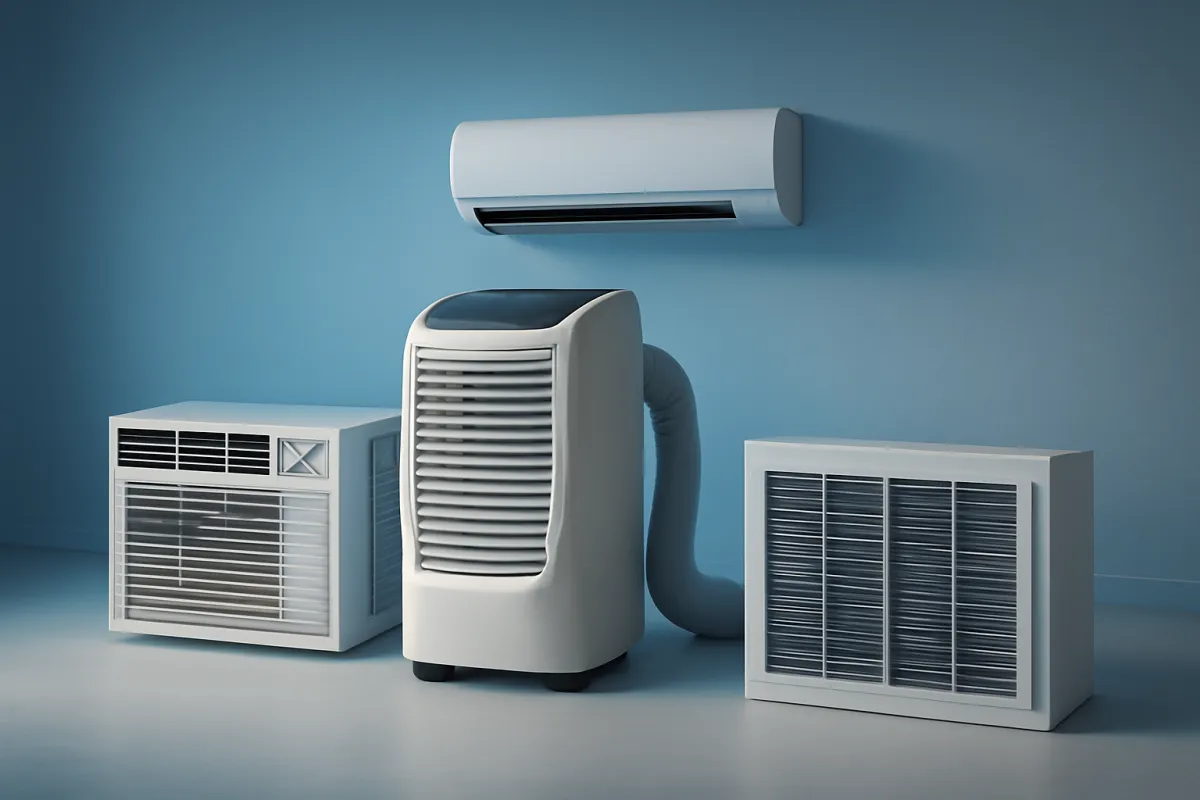
Held at the same eight hours a day for a 30-day month at a typical $0.16 rate, those wattages turn into very different monthly figures: near $23 for the mini-split zone, about $35 for the window unit, roughly $44 for the portable, and near $134 for the central system, all illustrative. The central number is not an apples-to-apples comparison, because it is cooling every room while the others cool one. That is exactly the point of the comparison: the whole-home systems cost more because they do more work, and the savings play later in this report comes from choosing how much of the house you actually need cooled.
Monthly cost by AC type
The chart below makes the spread visual. It holds each unit at eight hours a day for a 30-day month at a typical $0.16 rate and derives each bar’s length from that type’s wattage-driven monthly cost. The longer the bar, the more the unit costs to run.
Monthly running cost by air conditioner type
Each type at eight hours a day for 30 days at $0.16/kWh. Bars scale with the monthly dollar figure. Illustrative.
Central AC's bar dwarfs the rest because it cools the whole house, not one room. That is the case zone cooling exists to challenge.
Notice that the three single-room units cluster low and the central system towers over them. That gap is not waste; the central system is doing far more work, holding an entire house at temperature. But it frames the central question of cooling economics: are you paying to cool rooms nobody is in? When the answer is yes, one of the smaller bars, aimed at the room you occupy, can replace a lot of the tall one. Our cost-per-use calculator lets you enter any of these wattages and see the monthly figure for your own rate and hours.
How BTU and wattage relate
Air conditioners are sold by their cooling capacity in BTU, not by their wattage, which is why the running cost is not printed on the front of the box. The link between the two is the efficiency rating. Watts equal the BTU rating divided by the efficiency rating (EER for a fixed condition, SEER as a seasonal average). Rearranged, a unit’s power draw is its cooling capacity divided by how efficiently it delivers it.
Work an example. A 10,000-BTU window unit with an EER of 10 draws about 1,000 watts while cooling. The same 10,000 BTUs from a unit with an EER of 12 draws closer to 833 watts, because it produces the same cooling with less power. That is the whole reason two units with identical BTU ratings can cost different amounts to run: the more efficient one needs fewer watts to move the same heat, and fewer watts flow straight through the cost formula into fewer dollars per hour.
This is also why bigger is not automatically more expensive per unit of comfort, and why a mismatched size is. A unit sized correctly for the room reaches temperature and cycles its compressor off, so it spends fewer hours at full draw. The BTU number tells you whether the unit can cool the room; the efficiency rating tells you what that cooling costs. You need both to price a purchase, and the label gives you both if you know to look.
Your electricity rate is the biggest variable
Wattage is fixed by the unit and hours are set by you and the weather, but the electricity rate is the wild card, and it swings the answer more than anything else. Residential rates vary widely by region and by season, and summer rates in particular can climb, so the same window unit on the same schedule can cost dramatically different amounts depending on where the meter sits.
Find your rate on your electricity bill, where it is usually printed as cents per kilowatt-hour. Then hold the window unit at 900 watts and eight hours a day for a 30-day month, 216 kilowatt-hours, and watch how the monthly cost tracks the rate:
- At 10 cents per kilowatt-hour: about $22 a month
- At 16 cents per kilowatt-hour: about $35 a month
- At 24 cents per kilowatt-hour: about $52 a month
- At 32 cents per kilowatt-hour: about $69 a month
That is more than a threefold spread from the same appliance, driven entirely by the rate. It is why a blanket claim that air conditioners are cheap or expensive to run is meaningless without a rate attached. Before you judge whether cooling fits your budget, look up your own number and run it. Our cost-per-use calculator takes your exact rate in cents and returns your monthly figure directly.
Central AC vs window units: the zone-cooling case
Set central air and window units side by side and the trade becomes clear. A central system cools every room to the same temperature whether you are in it or not, which is comfortable and effortless and, at roughly 3,500 watts, the most expensive way to run. A window or portable unit cools exactly one room. When you only need one room comfortable, cooling that room and letting the rest of the house drift warmer can cost a fraction of running central air, the same logic as heating one room in winter.

The math works because you shrink the volume you are cooling. Holding a 150-square-foot bedroom comfortable for the eight hours you sleep in it costs a couple of dollars a night on a window unit. Holding a whole 2,000-square-foot house at the same temperature those hours, so that empty rooms and hallways stay cool, costs many times more. Raise the central thermostat several degrees and cover the difference in your one occupied room with a window unit, and the savings on the central system usually outrun the window unit’s running cost. The strategy fails the instant you use it wrong: run a window unit in one room while the central system still holds the whole house cold and you have simply added a cost. Zone cooling only saves money when you raise the big system’s setpoint to bank the difference.
One room vs the whole house: the cooling split
The chart below shows where a hot month’s cooling dollars go under a zone-cooling strategy, expressed as illustrative shares of what cooling the whole home to a cold setpoint would have cost. Raise the central thermostat, cover your occupied room with a window unit, and the total splits three ways.
A summer month's cooling: window unit vs whole-home
Illustrative split of what cooling the whole home to a cold setpoint would have cost, once you zone-cool instead. Shares sum to 100.
The window unit is real spending, but the deeper cut to central cooling more than covers it, leaving a net saving. Keep the house cold and add the window unit and the saving disappears.
The point of the split is that the window unit’s slice is real spending, not free cooling. It only pays because the reduction in central cooling is larger. If you had left the central system holding the whole house cold, that first slice would swell to fill the bar and there would be no saved slice at all. The saving is the gap between cooling everything and cooling only what you use, and the window unit is the tool that lets you close the house down to one comfortable room without sweating.
How SEER and efficiency change running cost
Every air conditioner carries an efficiency rating, and it is the number that decides how many watts a given amount of cooling costs you. Window and portable units usually show an EER or a CEER; central systems and mini-splits show a SEER, a seasonal average across a range of conditions. In every case, a higher number means more cooling per watt, which means a lower running cost for the same comfort.
Because watts equal BTUs divided by the efficiency rating, the effect flows straight through the cost formula. Two central systems both rated to cool your house, one at a low SEER and one at a high SEER, will hold the same temperature, but the high-SEER unit draws fewer watts to do it and therefore costs less every hour it runs. Over a full cooling season, where a central system may run hundreds of hours, that per-hour gap compounds into a meaningful difference on the bill. This is the same principle we apply to matching a machine to its job in our dehumidifier sizing and cost breakdown: the spec that looks like a marketing number is really a running-cost lever.
The catch, as always, is the purchase price. A high-efficiency unit costs more up front, and whether it repays that premium depends on how many hours you actually run it. For a unit that cools a hot climate many hours a day for months, the efficiency premium can pay back over a few seasons. For a unit that runs a handful of mild weeks a year, the cheaper, lower-rated unit may be the better total-cost choice. Price the efficiency the way you would price any feature: against the hours you will really use it.
The thermostat setting: each degree costs
The single cheapest lever on a cooling bill is the number on the thermostat. A commonly cited rule of thumb holds that each degree you lower the setpoint in summer adds roughly 3 percent to cooling cost, and each degree you raise it saves about the same. The exact figure depends on your home, your climate, and your equipment, so treat it as a planning estimate rather than a promise, but the direction is reliable.
The mechanism is the hours term in the formula. A lower setpoint means the compressor has to run more hours to hold the room against the outdoor heat, and every extra hour is more kilowatt-hours on the meter. Nudge the setpoint up a few degrees and the compressor cycles off sooner and stays off longer, cutting the running hours without changing a single watt of the unit’s draw. Raising the setpoint while you are out at work or asleep under a blanket, when nobody notices the extra degrees, is close to free money. A programmable or smart thermostat automates exactly that, letting the house drift warmer on a schedule and pulling it back down before you return.
Hours of use: a hot month’s assumption
Every cost figure in this report rests on an hours assumption, and cooling hours are the input people fudge most, because they are set as much by the weather as by choice. In a mild stretch a window unit might run two or three hours in the evening. In a heat wave the same unit runs most of the day and all night, and the compressor cycles far more of that time actually cooling. The difference between four hours and sixteen is a fourfold difference in cost from the same unit at the same rate.
Be honest about a hot month rather than a mild one. If the unit comes on after work and runs until you sleep, that is easily six to eight compressor hours. If it holds a bedroom all night through a warm spell, add several more. If a heat wave keeps it cooling around the clock, you have quietly signed up for the 24-hour column, where even a single window unit at a typical rate approaches $100 for the month. The most effective thing most people can do to cut cooling cost is not buy a different unit but shorten the hours the compressor runs: a higher setpoint, a closed-off room, and fans to stretch comfort at a warmer temperature. Our cost-per-use calculator lets you test a heat-wave schedule against a mild one and see the gap in dollars.
Portable AC vs window unit: the efficiency gap
Portable air conditioners are tempting because they need no window bracket and roll from room to room, but on running cost they usually lose to a window unit doing the same job. The reason is the single-hose design most portables use. The unit pulls air from the room to cool its condenser and then vents that air outside, which lowers the pressure indoors and draws warm, humid outside air in through every gap to replace it. The unit ends up fighting a small inflow of the very heat it just removed, so it runs longer and draws more watts to hold a temperature.
That inefficiency shows up in the ratings and in the wattage. A portable rated for a room may draw meaningfully more power than a window unit rated for the same room, which is why the portable’s bar sat higher in the chart above. Illustratively, a 1,150-watt portable doing the work of a 900-watt window unit costs roughly a quarter more per month at the same hours and rate. None of that makes the portable useless: for a rental where you cannot mount a window unit, or a room with windows that will not take one, the convenience is worth real money. Just buy it knowing you are paying a running-cost premium for that flexibility, not saving with it.
Amperage and the circuit ceiling for big units
Wattage is a cost number, but it is also a safety number, because it sets the current the unit pulls. Amps equal watts divided by volts, so on a standard 120-volt outlet a 1,440-watt window or portable unit draws about 12 amps. A typical household circuit is rated for 15 amps, which means a large single-room unit already uses most of that circuit’s capacity, leaving little headroom for anything else on the same wires.
That thin margin is why the same safety guidance that applies to space heaters applies here. Plug a window or portable air conditioner straight into a wall outlet, not into a power strip or a thin extension cord, both of which can overheat carrying that current for hours. Avoid running other significant loads on the same circuit while the unit is going, because the combined draw can trip the breaker. Larger window units and every central system step up to their own dedicated circuits, frequently 240 volts, precisely so they are not sharing capacity with the rest of the room. Treat the amperage math as a hard limit rather than a guideline, and if you are unsure whether a circuit can carry a big unit, or whether older wiring is up to it, ask a qualified electrician before you rely on it.
AC vs a heat pump in cooling mode
A point that surprises people: a heat pump in cooling mode is an air conditioner. The two use the same refrigeration cycle to move heat out of a room, so in summer a heat pump and a central AC of the same efficiency rating cost essentially the same to run for the same cooling. The heat pump’s advantage is not in summer at all; it is that the same hardware reverses in winter to heat efficiently, which a plain AC cannot do.
For running cost in cooling season, then, the comparison comes down to the efficiency rating, not the label on the box. A high-SEER heat pump and a high-SEER central AC will hold your house at the same temperature for about the same money through July. The reason to choose a heat pump is the year-round math: one system that cools efficiently in summer and heats efficiently in winter can beat a separate AC and furnace over its life, which is the same whole-cost-over-real-use logic we bring to every piece of gear we test. If you are pricing cooling alone, judge the unit by its SEER and its wattage; if you are pricing a home’s whole climate system, the heat pump’s winter side is where its case is really made.
Sizing AC to your room’s square footage
An air conditioner has to match the room, and both undersizing and oversizing cost you. A rough starting point is about 20 BTU per square foot of room for average ceilings and insulation, so a 150-square-foot bedroom points to roughly a 5,000-BTU unit and a 400-square-foot living room to something near 8,000 to 10,000. Sun exposure, ceiling height, and how many people use the room all nudge that up.
Sizing matters for cost because a mismatched unit runs badly. An undersized unit in a large or sunny room never reaches the setpoint, so its compressor runs continuously at full draw and still leaves you warm, the same expensive failure mode we describe for an undersized dehumidifier in our dehumidifier breakdown. An oversized unit is a subtler waste: it cools the air so fast that it hits the setpoint and shuts off before it has pulled much humidity out, then cycles back on a few minutes later, leaving the room cold and clammy and the compressor short-cycling in a way that wears it and wastes energy. A correctly sized unit runs in longer, steadier cycles, wringing out humidity and holding temperature at a lower total cost. Match the BTUs to the square footage, then let the thermostat do the rest.
Ways to cut your cooling cost
Because cost is watts times hours times rate, every saving comes from lowering one of those three. Here are the levers that actually move the number, in rough order of impact.
- Raise the setpoint, especially when you are out or asleep. Each degree up trims roughly 3 percent, illustratively, and nobody notices the extra degrees at 3 a.m. This is the biggest lever, and it costs nothing.
- Run fewer hours with a smart or programmable thermostat. Let the house drift warmer while it is empty and pull it back before you return, so the compressor is not holding an empty house cold all day.
- Zone cool, and raise the central setpoint. A window unit or mini-split only saves money if you bank the difference by letting the rest of the house warm up. Cool the room you occupy, not the ones you do not.
- Use fans to stretch comfort. A ceiling or box fan makes a room feel several degrees cooler by moving air over your skin, which lets you hold a higher setpoint for the same comfort. Fans cool people, not rooms, so switch them off when you leave.
- Cool at night and shut the heat out by day. Pull warm air out with the AC or open windows overnight when it is cheapest and coolest, then close windows, blinds, and curtains against the sun during the day so the unit fights less heat.
- Seal and insulate the room. Weatherstrip the door, close it, and block drafts so the unit is cooling a small sealed space rather than leaking cold into a warm house, which cuts the hours it runs.
- Check your rate and your plan. On a time-of-use rate, pre-cooling during off-peak hours and coasting through the expensive peak lowers the rate term directly.
Notice that none of these is about buying a fancier unit. The savings live in how you run it, which is why the unit you already own, run well, is usually the right tool.
A worked example: one window unit and central AC
Put it all together on a single realistic case. It is a hot month. You have central AC for the whole house and one 900-watt window unit in the bedroom, and you want to compare cooling the whole house cold against zone cooling with the window unit, at three different rates.
The window unit alone. 900 watts is 0.9 kilowatts. Run its compressor eight hours a day and that is 7.2 kilowatt-hours a day. At a typical $0.16 rate that is about $1.15 a day, roughly $35 for the month, illustratively. On a cheap $0.10 rate it falls to about $22; on an expensive $0.32 rate it climbs to about $69.
Central AC on the whole house. At around 3,500 watts running the same eight hours a day for the month, central air lands near $134 at the typical $0.16 rate, bracketed by roughly $84 on the cheap rate and about $269 on the expensive one. That is the cost of holding every room cold, occupied or not.
The season. Run the window unit’s eight-hour schedule across a three-month summer and the typical-rate total lands near $104, with cheap and expensive rates bracketing it from about $65 to about $207. Now weigh the strategy: if raising the central setpoint and covering the bedroom with the window unit cuts the central bill by more than the window unit’s cost, you are ahead. If the central system stays cold and you add the window unit, its cost is pure addition. The unit did not decide which; your strategy did. Swap your own wattage, hours, and rate into the cost-per-use calculator to see your version of this example.
How to shop: a running-cost checklist
Before you buy an air conditioner, or decide how to run the one you own, run it through these checks. Clear them and the unit will cost roughly what you expect, and no more.
- Know your rate. Pull it off your bill in cents per kilowatt-hour. Without it, no cost claim means anything.
- Read the wattage and the efficiency rating, not just the BTUs. The BTU number says whether it can cool the room; the watts and the EER or SEER say what that cooling costs per hour.
- Match the BTUs to the room. Around 20 BTU per square foot as a starting point, then adjust for sun and ceilings. Oversized short-cycles and leaves you clammy; undersized runs flat out and never catches up.
- Insist on a real thermostat. A unit that reaches a setpoint and cycles the compressor off is the difference between full-power hours and managed ones. A smart thermostat automates the setpoint schedule.
- Plan the zone. Decide which rooms you will actually cool and commit to letting the rest drift warmer. That is the move that turns a window unit into a saving rather than an addition.
- Respect the circuit. A big single-room unit can approach a 15-amp circuit’s limit. Wall outlet only, no power strips, nothing else heavy on the same wires, and a dedicated circuit for anything large.
- Do the seasonal math, not the hourly. Fourteen cents an hour sounds like nothing. Multiply it out to a hot month and a summer before you judge whether the unit fits your budget.
Clear those and you are buying and running on numbers rather than on the reassuringly small price tag, which is the entire point of a breakdown.
The bottom line
The cost of running an air conditioner is never a mystery, because the formula is fixed: wattage in kilowatts, times the hours the compressor runs, times your electricity rate. For a typical 900-watt window unit that is about fourteen cents an hour, near $1.15 a day at eight hours, and roughly $35 across a hot month at a typical rate, with your own rate swinging the monthly figure anywhere from about $22 to $69. Scale up to central air and the same schedule can land near $134, because you are cooling the whole house instead of one room. Efficiency ratings and BTUs decide the watts, but the watts, the hours, and the rate decide the dollars. Cooling earns its keep when you match the unit to the room, run the compressor on a thermostat for the hours you are actually there, and, when only one room needs to be comfortable, cool that room while you let the rest of the house drift warmer and bank the difference. Size it right, set it a few degrees higher, keep the big system’s hours down, and price it by the season rather than the hour, and an air conditioner becomes what it should be: a load you can predict to the dollar and run on purpose.
A note on scope: this breakdown exists to hand you the running-cost arithmetic for cooling, not to steer you toward any particular air conditioner. Every wattage, BTU, efficiency rating, and dollar amount above is an illustrative planning figure, built from typical ranges rather than measured on one model, and your real electricity rate, climate, hours, and room will move the result enough to matter. Nothing here is professional electrical or HVAC advice. An air conditioner is a substantial electrical load, and large or central units involve dedicated circuits, refrigerant, and wiring that are not do-it-yourself territory, so follow the maker’s instructions, keep window and portable units on their own wall outlets, and bring in a qualified electrician or HVAC professional for sizing, installation, or any doubt about a circuit’s capacity before you rely on the numbers in this article.
Frequently asked questions
How much does it cost to run an air conditioner per hour?
Take the unit's wattage, divide by 1,000 to get kilowatts, and multiply by your electricity rate. A typical 900-watt window air conditioner is 0.9 kilowatts, so at a rate near $0.16 per kilowatt-hour it costs about $0.14 an hour with the compressor running. A larger portable unit near 1,150 watts runs closer to $0.18 an hour, and a central AC compressor around 3,500 watts costs about $0.56 an hour while it is actually cooling. These are illustrative figures for the unit running at full draw; a thermostat that cycles the compressor off part of the time lowers the real number.
How much does it cost to run a window AC for a month?
Run a 900-watt window unit eight hours a day for a 30-day month and it uses about 216 kilowatt-hours. At a typical $0.16 per kilowatt-hour that is roughly $35 for the month, illustratively. The same unit on a cheaper $0.10 rate lands near $22, and on an expensive $0.32 rate closer to $69. Run it around the clock through a heat wave rather than eight hours and the total roughly triples. Your own rate and hours move the figure far more than the brand of the unit ever will.
Is central air conditioning expensive to run?
Central AC costs more per hour than a single window unit because it is a much larger load, often around 3,000 to 3,500 watts for the compressor plus the air handler, and it cools the whole house rather than one room. Run for eight hours a day across a hot month, a central system can land near $134 at a typical rate, illustratively, against roughly $35 for one window unit. Whether that is expensive depends on how much space you actually need cooled. Cooling a whole home is inherently more energy than cooling the one room you occupy, which is the entire logic behind zone cooling.
Does a portable air conditioner use more electricity than a window unit?
For the same cooling effect, a portable AC usually costs more to run than a window unit, because it is inherently less efficient. A single-hose portable pulls already-cooled air from the room and vents it outside, which pulls warm air in through gaps to replace it, so it works harder to hold a temperature. That shows up as more watts per unit of cooling and a higher rating gap. A portable near 1,150 watts can cost roughly a quarter more per month than a 900-watt window unit doing similar work, illustratively. The portable earns its place on convenience and rentals, not on running cost.
How does SEER or the efficiency rating change running cost?
SEER and EER measure how much cooling you get per watt, so a higher number means fewer watts for the same BTUs and a lower running cost. Watts equal the BTU rating divided by the efficiency rating, so a 10,000-BTU unit at an EER of 10 draws about 1,000 watts, while the same 10,000 BTUs at an EER of 12 draws closer to 833 watts. That difference flows straight through the cost formula: fewer watts, fewer dollars per hour, for identical comfort. Over a full cooling season the gap between a low and high efficiency unit can be meaningful, which is why the rating is worth checking before you buy.
How much does each degree on the thermostat cost?
A commonly cited rule of thumb is that each degree you lower the thermostat in summer adds roughly 3 percent to cooling cost, and each degree you raise it saves about the same. The exact figure depends on your home, your climate, and your equipment, so treat it as a planning estimate rather than a guarantee. The mechanism is simple: a lower setpoint means the compressor runs more hours to hold it against the outdoor heat, and running cost tracks those hours. Nudging the setpoint up a few degrees, especially while you are out or asleep, is one of the cheapest levers on the whole bill.
Can an air conditioner overload a circuit?
A large window or portable AC can draw enough current to matter on a standard circuit. A 1,440-watt unit on a 120-volt outlet pulls about 12 amps, close to the 15-amp ceiling of a typical household circuit, which leaves little headroom for anything else on the same wires. Bigger units and central systems are usually wired to their own dedicated circuits, often 240 volts, for exactly this reason. Plug a window or portable unit straight into a wall outlet rather than a thin extension cord or power strip, avoid sharing the circuit with other heavy loads, and consult a qualified electrician if you are unsure whether a circuit can carry the unit.
How do I calculate my own air conditioner running cost?
Use the formula wattage divided by 1,000, times hours of use, times your electricity rate in dollars per kilowatt-hour. For a 900-watt window unit run 8 hours at $0.16, that is 0.9 times 8 times 0.16, or about $1.15 a day. Find your exact rate on your electricity bill, usually printed as cents per kilowatt-hour, and count realistic hours rather than the maximum. Our companion calculator does the arithmetic for you: enter the unit's wattage, your hours, and your rate, and it returns the hourly, daily, monthly, and full-season figures.