What's on this page
- Why is my air conditioner not cooling? What the system is actually doing
- The safety rules that come before any check
- The eight checks, in the order that costs least
- Check one: the thermostat mode, setpoint and fan switch
- Check two: the thermostat batteries
- Check three: the breaker and the outdoor disconnect
- Check four: the air filter, the most common cause on this list
- Check five: blocked return vents
- Check six: closed or blocked supply registers
- Check seven: an outdoor unit choked with debris
- Check eight: a full or blocked condensate drain
- Ice on the coil or the line: shut it off and let it thaw
- The air is blowing but it is not cold
- The system runs all day and never reaches the setpoint
- Some rooms cool and others stay warm
- It cools overnight but gives up in the afternoon
- Where the line is: what only a licensed technician should touch
- Where an air conditioner cooling fault usually starts
- What a struggling air conditioner costs while you wait
- A worked example: one warm house, eight checks
- What to tell the technician when you call
- Repair or replace: how to think about the number
- Prevention: the habits that keep an air conditioner cooling
- The bottom line
An air conditioner that stops cooling almost never stops running. The thermostat lights up, the blower hums, the outdoor unit sits there making its usual noise, and every visible sign says the system is doing its job, right up until you stand in front of a register and feel air that is barely cooler than the room. That gap between a machine that is obviously working and a house that is obviously not getting cold is what sends people straight to the most expensive assumption, which is usually wrong.
These test notes work the fault the way the rest of our not-working family works: symptom first, then the cheap causes, then a hard line where the owner stops and a licensed technician takes over. That line matters more on an air conditioner than on any other appliance in the house, because this machine combines a sealed refrigerant circuit with line voltage electrics and parts that store a lethal charge after the power is off. Our window AC cleaning walkthrough covers the maintenance half of this, our air conditioner running-cost teardown prices the machine once it is healthy, and our refrigerator cooling report works the same logic on a machine that uses the same physics.
Key takeaways
- Eight things are genuinely yours to check: thermostat mode and setpoint, thermostat batteries, a tripped breaker or disconnect, the air filter, blocked return vents, closed supply registers, an outdoor unit choked with debris, and a full or blocked condensate drain.
- Everything else is a technician's job. Refrigerant, the compressor, capacitors, the contactor and the reversing valve are not owner territory, and a capacitor can hold a dangerous charge after the power is off.
- Power off at the outdoor disconnect and at the breaker before touching anything physical, and tell the household you have done it.
- Ice on the coil or on the copper line means shut the system down and let it thaw. It is a symptom of restricted airflow or low refrigerant, not a diagnosis on its own.
- A restricted system is expensive while you wait. On illustrative figures a fifth more runtime costs about $23 a month, or roughly $92 across a four month season.
Why is my air conditioner not cooling? What the system is actually doing
Two minutes of understanding here saves an hour of poking, because the mechanism tells you which checks are worth making and which are a waste of an afternoon.
An air conditioner does not create cold. It moves heat from inside your house to outside it, using a refrigerant that changes state as it goes round a closed loop. Indoors, warm room air is pulled across a cold coil, the refrigerant inside that coil absorbs heat from the air, and the now-cooler air is blown back into the rooms. Outdoors, that collected heat is released into the open air by a second coil with a fan on it, and the compressor sitting alongside is the pump that keeps the whole loop moving.
Three things have to work at once for a house to get cold: enough air has to move across the indoor coil, the loop has to be intact and correctly charged, and the outdoor unit has to be able to dump heat into the air around it. Break any one of them and the symptom is identical from the hallway. The system runs, the fan blows, and nothing gets cooler.
That is why the diagnosis is not about listening harder. It is about establishing which of those three jobs has stopped, and two of the three have owner-checkable causes at the top of their list.
The safety rules that come before any check
Read this section even if you skip everything else, because an air conditioner is the appliance in this category most capable of hurting somebody who treats it like a fridge.
Kill the power at two places, not one. Central systems normally have a disconnect box mounted on the wall near the outdoor unit, and a breaker in the panel that feeds it, plus a separate breaker or switch for the indoor air handler. Pull or switch the outdoor disconnect and turn off the breakers before you touch anything physical. Switching the thermostat off is not the same thing: the equipment is still live, and a control board can start a fan or a compressor on its own schedule while your hand is inside the cabinet.
Tell somebody you have done it. The classic accident in this whole category is a helpful person restoring power because the house was getting warm. Put a note on the panel if you have to.
Capacitors hold a charge after the power is removed. This is the specific hazard people do not expect from a garden appliance. The electrical compartment of the outdoor unit contains parts that store energy and do not necessarily let go of it when the disconnect is pulled. Treat that compartment as live, permanently, and do not open it. Nothing on the owner-checkable list in this report requires you to.
The refrigerant circuit is not a home job in any version of this fault. The compressor, the two coils, the metering device and the lines between them form a sealed system. Working on it needs recovery equipment, vacuum pumps and, in most places, a certification, and venting refrigerant is both an environmental problem and often an offence. There is no partial version of that work, and this report does not describe one.
Fins and blades cut. Coil fins are thin aluminium with sharp edges, and fan blades are heavier than they look. Gloves on, and keep fingers out of the fan grille even when the power is off.
The eight checks, in the order that costs least
The reason a checking order matters here is that the causes of a not-cooling air conditioner are wildly unequal in both frequency and price, and the two run in roughly opposite directions. The common causes are free. The rare ones are the ones with four figures attached.
The order these test notes use is: thermostat mode and setpoint, thermostat batteries, the breaker and the outdoor disconnect, the air filter, the return vents, the supply registers, debris around the outdoor unit, and the condensate drain. Every one of those is something a household can inspect with a flashlight, a screwdriver and an hour, and none of them requires opening a sealed system or an electrical compartment.
After those eight, the list stops being yours. Refrigerant charge, the compressor, the capacitor that starts it, the contactor that switches it, the reversing valve on a heat pump and the control board all produce the same not-cooling symptom, and every one of them is a call rather than a fix. That is not caution for its own sake. It is the point where the tools stop being household tools and the failure modes stop being recoverable.
One shortcut is worth applying immediately when it fits. If the system stopped cooling within days of somebody mowing near the outdoor unit, changing a thermostat, having work done in the attic, or a storm that cut the power, start with whatever changed. Recent disturbance is the strongest single clue this fault ever gives you, and it can turn an evening of diagnosis into a five minute check.

Check one: the thermostat mode, setpoint and fan switch
This is the check people are embarrassed to make and the one that resolves a genuine share of these complaints, so make it properly and move on.
Go to the thermostat and read what it actually says rather than what you assume it says. Confirm the system mode is set to COOL and not to HEAT, OFF, or FAN ONLY. Confirm the setpoint is meaningfully below the current room temperature, because a thermostat set two degrees above the room will never call for cooling and will look completely normal doing it. On a heat pump, check that an emergency or auxiliary heat setting has not been left on from the winter.
Then look at the fan switch, which is the single most misread control in the house. Set to AUTO, the blower runs only when the system is actively cooling. Set to ON, the blower runs continuously, which means room temperature air keeps coming out of the registers between cooling cycles. Stand at a vent during one of those gaps and the air feels warm, the machine feels broken, and nothing is wrong except a switch. Set it to AUTO and judge the system again.
Two more thermostat traps are worth knowing. A programmable or smart schedule can quietly hold a warmer setpoint during hours somebody set months ago, so read the schedule and not just the current display. And a thermostat mounted in direct sun, above a lamp, or on a wall shared with a warm appliance reads high and cools the house past the point anyone wanted, which produces the opposite complaint but the same confusion.
Check two: the thermostat batteries
This gets its own step because the failure is silent, common, and mimics an equipment fault well enough to buy a call-out.
Many wall thermostats run on batteries, sometimes as their only power source and sometimes as a backup that quietly becomes the main one. As the cells fade, the behaviour is rarely a clean shutdown. The screen keeps working, the buttons keep responding, and the relay that actually sends the call for cooling to the equipment stops closing reliably. From the hallway that looks like a machine that has stopped cooling, because functionally it is one.
Open the thermostat, which on most designs means pulling the faceplate straight off the wall plate without any tools, and fit fresh cells of the type it takes. Do it even if the display looks perfectly healthy, because the display is the last thing to fail. If the unit has a low battery indicator, take it seriously the first time rather than the tenth.
A related check belongs here. If the thermostat is completely blank, the problem may not be batteries at all but power to the indoor air handler, which many thermostats draw from. That points you at the next step rather than at the shop.
Check three: the breaker and the outdoor disconnect
A cooling system usually sits on more than one circuit, which is why it can half-work in a way that no other appliance manages.
Central systems typically have one breaker feeding the outdoor condensing unit and another feeding the indoor air handler or furnace. If the indoor breaker is on and the outdoor one has tripped, you get the exact symptom this report is about: the blower runs, air moves, the thermostat looks happy, and nothing gets cold, because the half of the system that removes heat is not powered. Check both breakers and reset anything that has tripped, once.
Then check the disconnect box on the wall near the outdoor unit. It usually holds a pull-out handle or a switch, and it can be left out after service work, knocked out during landscaping, or pulled by somebody who did not know what it was. Push or switch it fully home. There may also be a service switch near the indoor unit that looks like an ordinary light switch and gets turned off by mistake, particularly in a basement or a loft.
One rule matters more than any of that. If a breaker trips again immediately after you reset it, stop. Repeated tripping is the system telling you about an electrical fault, and resetting a breaker over and over is how a fault becomes a fire. That is a technician call, and it belongs on the far side of the line drawn later in this report.
Some systems also have a float switch on the condensate drain that cuts the cooling when the pan fills, which produces a fan-runs-but-no-cooling picture with no breaker involved at all. That one is covered in check eight.
Check four: the air filter, the most common cause on this list
If you only make one of the eight checks, make this one, because it is both the most likely cause and the easiest thing in the house to fix.
The indoor coil works by having a steady volume of warm room air dragged across it. A filter loaded with dust chokes that flow. Less air over the coil means less heat picked up per minute, so the system runs longer and longer while the house stays warm, and the electricity meter keeps turning the whole time. Pushed far enough, the reduced airflow lets the coil drop below freezing, condensation on it turns to ice, and the ice then blocks the airflow completely, at which point cooling stops outright.
The confusing part is what you feel at the register. Restricted airflow often makes the air coming out colder, not warmer, because a small amount of air is being over-cooled by a coil that has plenty of capacity and nothing to do. A cold register and a warm house is a classic airflow signature, and it points at the filter first.
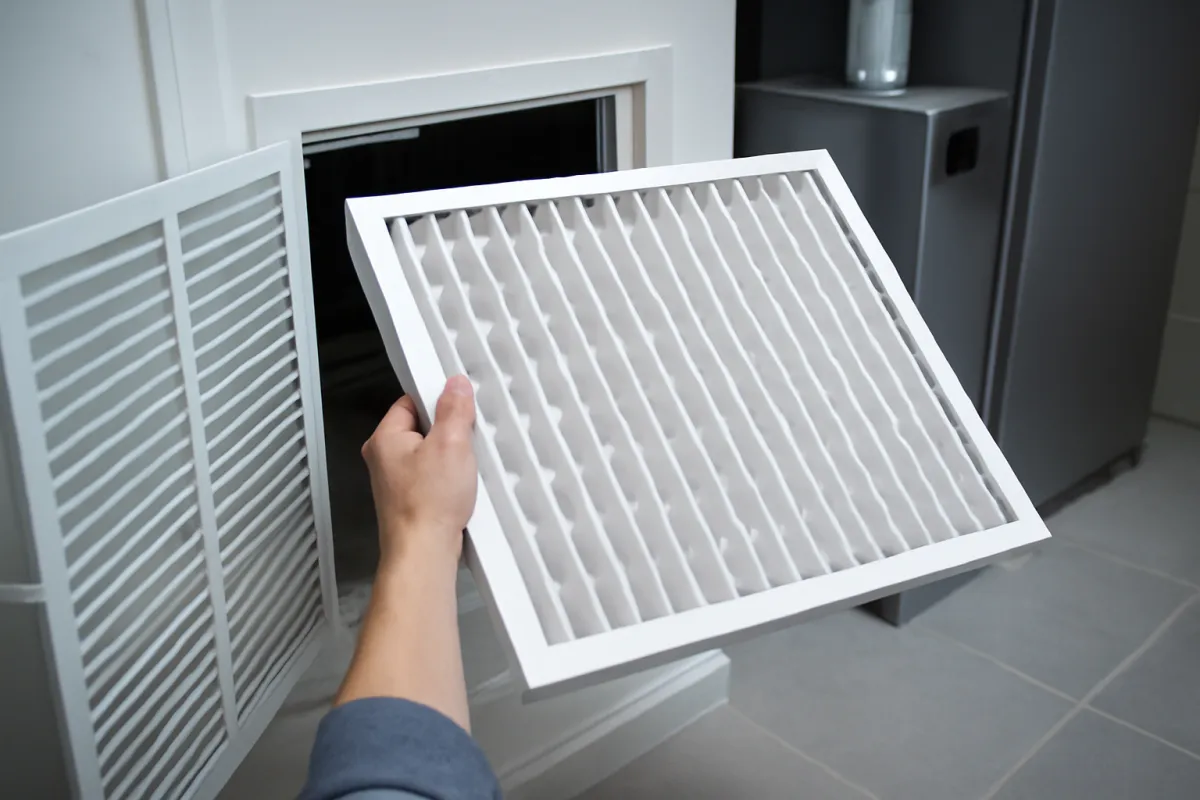
Find the filter, which lives either in a return grille on a wall or ceiling, or in a slot at the air handler where the return duct meets the equipment. Pull it out and hold it up to a light. If you cannot see light through it, it is finished, and no amount of tapping it out will bring it back. Fit a replacement of the same size with the airflow arrow pointing toward the equipment, and write the date on the frame with a marker so the next person knows.
Two cautions. A filter with a very high filtration rating restricts airflow more than a basic pleated one, and on some systems that alone is enough to cause this fault, so match what the equipment was designed for rather than buying the densest thing on the shelf. And never run the system with no filter at all while you wait for a new one, because the dust goes straight onto the coil where it does the same damage permanently. Our furnace filter interval report covers how often this should be happening in the first place.
Check five: blocked return vents
Returns are the half of the duct system nobody thinks about, and blocking them starves the coil exactly the way a dirty filter does.
Supply registers push cooled air into the rooms. Return grilles, which are usually larger and fewer, pull room air back to the equipment so it can be cooled again. If the returns cannot draw, the coil cannot get the air it needs, and the whole system behaves like it has a clogged filter even with a brand new one fitted.
Walk the house and find every return. They tend to be in hallways, on ceilings, high on walls, or as a large floor grille near the equipment. Then look at what is in front of them. A sofa pushed back over a wall return, a rug covering a floor return, a bookcase, a stack of storage boxes in the basement, or a curtain hanging flat across the grille will all do it. Pull furniture out to give the grille clear air, and vacuum the face of the grille itself, which collects a surprising mat of dust and pet hair.
Interior doors matter here more than people expect. In many houses the return is in a central hallway, and bedrooms rely on air flowing back under the door to reach it. Close every bedroom door with the system running and you have effectively strangled the return path for those rooms. Leaving doors ajar, or fitting a door undercut or a transfer grille, is a real fix for a real problem.
Check six: closed or blocked supply registers
This is the mirror image of the last check and it carries one piece of advice that most households have exactly backwards.
Supply registers are the outlets that deliver cooled air. Walk every room and confirm each one is open, unobstructed and pointing somewhere useful. Furniture pushed against a wall register, a rug laid over a floor register, boxes stacked on top of one, or a long curtain hanging over it all cut delivery to that room, and if enough of them are blocked the whole system suffers.
Now the counterintuitive part. Closing registers in unused rooms is common advice and, on most central systems, it is the wrong move. The blower is designed to push a certain volume of air through the duct system, and closing registers does not reduce the work it has to do, it raises the pressure in the ducts. That pushes more air out through every leak in the ductwork, reduces the total airflow across the indoor coil, and can bring you right back to the freezing-coil problem from check four. A couple of closed registers in a large house is usually harmless. Half the house closed off is a cause of this fault, not a saving.
While you are walking the rooms, check the registers themselves are not simply full of dust, and note which rooms feel worst. That map is useful later, both for the uneven-cooling section below and for anything you end up telling a technician.
Check seven: an outdoor unit choked with debris
Half the job of an air conditioner happens outside, and the outdoor unit is the half most exposed to everything that can stop it working.
The condensing unit rejects the heat your house has collected by blowing outdoor air across a coil that wraps around the cabinet. Anything that stops air moving through that coil stops heat leaving the system. Grass clippings blown into the fins by a mower, leaves packed against the base, cottonwood fluff matted across a whole side, a shrub that has grown in over a season, a fence built too close, or a pile of garden furniture stacked against it will all do it, and all of them are things that happened gradually enough that nobody noticed.
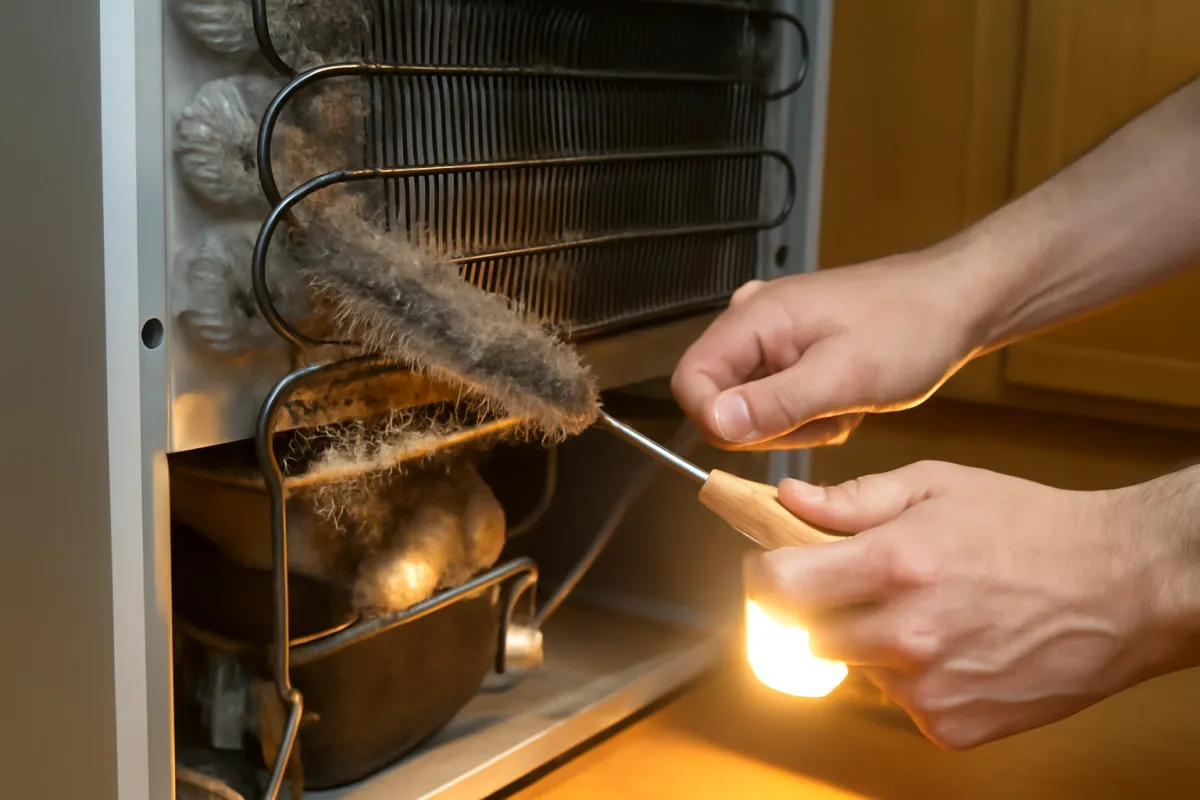
Here is the sequence, and it starts with the power. Pull the outdoor disconnect and switch off the breaker that feeds the unit. Then clear the ground around it: leaves, clippings, weeds, anything within roughly two feet on all sides, and anything sitting on top of the fan grille. Look at the coil fins from the outside and see whether they are matted. A soft brush used gently along the direction of the fins, never across them, lifts a lot of loose debris. A gentle rinse from a garden hose from the outside in can carry off more, with no pressure washer anywhere near it, because the fins bend at almost nothing and bent fins block the airflow you were trying to restore.
What you do not do is open the electrical compartment, remove the fan assembly to get better access, straighten fins with a screwdriver, or touch anything the wires run into. If the coil is packed solid with matted fluff and dirt, a proper coil cleaning is a service task and worth booking, and it will be on the technician’s list anyway.
Check eight: a full or blocked condensate drain
The last owner check is the one that explains a system that was cooling perfectly and then stopped dead with no warning at all.
Cooling air also dries it. Moisture condenses out of the room air onto the cold indoor coil and runs off into a drain pan, then out of the house through a condensate line, which is usually a length of plastic pipe running to a drain, a sump, or outside. On a humid day that line carries a genuinely surprising volume of water. Because it is a permanently damp pipe, it grows sludge and algae, and eventually it blocks.
When it blocks, the pan fills. Most modern installations have a float switch in the pan or in the line whose entire purpose is to shut the cooling off before the overflow reaches your ceiling. That is why this fault presents as a system that will not cool at all, often with the blower still running normally, and often with no error message a householder would recognise.
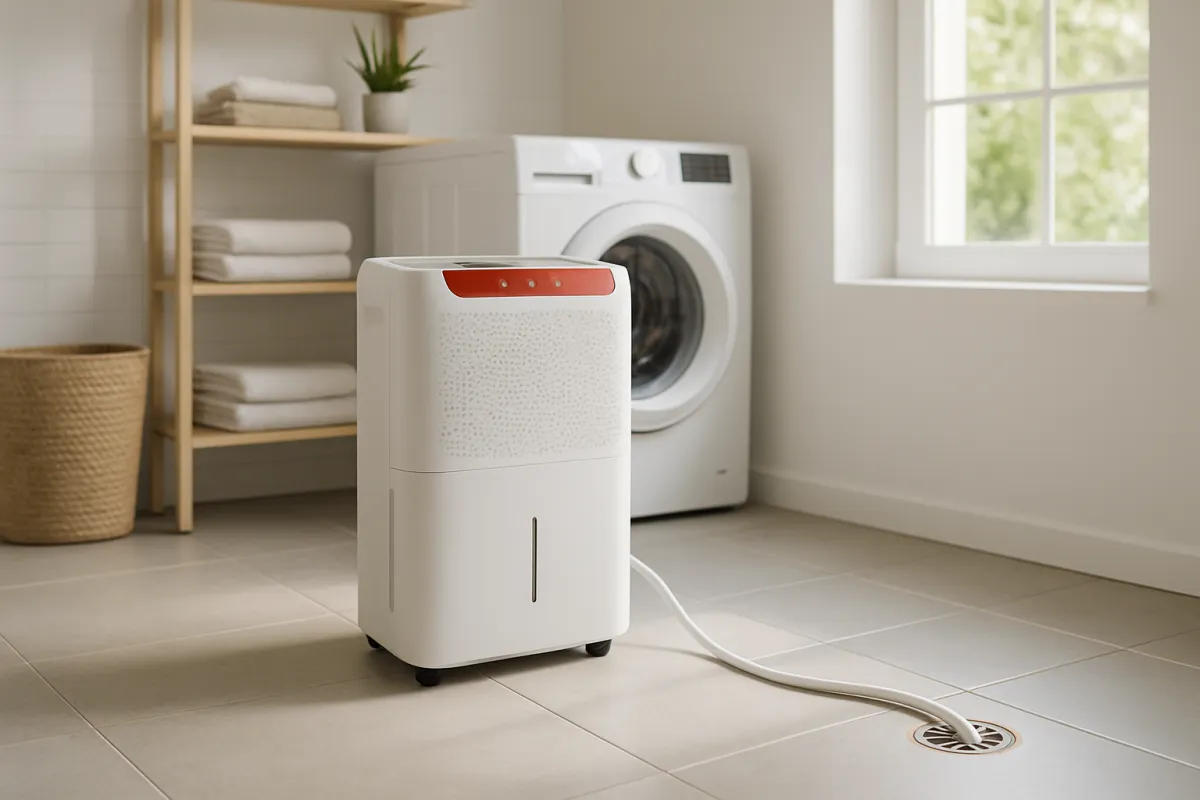
Your part is limited and useful. Look at the drain pan under the indoor unit and see whether it is holding water. Find the outdoor end of the condensate line and confirm water is actually coming out of it during a cooling run. Check the pan for standing water, and if there is any, a wet vacuum applied to the outdoor end of the line clears many blockages in a few minutes. Some installations have a capped access tee near the coil that lets you flush the line through. Clear the pan, clear the line, and see whether the system restarts.
What is not yours: cutting into the line, replacing a float switch, or removing panels to reach an evaporator coil. And a pan that refills fast after clearing is telling you about something upstream, which is a call. Persistent moisture problems in the house belong with our home humidity report rather than with the drain line.
Ice on the coil or the line: shut it off and let it thaw
If you see ice anywhere on this system, stop reading the rest of the list and deal with this first, because running an iced system is how a cheap fault becomes an expensive one.
Ice shows up in three places: on the indoor evaporator coil, on the insulated copper line running from the indoor unit to the outdoor one, and sometimes as a sheet at the base of the outdoor unit. It happens because the coil has dropped below freezing and the moisture condensing on it has frozen instead of draining away. Once a layer of ice forms it blocks airflow, which drops the coil temperature further, which grows more ice. It is a loop that only gets worse.
Two very different things cause it, and this is the important part: you cannot tell which from looking at the ice. Restricted airflow does it, meaning a clogged filter, blocked returns, closed registers, a failing blower or a dirty coil. Low refrigerant does it too, because a circuit that has lost charge runs at a lower pressure and therefore a lower temperature. The first family is yours to fix. The second is a technician’s, and it is a leak rather than a machine that used a substance up, which is why a top-up without a leak search is a repair that comes back.
So the instruction is the same regardless of cause. Turn the cooling off at the thermostat. If your system allows it, run the fan alone, which pushes room air over the coil and speeds the thaw. Put towels down under the air handler, because a fully iced coil holds a lot of water. Wait. A heavy ice-up can take several hours to clear and there is no safe way to hurry it: no hair dryer, no hot water, no chipping at it with anything, because the coil and its tubing damage easily and a punctured coil is a sealed-system repair.
When it has thawed completely, replace the filter, open every register, clear the returns, and run the system again while watching. If it cools normally and stays clear, restricted airflow was your answer. If it ices up again, shut it down and call a technician, and tell them it iced twice. That single fact is genuinely useful diagnostic information and it will shorten the visit.
The air is blowing but it is not cold
This is the most common way the complaint gets described, and it narrows the search usefully once you take it literally.
Air blowing means the indoor blower has power and is running, which clears the indoor breaker, the blower motor and, usually, the thermostat’s basic wiring. Air that is not cold means the heat is not being collected or not being rejected. So the blower half of the system is proven and the cooling half is not, which is exactly the split that sends you to the filter, the returns, the outdoor unit and, if all of those are clean, to a technician.
Do one measurement while you are there, because it costs nothing and it is the single most useful thing you can hand to a professional. Hold a thermometer in the airstream at a supply register near the equipment, then at the return grille, and note both. A working system produces a meaningful difference between those two numbers. A system producing almost no difference is not cooling at all, which is a different conversation from one that is cooling weakly. Do not chase a specific target figure from an article, including this one, because the correct difference depends on the equipment, the humidity and the conditions on the day, and a technician has the context to interpret it. Record the two numbers and the outdoor temperature, and let them do the interpreting.
One more distinction is worth drawing. Air that is cold at the register but never cools the house points at airflow volume or duct losses. Air that is not cold at all points at the refrigeration side. Those are different searches, and the register thermometer separates them in two minutes.
The system runs all day and never reaches the setpoint
A system that never satisfies the thermostat is a different symptom from one that blows warm, and it has its own short list.
Sometimes this is not a fault at all. Equipment is sized to hold a temperature against a design condition, not to win a fight against an extreme heat wave, and on the hottest afternoons of the year a correctly working system can run continuously and still sit a few degrees above its setpoint. If that only happens on the worst days and the house recovers overnight, the machine is doing what it was built to do.
When it happens routinely, the causes divide into the same two families as everything else here. On the owner side: a filter that has drifted from clean to marginal, returns that are partly blocked, half the registers closed, an outdoor unit slowly overgrown, or a house whose heat load has increased since the system was installed, which is a real thing when insulation is disturbed, a conservatory is added, or a loft becomes a bedroom. On the technician side: low charge, a compressor that is running but not compressing properly, a failing capacitor, duct leakage into a hot attic, or equipment that is genuinely undersized for the house.
The practical move is to work the eight checks first, then quantify the problem for the technician: how many degrees short, at what outdoor temperature, at what time of day, and whether the shortfall is the same in every room. Our electric bill reduction report covers the load side of this, because reducing what the system has to fight is often cheaper than upgrading what fights it.
Some rooms cool and others stay warm
Uneven cooling gets treated as an equipment failure and is usually a distribution problem, which changes both the diagnosis and the price.
Start by mapping it honestly. Which rooms are warm, and is it all the time or only in the afternoon? Are the warm rooms upstairs, on the west side, at the far end of the ductwork, or behind closed doors? Those four patterns point at four different causes: heat rising, solar gain through glass, a duct run that is too long or too leaky, and a return path that has been strangled by a closed door.
The owner-side fixes are the same ones from checks five and six, applied more carefully. Open every register in the warm rooms fully. Move the furniture off them. Clear the returns. Leave interior doors ajar or undercut them. Then look at the rooms themselves: heavy curtains or blinds closed during the hottest hours cut solar gain more than most people expect, and a west-facing bedroom with bare glass is fighting a load no duct can overcome.
Beyond that sits the ductwork, and that is a professional conversation. Crushed flexible duct, disconnected runs in an attic or crawl space, missing insulation on ducts crossing hot spaces, and a system that was balanced for a different house layout are all real and all common. None of them are dangerous to investigate, but the fixes involve access, sealing and balancing that need the right materials and a way to measure the result.
It cools overnight but gives up in the afternoon
This pattern is specific enough to deserve its own section, because it is frequently misread as an intermittent electrical fault when it is usually a capacity story.
A cooling system fights the heat coming into the house. That load peaks in the afternoon, when the outdoor temperature is highest, the sun has been on the walls and roof for hours, and the attic above the ceiling has become an oven. At the same time, the outdoor unit’s ability to reject heat falls as the air it is dumping into gets hotter. Load up, capacity down, and a system that coasted through the night starts losing ground at three in the afternoon.
If that is all that is happening, the fix is on the load side rather than the machine side: shade the west glass, close blinds before the sun hits rather than after, get the attic ventilated and insulated properly, run the ceiling fans that let you accept a slightly higher setpoint comfortably, and stop scheduling the oven for four in the afternoon.
But the same pattern also appears when the system is marginal for a mechanical reason. A partly restricted filter or a dirty outdoor coil is invisible at night, when there is spare capacity to absorb it, and obvious at peak, when there is none. That is why the eight checks come first even when the complaint sounds like a heat wave. Clean everything you are allowed to clean, then judge the afternoon again.
Where the line is: what only a licensed technician should touch
This is the section that defines the boundary of this report, and it is deliberately blunt.
Refrigerant, in every form. If the charge is low, the system has a leak, because refrigerant is not consumed by normal operation. Finding that leak, repairing it, evacuating the system and recharging it to the correct weight is regulated, certified work in most jurisdictions, it needs recovery machines, gauges and vacuum pumps rather than hand tools, and a top-up without a leak repair is money spent on a fault that returns. This report does not describe a charging procedure and you should be suspicious of any that does.
The compressor. It is the most expensive single part of the system and the one whose failure most often ends the machine rather than starting a repair. Diagnosing it involves electrical measurement inside a live cabinet.
Capacitors. The run and start capacitors store energy, and they can hold a dangerous charge after the power has been switched off at the disconnect and the breaker. This report will not tell you how to check one, because the safe procedure is not a householder procedure and the failure mode is severe. If somebody has told you a capacitor is a five dollar part you can swap yourself, the part price is right and the risk assessment is not.
The contactor. This is the relay that switches line voltage to the compressor and the outdoor fan. It sits in the same compartment as the capacitor and carries the same voltage. Not yours.
The reversing valve, on a heat pump. A heat pump swaps the direction of the refrigerant flow to move between heating and cooling. When that valve sticks, the machine can run in the wrong mode entirely, which produces warm air on a cooling call and looks like a total failure. It is inside the sealed circuit and it is a technician’s diagnosis.
Anything electrical inside the outdoor unit or the air handler cabinet. Control boards, transformers, blower motors, wiring. The rule that keeps this simple: if the fix requires you to open a panel that has voltage warnings on it, it is not an owner fix.
Our appliance lifespan report puts the age context around all of this, because a technician’s verdict lands differently on a machine at year four than at year fifteen.
Where an air conditioner cooling fault usually starts
Putting the whole list together shows the pattern this category always shows: the common causes are cheap and the expensive ones are rare. The split below is illustrative, drawn from the shape this complaint takes rather than from any formal survey, and it is meant to set your search order rather than to be a statistic.
Where an air conditioner cooling fault usually starts
Illustrative share of not-cooling complaints by cause. Bars scale to the largest slice.
On this illustrative split, four in five of these complaints start somewhere an owner can look, and the two slices that need a licensed technician account for the remaining fifth.
The practical reading of that chart is the search order this report already follows. Work the thermostat, then the power, then everything that touches airflow indoors and outdoors, then the drain. Only after all eight are clean does the refrigerant and compressor conversation begin, and by then you will have ruled out four fifths of the field for the price of a filter.
What a struggling air conditioner costs while you wait
The cost of a partly working system is invisible, which is why people live with one for a whole summer. Putting an illustrative number on it changes that.
Take a cooling system that draws about 3,000 watts while running, operates roughly 8 hours a day, and sits on our standard illustrative rate of $0.16 per kilowatt hour. That is 3.0 kilowatts times 8 hours, or 24 kilowatt hours a day, which comes to about $3.84 a day, near $115 a month, and around $461 across a four month cooling season. Every one of those figures moves a long way with your own equipment and hours, which is the point: they are a worked shape, not a quote.
Now add a restriction. A filter that has gone from clean to blocked, or an outdoor coil matted with clippings, forces the system to run longer for the same comfort. Assume it adds a fifth to the runtime, which is a modest assumption rather than a dramatic one. That is about $23 extra a month, or roughly $92 across the same four month season, spent on nothing at all. Put your own wattage, hours and rate into our cost-per-use calculator and the abstraction turns into your number.
One cooling season, with one mid-season repair
Illustrative split of a season's spend at $0.16/kWh: about $461 of normal running, about $92 of avoidable extra runtime from a restriction left in place, and one $350 repair. Segments sum to 100 percent.
The wasted slice is the one nobody sees on a bill, and it is the only slice a free filter change removes completely.
That third slice is the argument for making the eight checks the day the house stops feeling right rather than at the end of August. It is also the reason our appliance maintenance plan puts the filter on a calendar instead of a memory.
A worked example: one warm house, eight checks
Run the whole method on one illustrative case so the order is concrete rather than abstract.
A house stops holding temperature in the middle of July. The thermostat says 74, the hallway says 79, the blower is clearly running, and the outdoor unit is humming away. The owner is already imagining a compressor.
Thermostat. Mode is COOL, setpoint is 74, so a call for cooling exists. The fan switch is on ON rather than AUTO, which explains why the register felt warm between cycles but does not explain a five degree gap. Set to AUTO, note it, move on.
Batteries. Replaced anyway, because they were two years old and the check costs a dollar.
Breakers and disconnect. Both breakers on, the outdoor disconnect fully seated. Nothing tripped. That rules out the cheapest possible answer and takes four minutes.
Filter. Pulled from the hallway return, and no light passes through it. Replaced with the correct size, arrow pointing at the equipment, date written on the frame in marker.
Returns. The basement return grille has a storage box against it. Moved. The hallway grille is furred with dust. Vacuumed.
Registers. Two bedroom registers were closed last winter and never reopened. Opened. A rug is half over the dining room floor register. Moved.
Outdoor unit. Power off at the disconnect and the breaker first. One side of the coil is matted with grass clippings from mowing, a shrub has grown to within a foot of the cabinet, and there is a bag of compost leaning on the back. All cleared, coil brushed gently along the fins, two feet of clearance restored, power back on.
Condensate drain. Pan is dry, water is dripping steadily from the outdoor end of the line during a run. Nothing to do.
Result: the house is back on setpoint by the following morning, and the total spend is one filter. Put the alternative on the scale. Had this needed a technician, an illustrative $350 repair on top of a season that already costs about $461 to run is a real number, and the four fifths odds on the chart above say the free checks were the right first move. Our cost-per-use calculator will price your own version of that sum.
What to tell the technician when you call
If the eight checks come back clean, the call is the correct next step and a well-prepared call is a shorter, cheaper call.
Have these ready. What the symptom actually is: no cooling at all, weak cooling, or cooling that fails only at certain times. When it started, and what changed around then. Whether the blower runs, whether the outdoor unit runs, and whether either is making a new noise. Whether you have seen ice, where, and how many times. The register and return temperatures you measured, with the outdoor temperature at the time. The age of the equipment if you know it. And the list of what you have already done, because a technician who knows the filter is new and the coil is clear starts the visit two steps further along.
Ask for the diagnosis in plain language before you approve anything, and ask for the quote to separate parts from labour. If the answer is a refrigerant leak, ask where the leak is and what repairing it involves, because a recharge without a repair is a temporary purchase. If the answer is a capacitor or a contactor, that is a comparatively small part and a short visit. If the answer is the compressor, the conversation has become repair or replace, and it deserves the section below.
Expect a diagnostic fee and ask whether it is credited against the work if you proceed. Ask whether the part is still available for the model. And on older equipment, ask the technician directly what they would expect to fail next, because that answer often decides the whole question.
Repair or replace: how to think about the number
There is no honest universal price here, so this section gives you the reasoning rather than a figure to trust.
Use two tests together. The first is proportion: when a quote approaches or exceeds roughly half the cost of replacing the equipment, replacement starts to win, because you are spending half a machine to keep an old one. The second is remaining life: the same quote buys most of a decade on young equipment and one uncertain summer on old equipment, so the age of the system changes the answer even when the number does not.
Layer three things on top of those. What else is likely to fail next, which the technician can tell you and which matters enormously on a system where several components are the same age. Whether the failure is inside the sealed system, because refrigerant and compressor work is the category that most often flips the answer toward replacement on its own. And what the running cost difference would be, since newer equipment is generally more efficient and that difference compounds across every season you keep it.
Every actual price in this decision, the quote, the replacement cost, the labour rate, is local and current, so get it from installers in your area rather than from any article. What this report can give you is the structure: illustrative figures, consistently applied, and the reminder that our air conditioner running-cost teardown and our window AC buying report both feed the replacement side of the sum. Our heat pump running-cost report covers the option people increasingly consider at the same moment.
Prevention: the habits that keep an air conditioner cooling
Almost everything in this report is preventable, and the prevention list is short enough to actually happen.
Change the filter on a calendar, not on a hunch. This single habit addresses the largest slice on the chart. Write the date on the frame each time so the next change is obvious, and check it monthly during the cooling season even if the interval is longer, because a dusty month can finish a filter early.
Keep two feet clear around the outdoor unit, all season. Trim back growth in spring, aim the mower’s discharge away from it, clear leaves in autumn, and never stack anything against it or on top of it. This is a five minute job that protects the second largest slice.
Walk the registers and returns twice a year. Open everything, move the furniture off the grilles, vacuum the faces. It takes fifteen minutes and it removes two whole categories of fault.
Flush the condensate line before the season starts. A wet vacuum on the outdoor end, or a flush through the access tee if the installation has one, keeps the float switch from ending your July.
Book a service visit before the hot weather, not during it. A technician checking charge, electrical connections and coil condition in spring costs the same as one in a heat wave and arrives sooner, and the checks they make are precisely the ones this report tells you not to make yourself.
Reduce the load the machine is fighting. Blinds closed on sun-facing glass before the heat arrives, attic insulation and ventilation in decent shape, and ceiling fans running so a slightly higher setpoint still feels comfortable. All of it lowers runtime, which lowers both the bill and the wear.
The bottom line
Why is my air conditioner not cooling has a better answer than the warm hallway suggests, and eight of the possible causes are yours to check before anyone bills you for anything. Read the thermostat properly, including the mode, the setpoint, the schedule and the fan switch that fools everybody. Fit fresh batteries. Check both breakers and the outdoor disconnect. Pull the filter and hold it to the light. Clear the return grilles and open the supply registers. Cut back and clean out around the outdoor unit with the power off at two points. Confirm the condensate line is actually draining. Those eight cover the large majority of this complaint and cost roughly the price of one filter.
Then stop. Refrigerant, the compressor, the capacitor, the contactor and the reversing valve are a licensed technician’s work, not because the parts are exotic but because the circuit is sealed and the compartment is live, and a capacitor holds a charge after the power is off. If you see ice on the coil or the line, shut the cooling down, let it thaw completely with towels underneath, then fix the airflow and watch. If it ices a second time, that is the call, and telling the technician it happened twice is worth more than any guess you could offer. Keep the filter on a calendar and two feet clear around the outdoor unit, and most of this report will never apply to your house.
These test notes describe how home cooling systems fail in general terms. They are not professional HVAC, electrical, or refrigeration advice, and they deliberately stop short of any procedure involving refrigerant, capacitors, contactors, compressors or line voltage components, all of which belong to a licensed technician. Every wattage, share, interval and dollar figure here is an illustrative planning number at a standard $0.16 per kilowatt hour rate, not a measurement, a quote or a manufacturer specification, and your equipment, climate, hours and local rates will move all of them. Disconnect power at both the outdoor disconnect and the breaker before touching anything physical, and treat the electrical compartment as live regardless. Where the manufacturer’s documentation for your equipment or an installer’s instruction contradicts a general principle written here, follow theirs.
Frequently asked questions
Why is my air conditioner running but not cooling?
A machine that runs without cooling is usually still moving air and failing at one of the two things that make air cold: picking heat up indoors, or dumping it outdoors. Indoors, a clogged filter or blocked vents starve the coil of the airflow it needs. Outdoors, a unit packed with grass clippings, leaves or cottonwood cannot shed the heat it just collected, so the system works harder for less result. Both of those are owner checks. The other family of causes, meaning refrigerant charge, the compressor and its electrical starting parts, produces the same symptom and belongs to a licensed technician. Work the free checks first, because they are the common ones, then hand over what is left.
Why is my AC blowing warm air?
Start with the thermostat, because it explains this more often than anything mechanical. A thermostat set to fan ON rather than AUTO runs the blower continuously, so room temperature air keeps moving through the registers between cooling cycles and feels warm at the vent. A unit switched to heat or to fan only does the same thing more completely. Dead thermostat batteries can leave the display working while the call for cooling never reaches the equipment. If the mode and setpoint are right and the batteries are fresh, move to the filter, the return vents and the outdoor unit. Air that is moving but not cold means the cooling side is not doing its job, and the causes there run from a blocked filter to a refrigerant fault that needs a technician.
Should I turn my air conditioner off if it is not cooling?
Yes, and especially if you can see ice on the indoor coil, on the copper line, or dripping from either. Ice means airflow or refrigerant is wrong, and running the system in that state makes it worse and risks damage to the compressor, which is the most expensive part of the machine. Switch the cooling off at the thermostat, leave the fan on AUTO or run the fan alone if your system allows it, and let the ice melt fully, which can take several hours. Put towels under the air handler because melting ice produces real water. Once it is thawed, change the filter and open the vents, then run it again. If it ices up a second time, stop and call a technician rather than repeating the cycle.
How long should it take for my AC to cool the house?
Longer than most people expect, which causes a lot of unnecessary calls. A cooling system is sized to hold a temperature, not to pull a hot house down quickly, so a home that has been sitting closed and warm all day can take several hours to recover, and the recovery slows further as the outdoor temperature climbs. Dropping the thermostat far below your target does not speed this up, because the equipment has one cooling output and it is already running flat out. The useful test is direction rather than speed: if the indoor temperature is falling steadily, even slowly, the system is working. If it flatlines or climbs while the equipment runs, that is a fault worth chasing.
Can a dirty air filter really stop an air conditioner from cooling?
It can, and it is the most common single cause on the owner-checkable list. The indoor coil needs a steady volume of warm room air passing over it to absorb heat, and a filter loaded with dust chokes that flow. Less air over the coil means less heat collected, so the air coming out of the registers gets colder while the house as a whole gets warmer, which is a confusing symptom until you understand the mechanism. Pushed far enough, the coil drops below freezing, condensation on it turns to ice, and the ice blocks the airflow completely. Pulling the filter and holding it to a light takes thirty seconds and settles the question.
What should I never touch on an air conditioner myself?
Anything sealed and anything at line voltage. That means refrigerant of any kind, the compressor, the run and start capacitors, the contactor, the reversing valve on a heat pump, and any repair that involves opening the refrigerant circuit or working inside the electrical compartment of the outdoor unit. Capacitors are the specific hazard people underestimate, because they store energy and can hold a dangerous charge after the power is switched off. Refrigerant handling is regulated, certified work in most places, and topping up a system that has lost charge without finding the leak is a repair that fails again. Power off at the disconnect and at the breaker before you touch anything physical, and keep your work to the filter, the vents, the drain, the thermostat and the debris around the outdoor unit.
Why is my AC only cooling some rooms?
Uneven cooling is usually a distribution problem rather than an equipment failure, which is good news for the repair bill and bad news for the fix, because ductwork is harder to change than a filter. The usual causes are a return path that cannot pull enough air out of the far rooms, supply registers closed or covered by furniture, duct runs that are long, crushed, leaky or poorly insulated where they cross a hot attic, and rooms with a much larger heat load than the rest of the house, meaning west-facing glass, an uninsulated ceiling, or a door that stays shut. Open every register, clear the returns, leave interior doors ajar, and see how much of the gap closes before assuming the equipment is undersized.
How much does it cost when an air conditioner is not cooling properly?
Treat this as an illustrative planning figure rather than a quote. Take a system drawing about 3,000 watts that runs roughly 8 hours a day at 16 cents per kilowatt hour: that is about $3.84 a day, near $115 a month, and around $461 across a four month cooling season. A restriction that forces a fifth more runtime for the same comfort adds roughly $23 a month, or about $92 across that season. Those numbers move a long way with your own equipment, hours and rate, which is exactly why they are worth calculating for your house rather than borrowing. The larger point stands either way: a free filter change usually pays for itself faster than any part you could buy.