What's on this page
- What it costs to run a heat pump: the short answer
- The running cost formula for a heat pump
- Why a heat pump moves heat instead of making it
- Coefficient of performance, in dollars
- Cost per hour by heat pump capacity
- What one kilowatt-hour of delivered heat costs
- How cold weather changes the number
- When the backup resistance heat comes on
- What backup strip heat costs per hour
- Monthly cost by season
- Where a year of heat pump electricity goes
- Your electricity rate is the biggest single lever
- Heat pump vs space heater vs electric furnace
- Heat pump vs gas heat: what actually decides it
- Cooling season: the same machine, the other direction
- Defrost cycles and what they add
- Thermostat habits that cost or save money
- Ducted vs ductless: what changes on the bill
- Sizing, and why a bigger unit is not cheaper
- Filters, coils and airflow: the maintenance that lands on the bill
- A worked example: a 3-ton heat pump through a cold January
- Ways to cut a heat pump’s running cost
- Rebates and incentives: why there is no number here
- What this arithmetic cannot tell you
- The bottom line
A heat pump is the only box in the house that both heats and cools, which makes its running cost the most interesting arithmetic on the site and the most misunderstood. People arrive expecting one number, a dollar figure per month, and the honest answer is that a heat pump has at least four monthly numbers, one for deep winter, one for mild heating weather, one for the cooling season, and one for the shoulder months when it barely wakes up. Underneath all four sits a single formula and one physical idea that makes the machine unusual.
This lab report works that arithmetic in the open. It gives the input-power formula, prices an hour by capacity, explains what a coefficient of performance actually does to a bill, follows the number down as the outdoor temperature falls, shows what happens when the backup resistance heat engages, and then assembles the monthly and yearly totals. Every figure here is illustrative and built from arithmetic rather than measured on a specific machine, and every one uses the same electricity rate of $0.16 per kilowatt-hour that our other running-cost pages use, so the comparisons hold. Feed your own capacity, hours and rate into the cost-per-use calculator as you read.
Key takeaways
- The formula is unchanged from every other appliance: input kilowatts, times hours, times your rate. What changes is how much heat you get back for that input.
- As an illustrative planning rule, an air-source unit draws about one kilowatt per ton of capacity, so a 3-ton machine costs about $0.48 an hour at $0.16 per kilowatt-hour.
- A coefficient of performance near 3.5 makes a kilowatt-hour of delivered heat cost about 4.6 cents. Resistance heat at a coefficient of 1 costs the full 16 cents.
- Cold weather hits twice: the coefficient falls, and the hours rise. An illustrative 10-kilowatt backup strip costs about $1.60 an hour, more than three times the compressor.
- Across an illustrative year the same unit spans about $29 in a shoulder month and about $173 in a cold one, near $1,037 for twelve months at 6,480 kilowatt-hours.
What it costs to run a heat pump: the short answer
An illustrative 3-ton air-source heat pump, drawing about 3 kilowatts when it is working at full output, costs roughly $0.48 an hour at an electricity rate of $0.16 per kilowatt-hour. Multiply that by how many equivalent full-power hours a day the machine actually works and you have the daily figure. In a mild shoulder month that might be two hours a day, near $29 for the month. In a cooling month it might be six, near $86. In a cold heating month it can be eight compressor hours plus a stretch of backup resistance heat, which pushes the month toward $173.
Those four numbers are the honest shape of the answer. A heat pump does not have a monthly cost the way a refrigerator does, because a refrigerator faces roughly the same job in January and July while a heat pump faces the weather. The rest of this lab report explains why the number moves, how far, and which of the moves you control.

The running cost formula for a heat pump
The formula is the same one we use for every appliance in our appliance wattage and running-cost reference: input power in kilowatts, times hours of operation, times your electricity rate in dollars per kilowatt-hour, equals cost in dollars. Nothing about a heat pump changes that. A machine drawing 3 kilowatts for one hour consumes 3 kilowatt-hours, and at $0.16 that hour costs about $0.48.
What a heat pump changes is the meaning of the answer. With a resistance heater, the electricity you buy and the heat you receive are the same quantity, so the running cost and the heating cost are one number. With a heat pump they are two numbers. You buy 3 kilowatt-hours of electricity and, on a mild day, you receive something like 10.5 kilowatt-hours of heat, roughly 36,000 British thermal units an hour. The meter charges you for the first quantity. Your comfort depends on the second.
That gap between what you buy and what you get is the entire reason heat pumps exist, and it is also why the running-cost question needs two answers: what does an hour cost, and what does a unit of warmth cost. Both are worked below.
Why a heat pump moves heat instead of making it
A resistance element makes heat by resisting a current. Every electron pushed through it gives up energy as warmth, and the accounting is exact: one kilowatt-hour in, one kilowatt-hour of heat out. There is no way to beat that, because you cannot get more energy out of a wire than you put into it.
A heat pump does something different. It runs a compressor that circulates refrigerant through a loop, and that loop absorbs heat from the outdoor air, raises its temperature by compressing the refrigerant, and releases it indoors. The electricity does not become the heat. The electricity pays for the pumping. The heat itself came from outside, where there is a great deal of it even on a cold day, because cold air is not empty of energy, it is merely less full than warm air.
This is why the machine can appear to break the accounting rules and does not. It delivers more heat than it consumed in electricity because most of that heat was never made, only relocated. Reverse the loop and the same hardware moves heat the other way, out of the house, which is exactly what an air conditioner does and why our air conditioner running-cost lab report uses the same arithmetic in the other direction.
Coefficient of performance, in dollars
The ratio of heat delivered to electricity consumed is called the coefficient of performance. A coefficient of 3.5 means the machine hands you 3.5 units of heat for every unit of electricity it draws. A resistance heater has a coefficient of exactly 1. That single number is what separates a $0.48 hour from a $1.60 one.
Turning the coefficient into money takes one division. Your electricity rate, divided by the coefficient, gives the cost of a kilowatt-hour of delivered heat. At $0.16 per kilowatt-hour and a coefficient of 3.5, delivered heat costs about 4.6 cents per kilowatt-hour. At a coefficient of 2.5, it costs about 6.4 cents. At 1.8, about 8.9 cents. At 1, it is the full 16 cents.
Keep that division in mind because it explains almost every argument people have about heat pumps. Two houses on the same rate can pay very different amounts for the same warmth, and the difference is usually the coefficient their system managed to hold. The cost-per-use calculator will do this division for you against your own rate.
Cost per hour by heat pump capacity
Capacity is quoted in tons, an old unit that comes from the cooling side, where one ton is 12,000 British thermal units an hour. As an illustrative planning rule, an air-source heat pump draws roughly one kilowatt of electrical input per ton when it is working at full output, which is another way of saying its coefficient of performance sits near 3.5 in decent heating conditions. Read the real input from the rating plate when you can, since inverter-driven machines throttle their draw continuously and may never sit at the nameplate figure.
Using that rule and an illustrative $0.16 per kilowatt-hour, here is the hourly and monthly shape by capacity.
| Capacity | Illustrative input | Cost per hour | 8 hours a day | 30-day month at 8 hrs/day |
|---|---|---|---|---|
| 2 tons | 2.0 kW | $0.32 | $2.56 | $77 |
| 2.5 tons | 2.5 kW | $0.40 | $3.20 | $96 |
| 3 tons | 3.0 kW | $0.48 | $3.84 | $115 |
| 4 tons | 4.0 kW | $0.64 | $5.12 | $154 |
| 5 tons | 5.0 kW | $0.80 | $6.40 | $192 |
Read the last column carefully, because eight full-power hours a day for thirty days is a hard-working month, not an average one. A modern inverter unit spends most of its life at partial output, drawing perhaps a third of its full input while it holds a steady temperature. The way to use this table is as a ceiling and a scaling guide: whatever your capacity, cost tracks it in a straight line, so a 5-ton machine costs two and a half times what a 2-ton machine costs for the same hours in the same conditions.
What one kilowatt-hour of delivered heat costs
The hourly figure tells you what the meter records. The more useful figure, when you are comparing a heat pump against anything else, is what a unit of warmth costs once it reaches the room. That is your rate divided by the coefficient of performance, and it is the number that makes a heat pump look either brilliant or ordinary depending on the weather.
Cost of one kilowatt-hour of delivered heat
Electricity at an illustrative $0.16 per kilowatt-hour, divided by the coefficient of performance. Lower is cheaper warmth.
The same electricity, the same house, four different prices for warmth. The bar length is the cost of one kilowatt-hour of heat once it is in the room.
Notice that the top bar is under a third of the bottom one. That gap is the whole economic case for the machine, and it is also why the case weakens as the outdoor temperature falls: every step down the chart is warmth getting dearer, and the last step, when the resistance backup takes over, is warmth at the same price a plug-in space heater charges. Our space heater running-cost lab report prices that bottom bar in detail.
How cold weather changes the number
Cold weather raises a heat pump’s bill through two mechanisms working at once, and confusing them is the source of most bad advice on the subject.
The first is the coefficient of performance. The colder the outdoor air, the less heat energy there is available to collect, and the harder the compressor has to work to lift the refrigerant to a useful indoor temperature. So the coefficient falls: illustratively from around 3.5 in mild conditions above 45 degrees Fahrenheit, toward 2.5 nearer 35 degrees, toward 1.8 nearer 25. Each kilowatt-hour of electricity buys less warmth than it did yesterday.
The second is demand. A house loses heat in proportion to how much colder it is outside than in, so a bitter day asks for far more total heat than a mild one. The unit answers by running longer, or at higher output if it is an inverter model.
Put the two together and the bill can climb steeply for a modest drop in temperature, because you are paying more per unit of heat and buying more units. This is the single most common surprise on a first winter with a heat pump, and it is arithmetic rather than a fault.

When the backup resistance heat comes on
Almost every air-source heat pump installed with ductwork has electric resistance elements sitting in the air handler, variously called backup heat, auxiliary heat, strip heat or emergency heat. They exist because there are conditions in which the compressor alone cannot keep up, and the house needs warmth from somewhere.
Three situations usually bring them in. The first is a deep cold snap, when the outdoor temperature falls below the point at which the compressor can meet the house’s heat loss on its own. The second is recovery from a setback, when the thermostat sees a large gap between the room temperature and the setpoint and calls for extra capacity to close it quickly. The third is defrost, when the outdoor coil ices up and the system briefly reverses to melt it, leaving the indoor side cold unless the strips fill in.
There is also a fourth, which is not a design condition but a fault: a system left in emergency heat mode by a person or a control problem, running on resistance elements only while the compressor sits idle. Because that mode costs several times as much per unit of warmth, a bill that suddenly doubles in winter is worth investigating at the thermostat before anywhere else.
What backup strip heat costs per hour
Backup elements are ordinary resistance heat, so their cost needs no coefficient at all. Take their kilowatts and multiply by your rate. An illustrative 10-kilowatt strip package at $0.16 per kilowatt-hour costs about $1.60 for every hour it is energised.
Set that beside the compressor. The same illustrative system’s 3-kilowatt compressor costs about $0.48 an hour and, in mild conditions, delivers roughly 36,000 British thermal units an hour of heat. The 10-kilowatt strips deliver about 34,000, a similar amount of warmth, for roughly three and a third times the money. That ratio, not the raw hourly figure, is the thing to remember: an hour of strip heat costs about what three hours of ordinary heat pump operation costs.
Strips rarely run alone for a whole hour, and on most systems they stage in alongside the compressor rather than replacing it, so the real cost lands somewhere between. But the direction is fixed, and it is why the sections below on setbacks, sizing and airflow all come back to the same goal: keep the compressor able to do the job so the strips stay out of it.
Monthly cost by season
Here is where the illustrative arithmetic assembles into monthly figures. All of it uses the same 3-ton machine at 3 kilowatts input, the same $0.16 per kilowatt-hour, and thirty-day months. Hours are given as equivalent full-power hours a day, which is how you convert a variable-output machine into a number you can multiply.
| Month type | Equivalent full-power hours a day | Backup strips | Energy a month | Illustrative cost |
|---|---|---|---|---|
| Shoulder, barely running | 2 hrs | none | 180 kWh | $29 |
| Mild heating month | 5 hrs | none | 450 kWh | $72 |
| Cooling month | 6 hrs | none | 540 kWh | $86 |
| Cold heating month | 8 hrs | 1.2 hrs a day at 10 kW | 1,080 kWh | $173 |
The cold month deserves a line of arithmetic in the open, because it is the one people query. Eight equivalent hours at 3 kilowatts is 24 kilowatt-hours from the compressor. An hour and twelve minutes of 10-kilowatt strip heat is another 12 kilowatt-hours. That is 36 kilowatt-hours a day, about $5.76, and across thirty days 1,080 kilowatt-hours or roughly $173. The strips are a third of that day’s energy from about a seventh of its hours, which is the whole story of a cold-weather heat pump bill in one sentence.
Where a year of heat pump electricity goes
Stack twelve illustrative months together and you get a year: three cold heating months at $173, two mild heating months at $72, three cooling months at $86, and four shoulder months at $29. That totals 6,480 kilowatt-hours and about $1,037 at $0.16 per kilowatt-hour. The chart below splits that year by what the electricity was doing.
Where an illustrative year of heat pump electricity goes
6,480 kilowatt-hours across twelve months on the seasonal pattern above. Shares sum to 100.
Backup strips take about a sixth of the year's electricity while running a tiny fraction of its hours. That slice is where most of the available savings sit.
The proportions are the useful part, not the dollars. Heating is the biggest block because heating asks the machine to work in its least favourable conditions. Cooling is a quarter of the year’s electricity despite the summer being the season people expect to be expensive, because moving heat out of a house in July is an easier job than moving it in during January. And the backup slice is disproportionate: a sliver of hours buying a sixth of the annual energy.
Your electricity rate is the biggest single lever
Everything above holds the rate at $0.16 per kilowatt-hour so the figures agree with the rest of our running-cost pages. Your own rate is printed on your bill, usually in cents per kilowatt-hour, and it moves the answer more than any decision you will make about the equipment.
Hold the illustrative year at 6,480 kilowatt-hours and vary only the price:
- At 10 cents per kilowatt-hour: about $648 a year
- At 16 cents per kilowatt-hour: about $1,037 a year
- At 24 cents per kilowatt-hour: about $1,555 a year
- At 32 cents per kilowatt-hour: about $2,074 a year
That is a spread of more than a thousand dollars from the same machine doing the same work. It also changes the comparison with other fuels, because a heat pump’s advantage over gas depends on the ratio of two prices rather than on the machine. If you are on a time-of-use tariff, the picture gets one layer more interesting: a heat pump that pre-warms the house during a cheap window and coasts through an expensive one is buying the same warmth at a different price. Our note on how to lower your electric bill covers the wider habits that stack with this.
Heat pump vs space heater vs electric furnace
All three run on electricity, which makes them directly comparable without any fuel-price argument. The comparison is settled entirely by the coefficient of performance.
A plug-in space heater at 1,500 watts costs about $0.24 an hour at $0.16 per kilowatt-hour and delivers 1.5 kilowatt-hours of heat for every 1.5 it consumes. An electric furnace, essentially the same physics at a larger scale, might draw 10 kilowatts and cost about $1.60 an hour for 10 kilowatt-hours of heat. A heat pump drawing 3 kilowatts costs about $0.48 an hour and, in mild conditions, delivers around 10.5 kilowatt-hours of heat, more than the electric furnace, for less than a third of the price.
That is not a close contest, and it holds in every mild hour of the year. It narrows as the temperature falls, and it disappears entirely in the hours when the heat pump is running on its own backup strips, because in those hours the heat pump has become an electric furnace. The practical reading is that a heat pump is a resistance heater with a very good multiplier attached, and the multiplier works most of the time but not all of it.
Heat pump vs gas heat: what actually decides it
This is the comparison people want answered in one line and it cannot honestly be answered that way, because it depends on two prices that vary widely and that only your own bills can supply.
The mechanism is clear enough. A gas furnace delivers slightly less heat than the fuel contains, since some energy leaves through the flue, so the cost of delivered heat is the gas price divided by a number a little below 1. A heat pump delivers several times the electricity it draws, so its cost of delivered heat is the electricity price divided by a number well above 1. Whichever produces the smaller cost per unit of delivered heat wins for that hour.
To run it yourself, convert both bills to the same unit of delivered heat. Take your gas price per unit, divide by the furnace efficiency to get the cost per unit of heat delivered. Take your electricity rate, divide by the heat pump’s coefficient in the conditions you care about, using the chart above as a guide. Compare the two. Do it twice, once for mild weather and once for the coldest stretch, because the answer can flip between them. That two-price sensitivity is why blanket claims in either direction should be treated as marketing.
Cooling season: the same machine, the other direction
In summer the reversing valve swaps the loop and the outdoor coil becomes the place heat is dumped rather than collected. The machine is now an air conditioner, and the running-cost method is identical: input kilowatts times hours times rate.
The illustrative 3-ton unit still draws about 3 kilowatts and still costs about $0.48 an hour. At 36,000 British thermal units an hour of cooling for 3,000 watts of input, that works out to about 12 British thermal units per watt-hour, which is the sort of figure the cooling ratings on the label describe. Six equivalent hours a day for thirty days is 540 kilowatt-hours, near $86 for the month.
Cooling tends to be the cheaper season for the same machine, partly because the temperature gap between indoors and outdoors is usually smaller in summer than in winter, and partly because no backup element exists on the cooling side to spoil the ratio. If your summer bill nonetheless dominates, humidity is often the reason, since removing moisture costs energy that never shows up as a temperature change. Our dehumidifier running-cost lab report prices that side of the problem separately.
Defrost cycles and what they add
When the outdoor coil runs below freezing while collecting heat from damp air, moisture condenses on it and freezes. A frosted coil cannot absorb heat, so the system periodically reverses itself for a few minutes to send hot refrigerant out to melt the ice, then reverses back.
The cost of that is real but modest and easy to overstate. During the defrost the compressor is running while delivering no useful heat indoors, and on many systems the backup strips energise to stop cold air blowing into the house, which is the expensive part. A handful of defrosts on a damp near-freezing day can therefore add a slice of resistance heat you did not plan for. Damp weather right around freezing is worse for defrost than a dry deep freeze, which surprises people.
What you cannot do is remove defrost, because a frosted coil would otherwise stop working entirely. What you can do is notice it: steam rising from the outdoor unit for a few minutes, a change in fan noise, and a brief cool draught indoors are all normal. Constant defrosting, or ice that never clears, is a service call rather than an arithmetic problem.
Thermostat habits that cost or save money
With a gas furnace, a deep overnight setback usually saves money, because the furnace has plenty of spare capacity and recovers quickly at the same efficiency. A heat pump behaves differently, and the difference is worth money.
A large setback leaves the house a long way below setpoint by morning. When the thermostat calls for recovery, the gap it sees is big, and most controls interpret a big gap as a reason to bring in auxiliary heat. The strips then buy that recovery at roughly three times the compressor’s cost per unit of warmth, which can wipe out the overnight saving and occasionally exceed it.
The usual advice is a modest setback of a couple of degrees rather than a deep one, or a thermostat with intelligent recovery that starts early and ramps gently without calling for auxiliary heat. Some controls let you lock out the strips above a chosen outdoor temperature, which is one of the more effective settings in the house if your system supports it. The general principle is that steady operation suits a heat pump and dramatic swings do not.
Ducted vs ductless: what changes on the bill
A ducted system heats the whole house through a single air handler and a duct network. A ductless system, the sort with wall-mounted indoor heads, serves individual rooms from one or more outdoor units. Both use the same refrigerant cycle, so the formula does not change, but three things about the bill do.
Ducts lose heat. Air travelling through unconditioned space gives some of its warmth to the attic or the crawl space, and leaky joints lose more, so a ducted system delivers less to the room than it produced. Ductless heads have no duct to lose anything in.
Ductless systems also allow honest zoning: you can hold a bedroom warm and let a spare room drift, which shrinks the volume being conditioned in the same way our space heater lab report describes for zone heating. And many ductless systems have no resistance backup at all, so their cold-weather cost stays on the compressor’s coefficient rather than falling back to 1, which is a meaningful difference in a hard winter and a meaningful risk if the compressor cannot keep up.
Sizing, and why a bigger unit is not cheaper
There is an instinct that a larger machine will finish sooner and therefore cost less. For a heat pump this is mostly wrong, and it can be expensive.
An oversized unit reaches setpoint quickly and then shuts off, which sounds efficient and is not. Short cycling means the compressor spends a large share of its running time in start-up, where it is least efficient, and it never settles into the steady low-output operation where a modern inverter machine achieves its best coefficient. In cooling it is worse still: a unit that satisfies the thermostat in a few minutes never runs long enough to pull much moisture out of the air, so the house is cool and clammy and people compensate by setting the thermostat lower.
An undersized unit has the opposite failure. It runs continuously, falls behind on the coldest days, and lets the thermostat call in the backup strips, which is the most expensive way for a house to stay warm. Both errors show up on the bill. The right size is the one matched to the house’s actual heat loss and gain by a proper calculation, which is a job for a qualified installer rather than a rule of thumb, and our note on choosing energy-efficient appliances covers the same trap in other categories.
Filters, coils and airflow: the maintenance that lands on the bill
A heat pump moves heat between air and refrigerant, so anything that restricts airflow across either coil makes the machine work harder for the same result. That shows up directly in the coefficient of performance, and therefore in dollars.
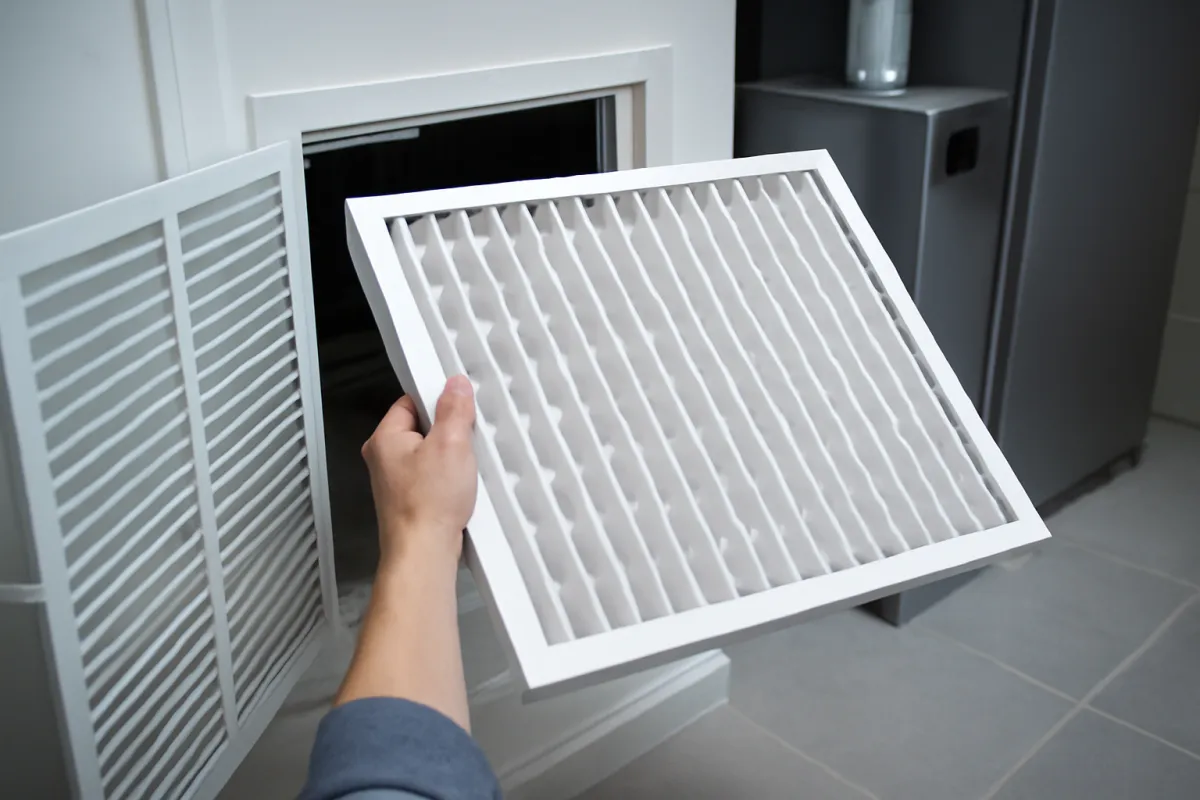
Three checks carry most of the benefit. Change the air filter on a real schedule rather than when you remember, which our note on how often to change a furnace filter sets out. Keep the outdoor unit clear: leaves packed into the coil, a shrub grown across the airflow, or snow drifted around the base all reduce the heat available to collect. And keep supply and return vents unblocked indoors, since a system trying to breathe through furniture is a system running longer than it needs to.
None of this transforms a bill. Together these habits are worth a few percent, which on the illustrative $1,037 year is a few tens of dollars, and they cost almost nothing to do.
A worked example: a 3-ton heat pump through a cold January
Put the whole method on one realistic month. The house has a 3-ton air-source heat pump with 10-kilowatt backup strips. January is cold enough that the compressor works eight equivalent full-power hours a day and the strips stage in for about an hour and twelve minutes daily, between defrost cycles and the coldest early mornings. The electricity rate is the illustrative $0.16 per kilowatt-hour.
The hourly figures. The compressor at 3 kilowatts costs 3 times 0.16, about $0.48 an hour. The strips at 10 kilowatts cost 10 times 0.16, about $1.60 an hour.
The daily figure. Eight compressor hours is 24 kilowatt-hours, about $3.84. The strip time is 12 kilowatt-hours, about $1.92. Together, 36 kilowatt-hours and about $5.76 a day.
The monthly figure. Thirty days at 36 kilowatt-hours is 1,080 kilowatt-hours, roughly $173 for January.
What the strips cost you. They are a third of the month’s energy and about $58 of the $173, bought in roughly 36 hours of running. Cut that strip time in half through a gentler thermostat schedule or a strip lockout and the month falls toward $144.
The delivered-heat check. At a January coefficient near 2.5, the compressor’s 720 kilowatt-hours delivered about 1,800 kilowatt-hours of heat. The strips’ 360 kilowatt-hours delivered 360. So the strips bought 17 percent of the month’s warmth with a third of its money. Swap your own capacity, hours, rate and conditions into the cost-per-use calculator to run your version of this month.
Ways to cut a heat pump’s running cost
Because cost is input kilowatts times hours times rate, and delivered warmth per dollar is set by the coefficient, every saving comes from one of four places. In rough order of how much they move the number:
- Keep the backup strips off. They are the single most expensive kilowatt-hours in the system. Gentle setbacks, intelligent recovery, and an outdoor lockout setting if your thermostat has one all point the same way.
- Let it run steadily. A heat pump is at its best holding a temperature at low output, not sprinting to recover from a swing. Resist the urge to manage it like a furnace.
- Reduce the heat loss. Every draught sealed and every gap insulated cuts the hours directly, and unlike the equipment it works in both seasons.
- Watch airflow. Filters, outdoor coil, unblocked vents. Cheap, dull, and worth a few percent a year.
- Look at your rate and tariff. If you are on time-of-use pricing, shifting some of the work into the cheap window changes the rate term without changing the machine.
- Size and commission properly. A correctly sized system with correct refrigerant charge and airflow is doing arithmetic in your favour every hour. This one is decided at installation, not afterwards.
Notice that none of these is a gadget. The savings in a heat pump live in keeping its coefficient of performance high and its strips idle, which is mostly a matter of settings and building fabric.
Rebates and incentives: why there is no number here
Heat pump incentives are the most frequently asked and least reliably answered part of this subject, so this lab report deliberately gives no figure. Programmes at the utility, state and national levels have all changed in recent years, some of them at short notice, and a stale number quoted confidently is worse than no number at all, because people plan purchases around it.
What can be said in general terms is how the landscape is structured. Utilities sometimes run their own rebates on qualifying equipment, often administered through installers. State and local bodies sometimes run separate schemes with their own eligibility rules. National tax treatment of efficiency upgrades exists in some years and in some forms, with its own qualifying criteria, income tests and caps, and it has been amended more than once.
The only safe method is to check your own utility’s current programme page, ask any installer quoting you to identify the specific programme by name so you can verify it yourself, and take the tax question to a qualified tax professional who can look at your actual situation. Treat any incentive as unconfirmed until it is in writing from the body paying it, and build your running-cost case on the arithmetic in this article, which does not expire.
What this arithmetic cannot tell you
Everything above is arithmetic, and arithmetic is only as good as the inputs. Three limits are worth stating plainly.
The first is that the coefficient of performance figures used here are illustrative bands tied to rough outdoor temperatures, not measurements of any specific machine. Real performance curves vary between models, and a cold-climate unit holds its coefficient far better at low temperatures than an older standard one. Your equipment’s own performance data, if you can get it, beats any general figure.
The second is that equivalent full-power hours are a modelling device. Inverter machines modulate continuously, so nothing in your house ever runs for exactly eight full-power hours. The device is useful because it converts a variable draw into something you can multiply, but it is a summary of a messy reality.
The third is that your house is the biggest variable of all and it is not in the formula. Insulation, air tightness, window area, orientation and how many degrees you actually hold indoors will move a heating bill further than the difference between two decent machines. That is why the levers above start with the fabric rather than the hardware.
The bottom line
A heat pump’s running cost is the same formula as every other appliance, input kilowatts times hours times your rate, with one extra number layered on top: the coefficient of performance, which decides how much warmth those kilowatt-hours actually buy. On an illustrative 3-ton machine at 3 kilowatts and $0.16 per kilowatt-hour, that is about $0.48 an hour, and delivered heat costs about 4.6 cents a kilowatt-hour when conditions are mild against a flat 16 cents from any resistance element. Cold weather pushes that price up twice over, first by dragging the coefficient down toward 2.5 and then 1.8, and second by asking for more hours, and if the backup strips engage at roughly $1.60 an hour you are briefly paying space-heater prices from a heat pump. Assembled across an illustrative year that is about $29 in a quiet shoulder month, $86 in a cooling month, $72 in a mild heating month and $173 in a cold one, near 6,480 kilowatt-hours and $1,037 for twelve months. Your own rate can halve or double that total on its own. The levers worth pulling are the ones that keep the compressor working steadily and the strips idle, and none of them is a purchase.
A note from the bench: every wattage, coefficient, rate and dollar figure in this article is an illustrative planning number produced by arithmetic, not a measurement taken from any particular heat pump, and no manufacturer’s specification is quoted or implied anywhere in it. Real equipment performance varies by model and by outdoor conditions, so read your own rating plate and your own bill before you rely on any total here. Nothing above is professional HVAC, electrical, financial or tax advice. Sizing, refrigerant work, electrical supply and backup heat configuration are jobs for a qualified installer or electrician, and any question about rebates or tax treatment belongs with your utility and a qualified tax professional rather than with a page of sums.
Frequently asked questions
How much does it cost to run a heat pump per month?
It depends on the season more than on anything else. Using an illustrative 3-ton unit that draws about 3 kilowatts at full output, and an illustrative electricity rate of $0.16 per kilowatt-hour, a mild shoulder month with two equivalent full-power hours a day lands near $29, a cooling month at six hours lands near $86, a mild heating month at five hours lands near $72, and a cold heating month with eight compressor hours plus backup strip heat lands near $173. Those are planning figures built from arithmetic, not measurements from a specific machine, and your own rate, climate and house will move them.
How much does a heat pump cost per hour to run?
Take the unit's electrical input in kilowatts and multiply by your rate. As an illustrative planning rule, an air-source heat pump draws roughly one kilowatt of input per ton of capacity when it is working hard, so a 2-ton unit is near 2 kilowatts, a 3-ton unit near 3, and a 5-ton unit near 5. At $0.16 per kilowatt-hour that is about $0.32, $0.48 and $0.80 an hour respectively. Read the real input figure off the unit's rating plate or its submittal sheet rather than trusting the rule, because inverter-driven machines vary their draw continuously.
Why is a heat pump cheaper to run than an electric heater?
Because it moves heat rather than making it. A resistance heater turns one kilowatt-hour of electricity into one kilowatt-hour of heat and can never do better. A heat pump uses that same kilowatt-hour to run a compressor that pumps warmth from outdoor air into the house, so it can deliver several kilowatt-hours of heat for the one it consumed. That ratio is the coefficient of performance. At an illustrative coefficient of 3.5, a kilowatt-hour of delivered heat costs about 4.6 cents when electricity is $0.16, against a flat 16 cents from a resistance element.
What happens to a heat pump's running cost in cold weather?
Two things, and both push the bill up. The colder the outdoor air, the less heat there is to pump, so the coefficient of performance falls and each kilowatt-hour of electricity buys less warmth. At the same time the house is losing heat faster, so the unit runs more hours. If the outdoor temperature drops far enough, or the house falls behind its setpoint, the system brings in backup resistance heat, which runs at a coefficient of 1 and costs several times as much per unit of warmth. The cold-weather bill is the compressor working harder and the backup filling the gap.
What does backup or emergency heat cost to run?
Backup electric heat is a resistance element, so its cost is simply its kilowatts times your rate. An illustrative 10-kilowatt strip heater at $0.16 per kilowatt-hour costs about $1.60 an hour while it is energised. For comparison, the 3-kilowatt compressor in the same illustrative system costs about $0.48 an hour and, on a mild day, delivers a similar amount of warmth. That is why an hour of strip heat can cost more than three hours of ordinary heat pump operation, and why a thermostat stuck in emergency heat is one of the more expensive faults in a house.
Is a heat pump cheaper than a gas furnace?
There is no universal answer, because it turns on two prices you have to look up yourself: what you pay per kilowatt-hour and what you pay per unit of gas. The mechanism is what matters. A furnace delivers slightly less heat than the fuel contains, while a heat pump delivers several times the energy it draws. So a heat pump wins when electricity is not much dearer than gas per unit of delivered heat, and loses when electricity is very expensive or the climate is cold enough to lean on backup strips. Price both from your own bills using the delivered-heat method in this lab report rather than trusting a general claim.
Does turning a heat pump down at night save money?
Less than it does with a furnace, and sometimes not at all. A deep setback lets the house cool a long way, and recovering from it often asks for more heat than the compressor can supply at its efficient output, which invites the backup resistance strips to switch on. The strips then erase the saving, because they buy warmth at roughly three times the compressor's cost. Modest setbacks of a couple of degrees, or a thermostat designed to ramp the recovery slowly without calling for auxiliary heat, are the usual advice. Check what your own thermostat does before assuming a big setback pays.
Are there rebates or tax credits for heat pumps?
Programmes exist and they change, sometimes with little notice, so this lab report will not quote an amount, a percentage or a deadline. What is true in general is that incentives come from several places at once: a utility may offer a rebate, a state or local body may run its own scheme, and national tax rules may or may not treat efficiency upgrades favourably in any given year. The only reliable route is to check your own utility's current programme page and speak to a qualified tax professional about your specific situation before you count any money you have not yet received.