What's on this page
- The difference between air purifier and humidifier, in short
- What an air purifier actually does
- What a humidifier actually does
- Particles vs moisture: the one sentence that settles it
- How to tell which one your room needs
- Symptom by symptom: which machine fixes what
- Ionizer vs filter: the split inside air purifiers
- What HEPA and carbon can and cannot do
- Humidifier types: evaporative, ultrasonic, steam
- Does an air purifier help with dry air?
- Does a humidifier clean the air?
- Allergies and asthma: which one earns its keep
- Winter congestion, static, and cracked skin
- The bedroom setup, including a baby’s room
- Can you run an air purifier and humidifier together?
- What each costs to buy and run
- A year of owning both, split out
- Maintenance: the chore list nobody mentions
- Air purifier vs humidifier vs dehumidifier
- How to choose each one well
- A worked example: one dry, dusty bedroom
- The bottom line
Short answer: The difference between an air purifier and a humidifier is that a purifier removes particles, pulling air through a filter that traps dust, pollen, smoke, and dander, while a humidifier adds water vapor to dry air. Neither does the other's job even slightly. A $10 hygrometer settles half the question: persistent readings under about 30 percent mean dry air and a humidifier, while sneezing, dust, and lingering smells point to a purifier.
The difference between air purifier and humidifier is the difference between a sieve and a sponge: one takes things out of the air, the other puts something in. A purifier pulls air through a filter and traps particles, dust, pollen, smoke, dander, so the air leaves cleaner but no less dry. A humidifier adds water vapor so the air leaves damper but no cleaner. Two machines, two jobs, zero overlap, and buying the wrong one solves nothing while costing real money.
This breakdown sorts the two out for good. It covers what each machine actually does, the ionizer-versus-filter split hiding inside the purifier aisle, how to read your room’s symptoms and a $10 hygrometer, the cases for running both at once, and what each costs to buy and feed. The deeper buying decisions live in our breakdowns of how to choose an air purifier and how to choose a humidifier; this piece settles which aisle you should be standing in first.
Key takeaways
- An air purifier removes particles; a humidifier adds moisture. Neither does the other's job even slightly, so the choice starts with which problem your room actually has.
- A $10 hygrometer settles half the question: persistent readings under about 30 percent mean dry air and a humidifier; particle problems announce themselves as sneezing, dust, and lingering smells.
- Inside the purifier aisle, filter units physically trap particles you throw away; ionizers charge particles so they settle on surfaces, and some emit trace ozone. The filter route is the dependable one.
- The two machines coexist happily in one room with a few feet of spacing, mist aimed away from the purifier's intake, and a 40 to 50 percent humidity target.
- Illustratively, a mid-range purifier costs more per year, filters near $85 plus about $30 of power, than a typical humidifier's power and wick care, so budget the recurring lines, not just the sticker.
The difference between air purifier and humidifier, in short
Strip both machines to their working parts and the difference is complete. An air purifier is a fan and a filter: room air goes in, particles stay in the filter, the same air comes out cleaner. Its whole effect is subtraction. A humidifier is a water tank and a dispersal mechanism, a wick and fan, an ultrasonic plate, or a heating element: water goes in, vapor comes out, and the room’s relative humidity rises. Its whole effect is addition.
That means neither machine touches the other’s problem. A purifier running full tilt all winter will not raise the humidity a point; the air passes through the filter and returns exactly as dry as it arrived. A humidifier misting away all allergy season captures not one grain of pollen; it has no filter in the air path doing any catching. People buy across this line constantly, usually a purifier for what is actually a dryness problem, because the machines look alike: white boxes that hum in a corner and promise better air.
The fastest sorting question: is your complaint about what is in the air, or about how the air feels? Stuff in the air, dust, smoke, dander, pollen, odor, is purifier territory. Air that feels wrong, dry throat, static, cracked skin, is humidifier territory. Everything else in this report hangs off that one distinction.
What an air purifier actually does
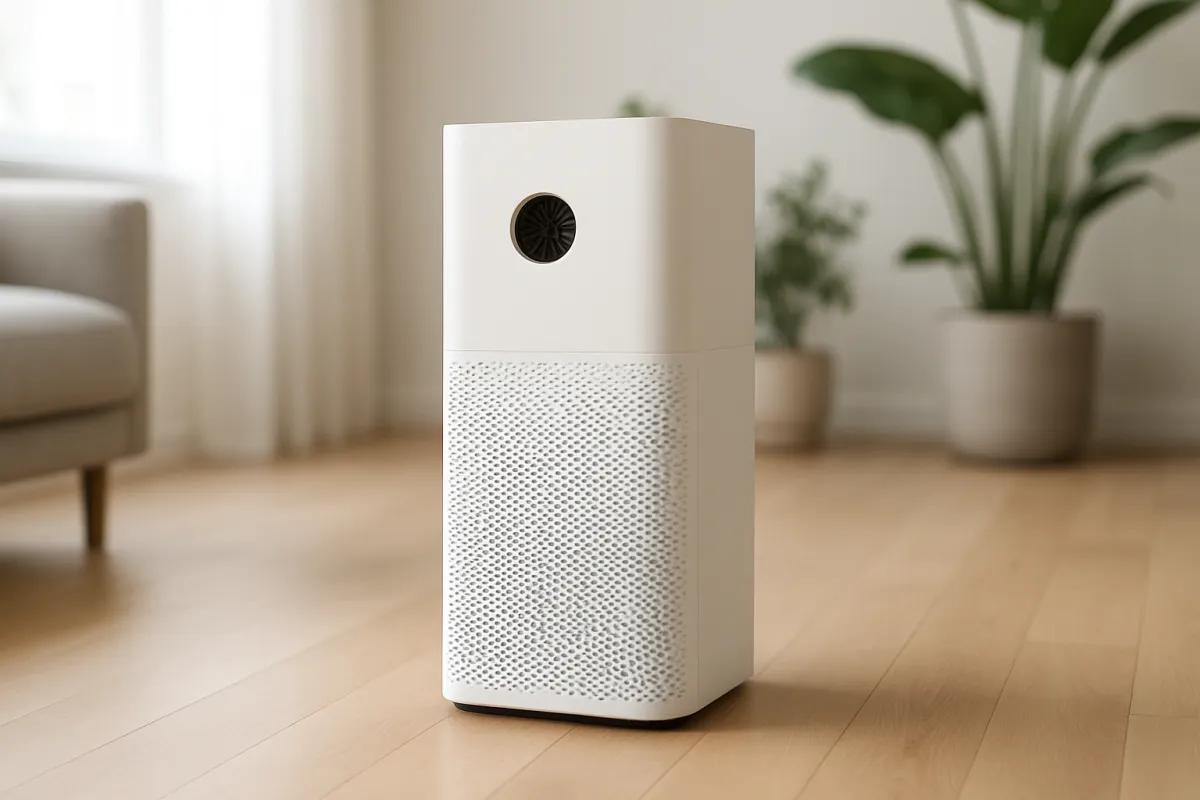
A portable purifier’s mechanism is honest and mechanical. The fan draws room air through a pre-filter that catches hair and lint, then through the main filter, where a dense mesh of fibers, HEPA-grade in units worth buying, traps fine particles down to smoke-sized fractions of a micron. Many units add a carbon stage whose porous granules adsorb odor and some gas molecules. The scrubbed air returns to the room and the machine grinds through the room’s air volume a few times an hour.
What it measurably helps: airborne dust and dander, pollen that made it indoors, smoke particles, and the general haze a busy household generates. What it half-helps: odors and cooking smells, where the carbon stage does real but exhaustible work. What it cannot touch: humidity in either direction, carbon dioxide and stuffiness, which are ventilation’s job, and particles that have already settled into carpet and bedding, which belong to the vacuum.
Capacity is the spec that separates units, expressed as CADR, the clean air delivery rate; a commonly cited rule of thumb targets roughly two-thirds of the room’s square footage as a minimum smoke CADR. The full spec walk, CADR, filter grades, noise, sensors, lives in our air purifier buying breakdown, and what the ongoing filters really cost sits in our report on how much an air purifier costs.
What a humidifier actually does
A humidifier converts liquid water into vapor or fine mist and hands it to the room’s air. The three common mechanisms matter later, so briefly: evaporative units blow air through a wet wick, so the room can only absorb what physics allows; ultrasonic units vibrate a plate to fling a visible cool mist; steam vaporizers boil water and release warm vapor. All three raise relative humidity, the percentage that tells you how full of moisture the air is compared to what it could hold at its temperature.
Why that number matters for comfort: indoor winter air is dry because cold outdoor air holds little moisture, and heating it drops its relative humidity into the desert range, sometimes below 20 percent. Air that dry pulls water from everything, skin, lips, sinuses, houseplants, wood floors and furniture, guitar necks. The commonly cited comfort band sits near 40 to 50 percent, high enough to stop the static shocks and morning throat scratch, low enough to avoid feeding condensation and mold.
The other half of the story is discipline. A humidifier with no humidistat, run hard with the door shut, will happily push a bedroom past 60 percent, where window condensation blooms and dust mites and mold get their favorite weather. That over-wet failure mode is the mirror image of the machine’s benefit, and it is why the same $10 hygrometer that justifies the purchase should supervise it afterward. Model types, tank sizes, and controls are covered in our humidifier buying breakdown.
Particles vs moisture: the one sentence that settles it
If the problem rides on particles, buy the machine with the filter; if the problem is the air itself feeling dry, buy the machine with the tank. Every symptom in the next two sections is just that sentence wearing different clothes.
It also settles the marketing edge cases. A “purifying humidifier” that passes air over a damp wick is a humidifier with a dust magnet, not a filtration device; its wick catches some large particles incidentally, the way any wet surface does, and nothing like what a HEPA mesh captures. An “air washer” is the same idea with better branding. Machines that genuinely do both jobs to a real standard exist but are effectively two appliances sharing one housing, priced accordingly, and rarely the value pick against buying each tool separately and running it where it is needed.
Hold the sentence and the aisle gets simple: the question is never which machine is better, it is which problem your room has.
How to tell which one your room needs
The diagnosis costs about $10 and a week of noticing. The instrument half is a hygrometer: set one in the room you care about and log the reading morning and evening for several days. Persistently under about 30 percent, especially in heating season, is a dry-air verdict, and the humidifier earns its place. Between 40 and 50 percent, humidity is not your problem, whatever else is. Above 55 to 60 percent, you have the opposite condition, and the machine you want is the one in our dehumidifier breakdown, not either of these.
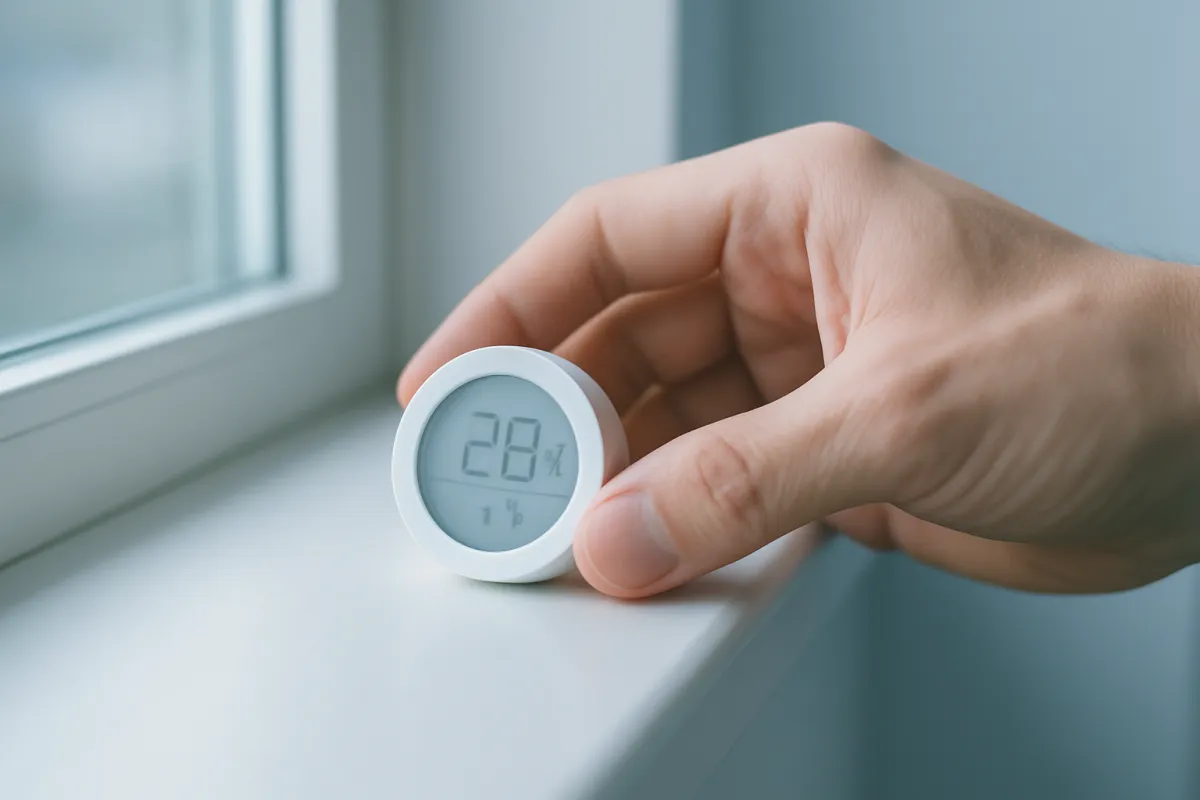
The symptom half covers particles, which no cheap meter reads as usefully as your own nose and mornings. Waking congested in a room that reads a healthy 45 percent points toward what you are inhaling rather than dryness. Sneezing that tracks dusting day, visible motes in a sunbeam, a lingering smoke or fry smell, a dust film that returns to the nightstand in days, dander reactions when the pet sleeps in the room: that cluster votes purifier.
When both columns fill in, a common verdict in dry climates with pets, the answer is honestly both machines, and a later section covers making them roommates. When neither fills in, the honest verdict is neither box: sometimes the fix is a vacuum habit, a kitchen exhaust fan, or an open window, the unglamorous levers in our report on improving indoor air quality.
Symptom by symptom: which machine fixes what
Here is the sorting table this category should hand every shopper. Match the row to your mornings, not to the marketing.
| The complaint | Purifier | Humidifier | Notes |
|---|---|---|---|
| Sneezing around dust or pollen | Yes | No | Filter captures airborne allergens |
| Static shocks, flyaway hair | No | Yes | Classic dry-air signature |
| Cracked lips, tight skin, dry sinuses | No | Yes | Air under about 30 percent RH |
| Lingering smoke or cooking odors | Partly | No | Carbon stage does the odor work |
| Dust film returning quickly | Yes | No | Reduces airborne share; vacuuming still rules |
| Window condensation, musty smell | No | No | That is dehumidifier territory |
| Snoring or dry-mouth mornings | No | Maybe | Dryness can contribute; ask a clinician if persistent |
| Pet dander reactions | Yes | No | Filter plus washing the bedding |
| Wood floors gapping, instruments drying | No | Yes | Wood tracks humidity closely |
Two honest caveats belong under the table. First, several rows have non-appliance answers that work better per dollar: bathroom and kitchen exhaust fans, entry mats, and washing bedding hot do quiet, unglamorous work. Second, health rows are deliberately hedged: machines change the air, and air can aggravate or ease symptoms, but persistent breathing complaints belong with a clinician, not with a shopping cart.
Ionizer vs filter: the split inside air purifiers
Once you are in the purifier aisle, a second distinction ambushes you, because two very different technologies share the shelf and the label “air purifier.”
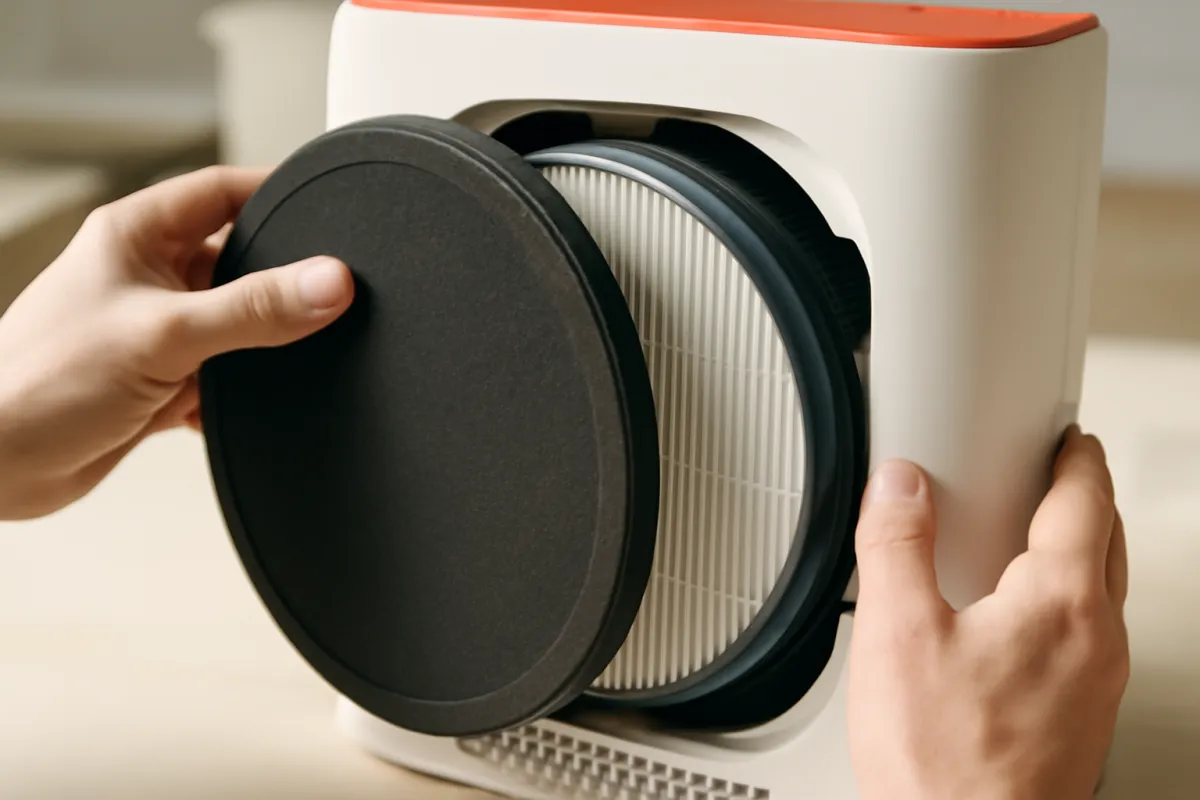
Filter units are the mechanism this whole report has assumed: a fan forces air through a physical mesh, particles lodge in the fibers, and you throw the loaded filter away on a schedule. The capture is measurable, the consumable is visible, and the failure mode is honest: neglect the filter and airflow drops where you can hear it.
Ionizers work by charging particles electrically. The charged particles clump together and settle out of the air onto floors, walls, and furniture, or, in units with collection plates, stick to a metal surface you wipe. Note what did not happen in that sentence: nothing left the room. The dust that was floating is now lying, ready for a footstep or a duvet flip to relaunch it. Many ionizers also move little air, so their reach in a real room is short, and some produce trace ozone as a byproduct of the corona discharge, a lung irritant that a clean-air device has no business emitting. Regulators cap permitted emissions, and reputable brands publish compliance, but the better question is what the feature is buying you at all.
The bench verdict is unglamorous: buy the fan-plus-filter machine. Where an ionizer arrives as a switchable extra on a good HEPA unit, treat it as optional seasoning, and feel free to leave it off; the filter is doing the verifiable work. Our deep dive on what a HEPA filter is and why it matters covers the capture standard the ionizer aisle would rather you not compare against.
What HEPA and carbon can and cannot do
Because purifier marketing leans hard on the word HEPA, it is worth pinning down what the filter stack genuinely delivers. A true HEPA filter captures the overwhelming majority of particles across the size range, including the fine smoke-sized fraction that ducks simpler filters; that part of the promise is real and mechanically boring. The carbon stage handles a different cargo, odors and some gaseous compounds, by adsorption onto porous granules, and it saturates quietly: an exhausted carbon bed simply stops working without looking any different.
The limits matter as much as the powers. The stack only cleans air that passes through it, so a weak fan wearing a great filter cleans a small bubble around itself; that is why CADR, not filter grade, separates working units from ornaments. It does nothing for humidity, in either direction, and nothing for stuffiness, since carbon dioxide sails through untouched. And the filter is a consumable with a real bill attached, typically the largest line in the machine’s five-year cost, ahead of the electricity and often ahead of the machine itself, as our purifier cost report lays out.
None of that is a knock; it is the honest spec sheet. A fan, a true HEPA mesh, and a fresh carbon bed do exactly what they claim, which is more than most of the aisle can say.
Humidifier types: evaporative, ultrasonic, steam
The humidifier aisle has its own three-way split, and it decides your maintenance chores more than your results.
Evaporative units blow air through a wet wick. They self-limit, since air absorbs less as it approaches saturation, which makes over-humidifying harder, and the wick traps minerals from tap water. The costs: a fan you can hear, and wicks that need replacing on a schedule.
Ultrasonic units vibrate mist into the air silently, which makes them bedroom favorites. The catch is that everything dissolved in the tank goes airborne too: hard tap water becomes a fine white mineral dust that settles on dark furniture and registers on particle counters. Distilled or demineralized water, or a demineralization cartridge, is effectively part of the running cost.
Steam vaporizers boil water, which sterilizes the vapor and adds gentle warmth, at the price of the highest electricity draw of the three and a hot-water hazard that rules them off nursery floors and toddler-height dressers.
Whichever type wins, the non-negotiable is cleaning. A tank of standing room-temperature water grows film and microbes within days, and an uncleaned humidifier disperses what grows; regular emptying, drying, and descaling is the whole difference between a comfort appliance and an aerosolizer of regret. Type-by-type picks, tank sizing, and humidistat features live in our humidifier breakdown.
Does an air purifier help with dry air?
No, and it is worth killing this hope cleanly because winter is exactly when purifier ads run hardest. A purifier’s air path is fan, filter, outlet; there is no water anywhere in the machine, nothing to add moisture, and no meaningful drying either. Air leaves the unit at essentially the humidity it entered. If your January complaints are static shocks, a scratchy morning throat, and lips that crack by lunch, a premium purifier will scrub the dust from your desert and hand the desert right back.
The confusion has an understandable root: dry-air symptoms and particle symptoms both live in the nose and throat, and both get worse in winter, when closed windows concentrate indoor particles at the same time heating dries the air. The hygrometer is the tiebreaker. A room reading 25 percent has a dryness problem whatever else is true; a room reading 45 percent with morning congestion points the finger at particles or something else entirely. Buy against the reading, not against the season’s advertising.
Does a humidifier clean the air?
Also no, and one version of the machine can technically make the particle count worse. A humidifier has no capture mechanism; air does not pass through anything that holds onto dust or pollen. Moist air can make some rooms feel fresher, and dryness genuinely irritates airways, so the comfort effect is real, but nothing has been removed from the air, which is what cleaning means.
The “worse” case is the ultrasonic white-dust effect: fine mineral particles aerosolized from hard tap water, settling as pale film on furniture and reading as particulate on a counter. It is avoidable, distilled water or a demineralization cartridge solves it, but it must be avoided rather than ignored. A neglected tank in any humidifier type raises a second concern, dispersing whatever grows in standing water, which the cleaning routine above prevents.
So the two rumors cancel cleanly: the purifier does not humidify, the humidifier does not purify, and each aisle’s marketing gets braver about the other machine’s job every winter. Buy each machine for its own verb.
Allergies and asthma: which one earns its keep
For airborne-allergy households the purifier does the direct work, since the triggers, pollen, dander, dust-mite debris, ride on particles a HEPA filter captures. Run it in the bedroom, where the nightly eight hours happen, size the CADR to the room, and keep it running rather than bursting it; steady turnover is the mechanism. Our report on whether air purifiers are worth it walks the honest evidence, which supports reduced airborne allergen levels while stopping short of promising symptom cures.
The humidifier’s role is indirect but not imaginary: very dry air irritates airways, and comfortably humidified air, in the 40 to 50 percent band, is easier on inflamed passages. The same band cuts both ways, though, because dust mites and mold, two of the biggest allergy triggers, thrive as humidity climbs. Pushing a bedroom to 60 percent for comfort feeds the trigger you were fighting; the band exists for a reason, and the hygrometer enforces it.
Two hedges stated plainly: severe or persistent symptoms belong with a clinician, and no appliance substitutes for the boring heavy hitters, hot-washing bedding, mite-proof covers, and keeping the pet off the pillow. The machines assist; they do not treat.
Winter congestion, static, and cracked skin
The dry-air symptom cluster deserves its own minute, because it is the case where the humidifier is simply the right tool and the purifier a $300 miss. Heated winter air routinely sits below 30 percent relative humidity indoors, and the body notices: sinuses feel sandpapered on waking, lips split, knuckles crack, and every doorknob bites. The house notices too, with wood floors gapping, doors shrinking loose, and static crackling off the laundry.
Restoring the room to the comfort band changes that cluster within days, and it is one of the highest satisfaction-per-dollar purchases in home gear, provided two disciplines hold. Target 40 to 50 percent rather than “more is better,” because windows will tell on you with condensation the moment you overshoot into mold weather. And place the unit sensibly: center-room or dresser height, mist away from walls, electronics, and direct contact with bedding, refilled with the water discipline the type demands.
If the hygrometer says the room is already in the band and winter mornings still feel rough, dryness was not the culprit, and attention swings back to particles, bedroom ventilation, or a conversation with a clinician rather than a bigger tank.
The bedroom setup, including a baby’s room
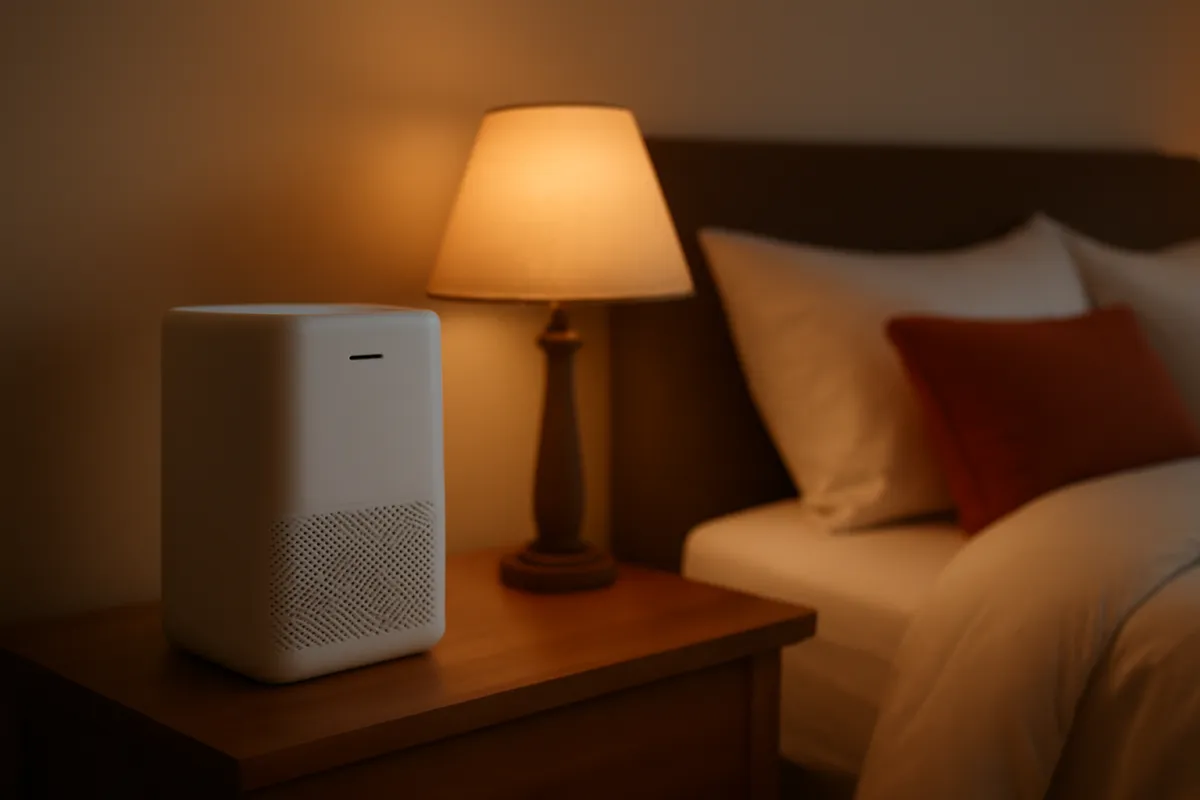
The bedroom is where this whole comparison usually gets decided, because it is the room with eight captive hours a night. For particles, a right-sized purifier runs continuously on a low, quiet setting, positioned a few feet from the bed with its intake clear of curtains and its outlet not blasting your face. For dryness, the humidifier joins at dresser height with its hygrometer target set, and quiet ultrasonic or evaporative types win the noise contest over anything that boils.
For a nursery, the same logic applies with the caution dial turned up, and the first sentence is the honest one: questions about an infant’s breathing, congestion, or sleep belong with your pediatrician before any appliance order. On the equipment side, cool-mist units are the standard nursery choice over steam precisely because there is no hot water to spill; keep any unit, cord, and mist plume well out of reach, clean the tank scrupulously, and favor units without bright displays. A purifier in a nursery follows the same rules as any bedroom, quiet, continuous, out of reach, with the filter schedule actually kept.
In every bedroom case, run the machines around the clock or on their own sensors rather than only at bedtime; both work by changing the room slowly, and the room resets fast when they stop.
Can you run an air purifier and humidifier together?
Yes, and the dusty winter bedroom is the textbook case for the pairing: the purifier subtracts the dander and dust while the humidifier lifts the room out of the static zone. The two mechanisms do not conflict; they simply need a little zoning so each machine reads the room honestly.
Give them a few feet of separation, and aim the humidifier’s plume toward open air rather than at the purifier’s intake. Two reasons: sustained damp air blowing directly through a HEPA mesh can shorten its life and, in the worst case, let the loaded filter grow what it caught, and an ultrasonic mist plume reads as a particle storm to a purifier’s sensor, spinning its fan up over what is mostly water and, with hard tap water, some genuine mineral dust. Cross-room corners solve all of it: purifier near the seating or bed side, humidifier across the room at dresser height, both with clear intakes.
Then let each machine hold its own number: the purifier on auto or steady low, the humidifier’s humidistat at 45 percent, and the hygrometer refereeing from the nightstand. Households that run this pairing all winter mostly report the boring ideal, clean-feeling air with no morning static, which is exactly what two right-sized single-purpose tools deliver more cheaply and reliably than most combination units.
What each costs to buy and run
The sticker comparison is close to a coin flip, but the feeding costs diverge, and that is where budgets get surprised. Upfront, illustratively: a decent room humidifier commonly lands between $30 and $120, a genuinely good mid-range HEPA purifier between about $180 and $330, with small purifiers below that and premium large-room units far above, per our purifier cost breakdown.
The recurring lines are where the machines separate. A mid-range purifier eats filters, roughly $85 a year as an illustrative midpoint of the common $50 to $120 band, plus about $30 of electricity for round-the-clock duty. A humidifier’s power draw is modest for evaporative and ultrasonic types, often under $20 a season as a midpoint, though a steam vaporizer multiplies that, while wicks, demineralization cartridges, and descaling supplies commonly add a few tens of dollars, call it $45 a season for an evaporative unit kept honestly.
The yearly feeding bill, machine by machine
Illustrative annual running costs for mid-range units. Bars scale to the largest line.
Consumables, not electricity, lead both machines' bills, and the purifier's filter line tops the whole chart. Price the refills before either box goes in the cart.
Either machine’s cost-per-use math takes a minute in our cost-per-use calculator: price, years, and nights of service in, honest dollars-per-night out. Both machines score well by that measure when they are solving a real problem, which is the whole point of diagnosing before buying.
A year of owning both, split out
For the both-machines household, stack the same numbers into one annual bill and the shape is instructive. Illustratively: $85 of purifier filters, $45 of humidifier wicks and care, $30 of purifier electricity, $20 of humidifier electricity, about $180 a year to feed the pair, before amortizing either purchase.
A year of running both machines
Illustrative split of a combined $180 annual running bill for a mid-range pair.
Nearly three-quarters of the pair's bill is consumables and care. Electricity, the cost people fear, is the smaller slice for both machines.
Two budget lessons fall out of the stack. The consumables dominate, so the cheapest pair to own is the one whose refills you priced before buying, a proprietary filter or an odd-size wick can double these slices quietly. And the electricity slice is small enough that running both machines properly, continuously in season rather than in guilty bursts, costs little extra while delivering the actual benefit. Skimping on refills is the one economy that backfires: a choked filter cleans nothing and a crusted wick humidifies nothing, at which point the power slice buys noise.
Maintenance: the chore list nobody mentions
Both machines are subscription appliances wearing one-time-purchase costumes, and the chores are the subscription. The purifier’s list is short but strict: check the pre-filter monthly and vacuum it clear, replace the HEPA filter on the maker’s schedule, commonly every 6 to 12 months, replace or refresh the carbon stage as directed, and keep the intake clear of curtains and pet beds. Skipped filter changes do not just dull the cleaning; they load the fan against a clogged mesh and turn a quiet machine loud.
The humidifier’s list is shorter-interval and more biological: empty and dry the tank daily or near it, rinse film off every few days, descale weekly-ish in hard-water homes, and swap wicks or cartridges on schedule. The stakes are different too. A neglected purifier merely stops helping; a neglected humidifier can actively disperse what grows in its standing water, which is why every credible use of these machines pairs them with the cleaning habit.
Fold both lists into the same household rhythm as the rest of your machines, the calendar approach in our appliance maintenance manual, and neither list is burdensome. Ignore them, and both purchases quietly become room decor with a power draw.
Air purifier vs humidifier vs dehumidifier
Since the third white box always crashes this comparison: a dehumidifier is the humidifier’s opposite, a machine that removes moisture from air that has too much. The three-way sort takes one sentence each. Air with too much stuff in it gets a purifier. Air too dry gets a humidifier. Air too damp, over roughly 55 to 60 percent, with condensation, mustiness, or mold as the tells, gets a dehumidifier.
The hygrometer referees all three: under about 30 percent points at the humidifier, the 40 to 50 band says humidity is fine and any purchase should be about particles, and sustained readings above 55 to 60 send you to our dehumidifier breakdown instead. Households run different verdicts in different rooms and seasons, a damp basement and a dry winter bedroom under one roof is completely normal, which is why the reading belongs to each room rather than the house.
The mistake to avoid is running a humidifier and dehumidifier against each other in one space, which happens more than anyone admits when one machine’s humidistat is set above the other’s. One moisture verdict per room, one machine enforcing it.
How to choose each one well
Once the aisle is settled, the buying criteria are mercifully short. For a purifier: true HEPA stated plainly, a smoke CADR matched to the room, around two-thirds of the square footage as a floor, a noise level you will tolerate on the setting you will actually use, and a replacement filter whose price and schedule you looked up before checkout. Everything else is trim. The full walkthrough, including sensor modes and sizing for open plans, is our air purifier breakdown.
For a humidifier: a built-in humidistat so the 40 to 50 target holds itself, a tank sized to at least a full night’s run so refilling is not a 3 a.m. hobby, the type whose trade-offs suit the room, evaporative for self-limiting simplicity, ultrasonic for silence with a water-quality plan, steam only where its heat and draw make sense, and parts that disassemble for cleaning without a fight. That walkthrough is our humidifier breakdown.
Both lists share a final test worth stating once: buy the machine you will maintain. A mid-range unit with refills you can afford and chores you will do beats a premium unit that goes stale by March.
A worked example: one dry, dusty bedroom
Put the whole method on one plausible room. A 150 square foot bedroom in a heating-season climate logs a week of hygrometer readings averaging 28 percent, and its resident wakes congested, shocks himself on the door handle, and dusts the nightstand twice a week for a cat who owns the bed. Both symptom columns filled in: dry air by the meter, particles by the mornings and the cat.
The pairing gets sized from the room. Two-thirds of 150 square feet suggests a smoke CADR around 100 cfm, a small quiet HEPA unit, illustratively $120, run continuously on low near the seating side. An ultrasonic humidifier with a humidistat, illustratively $60, takes the far dresser at 45 percent on distilled water, plume aimed at open air. Feeding them for a year: roughly $85 in filters if this unit tracks the mid-range norm, though small-unit filters often run less, $30 or so of purifier power, and perhaps $50 between cartridges and distilled water for the humidifier’s season.
The measured result to expect within a couple of weeks, stated as tendencies rather than promises: static gone and the meter holding 45, mornings less crusty as dryness stops compounding the dander, the nightstand film slower to return, and the cat unmoved. Total spend lands near $180 upfront and roughly $165 a year to run, numbers a minute in the cost-per-use calculator converts to cents per night. Whether that is worth it is a personal verdict, but it is now an informed one, made against the room’s actual measurements rather than a January ad.
The bottom line
The difference between air purifier and humidifier could not be more complete: the purifier subtracts particles through a filter it asks you to replace, the humidifier adds moisture from a tank it asks you to clean, and neither machine will do even a token version of the other’s job. Diagnose before buying, with a $10 hygrometer for the moisture half and a week of honest symptom-noticing for the particle half. Under 30 percent means the humidifier aisle, dust and dander mornings mean the purifier aisle, both signals mean both machines with a few feet of separation, and neither signal means keeping your money or spending it on ventilation.
Inside the purifier aisle, take the fan-and-filter machine over the ionizer promise, and price the refills before the register. Inside the humidifier aisle, take the humidistat and the cleaning-friendly tank, and respect the 40 to 50 band. Then run whichever machines survived the diagnosis continuously, feed them their consumables on schedule, and let the hygrometer keep everyone honest. The deeper dives are ready when you are: choosing the purifier, choosing the humidifier, and what the purifier really costs.
This breakdown explains what home air machines mechanically do and is not medical, health, or professional advice. Comfort observations about dryness, congestion, and allergies describe how equipment changes room air, not treatment claims; persistent breathing symptoms, and any decision about equipment for an infant’s room, belong with a qualified clinician. All prices, running costs, and percentages are illustrative examples rather than quotes or measured statistics, and your models, rates, and rooms will differ. Follow each manufacturer’s safety and cleaning instructions over any general habit described here.
Frequently asked questions
What is the difference between an air purifier and a humidifier?
An air purifier removes particles from the air by pulling it through a filter, so it changes what is in the air: dust, pollen, smoke, dander. A humidifier adds water vapor to the air, so it changes how dry the air is. They do not overlap at all: a purifier does nothing for dry winter air, and a humidifier removes nothing from the air, it only adds moisture. Pick by symptom: sneezing, dust, and smells point to a purifier; static shocks, cracked lips, dry sinuses, and a hygrometer reading under about 30 percent point to a humidifier.
Do I need an air purifier or a humidifier?
Read the room's symptoms. If the complaints are particles, sneezing around dust or pollen, visible haze, lingering smoke or cooking odors, pet dander reactions, you want an air purifier. If the complaints are dryness, static shocks, cracked skin and lips, scratchy sinuses on winter mornings, gapping wood floors, you want a humidifier, and a cheap hygrometer confirms it: readings persistently below about 30 percent relative humidity mean dry air. Some rooms genuinely need both, a dusty bedroom in a dry winter climate being the classic case, and the two machines run happily in the same room with a little spacing.
What is the difference between an ionizer and a filter air purifier?
A filter purifier physically traps particles: a fan forces air through a HEPA-grade mesh and the particles stay in the filter, which you later replace. An ionizer charges particles electrically so they clump and settle onto surfaces, or stick to a collection plate; many produce little airflow and capture nothing in a replaceable medium, and some produce trace ozone as a side effect. For measurable cleaning, the filter route is the dependable one, which is why our testing posture favors true HEPA units with a real fan. Treat an ionizer switch on a filter unit as optional seasoning you can leave off.
Can you use an air purifier and humidifier together in the same room?
Yes, and in a dry, dusty winter bedroom the pairing makes sense: the purifier handles particles while the humidifier restores moisture. Give them a few feet of separation so the humidifier's moist plume does not blow straight into the purifier's intake, since very damp air can shorten a HEPA filter's life and a cool-mist plume can read as 'particles' to a purifier's sensor and rev its fan. Aim the humidifier's mist toward open room air, keep both away from walls, and target roughly 40 to 50 percent relative humidity so you are not trading dry-air problems for damp-air ones.
Should I get a humidifier or air purifier for my baby's room?
It depends on the room's actual problem, and it is worth saying plainly that questions about an infant's breathing belong with your pediatrician. As a matter of what the machines do: a purifier reduces particles like dust and dander, which matters in allergy-prone households, while a cool-mist humidifier eases dry winter air that can aggravate little noses. If the nursery's hygrometer reads comfortably 40 to 50 percent and the air is clean, neither is required equipment. Whichever you run, keep cords and mist out of reach, clean a humidifier scrupulously to prevent microbial growth, and pick quiet units.
Does an air purifier help with dry air or add moisture?
No. A purifier moves air through a filter and back out at the same humidity it came in; nothing in a standard HEPA unit adds or removes meaningful moisture. If winter dryness is the complaint, a purifier is the wrong purchase entirely, no matter how premium the model. The reverse is also true: a humidifier adds water vapor but captures no dust, pollen, or smoke. The two machines answer different questions, which is why the hygrometer-plus-symptoms check matters before spending anything.
Does a humidifier clean the air?
No, and one type can add to what is floating in it. A humidifier's job is adding water vapor; it has no mechanism that captures particles. Ultrasonic models also aerosolize whatever is dissolved in their water, so hard tap water becomes a fine white mineral dust that settles on furniture and shows up on particle counters. Run distilled or demineralized water in an ultrasonic unit, or choose an evaporative design whose wick leaves minerals behind. If cleaner air is the goal, the machine you want is a purifier with a real filter.
Which costs more to run, an air purifier or a humidifier?
Illustratively, the purifier usually costs more per year, because its filters are a recurring bill: roughly $50 to $120 a year for a mid-range unit, plus about $20 to $40 of electricity for round-the-clock running. A humidifier's electricity is modest for evaporative and ultrasonic types, often under $20 or so a season, though steam vaporizers draw far more, and its consumables, wicks, demineralization cartridges, and descaling supplies, might run a few tens of dollars a season. Cheap distilled water or filters skipped, though, get paid for in mineral dust or choked airflow, so budget both machines honestly.