What's on this page
- How much does it cost to run a dishwasher? The short answer
- The running-cost formula: kilowatt-hours per cycle times your rate
- The electricity a dishwasher draws
- Where a dishwasher’s energy actually goes
- The cost of a single dishwasher load
- Cost per month by loads per week
- Where a dishwasher cycle’s energy goes
- What the heated dry setting adds
- The water a dishwasher uses per cycle
- Dishwasher versus washing by hand
- Eco cycle vs normal cycle
- How your electricity and water rates swing it
- ENERGY STAR dishwashers and what efficiency buys
- Running full loads and off-peak timing
- Does running the dishwasher raise my electric bill
- How a dishwasher compares to other big appliances
- Tips to cut a dishwasher’s running cost
- The annual cost of running a dishwasher
- A worked example: one household, five loads a week
- A running-cost checklist before you run it
- The bottom line
Short answer: A modern dishwasher uses about 1.2 kilowatt-hours per cycle, so at a typical electricity rate near $0.16 it costs roughly $0.19 a load, about $4 a month at five loads a week, and near $50 a year, illustratively, plus a few cents of water per load. Most of that energy heats water for the wash and the heated dry, so air drying, full loads, skipping the pre-rinse, and the eco cycle trim the total most.
The cost to run a dishwasher comes down to one figure on your bill: a modern machine uses about 1.2 kilowatt-hours per cycle, so at a typical electricity rate near $0.16 it costs roughly $0.19 a load, about $4 a month at five loads a week, and near $50 a year, illustratively. Your own rate, cycle, and water price move those numbers, but the shape is right: pennies a load, a few dollars a month, tens of dollars a year.
This breakdown does the full arithmetic behind that answer. It hands you the one formula that turns any dishwasher’s energy label into dollars, the same kilowatt-hours-to-dollars method we use in our clothes dryer running-cost breakdown, then works the standard modern-machine case per load, per month, and per year. It shows where a dishwasher’s energy actually goes (heating water is most of it), prices the heated dry setting you can switch off, settles the honest dishwasher-versus-handwashing question, and lays out the habits that genuinely trim the bill. You can feed your own machine, rate, and load count into our cost-per-use calculator as you read and watch every figure move.
Key takeaways
- The whole formula is kilowatt-hours per cycle times your electricity rate in dollars per kilowatt-hour. Everything else is detail, plus a few cents a load for water.
- A modern dishwasher uses about 1.2 kilowatt-hours per load, costing roughly $0.19 at a typical rate, near $4 a month at five loads a week, and about $50 a year.
- Most of that energy heats water, not sprays it. The heating element for the wash and the heated dry is the biggest draw; the pump and controls use little.
- A full modern dishwasher usually uses less water and energy than washing the same dishes by hand, which can run 20-plus gallons of hot water.
- Air drying instead of heated dry, running full loads, skipping the pre-rinse, and picking the eco cycle each trim the total more reliably than the badge on the box.
How much does it cost to run a dishwasher? The short answer
A dishwasher costs its energy per cycle in kilowatt-hours, times your electricity rate, plus a few cents of water. For the modern machine most people own, that works out to about 1.2 kilowatt-hours per cycle, so roughly $0.19 to wash and dry one load at a typical rate, near $4 a month if you run five loads a week, and about $50 across a full year at that pace. Those are illustrative figures, and your own rate and cycle can push them up or down, but the pattern holds: pennies a load, a few dollars a month, tens of dollars a year.
The reason the number lands lower than people expect is that a dishwasher is a modest electrical load that runs for a couple of hours. Its heating element pulls real power while it warms the wash water and runs the heated dry, but for most of the cycle the machine is quietly circulating water with a small pump, not drawing heavily. That gentle average is what keeps the cost per load in the pennies even though the cycle takes two hours. The rest of this article turns that short answer into a method you can apply to any dishwasher, at any rate, on any cycle, and shows which settings and habits actually change the total.
The running-cost formula: kilowatt-hours per cycle times your rate
Here is the entire calculation, and it is the same one we apply to every appliance in our space heater running-cost breakdown: take the energy the dishwasher uses in one cycle, measured in kilowatt-hours, and multiply it by your electricity rate in dollars per kilowatt-hour. The result is the cost of one load in dollars. Add a few cents for the water and sewer charge if you want the full picture, but electricity is the main event.
Written out: kilowatt-hours per cycle, times rate, equals cost per load. A modern dishwasher that uses 1.2 kilowatt-hours per cycle, run at a rate of $0.16 per kilowatt-hour, costs 1.2 times 0.16, about $0.19 a load. An efficient machine at 0.9 kilowatt-hours costs 0.9 times 0.16, about $0.14. An older or heavy sanitize cycle at 1.8 kilowatt-hours costs 1.8 times 0.16, about $0.29. The math scales in a straight line: run more cycles and the cost grows in proportion, with no hidden term, because nearly all the energy a dishwasher draws ends up as heat in the water or the drying air.
That linearity is what makes the formula so useful. Once you have the cost of one load, every longer period is just multiplication: loads per week, times 52, gives the year. Nail down two numbers, the kilowatt-hours per cycle and your rate, and you can price a dishwasher for a single load or a whole year without any further thought. The yellow EnergyGuide label or the manual usually lists the energy per cycle, and our cost-per-use calculator holds both figures and does the arithmetic live.
The electricity a dishwasher draws
The energy a dishwasher uses is set mostly by how much water it heats and how it dries, and for a modern machine both are fairly consistent. A typical dishwasher uses roughly 1.2 kilowatt-hours per cycle on a normal wash with heated dry. Of that, the great majority goes into warming the wash and rinse water to the temperature that cuts grease, with a smaller slice spent running the heated dry element at the end and a little left over for the pump, the valves, and the controls.
That 1.2-kilowatt-hour figure is the number worth anchoring on, because it is the basis for every cost in this report. To put it in context, 1.2 kilowatt-hours is roughly what a modern refrigerator uses in about half a day, spent instead in a couple of hours of washing. An ENERGY STAR machine on a normal cycle often lands lower, nearer 0.9 kilowatt-hours, because it heats less water and dries more gently. An older dishwasher, or a long sanitize cycle that heats the water hotter and holds it longer, can climb to 1.8 kilowatt-hours or more. The energy per cycle rises with hotter water, longer cycles, and heated dry, and it falls with eco settings, cooler washes, and air drying.
The key point, the one that explains almost every saving later in this report, is that a dishwasher is a water heater with a spray arm attached. It is not the spinning or the spraying that costs money; it is the warming of the water and the drying of the dishes. Once you see the machine that way, the levers that cut the bill become obvious, because they are all about heating less water or drying without electricity.
Where a dishwasher’s energy actually goes
It is worth being precise about where the kilowatt-hours land, because that is what tells you which settings matter. In a normal cycle with heated dry, the energy splits roughly three ways: the wash and rinse water heating takes the largest share, the heated dry takes a meaningful chunk, and the mechanism, the pump, the valves, and the controls, takes the smallest slice. The chart later in this report draws that split to scale, but the ordering is the story: water heating first, drying second, moving parts a distant third.
This matters because two of those three slices are things you control. The water heating shrinks when you pick a cooler eco cycle instead of a hot sanitize one, and the drying slice disappears entirely if you air dry instead of using the heated element. The mechanism slice, the part that genuinely spins and sprays, is small and fixed, and it is not where any real saving lives. So when someone worries that running the dishwasher is expensive, the honest answer is that the pump is cheap; it is the hot water and the heated dry that cost, and both are adjustable.
That framing also explains why an efficient dishwasher saves money: it does not spray less, it heats less. It uses less water so there is less to warm, it warms that water more precisely, and it leans on condensation or a fan rather than a hot element to dry. Every efficiency gain in a dishwasher is really a gain in how little water it heats and how little electricity it burns drying.
The cost of a single dishwasher load
Put the formula to work on the per-load figure, since that is the unit everyone pictures. At the standard 1.2 kilowatt-hours per cycle and a typical rate of $0.16 per kilowatt-hour, one load costs about $0.19 in electricity, illustratively. Add a few cents for the water and sewer on 3 to 5 gallons and you land near $0.22 to $0.25 all in, though the electricity is the part that moves with your rate and cycle.
That per-load figure looks trivial, under a quarter, pocket change. It is genuinely small, and that is the honest headline: a dishwasher is one of the cheaper appliances to run per use. But the same rule applies here as with every appliance we measure: the total is the event times how often you repeat it. A quarter a load sounds like nothing until you run it five times a week for a year and reach roughly $50, and a heavy-use household running it daily or twice daily lands proportionally higher.
The per-load cost also flexes with the cycle. An efficient machine on an eco setting can dip under $0.15 a load, while an old unit on a long, hot sanitize cycle with heated dry can push past $0.30. That is a twofold spread from the same task, driven entirely by how much water gets heated and how the dishes dry. The rest of the levers in this report all work on that spread, and the next section makes the monthly cost visual.
Cost per month by loads per week
The chart below holds the dishwasher at the standard 1.2 kilowatt-hours per cycle and a typical $0.16 rate, and varies only how many loads you run each week. The bars are drawn in proportion to the monthly dollar figure, so the length is the cost.
Monthly dishwasher cost by loads per week
Modern dishwasher, 1.2 kWh per cycle, at a typical $0.16 per kilowatt-hour. Only the number of loads changes. Illustrative figures.
The dishwasher never changes. The monthly cost tracks straight with how many loads you run, which is the habit lever you control most directly.
Notice that the bars scale exactly with the load count, because energy per cycle is fixed and cost is just loads times the per-load figure. Double the loads, double the bill. That clean proportionality is why running full loads rather than frequent half-empty ones is the first habit to get right: a household that runs the machine daily out of routine, half full, pays nearly double what one that waits for a full load does, for the same clean dishes. Whatever your true number, find your bar, and if it sits toward the right, the efficiency habits later in this report matter that much more.
Where a dishwasher cycle’s energy goes
The split below shows where the electricity in a normal cycle with heated dry actually lands, drawn to scale so the widths are the shares. Water heating dominates, heated dry takes a real slice, and the mechanism that sprays and pumps takes the least.
Where a dishwasher cycle's energy goes
Illustrative share of the electricity in a normal cycle with heated dry. Segments sum to 100 percent. Actual shares vary by machine and cycle.
Two of the three slices are adjustable: cooler eco cycles shrink the water heating, and air drying removes the heated dry entirely. The mechanism slice is small and fixed.
The picture makes the whole efficiency story obvious. The two largest slices, water heating and heated dry, are the two you can change, and together they are about 85 percent of the cycle. Pick a cooler, shorter cycle and the biggest slice shrinks; switch off heated dry and the second slice vanishes. The mechanism slice, the genuinely mechanical part, is small enough that it is not worth a second thought. This is why every dishwasher saving in the rest of this report comes back to heating less water or drying without the element, and why the pump running is not what shows up on your bill.
What the heated dry setting adds
Heated dry is the clearest single lever on the machine, because it is a slice of the bill you can remove with one button. At the end of the wash, the machine runs its heating element again to warm the air and evaporate the last drops off your dishes, adding roughly 0.3 to 0.5 kilowatt-hours per cycle. At a typical rate that is about $0.05 to $0.08 a load, illustratively, and over a year of five loads a week it adds up to somewhere on the order of $15 to $20. That is a small number, but it buys you nothing the dishes could not get by waiting.
The alternative costs nothing. Air dry, sometimes labeled energy-saver dry, either vents the moist air or relies on the residual heat in the dishes to evaporate the water, and many people simply crack the door open at the end of the cycle to let steam escape and the dishes finish drying in the room air. The dishes still come out dry; they just take longer, and plastic items may hold a few droplets that heated dry would have chased off. For most households that trade is easy, which is why air drying is the first setting we would change on a new machine.

The water a dishwasher uses per cycle
The water side of the bill is smaller than people assume, and it is one of the reasons a dishwasher is efficient in the first place. A modern machine uses only about 3 to 5 gallons of water per cycle, and an ENERGY STAR model can sit at the low end of that. That is far less than the picture most people carry of a machine flooding itself; it sprays a small amount of water forcefully and recirculates it, rather than filling like a sink.
Older dishwashers used far more, often 8 to 15 gallons a cycle, which is why replacing a decades-old unit can cut both the water bill and the energy bill at once: less water means less water to heat, and heating is where the energy goes. On the cost side, the water and sewer charge on 3 to 5 gallons is usually only a few cents a load, small next to the electricity, though a high local water rate nudges it up. For most homes the water is a rounding error on the running cost, and the real spending is the electricity that warms it.
That efficiency is also the crux of the handwashing comparison, because a dishwasher’s tight water use is exactly what a running tap cannot match. The next section works that comparison honestly, since it is the question people ask most and the answer runs against intuition.
Dishwasher versus washing by hand
Here is the honest answer, and it surprises people: for a full load, a modern dishwasher is usually cheaper and greener than washing the same dishes by hand. The reason is water heating. Hand-washing a full load’s worth of dishes under a running tap can use 20 or more gallons of hot water, and heating all of that is where the cost sits. An efficient dishwasher uses only about 3 to 5 gallons per cycle and heats it precisely, so it often uses less water and less energy than doing the same dishes by hand.
The comparison turns entirely on two words: full and running. A dishwasher wins when it is full, because it spreads its fixed water and heating cost across a complete load. Run it half empty every day and you throw that advantage away, since the machine heats nearly the same water for fewer dishes. Likewise, hand-washing wins only if you wash in a basin of still water rather than under a running hot tap, and if you skip the habit of rinsing everything under hot water before it goes in the machine, which quietly uses the very water the dishwasher was going to save you.
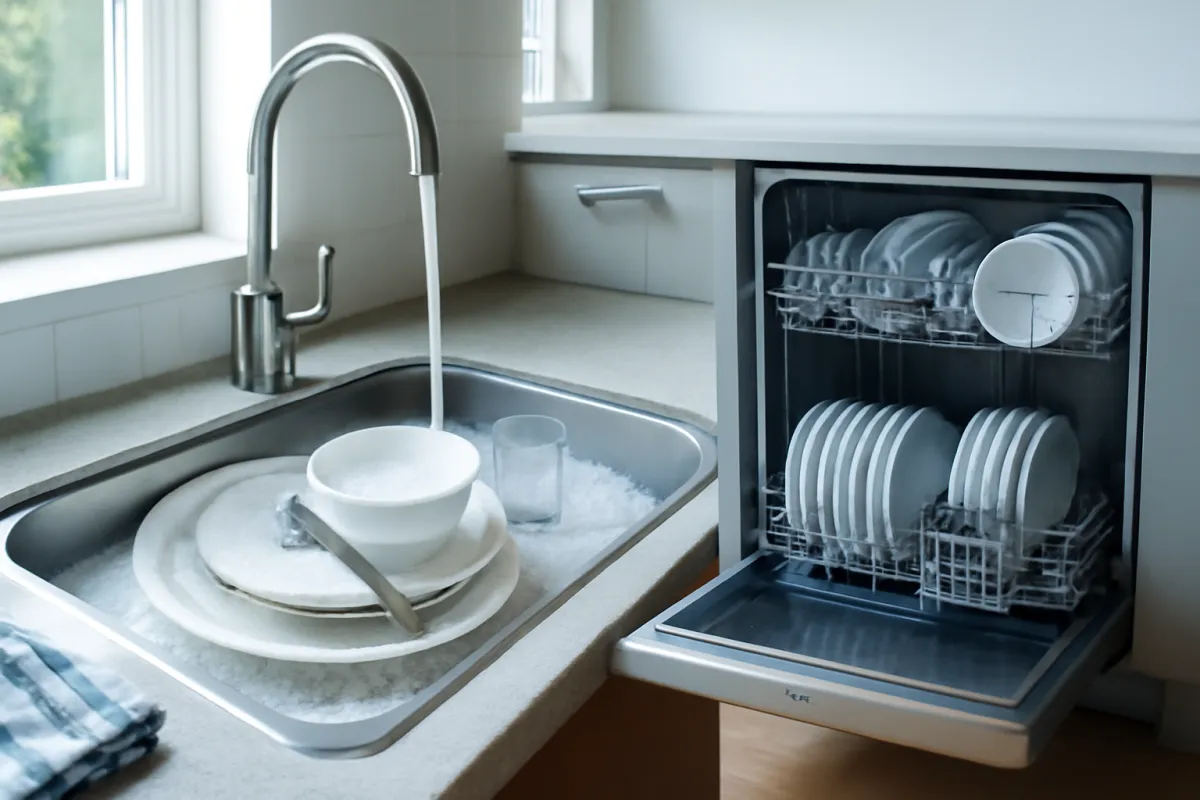
So the practical rule is simple: scrape food off, skip the pre-rinse, wait until the machine is full, and let it run. Done that way, the dishwasher is the cheaper and greener option for most households, and it saves you the labor besides. The people for whom hand-washing genuinely competes are those with very few dishes, who would run a machine mostly empty, or those who wash frugally in a still basin. Everyone else is usually better off letting a full machine do the work.
Eco cycle vs normal cycle
The cycle you pick changes the bill more than most people realize, and the eco or energy-saver cycle is the quiet default worth using. An eco cycle heats the water less aggressively and runs longer at that lower temperature, trading time for energy: it takes more minutes but uses fewer kilowatt-hours, because the biggest cost, heating water hot, is exactly what it dials back. On many machines the eco cycle is the most efficient setting available, even though it looks slower on the display.
A normal cycle sits in the middle, and the long sanitize or heavy cycle sits at the top of the cost range, heating the water hotter and holding it longer to blast off baked-on food. Those hot cycles have their place for genuinely dirty pots or when someone in the house is ill and you want the extra heat, but running them by default costs money for cleaning power most loads do not need. The practical move is to make eco or normal your everyday cycle and reserve the hot, long cycles for the loads that actually earn them. That single habit shifts the biggest slice of the energy split, the water heating, downward on most of your loads.
How your electricity and water rates swing it
Energy per cycle is set by the machine and the cycle, but your electricity rate is the wild card, and it swings the answer more than anything else. Residential rates vary widely by region and season, and the same dishwasher running the same loads costs very different amounts depending on where the meter sits. Find your rate on your electricity bill, printed as cents per kilowatt-hour, then hold the machine at 1.2 kilowatt-hours per cycle and watch how the cost of a single load tracks the rate:
- At 10 cents per kilowatt-hour: about $0.12 a load, near $31 a year at five loads a week
- At 16 cents per kilowatt-hour: about $0.19 a load, near $50 a year
- At 24 cents per kilowatt-hour: about $0.29 a load, near $75 a year
- At 32 cents per kilowatt-hour: about $0.38 a load, near $100 a year
That is more than a threefold spread from the same appliance, driven entirely by the rate. Your water and sewer rate adds a second, smaller swing on top, a few cents a load that a high local water price can nudge upward, but the electricity rate is the one that moves the total. It is why a blanket claim that dishwashers are cheap or expensive to run means nothing without a rate attached. Before you judge yours, look up your own number and run it. Our cost-per-use calculator takes your exact rate in cents and returns your cost per load, per month, and per year directly.
ENERGY STAR dishwashers and what efficiency buys
An ENERGY STAR dishwasher earns its label by heating less water and drying more gently, which are the two slices that actually cost money. In practice that means using less water per cycle, often near the 3-gallon end of the range, warming it efficiently, and leaning on condensation drying rather than a hot element. The result is an energy figure nearer 0.9 kilowatt-hours per cycle than 1.2, so a cost closer to $0.14 a load at a typical rate against $0.19 for a standard machine, illustratively.
Over a year of five loads a week, that difference is on the order of $10 to $15 in electricity, plus a smaller saving on water. That is a modest annual number, which is the honest framing: an efficient dishwasher pays back through years of use, not overnight, and it is rarely worth replacing a working machine on running cost alone. Where it earns its keep is when you are buying anyway, especially if you are replacing an old unit that used far more water and energy, in which case the efficient model cuts the bill on both meters. As with every purchase we test, the right question is total cost over the years you will own it, not the sticker or the badge in isolation.
Running full loads and off-peak timing
Two habits cost nothing and cut the bill directly: running full loads and, if your utility allows it, running off-peak. Running full loads works because the machine heats roughly the same water whether it holds a full rack or a half-empty one, so a full load spreads that fixed heating cost across the most dishes. The saving is not in each cycle costing less; it is in running fewer cycles for the same dishes, which is the same total-cost logic that runs through everything we test.
Off-peak timing helps only if your electricity plan charges different rates at different hours, which many time-of-use plans do. On those plans, starting the dishwasher late in the evening or overnight, using the delay-start button most machines have, shifts the cycle to the cheaper rate window. It does not change how much energy the machine uses, only what each kilowatt-hour costs, so the saving depends entirely on the gap between your peak and off-peak rates. If you are on a flat rate, the timing makes no difference and only the full-load habit matters. Check your plan before you rearrange your evenings around it.
Does running the dishwasher raise my electric bill
It is a fair worry, since the dishwasher hums for a couple of hours and you can hear the element working. But cost is energy times rate, and a dishwasher’s total energy per cycle is modest, so a typical five-loads-a-week household spends near $4 a month running it at a typical rate, illustratively, about $50 a year. That is real money, but it is usually one of the smaller lines on the bill. Heating and cooling, which run for hours at a stretch, and an aging refrigerator, which runs every hour of every day, cost far more over a month than the dishwasher does.
Where the dishwasher starts to show up is at the extremes: a large household running it twice a day, a habit of always using the longest sanitize cycle with heated dry, or a high electricity rate. Stack those and the monthly cost can climb toward $10 or $12, which is noticeable but still moderate next to the big appliances. If your bill has jumped and you suspect the dishwasher, the honest test is to count your loads, check your cycle, and run them through the formula rather than blaming the machine. In most homes the dishwasher is a small, predictable cost, and the levers to shrink it, air dry, full loads, eco cycle, are all free.
How a dishwasher compares to other big appliances
To size up where the dishwasher sits, it helps to put it next to the other appliances we have priced. A dishwasher is a light load run briefly, a few times a week, landing near $50 a year for a typical household. That is one of the smaller annual figures among major appliances, well below the ones that run for hours or run constantly.
A clothes dryer, its closest laundry-room cousin, costs noticeably more per year because it packs a large heating load into every cycle, as we work out in our clothes dryer running-cost breakdown. A space heater is a heavier resistance load you run for hours across a cold spell, and our space heater breakdown shows how quickly those hours add up over a winter. An air conditioner can run for many hours across a hot day, and over a summer its total often dwarfs a year of dishwashing, as our air conditioner running-cost breakdown lays out. A refrigerator costs little per hour but never switches off, running every hour of every day, which is why its steady drip reaches a real annual figure, detailed in our refrigerator running-cost breakdown.
The lesson across all of them is the same: instantaneous wattage tells you almost nothing about the bill on its own. What matters is energy times how often you run it. The dishwasher is a small, brief load, the fridge a small load run forever, the seasonal machines something in between. Judge each on its own yearly total, not its nameplate, and the dishwasher usually turns out to be one of the cheapest of the lot.
Tips to cut a dishwasher’s running cost
If you are going to run the dishwasher, a handful of free habits genuinely cut the energy each load uses, and they all work by heating less water or drying without electricity. Here are the levers that move the number, in rough order of impact.
- Run full loads, not frequent half-empty ones. The machine heats roughly the same water either way, so a full load spreads that cost across the most dishes. This is the single biggest free saving.
- Air dry instead of heated dry. Switch off heated dry, or crack the door open at the end, and you remove a whole slice of the energy split for dishes that dry anyway.
- Skip the pre-rinse. Scrape food off, but do not rinse everything under a running hot tap first. That habit wastes the very hot water the dishwasher was going to save you, and modern detergents work fine without it.
- Use the eco or normal cycle. Reserve the long, hot sanitize cycle for loads that truly need it. The everyday eco setting heats less water, which is the largest cost.
- Run off-peak if your plan rewards it. On a time-of-use plan, the delay-start button shifts the cycle to the cheaper overnight rate. On a flat rate it makes no difference.
- Keep the filter and spray arms clear. A clogged filter or blocked spray arm makes the machine work less effectively, tempting you into hotter or repeat cycles. A clean machine cleans in one efficient pass.
None of these asks you to buy anything. The savings live in how you run the dishwasher you already own, which is usually where the easiest money is.
The annual cost of running a dishwasher
The yearly figure is the one that actually matters, because a year is what you pay, not a single load. Take the cost per load, multiply by loads per week, and multiply by 52. For the modern dishwasher at 1.2 kilowatt-hours per cycle and a typical $0.16 rate, five loads a week works out to about $50 a year in electricity, illustratively, plus a few dollars of water across the year.
Slide the inputs and the annual figure moves in step. A light household running three loads a week pays closer to $30 a year; a busy one running ten pays nearer $100. Change the rate and the whole column shifts: the same five-loads-a-week household pays about $31 a year on a cheap $0.10 rate and about $100 on an expensive $0.32 rate. Switch the machine or the settings and it shifts again: an efficient ENERGY STAR model on the eco cycle with air dry might bring that typical $50 down toward $35, while an old unit on hot sanitize cycles with heated dry can push past $80.
The annual view is also where the free habits show their worth. Switching off heated dry alone trims roughly $15 to $20 a year at five loads a week, and moving your everyday washes to the eco cycle shaves more off the biggest slice, the water heating. Do the arithmetic on your own numbers rather than a national average, because your rate, your load count, and your cycle each move the yearly total more than any generic figure can. Our cost-per-use calculator returns your annual cost the moment you enter them.
A worked example: one household, five loads a week
Put it all together on a single realistic case. You have a modern dishwasher, you run five loads a week, and you want the per-load, monthly, and yearly cost at three different rates, then a sense of what the free levers change.
The per-load figure. A modern dishwasher uses about 1.2 kilowatt-hours per cycle. At a typical $0.16 rate that is 1.2 times 0.16, about $0.19 a load, illustratively. On a cheap $0.10 rate it falls to about $0.12; on an expensive $0.32 rate it climbs to about $0.38.
The monthly figure. Five loads a week is about 22 loads a month, or roughly 26 kilowatt-hours. At $0.16 that is near $4 a month. On the cheap rate it is closer to $2.50; on the expensive rate nearer $8.
The yearly figure. Five loads a week is 260 loads a year, about 312 kilowatt-hours. At the typical rate that is near $50 a year, with the cheap and expensive rates bracketing it from about $31 to $100. Those are the numbers that matter, because a year is what you actually pay.
Now weigh the free levers. If this household switched off heated dry and moved its everyday washes to the eco cycle, the yearly cost would fall toward $35, without spending a cent or washing a single dish by hand. And compared with hand-washing five full loads a week under a running tap, the dishwasher very likely uses less hot water overall, so the machine is the cheaper option and it saves the labor too. The dishwasher did not decide which path pays; the household’s cycle choices and load habits did. Swap your own kilowatt-hours, loads, rate, and heated-dry setting into the cost-per-use calculator to see your version of this example.
A running-cost checklist before you run it
Before you judge what your dishwasher costs, or decide whether an efficient one is worth it, run through these checks. Clear them and the machine will cost roughly what you expect, and no more.
- Know your rate. Pull it off your bill in cents per kilowatt-hour. Without it, no cost claim means anything.
- Find the energy per cycle. The yellow EnergyGuide label or the manual lists the kilowatt-hours. That number times your rate is your cost per load.
- Wait for a full load. A full machine is the whole basis for a dishwasher beating hand-washing. Frequent half-empty cycles throw the advantage away.
- Switch off heated dry. It is the easiest free saving, and the dishes dry anyway. Crack the door open if you want them faster.
- Make eco or normal your default cycle. Reserve the long, hot sanitize cycle for the loads that truly need it.
- Skip the pre-rinse. Scrape, do not rinse under a running tap. It wastes the hot water the machine was going to save.
Clear those six and you are running the dishwasher on numbers rather than on guesswork, which is the entire point of a breakdown.
The bottom line
The cost to run a dishwasher is never a mystery, because the formula is fixed: kilowatt-hours per cycle, times your electricity rate, plus a few cents of water. For the modern machine that is about 1.2 kilowatt-hours per cycle, roughly $0.19 a load at a typical rate, near $4 a month at five loads a week, and about $50 a year, with your own rate swinging the per-load figure anywhere from about $0.12 to $0.38. Most of that energy heats water rather than sprays it, which is why the levers that cut the bill, running full loads, air drying instead of heated dry, choosing the eco cycle, and skipping the pre-rinse, all work by heating less water or drying without the element. A full modern dishwasher usually beats hand-washing on both water and energy, so the machine is the cheaper and greener choice for most households when it is full. Count your loads, check your rate, and price the dishwasher by the year rather than the load, and it becomes what it should be: one of the smallest, most controllable costs in the house.
A note on scope: this breakdown exists to hand you the running-cost arithmetic for a dishwasher, not to steer you toward any particular machine, cycle, or brand. Every kilowatt-hour, gallon, rate, and dollar figure above is an illustrative planning number, drawn from typical ranges rather than measured on one model, and your real electricity rate, water and sewer price, cycle choice, and load count will move the result enough to matter. Nothing here is professional electrical, plumbing, or appliance-installation advice. A dishwasher draws real power and connects to both water and drain lines, so follow the maker’s instructions, keep the filter and connections sound, and bring in a qualified electrician or plumber for any wiring, water, or installation question before you rely on the numbers in this article.
Frequently asked questions
How much does it cost to run a dishwasher per load?
A modern dishwasher uses somewhere near 1.2 kilowatt-hours to wash and dry one full load, so at a typical rate near $0.16 per kilowatt-hour it costs roughly $0.19 a load, illustratively. On a cheaper $0.10 rate that falls to about $0.12, and on an expensive $0.32 rate it climbs to about $0.38. An efficient ENERGY STAR machine on a shorter cycle can dip under $0.15, while an older unit that heats more water can push past $0.30. These are typical figures for a full load; a lighter eco cycle costs less and heated dry adds a little on top.
How much electricity does a dishwasher use?
A typical modern dishwasher uses roughly 1.2 kilowatt-hours per cycle, most of it spent heating water rather than spraying it. The heating element that warms the wash water and runs the heated dry is the largest draw; the pump and controls use comparatively little. An ENERGY STAR machine on a normal cycle often lands nearer 0.9 kilowatt-hours, while an older or heavily soiled sanitize cycle can reach 1.8 or more. The exact figure depends on the cycle you pick, the water temperature, and whether heated dry is switched on.
Is it cheaper to run a dishwasher or wash by hand?
For a full load, a modern dishwasher is usually the cheaper and greener choice, which surprises people. Hand-washing a full load's worth of dishes under a running tap can use 20 or more gallons of hot water, and heating that water is where most of the cost sits. An efficient dishwasher uses only about 3 to 5 gallons per cycle and heats it precisely, so it often uses less water and less energy than washing the same dishes by hand. The catch is the word full: a half-empty machine run daily throws away that advantage, and rinsing everything under a hot tap before loading erases it entirely.
How much does the heated dry setting cost?
Heated dry is a small but real lever on the bill. It runs the heating element after the wash to evaporate the last water off your dishes, adding somewhere near 0.3 to 0.5 kilowatt-hours per cycle, so roughly $0.05 to $0.08 a load at a typical rate, illustratively. Over a year of five loads a week that is on the order of $15 to $20. Switching to air dry, where the machine just vents or you crack the door open, drops that cost to nothing and the dishes still dry, only more slowly. It is one of the easiest savings on the machine because it changes nothing about how clean the dishes get.
Does running the dishwasher raise my electric bill a lot?
Rarely by much. A dishwasher is a modest electrical load that runs for a couple of hours a few times a week, so a typical five-loads-a-week household spends near $4 a month running it at a typical rate, illustratively, about $50 a year. That is real but usually one of the smaller lines on the bill; heating, cooling, and an aging refrigerator cost far more. The dishwasher climbs into noticeable territory only if you run many loads, always use heated dry and the longest sanitize cycle, or pay a high electricity rate. Even then it stays a controllable, predictable cost.
How much water does a dishwasher use?
A modern efficient dishwasher uses only about 3 to 5 gallons of water per cycle, and an ENERGY STAR model can sit at the low end of that. Older machines from a couple of decades ago used far more, often 8 to 15 gallons a cycle, which is one reason a new dishwasher can cut both the water and the energy bill. Because the machine heats its own water so precisely, using less of it, the water cost per cycle is usually small next to the electricity. Your local water and sewer rate decides exactly how small, but for most homes it adds only a few cents a load.
What is the cheapest way to run a dishwasher?
Run full loads rather than frequent half-empty ones, since the machine heats roughly the same water either way, and let the dishes air dry instead of using heated dry. Pick the eco or normal cycle over the longest sanitize setting unless you actually need it, and skip pre-rinsing under a running tap, which wastes hot water the dishwasher does not need. If your utility charges less at night, start the cycle off-peak. Each step trims either the water heated or the minutes the element runs, which is nearly all of what you are paying for.
How do I calculate my own dishwasher running cost?
Take the dishwasher's energy per cycle in kilowatt-hours, which the yellow EnergyGuide label or the manual usually lists, and multiply it by your electricity rate in dollars per kilowatt-hour. For a 1.2-kilowatt-hour machine at $0.16 that is about $0.19 a load. Multiply by your loads per week and by 52 for the yearly figure, then add a few cents a load for water if you want the full picture. Our companion calculator does the arithmetic for you: enter the kilowatt-hours per cycle, loads per week, your rate, and whether heated dry is on, and it returns the cost per load, per month, and per year.