
What's on this page
- Where energy-efficient appliances actually save money
- Before you start
- Step 1: Read the EnergyGuide label and its kWh per year
- Step 2: Look for the ENERGY STAR mark and what it means
- Step 3: Calculate the lifetime running cost, not just the sticker price
- Step 4: Right-size the appliance to your household
- Step 5: Compare the efficiency features that matter by type
- Step 6: Weigh the upfront cost against the payback
- Step 7: Check rebates and proper installation and use
- A worked example: comparing two refrigerators
- Common mistakes when choosing energy-efficient appliances
- Troubleshooting: harder buying decisions
- Your energy-efficient appliance checklist
- The bottom line
Short answer: Choose energy-efficient appliances by comparing the running cost alongside the sticker price, because over a decade the energy an appliance burns can rival or exceed what you paid. Read the yearly kilowatt-hour figure on the yellow EnergyGuide label, multiply it by your own electricity rate, and run the payback against the cheaper model. Use ENERGY STAR as a shortlist filter, and focus hardest on heating and cooling, water heating, the refrigerator, and the dryer.
Buying an appliance on the sticker price is like judging a car on the color: it tells you almost nothing about what the thing will actually cost you. A refrigerator, a dryer, or a water heater keeps spending your money every day it runs, and over a decade that running cost can rival or even exceed what you paid at the register. The good news is that the information you need to choose well is printed right on the appliance, and turning it into a decision takes nothing more sophisticated than multiplication.
These notes give you a repeatable seven-step method for choosing energy-efficient appliances: how to read the yellow label, what the ENERGY STAR mark does and does not promise, how to turn a kilowatt-hour figure into a running cost in your own dollars, and how to tell when paying more up front actually pays off. Along the way we point you to our sibling reports for the appliances that matter most, including our refrigerator running-cost report and our step-by-step notes on lowering your electric bill. Feed a candidate appliance’s yearly kilowatt-hours and your own rate into the running-cost calculator as you read, and the lifetime number moves with every input.
Key takeaways
- The sticker price is often under half of what an appliance really costs you: the rest is the energy it burns over its life, so compare both.
- The yellow EnergyGuide label gives you a yearly kilowatt-hour figure. Multiply it by your own rate, not the label's average, for a running cost in your money.
- ENERGY STAR is a useful shortlist filter, not a guarantee of savings. Pair the mark with the label number and the payback math.
- Efficiency pays off most on the appliances that run the most: heating and cooling, water heating, the always-on fridge, and the dryer.
- The one mistake to avoid: buying on the sticker alone. A cheaper unit that costs more to run can lose over its life. Run the payback first.
Where energy-efficient appliances actually save money
Before you compare models, it helps to see where the savings live, because efficiency is only worth chasing in proportion to how much an appliance runs. A ten percent efficiency gain on a machine that costs $480 a year to run returns far more than the same ten percent on one that costs $24 a year. The chart below shows an illustrative annual running cost for several common appliances, priced at a typical $0.16 per kilowatt-hour so the bars are comparable. Your own figures will differ with your rate and how hard you use each machine, so treat the shape as a map rather than a measurement.
Illustrative annual running cost by appliance
At a typical $0.16 per kilowatt-hour. Bars scale with the yearly dollar cost. Your figures vary by rate and use.
The long bar is water heating. That is why a percentage saving on the big loads returns more real dollars than eliminating a small load entirely. Spend your comparison effort in proportion to the bar length.
The lesson of the chart is the whole strategy in one picture. The appliances with the longest bars, water heating and the heating and cooling load that sits off the top of this chart, are where an efficiency choice returns the most money, so they deserve the closest comparison. The always-on refrigerator and the heat-hungry dryer form a solid middle tier worth real attention. The dishwasher and clothes washer are the short bars: still worth choosing sensibly, but not worth agonizing over a small efficiency gap when the dollars are modest. The steps that follow give you one method that works for every bar, but keep this ranking in mind, because it tells you how much effort each comparison is worth. For a deeper look at any single load, our running-cost reports work the arithmetic appliance by appliance.
Before you start
This is a research-and-arithmetic task, not a technical one, and you can do the whole thing with a phone in a showroom aisle or from the product pages in a browser tab. Choosing well takes maybe half an hour of comparison once you know what you are looking at, and the payoff is a purchase that keeps saving quietly for years. Gather two things before you begin so the numbers you work with are your own rather than an illustrative stand-in.
- Your electricity rate, in cents or dollars per kilowatt-hour, pulled off a recent bill. The honest figure is your all-in rate: take the total dollar amount of the bill and divide it by the total kilowatt-hours used, which folds in every fee. That all-in number is usually a little higher than the headline supply rate, and it is the one to carry through every step here.
- The appliance category and a rough size you need, because efficiency is only comparable within a type and size class. A compact fridge and a large one are not rivals, and the right question is which unit is most efficient at the size your household actually needs.
A calculator, the product’s EnergyGuide label or spec sheet, and ten quiet minutes are all the equipment required. Nothing here asks you to install anything or open a panel, and anything that would, such as adding a gas line or a dedicated circuit, is explicitly handed to a licensed professional in the final step. With your rate written down, start at the label.
Step 1: Read the EnergyGuide label and its kWh per year
Everything downstream depends on one number: how much electricity the appliance uses in a year. In the United States, most major appliances carry a bright yellow EnergyGuide label, and its job is to let you compare two models on the same footing. The large figure in the middle is an estimated yearly energy use in kilowatt-hours, measured under a standardized test so that two units are judged the same way regardless of the maker. That kilowatt-hour figure is the one to write down for every model you are weighing.
The label also prints an estimated yearly operating cost in dollars, but read that number with care. It is calculated using a national average electricity rate chosen for the label, which may be nothing like what you pay. The reliable move is to ignore the printed dollar figure and compute your own: multiply the kilowatt-hour number by your rate in dollars per kilowatt-hour. On an illustrative label showing 500 kilowatt-hours a year, at a typical $0.16 per kilowatt-hour, that is 500 times 0.16, or about $80 a year in running cost. Do that same multiplication for each model and you have compared them in your own money.
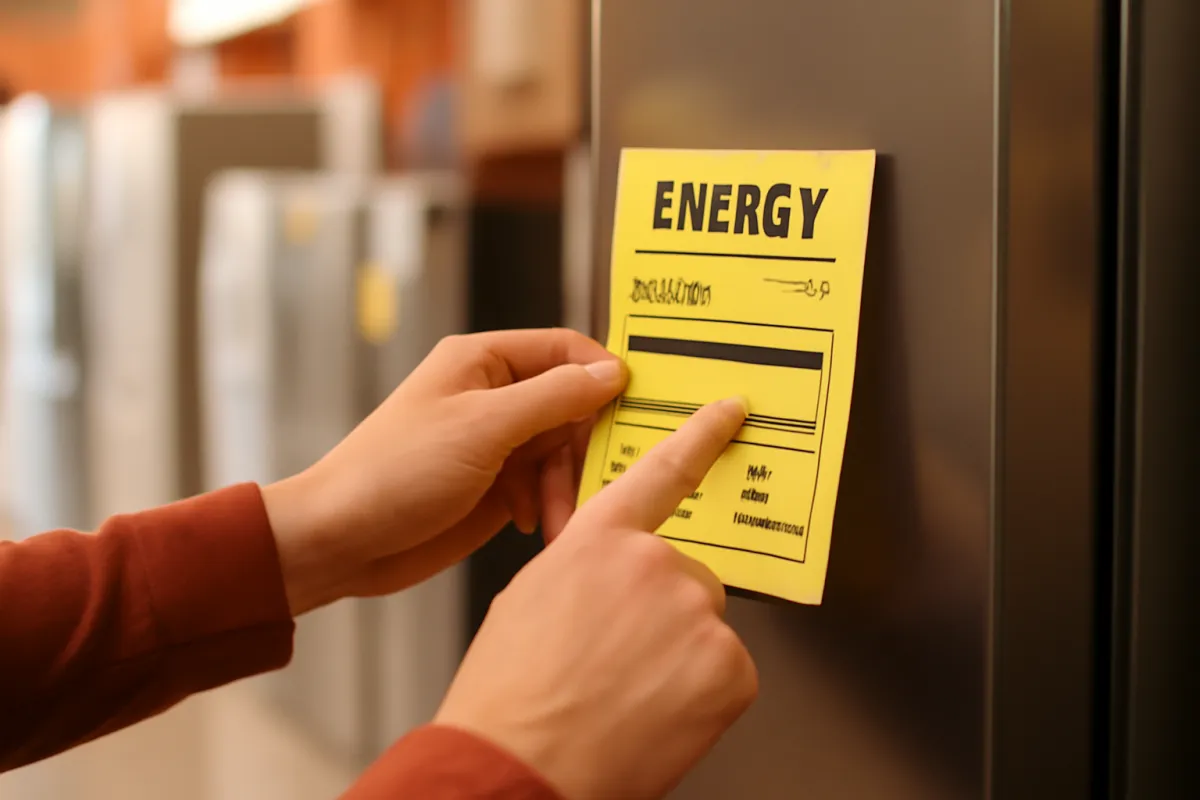
Watch out for two traps. First, only compare labels within the same size and type class, since a larger appliance can honestly use more energy than a smaller one while being the more efficient design for its size. Second, the range strip some labels show, marking where a model falls among similar units, is a quick sanity check but no substitute for your own rate math. Enter the yearly kilowatt-hours of your leading candidate into the running-cost calculator now, so the figure you carry into the next steps is genuinely yours.
Step 2: Look for the ENERGY STAR mark and what it means
Once you can read the label number, the blue ENERGY STAR mark becomes a fast way to build a shortlist. ENERGY STAR is a program run by the federal government that sets an efficiency specification for each appliance category, and a model earns the mark by meeting that specification. In plain terms, a certified model is generally more efficient than the minimum a standard model in that category must clear, so filtering a product listing to certified units is a reasonable first cut that narrows a crowded field to the more efficient contenders.
What the mark does not do is tell you how much money you will save, and that distinction matters. The specification is about meeting an efficiency bar, not about a dollar figure, because the dollars depend on your rate and how hard you run the appliance. A certified dishwasher used twice a week saves less in absolute terms than a certified water heater running for a family of five, even though both wear the same mark. So treat the mark as a filter that gets you to a better shortlist, then go back to the EnergyGuide kilowatt-hour number and your own rate to see the actual running cost of each certified model you are considering.
There is one more nuance worth knowing. Within the certified group, some programs flag the most efficient models of the year as a separate tier, which can be a useful pointer when you are weighing the big loads where efficiency pays most. But a top-tier certified model can still carry a higher sticker, which loops you straight back to the payback question in Step 6. The mark, in other words, is one honest input to the decision, not the decision itself. Use it to shortlist, then let the label number and your rate do the deciding, because two certified models can still differ enough in yearly use to matter.
Step 3: Calculate the lifetime running cost, not just the sticker price
This is the step that separates a good appliance decision from a guess. The sticker price is a one-time number you see clearly; the running cost is a recurring number that hides in plain sight and often ends up larger. To make it visible, turn the label into a lifetime figure. Take the yearly running cost you computed in Step 1, then multiply it by the number of years you expect to own the appliance. On an illustrative 500-kilowatt-hour fridge at $0.16 per kilowatt-hour, that is $80 a year, and over a 12-year life that is $960 in electricity, quite possibly more than a third of what you paid at the register.
For an appliance you run in sessions rather than around the clock, the label may not give a yearly figure, so compute it from the power draw. The formula is watts times hours divided by 1,000 for the kilowatt-hours, then times your rate. As an illustration, a 1,000-watt appliance run one hour a day uses one kilowatt-hour a day, about 365 a year, which at $0.16 is roughly $58 a year. Multiply by how many years you will keep it for the lifetime figure. Our dryer running-cost report works this same arithmetic per load for one of the heavier session appliances, and our refrigerator report does it for an always-on one.

Watch out for the instinct to stop at the sticker because it is the number on the tag. Two appliances with the same price can have very different lifetime costs, and two with different prices can end up costing the same once the energy is counted. Add the sticker and the lifetime running cost together for each model and compare those totals, not the tags. Drop your candidate’s yearly kilowatt-hours, your rate, and your ownership horizon into the running-cost calculator to see this lifetime figure without doing the multiplication by hand.
Step 4: Right-size the appliance to your household
Efficiency ratings compare like with like, but the size you buy is a separate lever, and buying too big quietly undoes an efficient design. A larger refrigerator, washer, or water heater has more volume to cool, spin, or keep hot, so it generally uses more energy in absolute terms even when it is the more efficient model in its class. The most efficient appliance for your home is the one sized to what your household actually needs, not the largest one that fits the space or the deal that happened to be on sale.
Match the size to real use. For a refrigerator, that means the capacity your household fills without cavernous empty shelves you are paying to cool, though not so small that you run a second unit to compensate, which is usually the worst outcome of all. For a clothes washer, it means a drum that suits your typical load rather than one you rarely fill, since a half-empty large machine wastes both water heating and spin energy. For a water heater, it means a tank or a capacity matched to your household’s hot-water demand, because an oversized tank keeps a larger reservoir hot around the clock whether you draw it down or not.

Watch out for two sizing traps. First, do not oversize for rare peaks, such as buying a giant fridge for the two weeks a year you host, because you pay to run that capacity every other week. Second, do not undersize so severely that you keep an old backup appliance running alongside the new one, which stacks two running costs where one would do. The honest target is the smallest size that comfortably covers your normal week, which is where an efficient design and a sensible size compound instead of fighting each other.
Step 5: Compare the efficiency features that matter by type
Efficiency is not one feature but a different short list for each appliance, so once you have shortlisted certified models at the right size, compare the handful of things that actually move the energy number for that type. Chasing the wrong feature wastes attention on a spec that barely changes the bill, so it helps to know what matters where.
For a refrigerator, the yearly kilowatt-hour figure already captures most of it, but configuration matters too: top-freezer designs are often more efficient than side-by-side ones, and features like through-the-door ice and water can add to the running cost. For a clothes washer, a higher spin speed pulls more water out, which means the dryer has less to do, so the washer’s spin quietly lowers the dryer’s bill. For a clothes dryer, the big divide is between conventional vented models and heat-pump models, which recycle heat and use markedly less energy, at a higher sticker that returns to the payback math. For a dishwasher, look at the yearly kilowatt-hour figure and whether it has an efficient wash cycle and a no-heat or air-dry option, since heated drying is a meaningful slice of a dishwasher’s energy.
For heating and cooling, the efficiency ratings are their own alphabet, and because this is the largest load in most homes it deserves the most careful comparison and, often, professional sizing advice. The principle holds across all of them: identify the two or three features that change the energy number for that appliance type, compare models on those, and ignore the marketing features that do not touch the bill. When a feature both improves efficiency and touches another appliance, like a washer’s spin speed lightening the dryer’s load, count that knock-on saving too, because it is real money in the next machine.
Step 6: Weigh the upfront cost against the payback
Now put the sticker and the running cost together into a single decision: the payback. An efficient model often costs more up front, and the question is whether the yearly saving it delivers earns that premium back within the years you will own it. The arithmetic is one division. Take the extra sticker price of the efficient model over the cheaper one, then divide it by the yearly running-cost difference between them. The result is the number of years before the efficient model pulls ahead on total cost.
Work it with illustrative numbers. Suppose the efficient model costs $150 more but uses enough less electricity to save $24 a year at your rate. Then $150 divided by $24 is about 6.25 years to break even. If you will keep the appliance twelve years, it spends roughly its second half saving you money, and the efficient model is the better buy. Flip the example: if that same $150 premium saved only $8 a year, the payback stretches to almost nineteen years, likely longer than the appliance lasts, and the cheaper model wins on total cost. The premium is worth paying only when the payback lands comfortably inside the appliance’s life. This same buy-it-or-skip-it arithmetic applies to appliances whose whole purchase is in question, not just the efficiency premium; our worth-it verdict on air purifiers is the clearest example, since its value rests entirely on matching the machine to a real problem.
Watch out for two things. First, the payback swings hardest on your electricity rate and on how much you use the appliance, so a premium that fails to pay back for a light user can pay back handsomely for a heavy one at a high rate. Both numbers are yours, which is why Steps 1 and 4 come first. Second, do not force a payback that is not there: on the short-bar appliances from the chart, the dollar gaps are small, so a modest premium may never pay back, and that is fine. Buy those on price and features and save the payback scrutiny for the long bars where the dollars are large. Run both models through the running-cost calculator to see the lifetime totals side by side before you decide.
Step 7: Check rebates and proper installation and use
Two things outside the appliance itself can change the real cost, and both are easy to overlook. The first is rebates and incentives. Utilities and various government programs sometimes offer rebates, discounts, or credits for efficient appliances, and where they exist they lower the effective sticker price, which shortens the payback you calculated in Step 6. These programs change over time and vary widely by location and appliance, so do not assume a specific amount: check your own utility’s current offers and any applicable program before you buy, and confirm the model you want actually qualifies. A rebate can turn a marginal payback into an easy yes, so it is worth the few minutes to look.
The second is installation and use, because the most efficient appliance run badly is no longer efficient. A refrigerator crammed against a wall with dusty coils, a dryer with a clogged lint filter or a long kinked vent, or a water heater set far hotter than it needs to be all burn energy the label never predicted. Efficiency ratings assume the appliance is installed and used the way the manufacturer intended, so follow the clearance, venting, and setting guidance to actually get the efficiency you paid for. Our notes on lowering your electric bill cover many of these habit-level settings in depth.
Watch out for the installation costs that belong in the comparison. Switching an appliance from electric to gas, or the reverse, can mean adding a gas line or a dedicated circuit, which is a real upfront cost that changes the payback and, importantly, a job for a licensed professional rather than a weekend project. Fold any such cost into the sticker side of your comparison before you conclude one option is cheaper, and hand the physical work to a qualified installer.
A worked example: comparing two refrigerators
Put the seven steps together on one illustrative decision so the numbers connect. You are choosing between two new refrigerators of the same size class. Fridge A is the budget pick at a $750 sticker, and its yellow label shows 550 kilowatt-hours a year. Fridge B is the efficient pick at a $900 sticker, and its label shows 400 kilowatt-hours a year. You expect to own whichever you choose for about twelve years, and your all-in rate is a typical $0.16 per kilowatt-hour.
Steps 1 and 3, the running costs. Fridge A at 550 kilowatt-hours times $0.16 is $88 a year. Fridge B at 400 kilowatt-hours times $0.16 is $64 a year. So Fridge B saves $88 minus $64, which is $24 a year at your rate.
Step 6, the payback. Fridge B costs $900 minus $750, a $150 premium. Divide that $150 by the $24 yearly saving and the payback is about 6.25 years. Since you will own the fridge for roughly twelve years, it spends its whole second half saving you money.
The lifetime totals. Over twelve years, Fridge A costs $750 up front plus $88 a year in electricity, which is $1,056 of energy, for a total of $1,806. Fridge B costs $900 up front plus $64 a year, which is $768 of energy, for a total of $1,668. So the efficient Fridge B, despite the higher sticker, costs about $138 less over the twelve years. The stack below shows how the true cost of the budget Fridge A splits between what you see and what you do not.
Sticker price vs lifetime energy cost
The budget fridge over 12 years at $0.16 per kilowatt-hour: $750 sticker plus $1,056 of energy, totaling $1,806. Segments sum to 100 percent. Illustrative.
On the budget fridge, the energy over its life costs more than the sticker did. That is the whole case for reading the label before the tag, and for running the payback in Step 6.
The shape of the split is the lesson repeated: the $750 you saw at the register was under half of what the budget fridge really costs, and the invisible energy half is exactly where the efficient model claws back its premium. Change any input, your rate, the labels, or how long you will keep the fridge, and the decision can flip, which is why the method matters more than these particular numbers. Swap your own candidate’s kilowatt-hours, rate, and ownership years into the running-cost calculator to build your own version of this comparison in your own dollars.
Common mistakes when choosing energy-efficient appliances
Most poor appliance buys are not the result of laziness but of anchoring on the wrong number. These are the pitfalls that quietly cost money over an appliance’s life.
- Buying on the sticker price alone. The tag is the one-time cost; the running cost is the recurring one, and on the big appliances it can outweigh the sticker over the appliance’s life. Compare the sticker plus the lifetime running cost, never the tag by itself.
- Oversizing. A larger fridge, washer, or water heater than your household needs uses more energy every day for capacity you rarely use. Buy the smallest size that comfortably covers your normal week, not the biggest one that fits.
- Ignoring the EnergyGuide label. Skipping past the yellow label to the price throws away the one number that makes efficiency comparable. Read the yearly kilowatt-hours and price it at your own rate on every model.
- Trusting the label’s dollar figure as your cost. The dollar amount on the label uses a national average rate, not yours. Always multiply the kilowatt-hour figure by your own rate to get a running cost that reflects your area.
- Skipping the rebate check. Available rebates and incentives can lower the effective price and shorten the payback, and they are easy to miss. Check your utility and any applicable program before you buy, and confirm your model qualifies.
- Undermining efficiency with poor installation or use. Dusty coils, a clogged dryer vent, or a water heater set too hot erase the efficiency you paid for. Install and use the appliance the way the manufacturer specifies to actually get the rated efficiency.
Clear these and your money flows to the appliance that costs the least to own, which is often not the one with the lowest tag.
Troubleshooting: harder buying decisions
The seven steps cover the straightforward purchase, but some decisions are messier. Here is how to think through the common edge cases without losing the thread.
What if my current appliance still works, should I replace it for efficiency? Usually not on energy alone, because a working appliance has no premium to pay back, only the full price of a new one. Run it as a replacement decision: the yearly running-cost saving against the full price of the new unit, not the gap between two new models. The math only tends to favor replacement for a genuinely old or oversized appliance, or a redundant second one such as a spare fridge in the garage, where the yearly running cost is high enough to earn back a purchase. Our refrigerator running-cost report walks through when an old fridge crosses that line.
What if my local electricity rate is very high? A high rate is the single biggest thing that makes efficiency pay, because every kilowatt-hour saved is worth more. Re-run the payback in Step 6 at your actual rate and you will often find a premium that looked marginal at an average rate pays back comfortably at yours. The higher your rate, the more the efficient model and the right size are worth, so lean harder into the long-bar appliances.
What if I have a small space or an odd layout? Size to the space you have, but be careful that a too-small appliance does not push you into a workaround that costs more, like running a second unit. Measure the opening, including the clearance an appliance needs for ventilation, before you fall for a model, and remember that an efficient design at a slightly awkward size can still beat a poorly sized bargain. Our companion walkthrough on choosing an air purifier uses the same size-to-the-room logic for a different appliance.
What if I am weighing gas against electric? The EnergyGuide label compares within a fuel type, not across, so you have to price the energy each appliance uses against your own gas and electricity rates. There is no universal winner: the answer depends on local fuel prices and the specific appliance, and a high-efficiency electric heat-pump model can undercut a gas one where electricity is reasonable. Add any installation cost, such as a new gas line or circuit, to the comparison, and treat that work as a job for a licensed professional.
Your energy-efficient appliance checklist
Work this list top to bottom for any appliance purchase. Clear it and you have chosen on total cost of ownership rather than the tag.
- Write down your all-in electricity rate. Total bill dollars divided by kilowatt-hours used, so every figure below is in your own money.
- Read the EnergyGuide label’s yearly kilowatt-hours on each model, and price it at your rate rather than trusting the label’s average-rate dollar figure.
- Filter to ENERGY STAR certified models as a shortlist, then compare the certified units on their actual label numbers.
- Compute the lifetime running cost: yearly running cost times the years you will own the appliance, and add it to the sticker for a true total.
- Right-size to your household, the smallest size that comfortably covers your normal week, never oversized for rare peaks.
- Compare the features that matter for that type, such as a dryer’s heat-pump design or a washer’s spin speed, and ignore the specs that do not touch the bill.
- Run the payback: extra sticker divided by yearly saving, and buy the premium only if it pays back inside the appliance’s life.
- Check rebates and confirm proper installation and use, folding any install cost into the comparison and handing physical work to a professional.
Save the list, work one line at a time, and the appliance that wins will be the one that costs the least to actually own.
The bottom line
Choosing an energy-efficient appliance is not about buying the greenest badge or the biggest number of features; it is about counting the whole cost instead of the visible half. Read the yellow EnergyGuide label for the yearly kilowatt-hours, use the ENERGY STAR mark to shortlist, and then price each model at your own rate so you are comparing running costs in your own dollars. Add that lifetime running cost to the sticker, right-size to your household, and run the payback before you pay any premium, because an efficient model only wins when it earns its extra price back inside the years you will own it. Spend the most scrutiny on the long-bar appliances, where the running cost is large, and buy the short-bar ones on price and features. Do that, check for a rebate, install it properly, and the appliance you carry home will keep quietly saving instead of quietly spending, which is the entire point of choosing on efficiency rather than on the tag.
A note on scope: these notes exist to hand you a repeatable method for choosing an appliance on its total cost, not to promise any specific saving. Every rate, kilowatt-hour figure, sticker price, and dollar amount above is an illustrative planning number drawn from typical ranges rather than measured on one purchase, and your own rate, usage, and the specific models on sale will move the result enough to matter, so price your own candidates before you count on any figure. The EnergyGuide label and the ENERGY STAR program are described in general terms; confirm the current label details and any rebate or incentive with the manufacturer, your utility, and the relevant program, since those change over time. Nothing here is professional advice, and any installation that involves a gas line, a circuit, or venting belongs to a qualified, licensed professional.
Frequently asked questions
How do I know if an appliance is energy efficient?
Start with the yellow EnergyGuide label attached to the appliance, which shows an estimated yearly energy use in kilowatt-hours and an estimated yearly operating cost. The lower the kilowatt-hour number for a comparable size and type, the more efficient the model is to run. A blue ENERGY STAR mark on top of that tells you the model meets a federal efficiency specification for its category. Together the label number and the mark give you a fair first read, but always compare like with like, because a larger appliance can use more energy than a smaller one even when it is the more efficient design.
What does the number on the EnergyGuide label actually mean?
The large kilowatt-hour figure is an estimate of how much electricity the model uses in a year under a standardized test, which lets you compare two units on the same footing. The dollar figure printed nearby is that energy use multiplied by a national average electricity rate chosen for the label, not your rate. To make it personal, ignore the printed dollar amount and multiply the kilowatt-hour number by your own rate in dollars per kilowatt-hour, which you can pull off your electricity bill. That gives you an illustrative running cost in your own money rather than an average that may be nothing like your area.
Is it worth paying more for an energy-efficient appliance?
Sometimes, and the way to know is to run the payback rather than trust the label alone. Take the yearly running-cost difference between the efficient model and the cheaper one, then divide the extra sticker price by that yearly saving to get the number of years before the efficient unit pulls ahead. If the payback lands comfortably inside how long you will own the appliance, the efficient model wins on total cost; if it stretches past the appliance's likely life, the cheaper unit may be the better buy. The math swings hardest on your electricity rate and how much you use the appliance, so both numbers are yours to supply.
Does ENERGY STAR really save money?
The ENERGY STAR mark means an independent specification for that appliance category has been met, so a certified model is generally more efficient than the minimum a standard model must clear. Whether that translates into meaningful money depends on the appliance and how hard you run it, because a small efficiency gain on a light-use appliance is a small saving in dollars. The mark is a useful shortlist filter rather than a guarantee of savings, so pair it with the EnergyGuide kilowatt-hour number and your own rate to see the actual figure. Treat it as one input to the payback math, not the whole decision.
Which appliances are worth focusing on for efficiency?
The appliances that use the most energy over a year give efficiency the most to work with, so that is where the attention pays off. Heating and cooling and electric water heating are usually the largest household electricity loads by a wide margin, followed by the always-on refrigerator and the heat-hungry clothes dryer. A dishwasher or a clothes washer uses far less over a year, so an efficiency upgrade there saves fewer dollars even when the percentage gain is similar. Spend your comparison effort in proportion to how much each appliance runs, and lean on our sibling running-cost reports to see where each one lands.
How do I calculate the running cost of an appliance?
For an appliance with a yearly kilowatt-hour figure on its label, such as a refrigerator, multiply that number by your electricity rate in dollars per kilowatt-hour for an illustrative annual running cost. For an appliance you run in sessions, multiply its wattage by the hours you use it, divide by 1,000 to get kilowatt-hours, then multiply by your rate and by how often you use it. As an illustration, a 1,000-watt appliance run one hour a day is one kilowatt-hour a day, about 365 a year, which at a typical $0.16 per kilowatt-hour is roughly $58 a year. Find your own rate on your bill so the figure reflects your area rather than a national average.
Should I replace a working appliance with a more efficient one?
Usually not on energy savings alone, because a working appliance has no sticker premium to pay back, only the full price of a new one. The exception is a genuinely old or oversized unit, or a redundant second appliance such as a spare refrigerator in the garage, where the yearly running cost can be high enough that a replacement pays for itself within its life. Run the numbers the same way as a new-purchase decision: the yearly running-cost saving against the full replacement price, not just the price gap between two new models. If the appliance is already near the end of its life and failing, the efficiency of the replacement becomes a factor in which new model to pick rather than whether to replace at all.
Do gas or electric appliances cost less to run?
It depends on the local price of each fuel and the efficiency of the specific appliance, so there is no single answer that holds everywhere. In many areas natural gas is cheaper per unit of heat than electricity, which is why gas water heaters, dryers, and ranges can have lower running costs where gas is inexpensive, though a high-efficiency electric heat pump appliance can flip that comparison. The EnergyGuide label helps within a fuel type but does not directly compare a gas model against an electric one, so you have to price the energy each uses against your own gas and electricity rates. Factor in installation too, since adding a gas line or a dedicated circuit is a real upfront cost that belongs in the comparison.