
What's on this page
- How much does it cost to run a dryer? The short answer
- The running-cost formula: kilowatts, minutes, and your rate
- How much electricity does a dryer use per load
- The standard electric dryer math
- Cost per month by loads per week
- Your electricity rate is the biggest variable
- Gas versus electric dryer running cost
- Electric vs gas vs heat-pump running cost
- What a heat pump dryer costs to run
- What drives a dryer’s running cost
- Whether the dryer really spikes your bill
- Air-drying to cut the cost
- Dryer-efficiency tips that actually move the number
- How a dryer compares to other big appliances
- The annual cost of running a dryer
- A worked example: one household, five loads a week
- A running-cost checklist before you dry
- The bottom line
Short answer: A standard electric dryer uses about 3 kilowatt-hours per load, so at a typical electricity rate near $0.16 it costs roughly $0.48 a load, about $10 a month at five loads a week, and near $125 a year, illustratively. The formula is watts divided by 1,000, times hours per load, times your rate. Your rate is the biggest variable, spanning about $0.30 to $0.96 a load, and a gas dryer often runs near $0.22.
How much does a dryer cost to run? It is one of the cheapest appliance questions to answer to the penny: a standard electric dryer uses about 3 kilowatt-hours to dry one load, so at a typical electricity rate near $0.16 it costs roughly $0.48 a load, about $10 a month at five loads a week, and near $125 a year. Those are illustrative figures, and your own rate and laundry habits move them, but the shape is right.
This breakdown does the full arithmetic behind that answer. It hands you the one formula that turns any dryer’s wattage into dollars, the same watts-to-dollars method we use in our space heater running-cost breakdown, then works the standard electric-dryer case per load, per month, and per year. It settles the gas-versus-electric question, prices the newer heat-pump dryers, shows how much your electricity rate swings everything, and lays out the handful of habits that actually cut the bill. You can feed your own dryer, rate, and load count into our cost-per-use calculator as you read and watch every figure move.
Key takeaways
- The whole formula is watts divided by 1,000, times the fraction of an hour per load, times your rate in dollars per kilowatt-hour. Everything else is detail.
- A standard electric dryer uses about 3 kilowatt-hours per load, costing roughly $0.48 at a typical rate, near $10 a month at five loads a week, and about $125 a year.
- Your electricity rate is the single biggest variable. The same dryer and load count ranges from about $0.30 to $0.96 a load across common rates.
- A gas dryer usually costs less per load to run, often near $0.22, but costs more to buy and install. A heat-pump dryer runs cheapest of all but is the priciest to buy.
- You pay for the minutes the heater runs. Full loads, a clean lint filter, a fast washer spin, and the moisture sensor all cut those minutes and the cost.
How much does it cost to run a dryer? The short answer
A dryer costs its wattage in kilowatts, times the fraction of an hour each load runs, times your electricity rate. For the standard electric dryer most people own, that works out to about 3 kilowatt-hours per load, so roughly $0.48 to dry one load at a typical rate, near $10 a month if you run five loads a week, and about $125 across a full year at that pace. Those are illustrative figures, and your own rate can push them meaningfully up or down, but the pattern holds: cents per load, a handful of dollars a month, low hundreds a year.
The reason the number surprises people is that a dryer is a big electrical load that runs for a short time. While the heating element is on it pulls around 3,000 watts, as much as two 1,500-watt space heaters at once, but each load lasts under an hour rather than all evening. That short runtime is what keeps the monthly cost modest even though the instantaneous draw is large. The rest of this article turns that short answer into a method you can apply to any dryer, at any rate, for any laundry schedule, and shows which dryer type and which habits actually change the total.
The running-cost formula: kilowatts, minutes, and your rate
Here is the entire calculation, and it is the same one we apply to every appliance in our space heater breakdown: take the wattage the dryer draws while heating, divide by 1,000 to convert watts into kilowatts, multiply by the fraction of an hour each load runs, then multiply by your electricity rate in dollars per kilowatt-hour. The result is the cost of one load in dollars.
Written out: kilowatts, times hours per load, times rate, equals cost per load. A 3,000-watt dryer is 3 kilowatts. Run it for one hour and it consumes 3 kilowatt-hours. If your rate is $0.16 per kilowatt-hour, that load costs 3 times 0.16, about $0.48. A 45-minute load is 0.75 of an hour, so 3 times 0.75 times 0.16, about $0.36. The math scales in a straight line: run more loads and the cost grows in proportion, with no hidden efficiency term, because a resistance heating element turns essentially all the power it draws into heat.
That linearity is what makes the formula so useful. Once you have the cost of one load, every longer period is just multiplication: loads per week, times 52, gives the year. Nail down three numbers, the wattage, the minutes per load, and the rate, and you can price a dryer for a single load or a whole year without any further thought. Our cost-per-use calculator holds all three and does the arithmetic live.

How much electricity does a dryer use per load
The energy a dryer uses is the wattage times the runtime, and for a standard vented electric dryer both are fairly consistent. The heating element draws roughly 3,000 watts while it is on, though the nameplate may list a higher peak because the motor and controls add a little on top. Across a full cycle of about 45 to 60 minutes, with the thermostat cycling the element on and off, a typical full load lands somewhere near 3 kilowatt-hours.
That 3-kilowatt-hour figure is the number worth memorizing, because it is the anchor for every cost in this report. To put it in context, 3 kilowatt-hours is roughly what a modern refrigerator uses in a whole day, spent instead in under an hour of drying. It is also why a dryer feels like a heavier load than its short runtime suggests: it packs a day’s worth of another appliance’s energy into a single cycle. The energy per load rises if the clothes go in soaking wet, if you overfill the drum so air cannot move, or if you run a longer high-heat cycle, and it falls with smaller or already-spun loads.
A heat-pump dryer breaks this pattern. Instead of heating fresh air and blowing it out the vent, it recycles warm air through a closed loop and squeezes the moisture out, so it uses only about half the electricity for the same load, closer to 1.5 kilowatt-hours. More on that below, because it is the single biggest lever on a dryer’s running cost that the machine itself controls.
The standard electric dryer math
Most vented electric dryers behave close enough to the 3-kilowatt-hour-per-load case that it is the one worth working out in full. At 3 kilowatt-hours per load and a typical rate of $0.16 per kilowatt-hour, here is how the cost stacks up as the loads add up, all illustrative.
| Loads dried | Energy used | Illustrative cost |
|---|---|---|
| 1 load | 3 kWh | $0.48 |
| 5 loads (a week) | 15 kWh | $2.40 |
| 22 loads (a month) | 66 kWh | $10.56 |
| 260 loads (a year) | 780 kWh | $125 |
The per-load figure looks trivial, under half a dollar, pocket change. That is the trap, and it is the same trap as with a space heater: the single event is cheap, but the total is the event times how often you repeat it. Five loads a week is a normal family pace, and it quietly reaches about $125 a year. A larger household running ten or twelve loads a week doubles that without doing anything unusual, just more laundry.
The math also scales down cleanly for anyone who dries less. A single person doing two loads a week uses about 6 kilowatt-hours weekly, roughly $50 a year at a typical rate. The dryer did not change; only the load count did, and the load count is the multiplier that turns a few cents into a real yearly number. That is exactly why the cost per month depends so much on how many loads you run, which the next chart makes visual.
Cost per month by loads per week
The chart below holds the dryer at the standard 3 kilowatt-hours per load and a typical $0.16 rate, and varies only how many loads you run each week. The bars are drawn in proportion to the monthly dollar figure, so the length is the cost.
Monthly dryer cost by loads per week
Standard electric dryer, 3 kWh per load, at a typical $0.16 per kilowatt-hour. Only the number of loads changes. Illustrative figures.
The dryer never changes. The monthly cost tracks straight with how many loads you run, which is the habit lever you control most directly.
Notice that the bars scale exactly with the load count, because energy per load is fixed and cost is just loads times the per-load figure. Double the loads, double the bill. That clean proportionality is why counting your real weekly loads, rather than guessing, is the first thing to get right. A household that thinks it does five loads but actually does nine is paying nearly double what it assumed. Whatever your true number, find your bar, and if it sits toward the right, the efficiency habits later in this report matter that much more.
Your electricity rate is the biggest variable
Wattage is set by the dryer and load count is set by your household, but the electricity rate is the wild card, and it swings the answer more than anything else. Residential rates vary widely by region and by season, and the same dryer running the same loads can cost dramatically different amounts depending on where the meter sits.
Find your rate on your electricity bill, where it is usually printed as cents per kilowatt-hour. Then hold the dryer at 3 kilowatt-hours per load and watch how the cost of a single load tracks the rate:
- At 10 cents per kilowatt-hour: about $0.30 a load, near $78 a year at five loads a week
- At 16 cents per kilowatt-hour: about $0.48 a load, near $125 a year
- At 24 cents per kilowatt-hour: about $0.72 a load, near $187 a year
- At 32 cents per kilowatt-hour: about $0.96 a load, near $250 a year
That is more than a threefold spread from the same appliance, driven entirely by the rate. It is why a blanket claim that dryers are cheap or expensive to run is meaningless without a rate attached. Before you judge whether your dryer is costing too much, look up your own number and run it. Our cost-per-use calculator takes your exact rate in cents and returns your cost per load, per month, and per year directly.
Gas versus electric dryer running cost
For a lot of households the real money question is not the rate but the fuel: should the dryer run on electricity or gas? On running cost per load, a gas dryer is usually the cheaper of the two. A gas dryer still uses a little electricity to spin the drum and run the controls, but it makes its heat by burning natural gas, and gas is typically a cheaper source of heat per unit than electricity. That puts a gas dryer’s running cost around $0.22 a load in many areas, against roughly $0.48 for a standard electric dryer at a typical rate, illustratively.
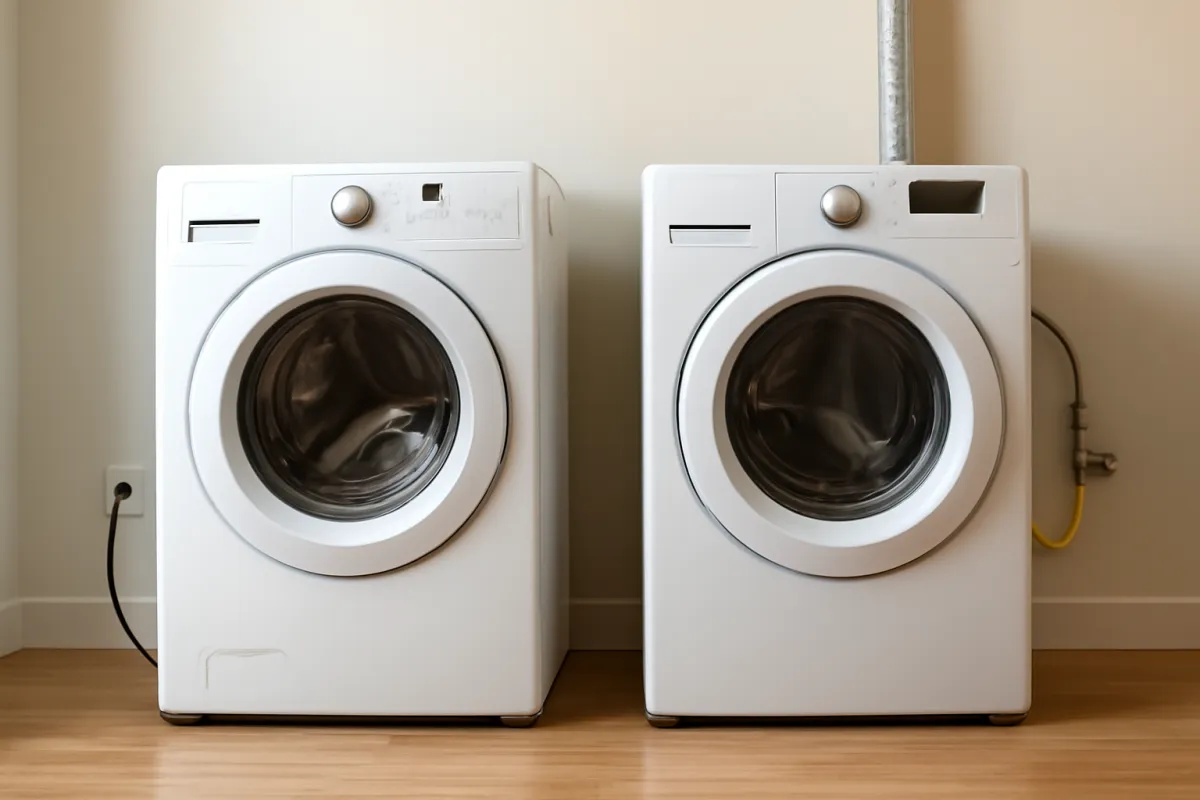
The catch is everything around the running cost. Gas dryers cost more to buy than comparable electric models, they need a gas line at the laundry location, they must be vented properly, and they often need professional installation for the gas connection. So the question is whether the lower cost per load repays that upfront gap. At a saving of roughly $0.26 a load, a household doing five loads a week saves on the order of $65 a year, so a few hundred dollars of extra purchase and installation cost can take several years to earn back. The gas advantage is real but modest, and it depends heavily on your local gas and electricity prices, which is exactly why the fuel comparison deserves its own numbers rather than a rule of thumb.
Electric vs gas vs heat-pump running cost
Set the three main dryer types side by side on running cost per load and the ordering is clear: a standard vented electric dryer is the most expensive to run, a gas dryer is cheaper, and a heat-pump dryer is cheapest of all. The chart below shows their illustrative cost per load, with each segment drawn in proportion to its cost, so the widths themselves are the comparison.
Running cost per load: electric vs gas vs heat-pump
Illustrative cost per load for the same full load, drawn in proportion so the widths compare directly. Segments sum to 100 percent of the three costs combined.
The electric segment is almost as wide as gas and heat-pump combined, because a standard electric dryer costs roughly double either one to run per load.
The point of the split is that the standard electric dryer’s slice is nearly as long as the other two together, which is the whole story in one picture: it costs about double per load. Gas and heat-pump land close to each other on running cost but get there differently, gas by using a cheaper fuel and the heat pump by using far less electricity. What the chart cannot show is the upfront side. The cheapest to run, the heat-pump dryer, is the most expensive to buy, and the standard electric dryer, the most expensive to run, is the cheapest to buy. That tension between purchase price and running cost is the real decision, and it is the same total-cost thinking we bring to every piece of gear we test.
What a heat pump dryer costs to run
A heat-pump dryer is the efficiency story worth understanding, because it changes the running cost more than any habit can. A standard vented dryer heats fresh air, passes it through the clothes, and blows the warm, moist air out a vent, throwing that heat away with every cycle. A heat-pump dryer instead runs the air through a closed loop: it cools the air to condense the moisture out, then reheats the same air and sends it back through the drum, recycling the heat rather than venting it. The result is that it uses only about half the electricity for the same load, near 1.5 kilowatt-hours instead of 3.
At a typical rate that puts a heat-pump dryer’s running cost around $0.24 a load, against roughly $0.48 for a conventional electric one. Over a year of five loads a week, that is a saving on the order of $60, and for a heavy-laundry household it is more. The honest caveats are real, though. Heat-pump dryers cost noticeably more to buy, they dry a load more slowly because they run at a gentler temperature, and they need their condensate emptied or plumbed to a drain. For a household that dries many loads a week and keeps the machine for years, the running-cost saving can repay the higher price. For light laundry use, the payback stretches out long enough that a plain electric dryer, run well, may be the more sensible total cost. Feed both the purchase prices and your real load count into the cost-per-use calculator before you decide.
What drives a dryer’s running cost
Beyond the fuel and the machine type, a handful of physical factors decide how much energy each load actually uses. Understanding them is what lets you trim the number without buying anything.
Wattage and the heating element. The element is where nearly all the energy goes. A higher-wattage element dries faster but pulls more power while it runs, so the two roughly cancel on energy used; what matters more is how long the element stays on to finish the load.
Load size and how full the drum is. A dryer heats and tumbles the whole drum whether it holds two towels or ten, so a full load spreads that fixed heating cost across more clothes and costs less per garment. Overfilling backfires, though: cram the drum and air cannot circulate, so the load takes much longer to dry and uses more energy overall.
How wet the clothes go in. The dryer’s job is to evaporate water, and evaporating water takes energy. Clothes that come out of the washer soaking take far longer to dry than clothes spun nearly dry, which is why the washer’s spin speed quietly sets part of the dryer’s bill.
The vent and airflow. A clogged lint filter or a blocked, kinked, or lint-choked vent hose strangles the airflow the dryer needs to carry moisture away. The machine responds by running longer to reach dryness, burning extra energy on every load, and a badly blocked vent is also a fire risk.
Each of these comes back to the same lever: the minutes the heater runs. Anything that shortens the cycle, a fuller but not overfull drum, drier clothes going in, and clear airflow, cuts the energy and the cost.
Whether the dryer really spikes your bill
It is a fair worry, because the dryer is one of the highest-wattage things you plug in. But wattage is only half the story; cost is wattage times time, and the dryer’s saving grace is that each load runs for well under an hour. That is why a typical five-loads-a-week household spends near $10 a month on drying at a typical rate, real money, but rarely the biggest line on the bill. Heating and cooling, which run for hours at a stretch, and an aging refrigerator, which runs every hour of every day, usually cost more over a month than the dryer does.
Where the dryer does start to show up is at the extremes: a large household running many loads a week, a habit of drying everything on the highest heat for the full timed cycle, or a high electricity rate. Stack those and the dryer can climb toward $25 or $30 a month, which is noticeable. If your bill has jumped and you suspect the dryer, the honest test is to count your loads and run them through the formula rather than blaming the machine. In most homes the dryer is a moderate, predictable cost, and the surest way to shrink its share of the bill is to move some loads off it entirely, which is the next section.
Air-drying to cut the cost
The one method that beats every efficient dryer is not drying with electricity at all. A clothesline outdoors or a folding rack indoors uses no energy, so every load you air-dry is a load that costs nothing to run. For a household doing five loads a week at a typical rate, shifting even two loads a week to a rack trims roughly $50 a year off the dryer’s cost, and shifting more trims proportionally more.
Air-drying is not a whole-year answer for everyone. It needs space and time, it works best with dry indoor air or good weather, and heavy items like towels and jeans can come out stiff without a short tumble to soften them. A common middle path is to air-dry the easy, fast-drying items, shirts, synthetics, and delicates that you would not want on high heat anyway, and reserve the dryer for towels, bedding, and anything you want soft. That split cuts the dryer’s load count, which is the very number that drives its monthly cost, without asking you to hang every sock. Think of air-drying as the free tier: use it where it is convenient, and let the dryer handle the rest.
Dryer-efficiency tips that actually move the number
If you are going to use the dryer, a few habits genuinely cut the energy each load uses, and they all work by shortening the minutes the heater runs. Here are the levers that move the number, in rough order of impact.
- Clean the lint filter before every load. A filter caked with lint chokes airflow, so the dryer runs longer to finish. Clearing it is the single easiest saving, and it is a fire-safety step too.
- Dry full loads, not many small ones. The machine heats the whole drum regardless, so a full load spreads that cost across more clothes. Just avoid overfilling, which blocks airflow and backfires.
- Spin clothes faster in the washer first. A higher washer spin speed wrings out more water, so the clothes enter the dryer less wet and finish sooner. The dryer only has to evaporate what the washer left behind.
- Use the moisture sensor, not a fixed timer. An auto cycle that senses dryness stops when the clothes are dry instead of baking them for a preset time, which avoids paying for minutes you do not need.
- Add dryer balls. Wool or rubber dryer balls tumble between the clothes, separating them so warm air moves through the load faster and cuts drying time.
- Keep the vent clear. A blocked or kinked vent hose traps moisture and forces longer cycles. Clear the hose and the exterior vent flap periodically for faster, safer drying.
None of these asks you to buy a new machine. The savings live in how you run the dryer you already own, which is usually where the easiest money is.

How a dryer compares to other big appliances
To size up where the dryer sits, it helps to put it next to the other heavy hitters we have priced. A dryer’s cost is bursty: a large draw for a short time, a few times a week, landing near $125 a year for a typical household. That is more than many people expect but less than the appliances that run for hours or run constantly.
An air conditioner, for instance, can run for many hours across a hot day, and over a summer its total often dwarfs a single month of drying, as we work out in our air conditioner running-cost breakdown. A refrigerator costs less per hour than a dryer but never switches off, running every hour of every day all year, which is why its steady drip can add up to a comparable or larger annual figure, detailed in our refrigerator running-cost breakdown. A space heater sits closest to the dryer in character, a large resistance load you run for a stretch, and our space heater breakdown shows how quickly its hours add up over a winter.
The lesson across all four is the same: instantaneous wattage tells you almost nothing about the bill on its own. What matters is wattage times hours. The dryer is a big load run briefly, the fridge a small load run forever, and the seasonal appliances something in between. Judge each on its own total, not its nameplate, and the dryer usually turns out to be a moderate, controllable cost.
The annual cost of running a dryer
The yearly figure is the one that actually matters, because a year is what you pay, not a single load. Take the cost per load, multiply by loads per week, and multiply by 52. For the standard electric dryer at 3 kilowatt-hours per load and a typical $0.16 rate, five loads a week works out to about $125 a year, illustratively.
Slide the inputs and the annual figure moves in step. A light household doing two loads a week pays closer to $50 a year; a busy one doing ten pays nearer $250. Change the rate and the whole column shifts: the same five-loads-a-week household pays about $78 a year on a cheap $0.10 rate and about $250 on an expensive $0.32 rate. Switch the machine and it shifts again: a gas dryer might bring that typical $125 down toward $65, and a heat-pump dryer toward $62 on electricity, though both carry higher purchase costs to weigh against the saving.
The annual view is also where efficiency habits show their worth. Shaving even 20 percent off drying time by keeping the filter and vent clear, spinning clothes drier, and running full loads turns that $125 into roughly $100 without air-drying a single load. Do the arithmetic on your own numbers rather than a national average, because your rate, your load count, and your machine each move the yearly total more than any generic figure can. Our cost-per-use calculator returns your annual cost the moment you enter them.
A worked example: one household, five loads a week
Put it all together on a single realistic case. You have a standard electric dryer, you run five loads a week, and you want the per-load, monthly, and yearly cost at three different rates.
The per-load figure. A standard dryer uses about 3 kilowatt-hours per load. At a typical $0.16 rate that is 3 times 0.16, about $0.48 a load, illustratively. On a cheap $0.10 rate it falls to about $0.30; on an expensive $0.32 rate it climbs to about $0.96.
The monthly figure. Five loads a week is about 22 loads a month, or 66 kilowatt-hours. At $0.16 that is roughly $10 a month. On the cheap rate it is nearer $6.50; on the expensive rate closer to $21.
The yearly figure. Five loads a week is 260 loads a year, about 780 kilowatt-hours. At the typical rate that is near $125 a year, with the cheap and expensive rates bracketing it from about $78 to $250. Those are the numbers that matter, because a year is what you actually pay.
Now weigh the alternatives. If this household air-dried two of its five weekly loads, it would cut the yearly cost by roughly 40 percent, toward $75. If it replaced the standard dryer with a heat-pump model, the running cost would fall toward $62 a year, though the higher purchase price would take several years of this load count to repay. The dryer did not decide which path pays; the household’s habits and machine did. Swap your own wattage, minutes, loads, and rate into the cost-per-use calculator to see your version of this example.
A running-cost checklist before you dry
Before you judge what your dryer costs, or decide whether a different machine is worth it, run through these checks. Clear them and the dryer will cost roughly what you expect, and no more.
- Know your rate. Pull it off your bill in cents per kilowatt-hour. Without it, no cost claim means anything.
- Count your real loads. Weekly loads times 52 is the multiplier behind the whole yearly figure. Guessing low is why the bill surprises people.
- Weigh fuel against upfront cost. A gas dryer usually runs cheaper per load but costs more to buy and install. Do the payback math on your own load count, not a rule of thumb.
- Consider a heat pump if you dry a lot. It roughly halves the running cost but costs more upfront and dries slower. The saving repays fastest for heavy-laundry households.
- Clean the filter and vent. Clear airflow is the free, repeatable saving on every load, and a safety step besides.
- Air-dry where it is convenient. Every load on a rack is a load that costs nothing. It is the surest way to shrink the dryer’s yearly share.
Clear those six and you are running the dryer on numbers rather than on the reassuringly small cost of a single load, which is the entire point of a breakdown.
The bottom line
The cost of running a dryer is never a mystery, because the formula is fixed: wattage in kilowatts, times the fraction of an hour per load, times your electricity rate. For the standard electric dryer that is about 3 kilowatt-hours per load, roughly $0.48 at a typical rate, near $10 a month at five loads a week, and about $125 a year, with your own rate swinging the per-load figure anywhere from about $0.30 to $0.96. A gas dryer usually runs cheaper per load, often near $0.22, and a heat-pump dryer cheaper still at around $0.24, but both cost more to buy, so the running-cost saving has to repay the higher price over years of use. What you actually pay for is the minutes the heater runs, so full loads, a clean lint filter, a fast washer spin, the moisture sensor, and air-drying where it is easy all trim the total more reliably than the machine on the box ever will. Count your loads, check your rate, and price the dryer by the year rather than the load, and it becomes what it should be: a moderate, predictable cost you chose on purpose.
A note on scope: this breakdown exists to hand you the running-cost arithmetic for a clothes dryer, not to push you toward any particular machine or fuel. Every wattage, rate, and dollar figure above is an illustrative planning number, built from typical ranges rather than measured on one model, and your real electricity rate, gas price, load count, and habits will move the result enough to matter. Nothing here is professional electrical, gas, or appliance-installation advice. A dryer is a high-wattage appliance with a real fire risk from lint and blocked vents, and a gas dryer adds a fuel connection that must be fitted correctly, so follow the maker’s instructions, keep the filter and vent clear, and bring in a qualified electrician or gas fitter for any installation or wiring question before you rely on the numbers in this article.
Frequently asked questions
How much does it cost to run a dryer per load?
A standard electric dryer uses about 3 kilowatt-hours to dry one full load, so at a typical rate near $0.16 per kilowatt-hour it costs roughly $0.48 a load, illustratively. On a cheaper $0.10 rate that falls to about $0.30, and on an expensive $0.32 rate it climbs to about $0.96. A gas dryer usually costs less per load, often near $0.22, because gas is a cheaper source of heat than electricity. These are typical figures for a full load on a heated cycle; a small load or a lower heat setting costs less.
How much electricity does a dryer use?
A standard vented electric dryer draws roughly 3,000 watts while its heating element is on, though the nameplate peak can read higher. Across a full cycle of about 45 to 60 minutes, with the element cycling, a typical load uses somewhere near 3 kilowatt-hours. A heat-pump dryer uses far less, often around half that, because it recycles warm air instead of heating fresh air and venting it out. The exact figure depends on the load size, how wet the clothes go in, and the heat setting you choose.
How much does a dryer cost to run per month?
At five loads a week on a standard electric dryer, roughly 22 loads a month, the running cost lands near $10 at a typical $0.16 rate, illustratively. Do ten loads a week and it is closer to $21 a month; do just two and it is nearer $4. Your electricity rate moves the total as much as your laundry habits do: the same five-loads-a-week household pays about $6 a month on a cheap rate and closer to $20 on an expensive one. Count your real loads and check your rate rather than guessing.
Are gas dryers cheaper to run than electric?
Usually yes, on running cost per load. A gas dryer burns natural gas to make heat, and gas is typically a cheaper source of heat per unit than electricity, so a gas dryer often costs around $0.22 a load against roughly $0.48 for an electric one at a typical rate, illustratively. The catch is upfront cost: gas dryers cost more to buy, need a gas line and proper venting, and may need professional installation. Whether the lower running cost repays that gap depends on how many loads you dry and your local gas and electricity prices.
How much does a heat pump dryer cost to run?
A heat-pump dryer is the cheapest electric option to run because it moves and recycles heat rather than generating it fresh and venting it away, typically using around half the electricity of a standard vented dryer. That puts its running cost near $0.24 a load at a typical rate, against roughly $0.48 for a conventional electric dryer, illustratively. Over a year of five loads a week, that difference is on the order of $60. Heat-pump dryers cost more to buy and dry a load more slowly, so the running-cost saving takes several years of regular use to repay the higher purchase price.
Does running the dryer raise my electric bill a lot?
A dryer is one of the larger loads in a home, but because each load runs for under an hour rather than all day, its monthly cost is usually modest: near $10 a month for a typical five-loads-a-week household at a typical rate, illustratively. That is real but rarely the biggest line on the bill; heating, cooling, and an old refrigerator often cost more. The dryer becomes noticeable when you run many loads a week, dry on the highest heat, or pay a high electricity rate. Air-drying some loads is the surest way to shrink its share.
What is the cheapest way to run a dryer?
Run full loads rather than several small ones, since the machine heats the same drum either way, and clean the lint filter before every load so air moves freely and the cycle finishes sooner. Use the moisture-sensor auto setting instead of a fixed timer so the dryer stops when the clothes are dry rather than baking them longer. Spin clothes on a high spin speed in the washer first so they enter the dryer less wet, and add wool or rubber dryer balls to separate items and cut drying time. Each trims the minutes the heater runs, which is the only thing you are paying for.
How do I calculate my own dryer running cost?
Take the dryer's wattage, divide by 1,000 to get kilowatts, multiply by the fraction of an hour each load runs, then multiply by your electricity rate in dollars per kilowatt-hour. For a 3,000-watt dryer running 60 minutes at $0.16, that is 3 times 1 times 0.16, about $0.48 a load. Multiply by your loads per week and by 52 for the yearly figure. Our companion calculator does the arithmetic for you: enter your dryer wattage, minutes per load, loads per week, and your rate, and it returns the cost per load, per month, and per year.