What's on this page
- How much does it cost to run a space heater? The short answer
- The running-cost formula: watts, hours, and your rate
- The standard 1500-watt space heater math
- Your electricity rate is the biggest variable
- Monthly cost of a 1500-watt heater by rate
- Running cost by heater type
- The 100 percent efficient truth
- Space heater vs heat pump vs gas heat
- When a space heater actually saves money: zone heating
- One room vs the whole house: the zone math
- Hours of use: the assumption that moves everything
- Always-on vs thermostatic vs eco mode
- Safety and the 15-amp circuit ceiling
- Comparing a heat-pump space heater
- Sizing a heater to your room
- Ways to cut your running cost
- A worked example: one 1500-watt heater, 8 hours a day
- How to shop: a running-cost checklist
- Running cost across a whole winter: three household patterns
- The bottom line
Short answer: A standard 1,500-watt space heater costs roughly $0.24 an hour at a typical electricity rate, near $1.92 a day at eight hours, and about $58 for a month, illustratively. The formula is watts divided by 1,000, times hours, times your rate per kilowatt-hour. Your rate is the biggest variable, spanning about $36 to $115 a month across common rates, and every electric heater at equal wattage costs the same to run.
A space heater is one of the most honest appliances in the house: whatever it costs to buy, its real price is the electricity it eats while it runs, and that number is knowable to the penny before you ever plug it in. The trouble is that people size up the purchase price, a tidy figure in the low tens of dollars, and never do the sum that actually matters, which is what it costs to keep warm through a winter. That sum can dwarf the sticker.
This breakdown does the arithmetic. It gives you the one formula that turns any heater’s wattage into dollars, works the standard 1,500-watt case per hour, per day, and per month, then shows how much your own electricity rate swings the result. It also settles the argument people have about heater types, walks through the one situation where a space heater genuinely saves money, and flags the circuit-safety limit that lives quietly behind that 1,500-watt number. You can feed your own heater and rate into our cost-per-use calculator as you read and watch every figure move.
Key takeaways
- The whole formula is watts divided by 1,000, times hours, times your rate in dollars per kilowatt-hour. Everything else is detail.
- A standard 1,500-watt heater costs roughly $0.24 an hour at a typical rate, near $1.92 a day at eight hours, and about $58 for a month.
- Your electricity rate is the single biggest variable. The same heater and schedule ranges from about $36 to $115 a month across common rates.
- Every electric heater is essentially 100 percent efficient, so at equal wattage they cost the same to run. Type changes comfort and cycling, not the per-hour rate.
- A space heater saves money only when it heats the one room you use while you turn the whole-home heat down. That is zone heating, and it is the case that pays.
How much does it cost to run a space heater? The short answer
A space heater costs its wattage in kilowatts, times the hours you run it, times your electricity rate. For the standard 1,500-watt unit that most people own, that works out to roughly a quarter an hour at a typical electricity rate, somewhere around $1.92 a day if you run it eight hours, and near $58 across a full month at that pace. Those are illustrative figures, and your own rate can push them meaningfully up or down, but the shape is right: cents per hour, a couple of dollars a day, tens of dollars a month.
The reason the number feels surprising is that a space heater is a big electrical load hiding in a small box. At 1,500 watts it draws as much power as ten 150-watt lamps burning at once. Nothing about the plastic housing signals that, which is why the running cost catches people off guard when the bill arrives. The rest of this article turns that short answer into a method you can apply to any heater, at any rate, for any schedule, and shows you the one strategy that makes the whole thing pay.
The running-cost formula: watts, hours, and your rate
Here is the entire calculation, and it is the same one we use for any appliance in our dehumidifier running-cost breakdown: take the wattage printed on the heater, divide by 1,000 to convert watts into kilowatts, multiply by the number of hours you run it, then multiply by your electricity rate expressed in dollars per kilowatt-hour. The result is the cost in dollars.
Written out: kilowatts times hours times rate equals cost. A 1,500-watt heater is 1.5 kilowatts. Run it for one hour and it consumes 1.5 kilowatt-hours. If your rate is $0.16 per kilowatt-hour, that hour costs 1.5 times 0.16, or about $0.24. Extend the hours and the cost scales in a straight line: two hours is twice as much, a full day of ten hours is ten times the hourly figure. There is no hidden efficiency term, no fudge factor, because an electric heater turns essentially all the power it draws into heat.
That linearity is what makes the formula so useful. Once you have the hourly cost, every longer period is just multiplication. Nail down three numbers, the wattage, the hours, and the rate, and you can price a heater for an evening, a month, or a whole heating season without any further thought. Our cost-per-use calculator holds all three and does the arithmetic live.
The standard 1500-watt space heater math
Most portable heaters top out at 1,500 watts, because that is about the most a standard household outlet can safely deliver, so the 1,500-watt case is the one worth memorizing. At 1.5 kilowatts and a typical rate of $0.16 per kilowatt-hour, here is how the cost stacks up as the hours grow, all illustrative.
| Time on (at full power) | Energy used | Illustrative cost |
|---|---|---|
| 1 hour | 1.5 kWh | $0.24 |
| 8 hours | 12 kWh | $1.92 |
| 24 hours | 36 kWh | $5.76 |
| 30 days at 8 hrs/day | 360 kWh | $58 |
| 30 days at 24 hrs/day | 1,080 kWh | $173 |
The hourly figure looks trivial, a quarter, pocket change. That is the trap. Stretch it across a realistic winter schedule, eight hours an evening every day for a month, and you are near $58; leave the heater running around the clock in a cold room and you cross $170 for a single month. The heater did nothing different. Only the hours changed, and hours are the multiplier that turns a small number into a real line on the bill.
Smaller heaters scale down proportionally. A 750-watt unit is half the wattage, so half the cost at the same hours and rate. A tiny 400-watt personal heater under a desk is cheaper still, which is exactly why a small heater aimed at one person can be the frugal choice while a 1,500-watt unit trying to warm a room is not.
Your electricity rate is the biggest variable
Wattage is fixed by the heater and hours are set by you, but the electricity rate is the wild card, and it swings the answer more than anything else. Residential rates vary widely by region and by season, and the same 1,500-watt heater on the same schedule can cost dramatically different amounts depending on where the meter sits.
Find your rate on your electricity bill, where it is usually printed as cents per kilowatt-hour. Then hold the heater at 1,500 watts and eight hours a day for a 30-day month, 360 kilowatt-hours, and watch how the monthly cost tracks the rate:
- At 10 cents per kilowatt-hour: about $36 a month
- At 16 cents per kilowatt-hour: about $58 a month
- At 24 cents per kilowatt-hour: about $86 a month
- At 32 cents per kilowatt-hour: about $115 a month
That is a better than threefold spread from the same appliance, driven entirely by the rate. It is why a blanket claim that space heaters are cheap or expensive is meaningless without a rate attached. Before you judge whether a heater fits your budget, look up your own number and run it. Our cost-per-use calculator takes your exact rate in cents and returns your monthly figure directly.
Monthly cost of a 1500-watt heater by rate
The chart below makes the rate’s leverage visual. It holds the heater at 1,500 watts and eight hours a day for a 30-day month, 360 kilowatt-hours, and varies only the electricity rate. The bars are drawn in proportion to the monthly dollar figure, so the length is the cost.
Monthly cost of a 1,500-watt heater by electricity rate
Same heater, same eight hours a day for 30 days. Only the rate changes. Illustrative figures.
The heater never changes. The bill more than triples across common rates, which is why your own rate is the first number to look up.
Notice that the bars scale exactly with the rate, because energy used is fixed and cost is just energy times price. Double the rate, double the bill. That clean proportionality is the whole reason the formula is worth trusting: there is nothing nonlinear hiding in an electric heater. Whatever your rate, find your bar, and if it sits toward the right, the strategies later in this report matter that much more.
Running cost by heater type
Walk the heater aisle and you will see fan-forced, ceramic, oil-filled radiators, and infrared models, each marketed as if it heats differently for less money. On running cost, the honest answer is blunt: at the same wattage they all cost the same per hour, because every one is an electric resistance heater converting electricity to heat at essentially 100 percent. A 1,500-watt oil-filled radiator and a 1,500-watt ceramic tower both draw 1,500 watts and both cost about $0.24 an hour at a typical rate. The type does not change the meter.
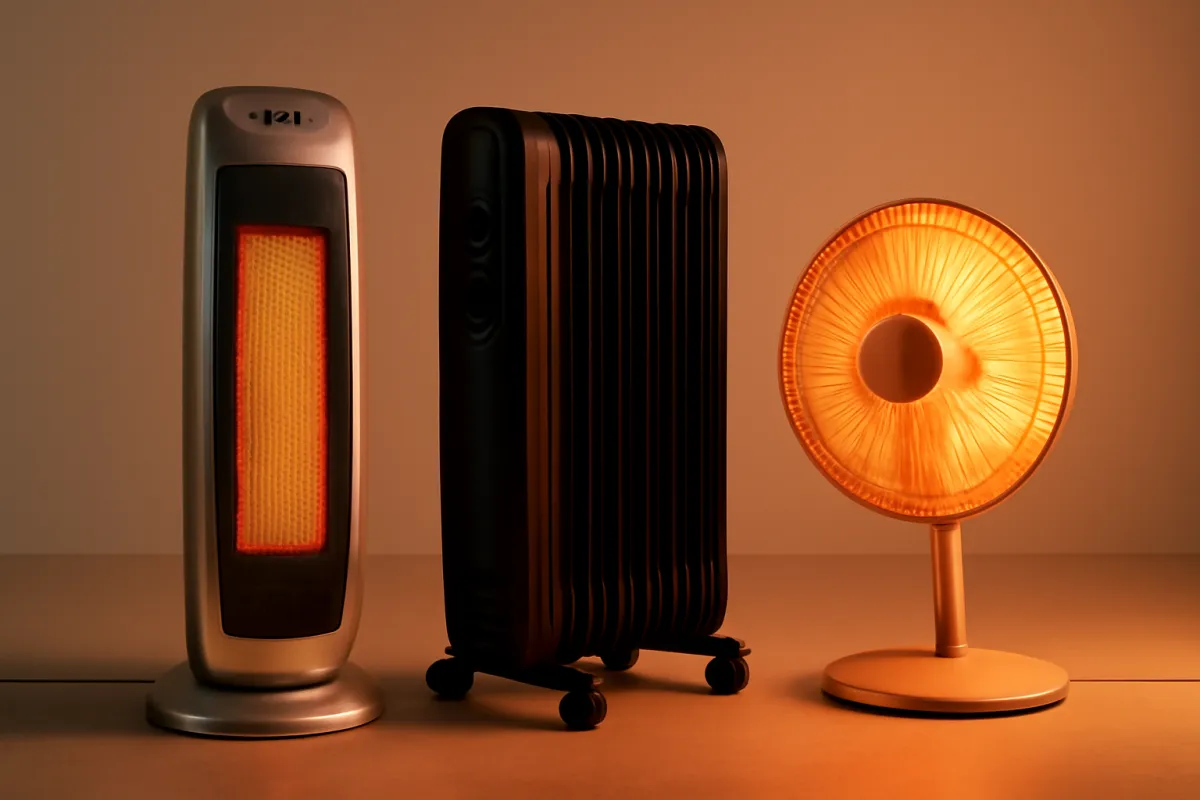
What the type does change is comfort and cycling, and cycling is where any real savings hide. Fan-forced and ceramic heaters push warm air fast, so a room feels warm quickly, but the heat fades quickly once they cut off. Oil-filled radiators heat a column of oil that stays warm and keeps radiating after the element cycles off, so they hold a room steadily and can spend fewer minutes at full draw. Infrared heaters warm objects and people directly rather than the air, so you can feel comfortable at a lower thermostat setting, which trims hours. None of that is efficiency in the physics sense; it is a difference in how long each type sits at full power to keep you comfortable, and that runtime is the only lever on cost.
The 100 percent efficient truth
Here is the fact that reframes the whole subject: an electric space heater is about 100 percent efficient. Nearly every watt it pulls from the wall becomes heat in your room, with negligible loss. That sounds like great news, and in a narrow sense it is, since you waste almost nothing. It is also why people wrongly assume a space heater must be a cheap way to heat.
The catch is that 100 percent efficient does not mean cheap. Efficiency measures how much of the electricity becomes heat, not how much that heat costs. Electricity is an expensive way to buy raw energy compared with natural gas, and a heat pump can deliver more than one unit of heat per unit of electricity by moving warmth rather than generating it. So a space heater is maximally efficient at converting a relatively expensive energy source. That is the paradox: the appliance wastes nothing and still costs plenty, because the input is dear. Understanding this is what stops you from expecting a space heater to be a bargain and starts you using it where it actually is one.
Space heater vs heat pump vs gas heat
Set the three main ways to heat side by side and the space heater’s place becomes clear. A gas furnace burns natural gas, which usually costs less per unit of heat than electricity, so heating a whole home with gas is typically cheaper than doing it with electric resistance. A heat pump runs on electricity but moves heat instead of making it, delivering roughly two to four units of warmth per unit of electricity, so it heats a whole home for a fraction of what resistance heat would cost. An electric space heater makes one unit of heat per unit of electricity, full stop.
That ordering, gas and heat pumps cheap for whole-home warmth, resistance heat expensive for it, is why nobody should try to heat an entire house with space heaters if central heat is available. But the comparison flips the moment you stop heating the whole house. A heat pump or furnace warms every room whether you are in it or not. A space heater warms exactly one. When you only need one room warm, paying the space heater’s higher per-unit rate on a tiny volume can beat paying the central system’s lower rate on the whole house. That pivot is the next section.
When a space heater actually saves money: zone heating
The one situation where a space heater is the frugal choice is zone heating: you turn the whole-home thermostat down several degrees, let the unused rooms go cool, and run a space heater in the single room you actually occupy. Instead of paying to keep an entire house at a comfortable temperature, you pay to keep one room warm and let the rest coast.

The math works because you shrink the volume you are heating. Warming a 150-square-foot office for the eight hours you sit in it costs a few dollars. Warming a whole 2,000-square-foot house those same hours, so that empty bedrooms and hallways stay toasty, costs far more. Turn the central heat down from 70 to 62 and cover the difference in your one room with a space heater, and the savings on the central system usually outrun the space heater’s running cost. The strategy fails the instant you use it wrong: run the space heater in one room while the central heat still holds the whole house warm and you have simply added a cost. Zone heating only saves money when you turn the big system down to bank the difference.
One room vs the whole house: the zone math
The chart below shows where a winter month’s heating dollars go under a zone-heating strategy, expressed as illustrative shares of what heating the whole home warmly would have cost. Turn the central thermostat down, cover your occupied room with a space heater, and the total splits three ways.
A winter month's heating: space heater vs whole-home
Illustrative split of what heating the whole home warmly would have cost, once you zone-heat instead. Shares sum to 100.
The space heater adds a cost, but the deeper cut to central heat more than covers it, leaving a net saving. Reverse it, keep the house warm and add the heater, and the saving disappears.
The point of the split is that the space heater’s slice is real spending, not free warmth. It only pays because the reduction in central heating is larger. If you had left the furnace or heat pump holding the whole house at full temperature, that middle slice would be much bigger and there would be no saved slice at all. The saving is the gap between heating everything and heating only what you use, and the space heater is the tool that lets you close the house down to one room without freezing.
Hours of use: the assumption that moves everything
Every cost figure in this report rests on an hours assumption, and hours are the input people fudge most. It is tempting to picture the heater running only while you feel cold, but in practice a heater left on runs far longer than you would guess, holding a room against a cold house all evening. The difference between four hours and twelve is a threefold difference in cost, from the same heater at the same rate.
Be honest about the count. If the heater comes on at dinner and runs until bed, that is easily six to eight hours. If it holds a home office all working day, that is eight or nine. If you leave it on overnight, you have quietly signed up for the 24-hour column, where a 1,500-watt unit at a typical rate runs close to $6 a day. The single most effective thing most people can do to cut running cost is not buy a different heater but run the one they have for fewer hours: on when the room is occupied, off when it is not. Our cost-per-use calculator lets you test realistic hours against padded ones and see the gap in dollars.
Always-on vs thermostatic vs eco mode
How the heater decides when to draw power matters as much as how long you leave it switched on. Three modes cover most units, and they cost very differently.
Always-on, or a simple high-low switch with no thermostat, means the element draws full wattage the entire time the heater is on, regardless of how warm the room gets. This is the most expensive way to run, because it never cycles off. A 1,500-watt heater on always-on for eight hours uses the full 12 kilowatt-hours no matter what.
Thermostatic control lets you set a target temperature, and the heater cycles the element off once the room reaches it, back on when it drifts down. Because running cost tracks the hours spent actually drawing power, a thermostat that cycles the heater off half the time roughly halves the cost of holding a room. This is the single most valuable feature on a space heater and the one worth paying for.
Eco mode, or an economy setting, usually caps the heater at a lower wattage or cycles more aggressively around the setpoint, trading a little peak output for fewer full-power minutes. It is not a different physics; it is the same 100 percent conversion spending less time at full draw. On a heater that supports it, eco mode plus an honest thermostat setting is how you keep the monthly figure toward the low end.
Safety and the 15-amp circuit ceiling
The 1,500-watt limit on most heaters is not arbitrary; it is set by the circuit. On a standard 120-volt outlet, a 1,500-watt heater draws about 12.5 amps, because amps equal watts divided by volts. A typical household circuit is rated for 15 amps, so a single 1,500-watt heater already uses most of that circuit’s capacity, leaving little headroom for anything else on the same wires.
That thin margin is why space heater safety guidance is so specific. Plug the heater straight into a wall outlet, never into a power strip or a thin extension cord, both of which can overheat carrying 12.5 amps continuously. Avoid running other significant loads, a second heater, a microwave, a hair dryer, on the same circuit, because the combined draw can trip the breaker or, worse, overheat wiring behind the wall. The amperage math is a hard safety limit rather than a guideline: if your heater plus whatever else is on that circuit approaches 15 amps, something has to give. When in doubt about what shares a circuit, or whether an older circuit can handle a heater at all, ask a qualified electrician rather than guessing.
Comparing a heat-pump space heater
A newer category worth knowing about is the portable heat-pump heater, which uses the same heat-moving trick as a whole-home heat pump in a plug-in form. Instead of converting electricity straight to heat at 100 percent, it moves ambient heat and can deliver more warmth per unit of electricity, so in principle it heats a space for less than a resistance heater of the same size.
The honest caveats are real. Portable heat-pump units cost far more to buy than a $30 resistance heater, they are bulkier, and their efficiency advantage shrinks in very cold conditions, which is exactly when you want heat most. For a small, mild space run many hours a day, the lower running cost can repay the higher purchase price over a few seasons. For occasional use, or in a hard winter climate, a plain resistance heater run wisely on a thermostat often makes more sense once you account for the upfront gap. As with any gear we test, the decision is the total cost over how you will actually use it, not the sticker or the spec sheet alone. Feed both the purchase prices and your realistic hours into the cost-per-use calculator before you decide.
Sizing a heater to your room
A rough rule for electric heating is about 10 watts per square foot of room, for a space with average insulation and normal ceilings. A 150-square-foot bedroom points to around 1,500 watts, which is why the standard unit suits a single room. A small 100-square-foot office needs closer to 1,000 watts, and a tiny nook or a spot at a desk can be served by a 400 to 750-watt personal heater.
Sizing matters for cost because an undersized heater in a large or drafty room runs constantly at full power and never quite catches up, which is the same expensive failure mode we describe for an undersized dehumidifier in our dehumidifier breakdown. It draws full watts for hours and still leaves you cold. A heater matched to the room reaches a comfortable temperature and then, if it has a thermostat, cycles off to hold it, spending fewer hours at full draw. Bigger is not automatically better either: a 1,500-watt unit in a tiny space just reaches temperature and cycles, so you gain nothing over a smaller heater except a larger appliance. Match the wattage to the square footage, then let a thermostat do the rest.
Ways to cut your running cost
Because cost is watts times hours times rate, every saving comes from lowering one of those three. Here are the levers that actually move the number, in rough order of impact.
- Run it fewer hours. On when you occupy the room, off when you leave. This is the biggest lever, and it costs nothing to pull.
- Use the thermostat, not always-on. Let the heater cycle off once the room is warm instead of drawing full power the whole time. A cycling heater can cost half of one pinned on high.
- Zone heat, and turn the central system down. The space heater only saves money if you bank the difference by lowering the whole-home thermostat. Warm one room, cool the rest.
- Size the heater to the room, and use a smaller one when you can. A 750-watt personal heater aimed at you costs half what a 1,500-watt unit costs, and for a desk or a single seat it is often enough.
- Close the room off. Shut the door and pull the curtains so the heater is warming a small sealed space, not leaking heat into a cold hallway, which cuts the hours it needs to run.
- Check your rate and your plan. If you are on a time-of-use rate, running the heater during off-peak hours can lower the rate term directly.
Notice that none of these is about buying a fancier heater. The savings live in how you run it, which is why the cheap resistance heater you already own is usually the right tool once you use it well.
A worked example: one 1500-watt heater, 8 hours a day
Put it all together on a single realistic case. You have one 1,500-watt heater, you run it eight hours a day to warm your home office and living room in the evenings, and you want the monthly and seasonal cost at three different rates.
The daily figure. 1,500 watts is 1.5 kilowatts. Eight hours gives 12 kilowatt-hours a day. At a typical $0.16 rate that is 12 times 0.16, about $1.92 a day, illustratively.
The monthly figure. Thirty days at 12 kilowatt-hours is 360 kilowatt-hours. At $0.16 that is roughly $58 a month. On a cheap $0.10 rate it falls to about $36; on an expensive $0.32 rate it climbs to about $115.
The seasonal figure. Run that same eight-hour schedule across a four-month heating season and the typical-rate total lands near $230, with the cheap and expensive rates bracketing it from about $144 to $461. Those are the numbers that matter, because a season is what you actually pay, not an hour.
Now weigh it against the alternative. If running that heater lets you turn the central thermostat down enough that the whole-home heating drops by more than the heater’s seasonal cost, you are ahead. If the central system stays where it was, the heater’s $230 is pure addition. The heater did not decide which; your strategy did. Swap your own wattage, hours, and rate into the cost-per-use calculator to see your version of this example.
How to shop: a running-cost checklist
Before you buy a space heater, or decide how to run the one you own, run it through these checks. Clear them and the heater will cost roughly what you expect, and no more.
- Know your rate. Pull it off your bill in cents per kilowatt-hour. Without it, no cost claim means anything.
- Insist on a thermostat. A heater that cycles off at a target temperature is the difference between full-power hours and managed ones. Skip always-on-only units.
- Match wattage to the room. Around 10 watts per square foot, and reach for a smaller personal heater when you only need to warm yourself, not the whole room.
- Plan the zone. Decide which room you will heat and commit to turning the central thermostat down. That is the move that turns the heater into a saving rather than an addition.
- Respect the circuit. A 1,500-watt heater is 12.5 amps on a 15-amp circuit. Wall outlet only, no power strips, nothing else heavy on the same wires.
- Do the seasonal math, not the hourly. A quarter an hour sounds like nothing. Multiply it out to a month and a season before you judge whether the heater fits your budget.
Clear those six and you are buying and running on numbers rather than on the reassuringly small price tag, which is the entire point of a breakdown.
Running cost across a whole winter: three household patterns
The seasonal figure is the one that actually hits your budget, so it helps to see how three realistic patterns diverge from the same 1,500-watt heater at a typical $0.16 rate. Pattern one, the evening zone-heater: four hours a night warming the room you occupy, then off. That is about $0.96 a day, near $29 a month, and across a four-month winter roughly $115, illustratively, the cheapest honest way to run the machine and the one that pairs with a turned-down thermostat.
Pattern two, the all-day home office: eight or nine hours holding one room through the working day. Call it $1.92 to $2.16 a day, close to $60 a month, and about $240 across the season. Still defensible if it lets you keep the rest of the house cool, but a real line on the bill that a thermostat and a closed door should be trimming wherever possible.
Pattern three, the overnight-and-all-day drift: a heater left running most of the day and night in a cold room, brushing the 24-hour column at nearly $6 a day. That is close to $170 a month and can pass $600 across a winter, which is the pattern that produces the shocking bill and the assumption that space heaters are ruinous. The heater is identical in all three; only the hours moved, which is the lesson this whole breakdown keeps returning to. Before you judge a heater’s cost, decide which of these three patterns is yours, and if it is the third, the zone-heating and thermostat sections are where the savings live. Our note on how to lower your electric bill covers the wider habits that compound with this one.
The bottom line
The cost of running a space heater is never a mystery, because the formula is fixed: wattage in kilowatts, times the hours you run it, times your electricity rate. For the standard 1,500-watt unit that is about a quarter an hour, near $1.92 a day at eight hours, and roughly $58 a month at a typical rate, with your own rate swinging the monthly figure anywhere from about $36 to $115. Every electric heater is essentially 100 percent efficient, so at equal wattage the type changes comfort and cycling but not the per-hour cost. That efficiency does not make electric heat cheap, because electricity itself is dear, which is why heating a whole home with space heaters loses to gas or a heat pump. The heater earns its place in exactly one job: warming the single room you occupy while you turn the whole-home thermostat down, banking the difference. Run it on a thermostat for the hours you are there, size it to the room, keep it on its own circuit, and price it by the season rather than the hour, and a space heater becomes what it should be, a small, honest appliance whose cost you chose on purpose.
A note on scope: this breakdown exists to hand you the running-cost arithmetic, not to steer you toward any particular heater. Every wattage, rate, and dollar amount above is an illustrative planning figure, built from typical ranges rather than measured on one model, and your real electricity rate, hours, and room will move the result enough to matter. Nothing here is professional electrical advice. A space heater is a large electrical load with real fire and circuit-overload risks, so follow the maker’s instructions, keep it clear of anything flammable, plug it straight into a wall outlet, and bring in a qualified electrician if you have any doubt about a circuit’s capacity or condition before you rely on the numbers in this article.
Frequently asked questions
How much does it cost to run a space heater per hour?
Take the heater's wattage, divide by 1,000 to get kilowatts, and multiply by your electricity rate. A standard 1,500-watt heater is 1.5 kilowatts, so at a typical rate near $0.16 per kilowatt-hour it costs about $0.24 an hour to run flat out. At a cheaper $0.10 rate that drops to roughly $0.15 an hour, and at an expensive $0.32 rate it climbs to about $0.48. These are illustrative figures for a heater running at full power the whole hour; a thermostat that cycles it off part of the time lowers the real number.
How much does it cost to run a 1500-watt space heater for a month?
Run a 1,500-watt heater eight hours a day for a 30-day month and it uses about 360 kilowatt-hours. At a typical $0.16 per kilowatt-hour that is roughly $58 for the month, illustratively. The same heater on a cheap $0.10 rate lands near $36, and on an expensive $0.32 rate closer to $115. Run it around the clock rather than eight hours and you roughly triple those numbers. Your own rate and hours move the total more than the heater's brand ever will.
Are electric space heaters expensive to run?
They can be, because heating with electricity is inherently power-hungry: a single 1,500-watt heater draws as much as ten bright lamps combined. Whether that is expensive depends on how you use it. Running one to heat a whole home for a season is usually costly, often more than central heat. Using one to warm the single room you occupy while you turn the whole-home thermostat down can cost less overall. The heater is not cheap or expensive on its own; the strategy around it decides.
Which type of space heater is cheapest to run?
At the same wattage, every electric resistance heater costs the same to run, because they all convert electricity to heat at essentially 100 percent. A 1,500-watt ceramic, fan-forced, oil-filled, or infrared heater all use 1,500 watts and cost the same per hour at full power. The differences are in comfort and how long each stays on: an oil-filled radiator holds heat and cycles off gently, while infrared warms objects and people directly so you may feel warm at a lower setting. The cheapest to run is the one whose thermostat lets it spend the fewest hours at full draw.
Is a space heater cheaper than central heating?
It depends entirely on how much of the house you are heating. Heating your whole home with electric space heaters is usually more expensive than a gas furnace or a heat pump, because electric resistance heat costs more per unit of warmth delivered. But heating one occupied room with a space heater while you turn the central thermostat down can be cheaper than keeping the entire house warm, which is the zone-heating case. Central heat wins for whole-home comfort; a space heater wins when you only need one room warm.
Can a space heater overload a circuit?
A 1,500-watt heater on a standard 120-volt outlet draws about 12.5 amps, which sits close to the 15-amp ceiling of a typical household circuit. That leaves little headroom, so running the heater on the same circuit as other significant loads, or through a thin extension cord or power strip, can trip a breaker or overheat the cord. The common guidance is to plug a space heater straight into a wall outlet on its own circuit, never a power strip. Treat the amperage math as a safety limit, not a suggestion, and consult an electrician if you are unsure about a circuit.
Does a space heater use a lot of electricity on eco mode?
Eco mode, or an economy setting, typically caps the heater at a lower wattage or lets its thermostat cycle the element off more aggressively once the room reaches temperature. Because running cost tracks the hours spent at full power, anything that trims those hours cuts the bill. A heater that holds a room at a set temperature by cycling can use noticeably less than the same heater pinned on maximum. Eco mode is not magic efficiency; it is the same 100 percent conversion, just spending fewer minutes drawing full watts.
How do I calculate my own space heater running cost?
Use the formula wattage divided by 1,000, times hours of use, times your electricity rate in dollars per kilowatt-hour. For a 1,500-watt heater run 8 hours at $0.16, that is 1.5 times 8 times 0.16, or about $1.92 a day. Find your exact rate on your electricity bill, usually printed as cents per kilowatt-hour, and count realistic hours rather than the maximum. Our companion calculator does the arithmetic for you: enter your heater's wattage, your hours, and your rate, and it returns the hourly, daily, monthly, and seasonal figures.