What's on this page
- Why is my heat pump not heating? What the system is actually doing
- Do these three things before you touch anything
- The safety part: what belongs to you and what does not
- The order to check things in, and why it saves money
- Check one: the thermostat mode, emergency heat, and the setpoint
- Check two: the breaker and the outdoor disconnect
- Check three: the air filter, restricting airflow across the indoor coil
- Check four: a blocked or iced outdoor unit
- Check five: a defrost cycle that will not end, or ice that never clears
- Check six: blocked or closed vents indoors
- The house is warm but the bill doubled: stuck backup heat
- It blows cold air on a heating call, not just lukewarm
- It runs constantly and never reaches the set temperature
- Short cycling: it starts, runs briefly, and stops again
- Ducted vs ductless: does this fault look different?
- Where the line is: what only a licensed technician should touch
- Where a heat pump heating fault usually starts
- What a struggling heat pump costs while you wait
- A worked example: one cold morning, five checks
- What to tell the technician when you call
- Repair or replace: how to think about the number
- Prevention: the habits that keep a heat pump heating
- The bottom line
Short answer: A heat pump that is not heating has usually stopped for one of a short list of reasons: the thermostat is in the wrong mode, a breaker has tripped, the outdoor unit is blocked or iced, or the backup resistance heat that should be filling the gap on a cold day is not engaging. Check the thermostat and the breaker first, since both cost nothing. Cool air for a few minutes during a defrost cycle is normal. A reversing valve or compressor fault is a licensed technician's job.
A heat pump that stops warming the house announces itself in a few different ways: air from the vents that feels cool rather than warm, a system that runs constantly without the house ever reaching setpoint, or an outdoor unit sitting under a crust of ice that was not there yesterday. All three read like the machine has failed outright. Most of the time it has not, because a heat pump is the one piece of home comfort equipment doing two jobs with the same hardware, and a fault that looks catastrophic in winter is often the same cheap, common cause that would have shown up as a cooling complaint in summer, approached from the other direction.
These notes work the fault from the cheapest and most likely cause to the most expensive and rarest, the same method used across every troubleshooting report on this site. Our air conditioner not cooling report covers the eight owner-level checks that apply to this same outdoor unit in cooling mode and is not repeated here in full, and our heat pump running-cost breakdown prices what the machine costs to operate once it is healthy again, including exactly what the backup strip heat you will read about below costs per hour.
Key takeaways
- Check the thermostat mode and the breaker first. Both cost nothing, and a mode left on cooling or emergency heat from a prior season is a more common cause than people expect.
- A few minutes of cool air during a defrost cycle is normal. Air that stays cool, or a system that never reaches setpoint, is the fault this report works through.
- An iced or debris-choked outdoor unit cannot collect heat from the outside air, which produces a system that runs constantly and still falls behind.
- Backup resistance heat exists to fill the gap on the coldest days. When it fails to engage, the compressor runs flat out alone and the house still falls behind, which looks identical to total failure.
- The reversing valve, the compressor, and anything inside the sealed refrigerant circuit are a licensed technician's work, not because the parts are exotic but because the circuit is sealed and the compartment carries line voltage.
Why is my heat pump not heating? What the system is actually doing
A heat pump does not make heat the way a furnace does. It runs a compressor that moves refrigerant through a loop, collects warmth from the outside air even on a cold day, and releases that warmth indoors. A reversing valve lets the same hardware run the loop backward in summer, dumping heat outside instead, which is why the identical box on your property handles both seasons.
That shared hardware is the reason a heating-season fault and a cooling-season fault often trace back to the same handful of components: a dirty filter, a choked outdoor unit, a tripped breaker, a misread thermostat. What changes between the two seasons is the two failure modes that only show up on the heating side, because they only exist on the heating side: a defrost cycle that runs to clear ice off the outdoor coil, and a backup resistance heat system that exists specifically to help the compressor on the coldest days. Those two are where this report spends most of its attention, after working through the checks shared with the cooling side.
Do these three things before you touch anything
Three actions come before any diagnosis, and doing them in order saves time and rules out the two most common causes immediately.
Read the thermostat, not your assumption of it. Confirm the system mode is actually set to HEAT and not to COOL, OFF, FAN ONLY, or an emergency heat setting left over from a prior fault or a prior winter. A thermostat sitting two degrees below the room temperature will never call for heat and will look exactly like a dead system doing it.
Check the breaker panel and the outdoor disconnect. A heat pump draws power at both the indoor air handler and the outdoor unit, on separate circuits on most installations, and either one tripping can produce a system that seems to do nothing, or that runs the indoor fan with no actual heat behind it.
Look at the outdoor unit before anything else. A unit buried in leaves, packed with snow, or coated in a thick, uneven layer of ice is very often the entire story, and it costs nothing to clear.
The safety part: what belongs to you and what does not
This is the section to read even if you skip everything else, because it draws the line between a free fix and a call you should make instead of a repair you should attempt.
Anything sealed, and anything at line voltage, is not yours. That means the refrigerant of any kind, the compressor, the run and start capacitors, the contactor, the reversing valve, and any repair that opens the refrigerant circuit or the electrical compartment of the outdoor unit. Capacitors specifically store energy and can hold a dangerous charge after power is switched off, which is the hazard people most often underestimate. Refrigerant handling is regulated, certified work in most places.
Power off at the disconnect and the breaker before touching anything physical outdoors. The outdoor unit has its own disconnect switch, usually a small box mounted on the wall beside it, and switching it off along with the indoor breaker is the difference between clearing debris safely and reaching into a live compartment.
Your work stops at the filter, the vents, the outdoor debris, and the thermostat. Everything past those four is a technician’s diagnosis, covered in full later in this report.
The order to check things in, and why it saves money
The causes of a heating failure run from free to expensive in roughly the same order every time, and working the list in that order means you never pay for a diagnostic visit to be told the filter was clogged.
The order these notes use is: the thermostat mode, the breaker, the air filter, the outdoor unit for blockage or ice, a defrost cycle that will not end, blocked indoor vents, stuck backup heat, and only after all of that the sealed-system faults, the reversing valve, the compressor, and the capacitor, where the job moves from an owner check to a service call.
Check one: the thermostat mode, emergency heat, and the setpoint
This single check resolves more of these complaints than any other, and it is entirely free.
Confirm the system mode reads HEAT, not COOL or OFF. On systems with a separate emergency heat setting, confirm it is off unless you deliberately set it, because emergency heat deliberately bypasses the compressor and runs on resistance elements alone, which heats the house while quietly costing several times the normal rate, and a setting left on from a prior fault is a surprisingly common cause of an unexplained winter bill spike rather than an unexplained cold house. Confirm the setpoint is meaningfully above the current room temperature, and if the thermostat runs on batteries, confirm they are not the reason the display looks normal but the system is not actually calling for anything.
Check two: the breaker and the outdoor disconnect
A heat pump typically draws power through two separate circuits, one for the indoor air handler and one for the outdoor compressor and fan, and either can trip independently.
Check the breaker panel for a tripped breaker on either circuit, and check the outdoor unit’s own disconnect switch, usually mounted on the exterior wall beside the unit, to confirm it is in the on position. Reset a tripped breaker once. If it trips again immediately, stop, and treat that as an electrical fault rather than something to keep retrying, since repeated tripping points at a short or an overloaded circuit that belongs with an electrician.
Check three: the air filter, restricting airflow across the indoor coil
This is the most common cause on the equivalent cooling-side list, and the mechanism is identical here: a loaded filter starves the indoor coil of air, which drags down how efficiently the system can move heat, in either direction.
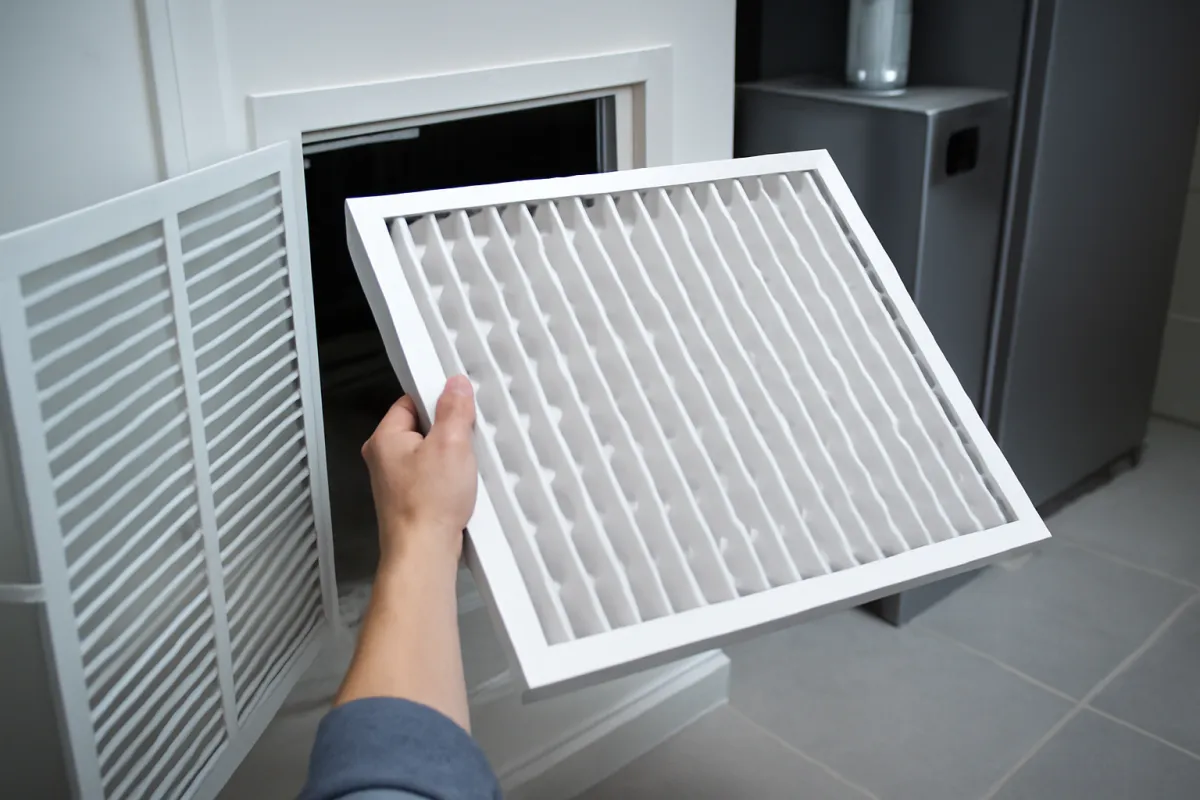
Find the filter, usually behind a return air grille in a wall, ceiling, or at the air handler itself, hold it up to a light, and replace or wash it if light does not pass through evenly. Our note on how often to change a furnace filter covers the interval in detail, and the short version is to check monthly and replace on a real schedule rather than when you remember.
Check four: a blocked or iced outdoor unit
This is very often the entire fault, and it is free to clear.
The outdoor unit needs air moving freely across its coil to collect heat from the outside air, and anything restricting that airflow, leaves and debris packed into the fins, a shrub grown across the clearance, snow drifted against the base, or a thick, uneven coating of ice, reduces how much heat the system can collect. A light, even coating of frost during cold, damp weather is normal and clears on its own during defrost. A heavy, solid sheet of ice, or ice that is building rather than clearing, is not.
With power off at the outdoor disconnect, clear visible debris by hand, trim back anything growing into the unit’s clearance, and shovel snow away from the base and sides, leaving at least the clearance your manual specifies. Do not chip at ice with a tool, since that risks puncturing the coil or the fins. If the unit is genuinely iced solid rather than lightly frosted, that points to the defrost system itself, covered next.
Check five: a defrost cycle that will not end, or ice that never clears
A little cold air and a little ice at the outdoor unit are both normal parts of how a heat pump heats in winter, and telling normal apart from a fault matters here more than almost anywhere else in this report.
In normal operation, moisture in damp outdoor air condenses and freezes on the outdoor coil when it runs below freezing while collecting heat. The system periodically reverses itself for a few minutes, sending warm refrigerant outdoors to melt that ice, and on many systems the backup strips energize briefly indoors during this so cold air does not blow into the house. You may see steam rising off the outdoor unit, hear a change in fan noise, and feel a brief cool draught indoors. All of that is normal and resolves within a few minutes.
A system that is genuinely stuck in defrost, running it continuously, or whose outdoor unit stays coated in ice even after repeated cycles, points at a failed outdoor temperature sensor, a stuck relay on the defrost control board, a reversing valve that cannot fully switch back, or an outdoor fan that has failed, since a coil cannot shed frost without airflow across it. This is a technician’s diagnosis rather than something to keep monitoring, because a coil that cannot defrost properly will progressively lose its ability to heat at all.
Check six: blocked or closed vents indoors
With the outdoor side clear, the diagnosis moves indoors, and blocked airflow there produces the same symptom from the opposite end of the system.
Walk the house and confirm supply registers are open and not blocked by furniture, rugs, or curtains, and confirm return air grilles are not covered. A system straining to breathe through a blocked return runs longer, works harder, and is more likely to call in the expensive backup heat to compensate, which is the next section.
The house is warm but the bill doubled: stuck backup heat
This is the fault that most often goes unnoticed, because the house stays comfortable while the cost quietly multiplies behind it.
Backup resistance heat, also called auxiliary or emergency heat, exists for a reason: on the coldest days, or during a sudden recovery from a thermostat setback, the compressor alone cannot always keep up, and the house needs warmth from somewhere. The backup elements supply it, but they do so at a coefficient of performance of exactly 1, meaning every unit of electricity buys one unit of heat, against roughly three and a half units from the compressor in mild conditions. Our heat pump running-cost breakdown prices this exactly: an illustrative 10-kilowatt strip package costs about $1.60 an hour at $0.16 per kilowatt-hour, against about $0.48 an hour for the compressor doing similar work.
The fault version of this is backup heat that runs far more than the weather justifies, or that runs continuously because the compressor has stopped contributing at all, a thermostat stuck in emergency heat mode, or a control fault that calls in the strips when the compressor should be handling the load on its own. The tell is a winter bill that climbs sharply without a matching jump in how cold it has actually been, alongside an outdoor unit that sounds and feels quiet, no fan or compressor hum, while the house stays warm regardless.
It blows cold air on a heating call, not just lukewarm
Air that feels genuinely cold rather than simply less warm than expected, on a system that is supposed to be heating, points at one of three things, and distinguishing them matters.
If it happens for a few minutes and then resolves, that is almost certainly a defrost cycle doing its job, covered above. If it is constant and the thermostat mode has already been confirmed as HEAT, the reversing valve, the component that switches the refrigerant flow between heating and cooling, may be stuck in the cooling position, which makes the machine run in the wrong mode entirely while still consuming power and appearing to operate. That is a sealed-system fault inside the outdoor unit, and it belongs with a technician. The third possibility, more common than people expect, is simply a thermostat accidentally left on COOL, which is why this check sits first on the list rather than last.
It runs constantly and never reaches the set temperature
A system working nonstop without closing the gap to setpoint is usually losing a fight on more than one front at once.
Work through what has already been covered: a choked or iced outdoor unit starving the compressor of heat to collect, a loaded filter or blocked vents restricting indoor airflow, and backup heat that should be helping on a genuinely cold day but is not engaging. If all of those check out and the system still cannot keep up, two remaining possibilities exist: the system may simply be undersized for the house’s actual heat loss on the coldest days, a sizing question for a qualified installer rather than a repair, or the compressor itself may be losing capacity, which is where the line into technician territory below applies.
Short cycling: it starts, runs briefly, and stops again
A system that turns on, runs for a few minutes, and shuts off again, over and over, is a different symptom from one that simply refuses to warm the house, and it deserves its own look because the likely causes are not quite the same list.
A loaded filter or a blocked return can starve the indoor coil badly enough that a safety control shuts the compressor down to protect it, which the system reads as a fault even though the starting cause is the same cheap airflow restriction covered above. An oversized system for the house it is heating can satisfy a thermostat’s call so quickly that it never settles into steady operation, which wastes energy and wears the compressor through repeated starts even when nothing is actually broken. A failing thermostat sensor, reading the room temperature incorrectly, can call for heat and then cancel the call within minutes on a loop that has nothing to do with the heat pump itself. And a refrigerant charge that has dropped from a slow leak can trip a low-pressure safety control repeatedly, which is a sealed-system fault belonging with a technician rather than an owner check.
Rule out the filter and the vents first, since they are free and common, before assuming anything more serious. If short cycling continues on a system with a clean filter and clear vents, that pattern itself is useful information to give a technician, since it points away from a simple blockage and toward either sizing or the refrigerant circuit.
Ducted vs ductless: does this fault look different?
A ducted system heats the whole house through one air handler and a network of ducts. A ductless system, the kind with wall-mounted indoor heads, serves individual rooms from one or more outdoor units. Both use the same refrigerant cycle and the same reversing valve principle, so almost everything in this report applies equally to either, but a few details shift.
On a ducted system, a fault that looks like “the whole house is cold” can actually be local: a single blocked or closed register, or a duct run that has come loose in an attic or crawl space, can leave one room cold while the rest of the house is fine, which is worth ruling out room by room before assuming the whole system has failed. On a ductless system, each indoor head has its own filter, usually a simple washable mesh behind the front cover, and a head that is not warming its room may simply need that filter cleaned rather than pointing at anything with the outdoor unit at all. Many ductless systems also carry no resistance backup heat whatsoever, which means their cold-weather performance rests entirely on the compressor’s own coefficient of performance, a meaningful detail if a specific room is falling behind on the coldest days and there is no strip heat to blame or to fix.
Where the line is: what only a licensed technician should touch
Past the owner checks above, the remaining causes sit inside the sealed refrigerant circuit or the control electronics, and they share one trait: diagnosing them with confidence needs testing equipment and training rather than observation.
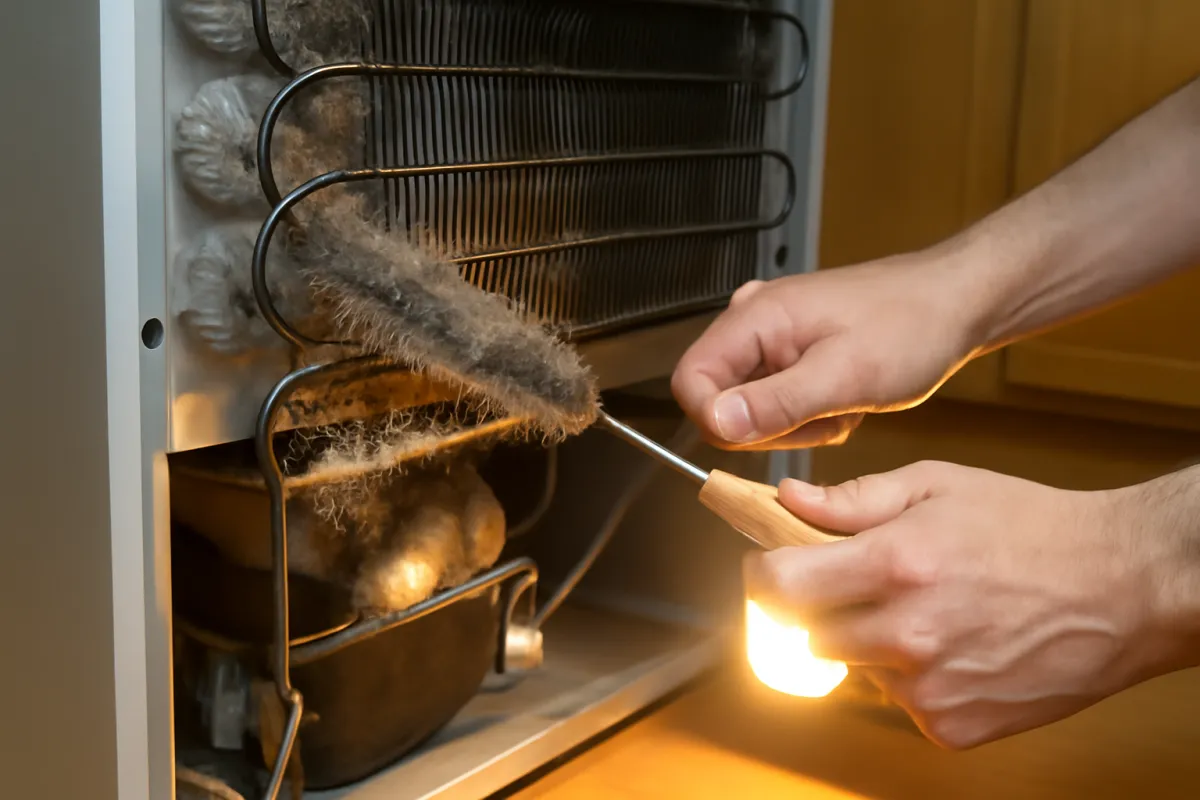
The reversing valve can stick partway, fully, or chatter between positions, producing anything from total failure to heat in the wrong direction. The compressor itself can lose capacity gradually or fail outright, and testing it means pressure and electrical readings rather than observation. The run and start capacitors can weaken enough that the compressor hums without starting, or starts and short-cycles. The contactor, the relay that switches power to the outdoor unit, can pit and fail to make reliable contact. The defrost control board and its outdoor temperature sensor, covered above, sit in this category too when the owner-level symptoms point at them. All of these involve either the sealed refrigerant circuit or line-voltage components that can hold a charge after power is removed, and none of them belongs to a Saturday afternoon repair.
Where a heat pump heating fault usually starts
Pulling the whole list together shows the pattern this category always shows: the cheap, common causes sit at the top and the expensive, rare ones sit at the bottom. The split below is illustrative, drawn from the shape of the causes rather than from any formal survey, and it is meant to set your search order rather than to be a statistic.
Where a heat pump heating fault usually starts
Illustrative share of not-heating complaints by cause. Bars scale to the largest slice.
About four in five of these faults sit outside the sealed refrigerant circuit entirely, in a setting, a breaker, a filter, or debris. Only the last slice routinely needs the expensive repair.
What a struggling heat pump costs while you wait
A system that is running but underperforming is not free while you investigate, and putting a number on that helps decide how quickly to act.
Using the illustrative figures from our heat pump running-cost breakdown, a 3-ton system drawing about 3 kilowatts costs roughly $0.48 an hour at $0.16 per kilowatt-hour under normal operation. A system restricted by a dirty filter or a choked outdoor unit commonly runs a meaningful share longer to deliver the same warmth, and a system that has fallen back on backup strips is paying closer to $1.60 an hour for the portion of its runtime those strips cover, more than three times the compressor’s rate. Put your own system’s capacity, hours, and rate into the cost-per-use calculator to see what a restricted system is costing you specifically while a fix is pending.
A worked example: one cold morning, five checks
Here is the method compressed into one plausible morning, with real decisions at each fork.
A house wakes up to a heat pump that has been running all night and the thermostat still reads four degrees below setpoint. The outdoor temperature is near freezing and damp.
The thermostat is checked first: mode reads HEAT, setpoint is reasonable, nothing is left on emergency heat. The breaker panel is checked next: both circuits are on. Outside, the unit is found under a thick, uneven sheet of ice rather than the light even frost that would be normal for the weather, and the outdoor fan is not audibly running.
With the outdoor disconnect switched off, loose ice is cleared by hand from the fins and the base, taking care not to chip at anything frozen solid to the coil itself. Power is restored. The fan starts immediately and runs steadily, which it had not been doing before, and within twenty minutes warm air is noticeably reaching the vents. The house closes the gap to setpoint over the next hour.
The icing itself is still worth a technician’s look soon, since a healthy defrost cycle should have prevented a sheet that thick from building in one overnight period, but the immediate fault, a stalled outdoor fan unable to clear normal frost, cost nothing to work around and bought the house its heat back the same morning.
What to tell the technician when you call
A few details, gathered before the call, make the visit faster and cheaper.
What mode the thermostat was in and what temperature it is holding against setpoint. Whether the outdoor unit’s fan is running, and whether it is iced, and if so how heavily. Whether the house feels warm but the bill has spiked, which points at backup heat. Whether the air at the vents is cold, cool, or simply less warm than expected, and whether that is constant or intermittent. Any breaker trips, and whether they repeated. That short list often lets a technician arrive with the likely part already in hand rather than diagnosing from scratch on site. It is also worth writing down the model and serial number from the outdoor unit’s rating plate before the call, since a technician quoting parts over the phone can often confirm compatibility and rough pricing before ever stepping onto the property, which saves a second visit if the first part ordered turns out to be the wrong revision for an older system.
Repair or replace: how to think about the number
When a heating fault needs a paid repair, the decision uses the same two tests applied to every appliance on this site.
The first is the 50 percent test: if the repair quote exceeds roughly half the price of a comparable new installed system, replacement usually wins. The second is age weighting, because outdoor HVAC equipment such as a heat pump is commonly cited in a 12 to 15 year typical service window, so the same repair buys most of that window at year three and very little of it at year thirteen.
Run an illustrative case. A system that would cost about $6,500 installed to replace develops a contactor and capacitor fault at year six, quoted at $380. That is about 6 percent of a replacement, far under the line, and it buys most of the system’s remaining typical life. Repair is the clear answer. Change one variable: the same system at year fourteen, diagnosed with a failed compressor, quoted at $3,800. That is 58 percent of replacement, on a system past the middle of its window, and both tests now point the same way.
Put your own installed replacement price, the quote you were given, and the years you expect the system to keep running into our cost-per-use calculator and the comparison stops being a feeling. If you do not yet have a real installed replacement price to work with, our HVAC system cost by equipment type and size breakdown builds a planning estimate before you call anyone.
Prevention: the habits that keep a heat pump heating
Most of this report is preventable, and the prevention list is short enough to actually do.
Change the filter on a real schedule. This is the single highest-value habit on the list, because it targets the airflow restriction behind a large share of the chart above.
Keep the outdoor unit clear year-round. Leaves in autumn, snow in winter, and a shrub grown into the clearance at any time of year all restrict the airflow the system depends on to collect heat.
Avoid deep thermostat setbacks. A large overnight setback often forces a big recovery call the following morning, which is exactly the condition that invites backup strips to switch on and buy that recovery at several times the normal rate. A modest setback, or a thermostat with intelligent recovery, avoids the trap.
Watch for repeated icing. A little frost on a cold, damp day is normal. Ice that keeps coming back thicker than the weather explains is worth a technician’s look before it becomes a bigger fault.
Have the system serviced on a schedule. A qualified technician checking refrigerant charge, electrical connections, and the defrost control catches several of the expensive faults on this list while they are still cheap.
Our heat pump running-cost breakdown covers the operating side of the same machine, and our eight-point appliance maintenance plan puts these habits on a calendar alongside the rest of the house.
The bottom line
Why is my heat pump not heating has a better answer than a cold house suggests, and finding it is a matter of order rather than skill. Start with the thermostat mode and the breaker, both free checks that resolve a large share of these complaints on their own. Then the filter and the outdoor unit, where debris or ice restrict the airflow the system depends on in both directions. A few minutes of cool air during a defrost cycle is normal; cool air that persists, or a system that runs constantly without closing the gap to setpoint, is not. Backup resistance heat exists to help on the coldest days, and when it is stuck on, or stuck off when it should be helping, the house can stay warm while the bill multiplies, or stay cold while the compressor works alone. Past those checks, the reversing valve, the compressor, the capacitor, and the control board are a licensed technician’s diagnosis, not because the parts are exotic but because the circuit is sealed and the compartment carries line voltage. Then let the arithmetic close it out: a repair under half the price of a comparable new system, on equipment with years left in its typical window, is usually worth doing, and a compressor quote on a system past that window is generally the end of the road. Keep the filter fresh and the outdoor unit clear, and most of this report will never apply to your house.
These notes are general information about heat pump faults, not professional HVAC, electrical, or tax advice. Every cost, share, and lifespan quoted here is an illustrative planning figure built from arithmetic rather than a measurement taken from any specific system, and your equipment, your climate, and local labor rates will move all of them. Switch off the outdoor disconnect and the indoor breaker before touching anything physical around a heat pump, never attempt work on the refrigerant circuit, the compressor, or the capacitor yourself, and treat a tripped breaker that will not stay reset as an electrical question rather than something to keep retrying. Anything involving the sealed refrigerant circuit, the control wiring, or a repair you cannot confirm belongs with a qualified HVAC technician or electrician, and where the manufacturer’s documentation for your system contradicts a general principle stated here, the manufacturer’s documentation wins.
Frequently asked questions
Why is my heat pump blowing cold air instead of heat?
A heat pump blowing air that feels cool, rather than merely lukewarm, on a heating call has one of three likely explanations. The thermostat may be set to a cooling or fan-only mode rather than heat, which is the cheapest and most common cause. A defrost cycle may be running, which briefly reverses the system to melt frost off the outdoor coil and feels cold indoors for a few minutes before warm air resumes, a normal event rather than a fault. Or the reversing valve, the component that switches the refrigerant flow between heating and cooling, may be stuck in the cooling position, which is a sealed-system fault that belongs with a licensed technician rather than an owner check.
Is it normal for a heat pump to blow cool air for a few minutes?
Yes, in two specific situations, and telling them apart from a fault matters. During a defrost cycle, which clears ice from the outdoor coil on cold, damp days, the system briefly reverses and the indoor air can feel cool or even cold for a few minutes, often alongside steam rising from the outdoor unit. On startup from a cold stop, a heat pump takes longer to feel warm than a furnace does because it is gently raising a refrigerant loop's temperature rather than igniting a flame. Both resolve within a few minutes on their own. Air that stays cool for much longer than that, or that never warms up at all, is the fault this report works through.
Why does my heat pump run constantly but never reach the set temperature?
Constant running without reaching setpoint usually means the system is losing a fight it was built to win, and the common causes are an iced or blocked outdoor unit that cannot collect enough heat from the outside air, a dirty filter or blocked vents restricting airflow across the indoor coil, an undersized system working below its design conditions, or, on the coldest days, genuine weather beyond what the compressor alone was sized for, which is when backup heat is supposed to help close the gap. If backup heat is not engaging when it should, the compressor runs flat out and still falls behind, which looks identical to a failed unit even though the compressor itself may be healthy.
How do I know if my heat pump's backup heat is stuck on?
The clearest sign is the bill rather than the temperature, because stuck backup heat often keeps the house comfortably warm while quietly costing several times the normal rate. Watch for a winter electricity bill that jumps sharply without a matching jump in how cold the weather has been, a thermostat accidentally left on an emergency heat setting from a prior fault or a prior winter, or outdoor air that sounds like the compressor has stopped running (no fan or compressor hum from the outdoor unit) while the house stays warm regardless. Confirm the thermostat mode is set to normal heat rather than emergency heat, since emergency heat deliberately runs on resistance elements alone and is meant to be temporary.
How much does it cost to fix a heat pump that is not heating?
It ranges from nothing to a significant repair, which is why checking order matters. Confirming the thermostat mode, resetting a tripped breaker, and clearing a blocked outdoor unit cost nothing. A dirty filter costs a few dollars. A stuck or failed component in the defrost control, a contactor, or a capacitor is commonly cited in an illustrative range around $150 to $400 installed. A reversing valve replacement is a more involved sealed-system repair, often quoted higher given the refrigerant handling involved. A failed compressor is the expensive end and, on an older system, is usually the repair that fails the replacement math outright, since it commonly approaches or exceeds half the cost of a new system.
Why is my heat pump stuck in defrost, with ice that never clears?
A normal defrost cycle runs for a few minutes every so often during cold, damp weather and then returns to heating on its own. A heat pump stuck in defrost, or one whose outdoor unit stays coated in ice even after repeated cycles, points at a fault in the defrost control itself, such as a failed outdoor temperature sensor, a stuck defrost board relay, or a reversing valve that cannot fully switch back to the heating position. It can also point at a simple airflow problem outside, such as an outdoor fan that has failed, since a coil cannot shed frost efficiently without the fan moving air across it. Persistent icing that does not clear on its own within a normal cycle is a technician's diagnosis rather than something to keep monitoring.
Is it worth repairing a heat pump that will not heat, or should I replace the whole system?
Run the same two tests used on every appliance here. If the repair quote exceeds roughly half the price of a comparable new installed system, replacement usually wins, and outdoor HVAC equipment such as a heat pump is commonly cited in a 12 to 15 year typical service window, so age breaks the tie when a quote sits close to that line. An illustrative case: a $6,500 installed replacement, a $380 contactor and capacitor repair, and a system at year six. The quote is about 6 percent of a new system, far under the line, so repair is the clear answer. Change the quote to a $3,800 compressor replacement on a system at year fourteen and both tests point the other way.