What's on this page
- What a dishwasher actually has to do
- Before you start: what to measure and what to know
- Step 1: Measure the cabinet opening and confirm the connections
- Step 2: Decide built-in or portable
- Step 3: Size by place settings, not cubic feet
- Step 4: Check the noise rating
- Step 5: Pick the cycles and features worth paying for
- Step 6: Price the running cost before the sticker price
- Step 7: Compare tubs, racks and the installation details
- A worked example: choosing for a household of four
- Common mistakes when choosing a dishwasher
- Troubleshooting the decision when it will not resolve
- Choosing for a rental, a small kitchen or a shared household
- Reading a dishwasher spec sheet without getting lost
- Delivery day, installation and the first wash
- Your dishwasher choosing checklist
- The bottom line
Short answer: Choose a dishwasher by measuring the cabinet opening and confirming the water, drain and electrical connections first, then size it by place settings rather than guesswork, roughly 3 per household member for a daily-use household. Favor a published decibel rating in the mid-40s or below for an open kitchen, and budget an illustrative 1.2 kilowatt-hours per cycle, about 19 cents a load at a typical electricity rate, as the running cost baseline.
How to choose a dishwasher looks like a one-spec decision, pick the capacity and move on, but the appliance sits closer to the kitchen’s daily rhythm than almost anything else in the house, and the differences that actually matter rarely show up clearly on a showroom floor. A model that looks identical to its neighbor in the aisle can be ten decibels quieter, hold two more place settings in a smarter rack layout, or use a third less water per cycle, none of which is obvious until it has been running in your kitchen for a few weeks.
These notes give a seven-step method for how to choose a dishwasher, ordered so each step narrows the field before the next one asks for a specific comparison. The first step is the cabinet opening and the connections behind it, the part a showroom cannot show you and the one most likely to eliminate a model you liked. For the day-to-day running cost once a machine is installed, see our dishwasher running-cost notes, and for the maintenance routine that keeps any dishwasher performing like new, our dishwasher cleaning notes. Set your household size and loads per week in the sizing planner as you read, and it will size the decision to your kitchen rather than to a showroom average.
Key takeaways
- Measure the cabinet opening and confirm the water, drain and electrical connections before comparing a single feature. A dishwasher that will not fit or connect eliminates itself instantly once you know to check.
- Size by place settings, not cubic feet. A workable rule is about 3 settings per household member for daily use, which puts most households inside a standard 12 to 16 setting capacity.
- Noise rating matters most in an open-plan kitchen. Ratings in the low-to-mid 40s decibels and below are the quiet range; the 50s and up are noticeably audible from an adjacent room.
- Running cost is modest and formula-driven: an illustrative 1.2 kilowatt-hours per cycle costs about 19 cents a load at a typical electricity rate, with ENERGY STAR models trimming that further.
- A full modern dishwasher usually beats hand-washing on both water and energy, since it uses only a few gallons per cycle against 20 or more under a running tap.
What a dishwasher actually has to do
Every dishwasher on the floor cleans dishes. That part of the job has been reliably solved for a long time, which is exactly why the spec sheet is a weak predictor of whether you will like living with the one you bring home. What decides satisfaction is physical and behavioral: whether it fits the opening and connects without a surprise, whether the racks hold what your household actually dirties in a day, whether it is quiet enough for a kitchen open to the rest of the house, and whether the cycles you will actually use are the ones that come standard rather than buried behind a premium tier.
The chart below is an illustrative split of where dishwasher regret tends to come from, a shape to plan against rather than a measured survey, and it explains why these notes put fit and capacity ahead of the feature list.
Where dishwasher regret actually comes from
An illustrative split of post-purchase complaints. Segments sum to 100 percent. A shape to plan against, not a survey result.
Half the shape is capacity and noise, both of which are settled with place settings, a tape measure, and a decibel number rather than a showroom glance. Illustrative proportions, not measured data.
Read that shape and the shopping order writes itself. If a quarter of the trouble is capacity, place settings deserve a real calculation rather than a guess. If another quarter is noise, the decibel rating belongs on the comparison list from the start, not as an afterthought. And if cycle time and installation surprises account for the next third between them, the eco cycle’s real duration and the hookup check both earn a place ahead of the feature tier comparison.
Before you start: what to measure and what to know
This is a shopping decision, so the preparation is measurement and an honest look at your household’s dishwashing habits rather than tools. Twenty minutes now avoids the two expensive outcomes: an appliance that does not physically fit the cabinet opening, and one that fits but is too loud, too slow, or too small for how the kitchen is actually used.
Gather these before opening a single product page.
- The cabinet opening, width, height and depth, measured at the floor and at the countertop line, since cabinetry is not always perfectly square.
- The water supply line and shutoff valve, their location and condition.
- The drain connection, whether it runs to a garbage disposal, a dedicated drain line, or an air gap, and its height relative to the dishwasher.
- The electrical requirement, whether the model is hardwired, plug-in, or needs a dedicated circuit.
- Whether you need built-in or portable, which depends on whether a cabinet opening and fixed connections exist at all.
- Your real dishwashing pattern, honestly: loads per day or per week, how many people are generating dishes, and how often pots and pans need a heavy cycle.
- Whether the kitchen is open to living space, which decides how much the noise rating should weigh in the decision.
- Your electricity rate, from a real bill, so the running-cost step means something. Our notes on lowering an electric bill cover where to find it.
Two ground rules before you start. Download the installation manual for any model you are seriously considering, since it states the exact clearance, leveling and connection requirements that the product page leaves out. And write every measurement down, because a standard dishwasher opening is commonly built to a narrow tolerance, and the numbers that matter are frequently within half an inch of each other.
Step 1: Measure the cabinet opening and confirm the connections
This step eliminates more models than any other single factor, which is what makes the rest of the comparison fast.
Standard built-in dishwashers are sized to fit a common cabinet opening, but width, height and depth all vary enough between brands to matter, especially in an older kitchen where the opening was built around a specific model decades ago. Measure at the floor and at counter height, and note whether the opening is framed by cabinetry on both sides or open on one side, since a side panel is sometimes required for a finished look on an end-of-run installation.
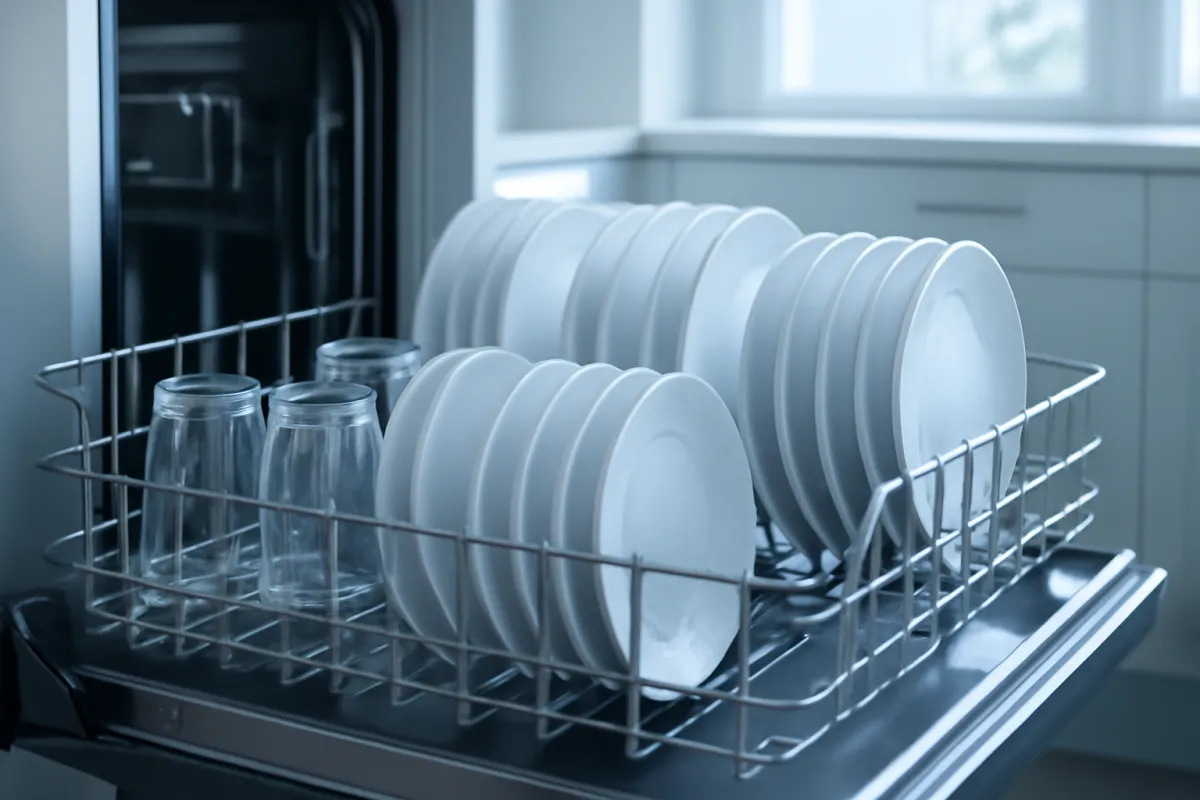
Then confirm the connections. The water supply is typically a hot water line with a shutoff valve under the sink, shared with the sink’s own supply, and it should be reachable and not seized shut from disuse. The drain runs either to the garbage disposal, to a dedicated branch of the sink drain, or through an air gap mounted at the sink or counter, and the specific routing affects both the installation and, occasionally, troubleshooting later. Our notes on a dishwasher that will not drain cover what a poor drain connection can cause down the line.
Finally the electrical requirement. Most built-in dishwashers are hardwired to a dedicated circuit, though some residential models use a standard plug, and the manual states which your chosen model expects. If you are replacing an existing dishwasher, confirm the new model’s requirement matches what is already there, since a mismatch is an electrician’s job rather than a weekend swap.
Step 2: Decide built-in or portable
This decision is usually made for you by the kitchen itself, but it is worth stating explicitly rather than assuming.
Built-in dishwashers install permanently into a cabinet opening with fixed water, drain and electrical connections, and they are what the overwhelming majority of kitchens are designed around. They offer the widest range of capacities, features and price points, and once installed they require no setup or teardown between uses.
Portable or countertop dishwashers exist for kitchens that genuinely cannot host a built-in unit: a rental where permanent installation is not permitted, a kitchen with no adjacent cabinet opening, or a very small space where a full-size built-in simply does not fit. A rolling portable connects to the kitchen faucet with a hose for each use and drains back through the sink, while a countertop model sits on the counter and connects similarly on a smaller scale, and a drawer-style compact unit can sometimes be semi-permanently plumbed even in a tight space. Capacity on any portable option generally trails a full-size built-in, so compare place settings directly against your household’s needs rather than assuming the convenience is free.
Choose portable only when built-in is genuinely not available to you, since it trades real convenience, the hookup and disconnect routine around every use, for the ability to have a dishwasher at all in a kitchen that otherwise could not host one.
Step 3: Size by place settings, not cubic feet
Capacity on a dishwasher is measured in place settings rather than cubic feet, and getting comfortable with that unit changes how you shop.
A workable planning rule is roughly 3 place settings per household member for a household that runs the dishwasher daily, plus a few extra settings worth of room for serving pieces, mixing bowls and the odd pot. That puts a couple near 8 to 10 settings, a family of four near 12 to 14, and a larger household nearer 16, which happens to span the range that most standard full-size dishwashers already cover, so the majority of households fit into a standard-capacity model rather than needing to hunt for an oversized one.
The correction that matters more than headcount is frequency. A household that runs a load every single day can comfortably size toward the lower end of the rule, since the dishwasher never has to hold more than a day’s accumulation. A household that runs it every second or third day, common for a smaller household trying to save water and energy by running only full loads, needs more capacity to hold multiple days of dishes without the rack overflowing or dishes going back into circulation unwashed. The sizing planner converts your household size and your loads-per-week habit into an estimated place-setting target and a baseline running cost.
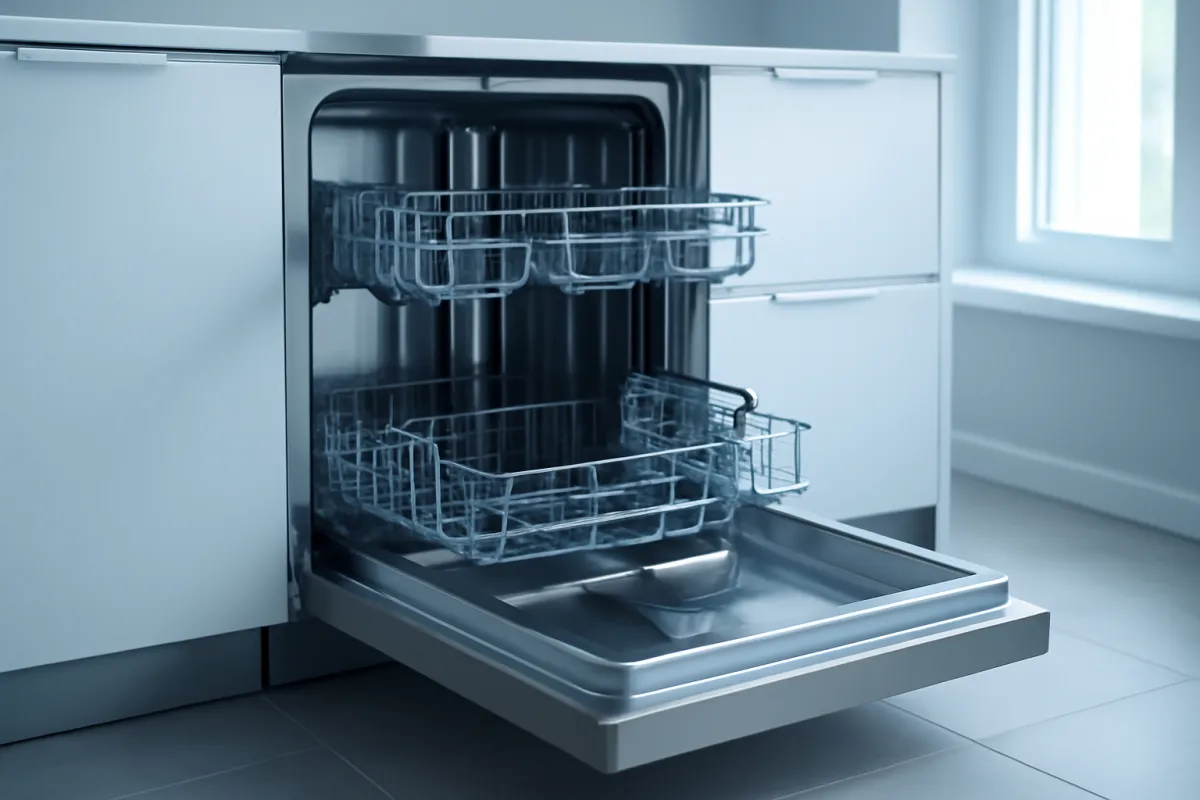
Rack layout changes how much of the rated capacity you can actually use in practice. Adjustable tines that fold flat, a middle rack that moves up or down to accommodate taller items, and a silverware basket that splits or relocates all affect how well a given place-setting rating translates into your actual mixed load of plates, bowls, glasses and pots, so take a few of your own larger plates or bowls to the showroom and check them against the display model’s racks directly.
Step 4: Check the noise rating
Noise is the second-largest slice of the regret chart above, and it is the factor a showroom is worst at letting you evaluate honestly, since every floor model in a busy store is either silent or running under a glass panel specifically built to demonstrate quietness.
Dishwasher noise is published in decibels, and lower is quieter. As a rough planning guide, ratings in the low-to-mid 40s and below sit in the quiet range, generally unnoticeable from an adjacent room with a door closed and only a background hum in an open kitchen. Ratings in the high 40s remain reasonable for most open-plan kitchens without becoming disruptive during conversation or television. Ratings in the 50s and above are noticeably audible, which can be perfectly fine for a kitchen closed off from living space or for a household that mostly runs the dishwasher after everyone has gone to bed, but worth weighing seriously for a kitchen open to a living or dining area used throughout the evening.
If an open kitchen is part of your situation, treat the decibel rating as a primary spec rather than a tiebreaker, on the same level as capacity and price, since it is the one factor you will notice every single evening the dishwasher runs while people are in the room.
Step 5: Pick the cycles and features worth paying for
Cycle lists on modern dishwashers run long, and most households settle into using two or three regularly while the rest sit unexplored, which lines up with the 14 percent of regret the chart above attributes to unused features.
The cycles worth having on nearly any dishwasher: a normal or auto-sensing cycle for everyday mixed loads, a heavy or pots-and-pans cycle for genuinely soiled cookware, and a quick or express cycle for lightly soiled loads run under time pressure. Beyond that, weigh each addition against whether you will actually use it.
Auto-sensing cycles, which use a soil sensor to judge how dirty the load is and adjust water use and cycle length accordingly, are generally worth having since they save water and time on lighter loads automatically rather than asking you to guess the right setting every time.
Sanitize cycles run hotter water for a documented time and temperature, which is useful for a household managing illness, very young children, or anyone with a specific health reason to want it, and is largely unnecessary for routine daily washing.
A third rack, covered in the FAQ above, is worth the added cost for a household that regularly washes a lot of flatware or small utensils, and a convenience rather than a necessity for others.
Heated dry versus air dry or condensation dry is a real running-cost lever. Heated dry adds real energy use for faster, more thorough drying, while condensation or fan-assisted drying uses less energy at the cost of slightly longer drying time and occasionally some residual moisture on plastic items, which dry poorly under any non-heated method regardless of machine.
Wifi connectivity and app control are the feature most likely to go unused. Apply the same honest test that applies to any connected appliance: will you check an app regularly, and does its failure stop the dishwasher from washing or only disable the extra.
Step 6: Price the running cost before the sticker price
The purchase price is a one-time number; the running cost compounds over a decade of near-daily use, and it follows a simple formula worth understanding before you compare models.
A modern dishwasher’s energy cost is its kilowatt-hours per cycle, usually listed on the yellow EnergyGuide label, multiplied by your electricity rate. For the standard modern machine at an illustrative 1.2 kilowatt-hours per cycle and a typical rate of 16 cents, that works out to about 19 cents a load, near 4 dollars a month at five loads a week, and close to 50 dollars across a year. An ENERGY STAR model typically runs closer to 0.9 kilowatt-hours per cycle, trimming the per-load figure to roughly 14 cents at the same rate.
Illustrative annual running cost by efficiency class
At 5 loads a week and a typical 16 cent electricity rate. Bars scale to the higher cost.
Illustrative figures at 5 loads a week and 16 cents per kilowatt-hour. Your own cycle count, rate and heated-dry setting will move the real number.
Water is a small but real add-on: a modern machine uses only about 3 to 5 gallons per cycle, far less than the picture most people carry of a dishwasher filling like a sink, since it sprays and recirculates a small volume rather than submerging the load. Older dishwashers from a couple of decades ago commonly used 8 to 15 gallons a cycle, which is one reason replacing a genuinely old unit can lower both the water and the energy bill together. For a full load, a modern dishwasher is usually the cheaper and greener option against hand-washing the same dishes under a running tap, which can use 20 or more gallons of hot water. Our dedicated running-cost notes carry the complete arithmetic across a range of electricity rates.
Step 7: Compare tubs, racks and the installation details
The last step is the collection of smaller things that decide day-to-day satisfaction, and a feature-list comparison handles them worst.
Tub material, stainless steel or plastic, affects heat retention during drying and long-term stain and odor resistance, as the FAQ above covers, though it is one factor among several rather than the single deciding spec.
Rack quality is where the real usability differences hide. Look for tines that fold flat for larger items, a middle rack with adjustable height, and a silverware basket positioned so it does not block larger items on the rack below it. Bring a few of your own larger plates or awkward items to the showroom and test them in the display racks directly.

Filter type is worth checking specifically. Most current dishwashers use a manual filter that needs periodic rinsing by hand, which performs better on food soil and runs quieter than the older grinding, self-cleaning filter design still found on some budget models, at the cost of a few minutes of maintenance every week or two.
Leveling and installation clearance matter the same way they do for any built-in appliance: confirm the model’s required clearance against your cabinet opening, and plan on leveling it carefully once installed, since an unlevel dishwasher can affect both draining and door seal performance over time.
A worked example: choosing for a household of four
A household of four in a kitchen with a standard 24 inch cabinet opening, existing water, drain and electrical connections from a prior dishwasher, and a kitchen open to the dining area. They run the dishwasher daily on weekdays and skip a day most weekends. Every figure below is illustrative.
Step 1, measurement. The opening measures 24 inches wide and the existing connections are in good condition, confirmed by checking the shutoff valve operates smoothly and the drain line shows no signs of a prior leak.
Step 2, built-in or portable. The existing opening and connections make built-in the clear and only sensible choice.
Step 3, capacity. The rule gives 3 times 4, or 12 place settings, which sits at the lower end of the standard range. Because they run it almost daily, they do not size up further, and a standard 12 to 14 setting model covers their pattern comfortably.
Step 4, noise. The kitchen opens directly to the dining area where the household eats dinner most nights, so they prioritize a published rating in the mid-40s decibel range or below over a louder model with a slightly lower price.
Step 5, cycles. They choose a model with auto-sensing normal, a heavy cycle for the one or two pot-heavy dinners a week, and a quick cycle for lightly soiled weekday lunches, and skip the sanitize cycle as a feature they are unlikely to use regularly.
Step 6, running cost. At an illustrative 1.1 kilowatt-hours per cycle, a near-ENERGY STAR figure, six loads a week and a local rate of 16 cents, each load costs about 18 cents, which comes to roughly 56 dollars across a year, a number small enough that it does not meaningfully change their shortlist but worth knowing regardless.
Step 7, the small things. They check the rack’s middle-tier height adjustment against their everyday dinner plates, confirm the filter is the manual rinse-and-replace type rather than an older grinding design, and level the installed unit carefully, checking it again after the first week of regular use.
The decision. A standard-capacity built-in dishwasher at 12 to 14 place settings, a decibel rating in the mid-40s confirmed before purchase, a manual filter they are prepared to rinse periodically, and a known running cost near 56 dollars a year that barely registers against the daily convenience it buys back.
Common mistakes when choosing a dishwasher
Skipping the cabinet opening measurement. Assuming any standard dishwasher fits any standard opening is how a delivery crew ends up standing in the kitchen with an appliance that is a half inch too tall.
Sizing by cubic feet instead of place settings. Place settings is the unit that actually maps to how many dishes a household generates, and most households fit a standard 12 to 16 setting model regardless of what a cubic-foot figure suggests.
Ignoring the noise rating in an open kitchen. The ambient noise in a showroom tells you nothing about how a dishwasher sounds from the next room during a quiet dinner conversation.
Buying every feature by default. Each added cycle or connected feature costs money and is one more thing that can fail. Add a feature because you will use it weekly, not because it is on the box.
Forgetting to confirm the connections. A seized shutoff valve or a drain line routed differently than expected turns a straightforward swap into a rescheduled installation.
Choosing portable to save money rather than out of necessity. Portable and countertop units trade real convenience for a lower price and usually lower capacity, and that trade is only worth making when built-in genuinely is not an option.
Comparing cycle time only on the normal setting. The eco or auto-sensing cycle, often the one used most, can run considerably longer than the normal cycle, which surprises people who assumed cycle length was fixed.
Letting a sale pick the model. Timing should choose among a shortlist that already fits your opening, capacity and noise requirements, never build the shortlist itself.
Troubleshooting the decision when it will not resolve
What if nothing fits the cabinet opening? Check for a slimmer-depth or narrower model in the capacity range you need, since manufacturers offer compact and narrow-width versions of most standard features. If the opening truly cannot take a full-size unit, a drawer-style or countertop option may be the honest answer rather than forcing a standard model into a space built for something smaller.
What if the household disagrees on capacity? Weight the decision toward actual daily dish generation rather than an aspirational larger household size, and remember that running the dishwasher more frequently is a reasonable way to handle a smaller capacity if the kitchen genuinely cannot fit a larger model.
What if noise and price pull in opposite directions? Treat the decibel rating as non-negotiable only if the kitchen is genuinely open to living space used during the hours you would run the dishwasher; if you mostly run it overnight or the kitchen is closed off, a louder, less expensive model is a reasonable tradeoff.
What if the old one just died and I need one immediately? Buy the sensible like-for-like replacement that matches the existing opening and connections, and resist changing size class or installation type under time pressure, since those changes are the ones that run into cabinetry or plumbing complications.
What if I cannot tell whether a model is reliable? Reduce exposure rather than trying to predict the unpredictable: fewer connected features, a warranty that names the pump and motor assembly specifically, and a preference for a manual filter and mechanical simplicity over an elaborate connected control panel.
Choosing for a rental, a small kitchen or a shared household
In a rental, the appliance may not be yours to choose, and where you are considering a portable unit for a rental that does not allow built-in installation, confirm with the landlord whether even a portable hookup routine is acceptable before buying one.
In a very small kitchen, a compact or slimline model, narrower than the standard 24 inch width, can be the difference between having a dishwasher at all and doing everything by hand, and modern compact models hold a reasonable place-setting count despite the smaller footprint.
In a shared household with inconsistent dishwashing habits, size toward the higher end of the capacity rule rather than the lower end, since a dishwasher that is comfortably oversized tolerates inconsistent loading far better than one sized exactly to a best-case daily routine.
Reading a dishwasher spec sheet without getting lost
Specification sheets run long, and a handful of lines decide the purchase. Read these and skim the rest.
Place settings, the actual capacity unit, rather than any cubic-foot figure that sometimes appears alongside it.
Decibel rating, if published, more reliable than any showroom impression.
Cycle times, specifically the normal or auto-sensing cycle’s typical duration, since this is the cycle most households run most often.
Energy use per cycle in kilowatt-hours, from the yellow EnergyGuide label, which is the only comparable energy figure on the floor.
Water use per cycle in gallons, increasingly published directly and worth comparing against the illustrative 3 to 5 gallon range for modern machines.
Filter type, manual rinse or self-cleaning grinder, which affects both maintenance and noise.
Tub material, stainless steel or plastic, relevant to drying performance and long-term wear.
Warranty terms, with the pump and motor assembly called out separately, since that is the expensive repair that decides whether a future fault is worth fixing.
Delivery day, installation and the first wash
The purchase is not finished at checkout, and a few details on delivery day protect the decision already made.
Confirm the installation terms in writing: whether the crew connects the water, drain and electrical lines or only places the unit, whether they haul the old dishwasher away, and what happens if the new unit does not fit the existing opening. Clear the space under the counter and have the shutoff valve accessible before the crew arrives.
Once installed, level the unit using its adjustable feet, and check that the door seals and closes cleanly all the way around, since an unlevel dishwasher can affect both draining and the door seal over time. Run an empty or lightly loaded first cycle to confirm the water and drain connections do not leak before trusting it with a full real load, and check under the unit for any moisture after that first run, since a slow leak at a new connection tends to announce itself early if anyone is looking for it.
Your dishwasher choosing checklist
Work it in order. The first three items eliminate most of the market, which is what makes the rest quick.
- Cabinet opening measured at the floor and at counter height, with side clearance for a side panel if the installation is at the end of a run.
- Connections confirmed: a functioning water shutoff valve, a clear drain route, and an electrical connection matching the model’s requirement.
- Built-in versus portable decided, based on whether the opening and connections actually exist.
- Capacity set in place settings, using the household rule as a floor and your run frequency as the correction.
- Noise rating checked, weighted heavily if the kitchen is open to living space.
- Cycles and features audited against which ones you will actually use weekly.
- Running cost estimated honestly from the energy label and your own electricity rate.
- Racks and filter type compared with your own dishes and awkward items in mind.
- Tub material weighed alongside the other factors rather than treated as the deciding spec.
- Delivery terms confirmed in writing: connection work, haul-away, and what happens if it will not fit.
The bottom line
Choosing a dishwasher is a measuring and habits exercise that most people shortcut to a single capacity number, which is why so many kitchens end up with a machine that is slightly too loud, slightly too small, or running a cycle twice as long as expected. Measure the cabinet opening and confirm the water, drain and electrical connections first, since those decide what is even possible before capacity or noise does. Size by place settings using the household rule, roughly 3 per person for daily use, as a floor, then correct for how often you actually run it. Treat the decibel rating as a primary spec in any kitchen open to living space, not a tiebreaker, and remember running cost is a simple formula: an illustrative 1.2 kilowatt-hours a cycle at a typical rate lands near 19 cents a load and about 50 dollars a year, with an ENERGY STAR model trimming that further. Compare racks and filter type with your own dishes in mind, weigh tub material as one factor among several, and audit every added cycle and connected feature against whether you will genuinely use it. Get those right and the control panel finish, which is what a showroom shows you first, becomes exactly what it should be: the last thing you decide.
A note on scope: these notes set out a general method for choosing a home dishwasher and are educational rather than professional plumbing, electrical or appliance-installation advice. Every place-setting figure, decibel range, kilowatt-hour number and dollar amount above is an illustrative planning figure chosen to make the arithmetic followable, not a measurement of any particular model, and your own household, rates and habits will move the real numbers. The installation manual for the specific appliance you are considering outranks everything written here, particularly on required clearances, electrical requirements, drain routing and leveling. Water, drain and electrical connections belong with a qualified plumber or electrician if you are not confident doing them yourself, and a leak, a burning smell, a tripping circuit or a unit that will not level means stop using it and have it looked at.
Frequently asked questions
How many place settings do I need in a dishwasher?
A workable planning rule is about 3 place settings per household member for a household that washes daily, plus a few extra for serving pieces and pots, which puts a couple near 8 to 10 settings, a family of four near 12 to 14, and a larger household nearer 16. Standard full-size dishwashers commonly hold somewhere between 12 and 16 place settings depending on rack design, so most households fit comfortably into the standard size class rather than needing a specialty large-capacity model. The correction that matters more than the headcount rule is how often you run it: a household that runs a load every single day can size smaller than one that runs every second or third day and needs the dishwasher to hold more between cycles.
Should I buy a built-in or a portable dishwasher?
Built-in is the better choice whenever your kitchen has the cabinet opening and the water and drain connections to support it, because it uses counter and floor space more efficiently and is what most kitchens are designed around. A portable or countertop dishwasher exists for kitchens that genuinely cannot host a built-in unit, typically a rental where installation is not allowed or a kitchen with no adjacent cabinet opening, and it connects to a kitchen faucet rather than a fixed water line, which is both its convenience and its limitation, since it has to be hooked up and disconnected around the sink for each use unless it is a drawer-style unit with its own connection. Capacity on a portable unit is usually smaller than a full-size built-in, so compare place settings directly rather than assuming the smaller footprint. Choose portable only when built-in is genuinely not possible, not as a lower-cost shortcut.
What is a good noise rating for a dishwasher?
Dishwasher noise is published in decibels, and lower numbers are quieter. As a rough planning guide, ratings in the low 40s and below are considered very quiet and are largely inaudible from an adjacent room, the mid-to-high 40s are quiet enough for an open-plan kitchen without becoming a nuisance during conversation, and ratings in the 50s or higher are noticeably audible and better suited to a kitchen that is closed off from living space or run only when the room is empty. If the kitchen is open to a living or dining area, prioritize the published decibel rating over any showroom impression, since a showroom floor's ambient noise makes it nearly impossible to judge how quiet any model will actually be in your home.
How much does it cost to run a modern dishwasher?
Illustratively, a standard modern dishwasher uses around 1.2 kilowatt-hours per cycle, which at a typical electricity rate near 16 cents works out to about 19 cents a load, close to 4 dollars a month at five loads a week, and near 50 dollars a year, plus a few cents of water per load since a modern machine uses only about 3 to 5 gallons per cycle. An ENERGY STAR model typically uses closer to 0.9 kilowatt-hours per cycle, trimming the per-load cost further. For most households running full loads, this is less water and less energy than hand-washing the same dishes under a running tap, which can use 20 or more gallons of hot water. Our dedicated running-cost notes work the full arithmetic at your own electricity rate.
Do I need a third rack in a dishwasher?
A third rack, usually a shallow tray near the top of the tub, is genuinely useful if your household regularly washes a lot of flatware, small serving utensils, or oddly shaped items like spatulas and whisks that otherwise clutter a flatware basket or rattle loose in a main rack. It frees up the main racks for plates, bowls and glasses, and most owners who have one report using it constantly rather than as an occasional convenience. It is not essential for a household with simpler flatware needs, and some third-rack designs reduce the usable height of the middle rack slightly, which matters if you regularly wash taller items. Check that specific tradeoff on any model with a third rack before counting it as pure upside.
Are stainless steel tubs better than plastic tubs in a dishwasher?
Stainless steel tubs generally hold heat better during the dry cycle, which can mean better drying performance, especially on an air-dry or condensation-dry cycle without a heating element, and they tend to resist staining and absorb less odor over years of use than plastic. Plastic tubs are usually found on lower-priced models, and modern plastic tub designs have improved considerably, so the gap matters less than it once did, particularly if you plan to run heated dry regularly regardless of tub material. The tub is one factor among several rather than a decision on its own, and it is worth weighing against rack quality, noise rating, and cycle options rather than treated as the single deciding spec.
What is the difference between a dishwasher's wash cycles and worth paying for?
A normal or auto-sensing cycle for everyday loads, a heavy or pots-and-pans cycle for genuinely soiled cookware, a quick or express cycle for lightly soiled loads run under time pressure, and a delicate cycle for glassware cover what most households actually use week to week. Auto-sensing cycles, which use a soil sensor to adjust water and time to how dirty the load actually is, are worth having since they save water and energy without asking you to guess the right cycle. Beyond that, evaluate sanitize cycles, which run hotter water for a documented temperature and time rather than a marketing claim, and are useful for a household managing illness or very young children, against whether you will use them regularly rather than buying them as a default.
Should I buy a dishwasher during a holiday sale?
Timing can genuinely save money, but it should never choose the model ahead of fit, capacity and noise, since those are the factors that decide whether you are happy with the appliance for the next decade. Work through the space, place-setting, and noise steps first to build a shortlist of models that actually fit your kitchen and your household's dishwashing habits, then let price and timing decide among that shortlist rather than the other way round. A steeply discounted dishwasher that is too small, too loud for an open kitchen, or the wrong configuration for your cabinet opening is not a bargain. Our seasonal appliance deal notes cover how to tell a real reduction from a reset sticker price.