What's on this page
- Portable AC vs window AC: the short answer
- How each type actually works
- Cooling efficiency: why window usually wins
- Noise: the compressor is the loudest part
- Installation: lifting a chassis versus rolling one into place
- Sealing and leakage: the gap window units avoid
- Running cost: the efficiency gap in dollars
- Upfront cost: portable usually costs more
- Sizing: portable units often need a notch up
- Climate and room considerations
- Humidity and air quality: what each type does to room moisture
- Energy Star ratings and the EER or CEER numbers to check
- Lifespan and repair: which type lasts longer
- Common portable AC mistakes that quietly hurt performance
- When a window AC is the clear choice
- When a portable AC is the clear choice
- Resale, rentals, and taking a unit with you
- Two-in-one and multi-function portable units
- A worked example: choosing for a shared apartment bedroom
- Maintenance: both need regular filter care
- Placement tips that improve either unit’s real-world cooling
- Portable and window AC basics before you buy
- The bottom line
Short answer: A window AC is usually the more efficient, quieter, and cheaper choice for the same cooling capacity, because its compressor hangs outside through the window. A portable AC costs more to buy, runs louder, and is generally less efficient at the same BTU rating, but it needs no window mounting and moves between rooms, which makes it the practical choice when a window unit simply will not fit or cannot be installed.
Portable AC vs window AC is really a choice between two different compromises rather than a contest with one obvious winner, which is why so many people end up comparing the two side by side before buying either. A window unit asks for a window it can occupy for the season and some lifting to get it installed, in exchange for better efficiency, lower noise, and usually a lower price. A portable unit asks for more money and tolerates more noise and somewhat weaker real-world cooling, in exchange for mobility and an installation that takes minutes instead of muscle.
This comparison lines the two up directly on cooling efficiency, noise, installation, running cost, and the situations where one clearly beats the other, rather than repeating the cost-only breakdown in our window AC unit cost guide or the installation-focused advice in our how to choose a window air conditioner guide. Every number here is an illustrative planning range rather than a guarantee for any specific model, since real performance varies by brand, room, and climate. Set your room size and preferences in the estimator further down to see an illustrative running-cost comparison between the two types as you read.
Key takeaways
- A window AC's compressor sits outside through the window, which is why it is generally quieter and more efficient than a portable unit of the same BTU rating.
- A portable AC's entire chassis, compressor included, sits inside the room, making it louder and typically less efficient, especially in the common single-hose design.
- For a comparable cooling capacity, a portable unit usually costs more to buy and more to run than a window unit.
- Portable wins decisively when a window cannot support a unit, a lease forbids window mounting, or cooling needs to move between rooms.
- A dual-hose portable unit closes much of the efficiency gap with a window unit, at a higher price than a single-hose model.
Portable AC vs window AC: the short answer
If you need one sentence before the detail, a window AC is the generally stronger choice on efficiency, noise, and price for a comparable cooling capacity, and a portable AC is the practical choice when a window simply cannot hold a unit, a lease or HOA forbids window-mounted equipment, or you need to shift cooling between rooms as the day or season changes. Neither type is universally better, which is the entire reason this comparison exists rather than a simple recommendation.
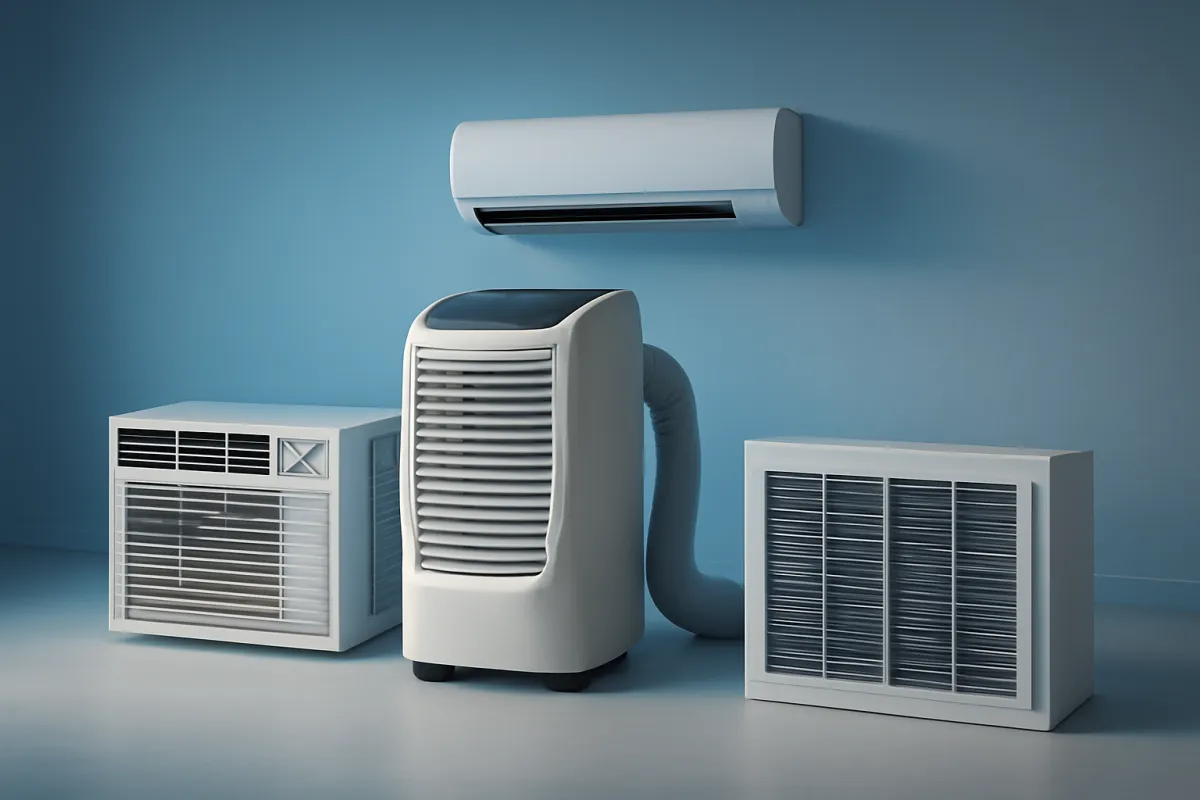
The single biggest fact driving every other difference between these two types is where the compressor sits. A window unit’s compressor and condenser hang outside the home through the window opening, venting their heat and noise directly outdoors. A portable unit keeps everything, compressor included, inside the room, venting only exhaust air through a flexible hose. That one design choice is the root cause of the efficiency gap, the noise gap, and much of the price gap covered in the sections below.
How each type actually works
Both machines use the same basic refrigeration cycle as any air conditioner, moving heat from inside the room to outside the home using a compressor, a refrigerant loop, and a fan on each side of the cycle. The difference is purely architectural: where that hardware physically sits relative to the wall.
A window unit is a single sealed chassis that straddles the window opening, with the cold evaporator side facing into the room and the hot compressor and condenser side facing outward, so the heat removed from the room is rejected directly to outdoor air with no path back inside. A portable unit sits entirely on the floor inside the room, pulling room air across its evaporator coil for cooling and across its condenser coil for heat rejection, then pushing that hot condenser air out through a hose connected to a window kit or door panel. Every efficiency, noise, and cooling-performance difference discussed below traces back to that one architectural split.
Cooling efficiency: why window usually wins
Efficiency is where the two types diverge the most, and the reason is mechanical rather than a matter of brand quality. Because a window unit’s compressor sits outside, none of the heat that component itself generates while running ends up inside the room working against the cooling effort. A portable unit’s compressor sits inside the room, so it is actively adding heat to the same space the air conditioner is trying to cool, which the cooling output then has to overcome before it can lower the room temperature at all.
The common single-hose portable design adds a second efficiency penalty. Pulling air from the room to cool the condenser and then exhausting it outside creates a slight negative pressure in the room, which draws warm, humid outdoor air back in through door gaps, electrical outlets, and other small openings, partially undoing the cooling the unit just produced. A dual-hose portable design avoids this specific problem by drawing condenser air from outside instead of from the room, closing much of the efficiency gap with a window unit, though usually not all of it, and at a higher purchase price.
Illustrative cooling efficiency by type
A relative efficiency index for a similar nominal cooling capacity, with window set as the baseline. Higher is more efficient. Your actual unit varies by brand and model.
An illustrative relative index, not a specific efficiency rating. The single-hose penalty comes mostly from the negative-pressure effect described above; a dual-hose design closes much of that gap.
The practical upshot is that a portable unit, especially a single-hose model, often needs a higher nominal BTU rating than a window unit to cool the same room equally well, which is covered further down in the sizing section. Chasing the cheapest portable unit by BTU number alone is one of the most common ways people end up disappointed with a portable AC’s real-world performance.
Noise: the compressor is the loudest part
Sound follows the same logic as efficiency: the compressor is the single loudest component in any air conditioner, and where it sits determines how much of that noise you hear. A window unit’s compressor hangs outside the glass, so the sound heard indoors is mostly the quieter evaporator fan, with the compressor noise muffled by distance and the window frame itself. A portable unit’s compressor sits a few feet away on the floor of the same room you are sitting in, so its full operating sound, not just a fan, is part of the room’s ambient noise the entire time it runs.
For a living room or a space you are not trying to sleep or concentrate in, this difference may not matter much. For a bedroom or a home office on a video call, the gap is often noticeable enough to be the deciding factor on its own, regardless of what the efficiency and price numbers say.

To put a rough number on it, a window unit commonly runs in a range people describe as comparable to a quiet conversation to a running dishwasher, while a portable unit at a similar cooling capacity often sits a notch louder, closer to a running washing machine or a box fan on a higher setting. These are illustrative comparisons rather than measured decibel figures for any specific model, since sound output varies by brand, fan speed, and how the unit is positioned relative to hard surfaces that can reflect noise back into the room, but the relative ordering, window quieter than portable, holds consistently across most comparable models.
Installation: lifting a chassis versus rolling one into place
Installation is the category where portable units clearly win on convenience. A window AC has to be lifted, often by two people for a larger unit given the weight involved, into the window opening, supported from below, secured with mounting brackets or a support bar, and sealed along the side gaps with the foam strips that come in the box. That is genuine physical work, and for a second-story window or an older frame of uncertain strength, it can be a real safety consideration.

A portable unit rolls into place on its own wheels, and the only installation step is routing the flexible exhaust hose through a window kit panel or a sliding door bracket, a job that typically takes a few minutes with no lifting at all. That ease is a major reason renters, people in apartments with weight restrictions on windows, and anyone who wants cooling moved between rooms over the course of a day gravitate toward portable units despite the price and performance tradeoffs.
Sealing and leakage: the gap window units avoid
A window unit, properly installed with its side foam strips in place, creates a reasonably tight seal around the opening it occupies, since the whole chassis is designed to fill that specific gap. A portable unit’s window kit, by contrast, is a flat panel with a hole for the hose that slides into a window track or door frame, and the fit around the panel’s edges is often less precise, leaving small gaps that let conditioned air escape and warm air in.

A loose kit panel is one of the quieter ways a portable unit underperforms relative to its rated capacity, since some of the cooled air effectively leaks back out around the exhaust point rather than staying in the room. Taking the extra few minutes to seal the kit panel’s edges with foam tape or the included sealing strips is a small step that meaningfully improves a portable unit’s real-world performance.
Running cost: the efficiency gap in dollars
Lower efficiency translates directly into higher running cost for the same amount of cooling, since a less efficient unit has to consume more electricity to remove the same amount of heat from a room. Combined with the fact that a portable unit often needs a higher nominal BTU rating to match a window unit’s real-world cooling in the first place, the running-cost gap between the two types compounds across a full cooling season.

For a precise comparison, the type of unit, its efficiency rating, your local electricity rate, and how many hours a day you run it all matter more than any single published average. Our appliance wattage and running-cost reference walks through the general formula for turning any appliance’s wattage into a cost per hour, day, or month, which you can apply to either unit’s nameplate rating. Set your own room size and hours of use in the estimator above for an illustrative seasonal comparison between the two types.
Upfront cost: portable usually costs more
For a comparable rated cooling capacity, a portable AC typically costs more to buy than a window AC, which surprises people who assume mobility would be the cheaper, simpler option. The reason is mechanical complexity: a portable unit packs a compressor, both coils, a condensate system, a chassis, wheels, and exhaust hose hardware into a single self-contained box, while a window unit’s simpler, single-location design needs less engineering to achieve the same cooling output.
A dual-hose portable unit, which closes more of the efficiency gap discussed earlier, typically costs even more than a single-hose model of the same rated capacity. Our window AC unit cost guide breaks down window unit pricing by size in detail if you want the cost side of that type specifically. Combined with the generally higher running cost from lower efficiency, the total cost of ownership gap between the two types over a cooling season is usually wider than the upfront price difference alone suggests.
What drives a portable unit's higher total cost
An illustrative breakdown of why a portable AC commonly costs more than a window unit over a season of ownership. Segments sum to 100 percent.
An illustrative attribution, not a measured cost breakdown for any specific pair of models. The equipment price and the running-cost gap together account for most of the difference, which is why both matter when comparing two specific units.
Sizing: portable units often need a notch up
Sizing either type correctly starts with the same basic principle: match the rated cooling capacity to your room’s square footage, with adjustments for ceiling height, sun exposure, and how many people typically occupy the space. Where the two types diverge is that a portable unit, because of the negative-pressure and indoor-compressor-heat effects described earlier, often cools somewhat less effectively per rated BTU than a window unit of the same nominal rating.
The practical adjustment is to size a single-hose portable unit a notch above what a straightforward square-footage chart would suggest if you want performance comparable to a window unit of that chart’s rating, or to look specifically for a model that lists an adjusted or newer-standard BTU rating, which more accurately reflects real-world performance than the older rating method. A dual-hose unit needs less of an adjustment, since it avoids the negative-pressure penalty, but still runs its compressor indoors.
Climate and room considerations
Beyond square footage, a few conditions push the decision one way or the other regardless of the general efficiency comparison. A room with a south- or west-facing window that gets strong afternoon sun needs more cooling capacity than the square footage alone suggests, for either unit type. A kitchen or a room with several heat-generating electronics adds load the same way. A very open floor plan without doors to separate the cooled space from the rest of the home works against both types, but tends to hurt a portable unit’s effective performance more, since any air leakage around its window kit has more uncontained space to escape into.
A room with no accessible window at all, a window that cannot structurally support a unit’s weight, or a lease or HOA rule against window-mounted equipment rules out a window AC outright and makes portable the only workable choice among these two types, regardless of the efficiency and noise tradeoffs.
Humidity and air quality: what each type does to room moisture
Both unit types remove some humidity from the air as a byproduct of cooling, since condensation forms on the cold evaporator coil as it pulls moisture out of the air passing over it, the same basic process a dedicated dehumidifier uses. A window unit drains that condensate outside automatically through a small weep hole or a drip path built into its chassis, so moisture management mostly takes care of itself once the unit is properly leveled with a slight outward tilt. A portable unit collects that condensate inside the chassis, and depending on the model and the humidity level in the room, it either evaporates the moisture back out through the exhaust hose automatically, drains continuously through a small hose you route to a floor drain, or collects in an internal reservoir that needs to be emptied manually on a schedule.
In a genuinely humid climate or a room that runs damp, a portable unit’s reservoir can fill often enough to become a real chore, and an overlooked full reservoir can cause the unit to shut off entirely until it is emptied. A window unit sidesteps this almost entirely because of its automatic outdoor drainage path. Neither type is a substitute for a dedicated dehumidifier if moisture control, rather than temperature, is your primary problem; our guide on how to choose a dehumidifier covers that separate appliance category in depth.
Energy Star ratings and the EER or CEER numbers to check
Beyond the BTU rating that determines cooling capacity, both unit types carry an efficiency rating, commonly expressed as EER or the newer combined CEER figure for portable units specifically, that tells you how much cooling you get per watt of electricity consumed. A higher number means more cooling for the same running cost, and comparing this figure, not just the BTU number or the price tag, is how you tell a genuinely efficient model from a cheap one within either category.
An Energy Star certification on either type generally signals an above-average efficiency rating for that category, though the baseline differs between window and portable units given their inherent efficiency gap, so an Energy Star portable unit is not necessarily as efficient in absolute terms as an Energy Star window unit of the same BTU rating. Our broader notes on Energy Star certification and whether Energy Star appliances are worth it explain how the certification program works in general. Checking the specific EER or CEER number on the spec sheet, rather than relying on the certification badge alone, is the more precise way to compare two specific models against each other.
Lifespan and repair: which type lasts longer
A window unit, with its simpler single-chassis design and no wheels, hose connections, or internal condensate handling beyond a drain path, tends to have fewer points of failure and commonly reaches a service life in the range of eight to twelve illustrative years with reasonable care. A portable unit has more moving parts and more places for something to go wrong, including the condensate pump or reservoir system on some models, the hose connections, and the caster wheels, which can translate to a somewhat shorter typical service life and a higher chance of needing a minor repair or part replacement during ownership.
Neither type is usually worth repairing extensively once it is out of warranty, since the cost of diagnosing and fixing a sealed refrigeration system often approaches or exceeds the cost of a new unit at these price points. For either type, a unit that stops cooling effectively, runs constantly without reaching the set temperature, or develops a refrigerant leak is typically a replace rather than repair situation, while a clogged filter, a tripped internal safety switch, or a full condensate reservoir on a portable unit are simple, legitimately fixable issues worth checking first before assuming the worst.
Common portable AC mistakes that quietly hurt performance
A handful of avoidable mistakes account for a large share of the complaints people have about portable AC performance, and most of them are easy to fix once you know to look for them. Leaving the exhaust hose kinked or stretched to an awkward angle restricts airflow and makes the compressor work harder for less cooling, so routing the hose as straight and short as the installation allows helps meaningfully. Skipping the window kit’s seal around the edges, mentioned earlier in the installation section, lets cooled air leak out and warm air leak back in continuously while the unit runs.
Undersizing the unit by trusting a basic BTU-per-square-foot chart without the adjustment for a single-hose unit’s efficiency penalty, covered earlier in the sizing section, is another common source of disappointment, since the unit ends up running constantly without ever quite catching up to the room’s heat load. Letting the air filter go uncleaned for an extended stretch is the simplest mistake of all, and one that applies equally to window units, quietly reducing airflow and increasing running cost the longer it goes unaddressed.
When a window AC is the clear choice
A window AC comes out ahead when the room has a standard, structurally sound window you are comfortable occupying for the cooling season, when noise matters because the room is a bedroom or workspace, when budget favors the generally lower price for a given cooling capacity, and when you plan to leave the unit in place rather than moving cooling around the home. For most single-room cooling situations where installation is not a barrier, these advantages add up in the window unit’s favor.
When a portable AC is the clear choice
A portable AC comes out ahead when a window cannot be used at all, whether due to structural weight limits, a lease restriction, a casement or sliding window style that will not fit a standard chassis, or simply no accessible window in the room that needs cooling. It is also the better fit when you genuinely need to move cooling between rooms over the course of a day, since rolling a unit down a hallway and reconnecting its hose to a different window kit takes minutes, something a window unit cannot do at all once installed. Renters who cannot modify a window, or anyone on an upper floor where lifting a heavy window unit safely is a real concern, also tend to land on portable despite the cost and noise tradeoffs.
Resale, rentals, and taking a unit with you
A window unit, once installed, is somewhat less convenient to relocate than a portable unit, since taking it with you when you move means repeating the lifting, bracket, and sealing process in reverse and then again at the new home. Some renters simply leave a window unit behind for the next tenant rather than deal with reinstalling it elsewhere, which can be a reasonable trade if the unit is older or the next home has a different window configuration anyway.
A portable unit travels far more easily, since it is designed to roll from room to room in the first place, which extends naturally to rolling it into a moving truck and setting it up again in a new apartment with a different window kit adapter if needed. For anyone who expects to move within a year or two, that portability advantage can offset some of the price and efficiency disadvantages discussed earlier, since the unit’s value is not tied to a specific window the way a window unit effectively is once installed.
Two-in-one and multi-function portable units
Many portable units are marketed as multi-function, combining air conditioning with a standalone fan mode and sometimes a dehumidifier mode that runs without the compressor cycling for cooling. The fan-only mode is genuinely useful on a mild day when full cooling is unnecessary, since it uses a small fraction of the electricity a cooling cycle does. The dehumidifier-only mode is real but typically less effective per hour than a unit actually built and sized as a dedicated dehumidifier, since it is a secondary feature on hardware optimized primarily for cooling rather than moisture removal.
Treat these extra modes as a convenience rather than the deciding factor in the portable-versus-window decision, and if dehumidification on its own is the primary goal for a damp room rather than an occasional convenience, a dedicated unit sized properly, as our dehumidifier sizing guide explains, will outperform a multi-function air conditioner’s secondary mode.
A worked example: choosing for a shared apartment bedroom
Put the comparison to work on one concrete scenario. Picture a one-bedroom apartment where the lease prohibits any window-mounted equipment, but the window itself is a standard double-hung style that would otherwise support a unit. The bedroom is a typical size, used for sleeping, and the renter wants the option to eventually move the unit to a living room window in a future apartment.
Given the lease restriction alone, a window AC is off the table regardless of its efficiency and noise advantages, since the install itself is not permitted. A portable AC, sized a notch above the square-footage chart’s suggestion to account for the single-hose efficiency penalty, with its window kit sealed carefully along the edges to limit leakage, is the workable answer here. The tradeoffs, a higher price, a higher running cost, and more noise during sleep, are accepted in exchange for a solution that actually fits the lease and moves with the renter to the next apartment. In a bedroom specifically, placing the unit as far from the bed as the hose length allows helps offset some of the noise disadvantage discussed earlier.
Maintenance: both need regular filter care
Both unit types need a similar maintenance habit: a washable or replaceable air filter that should be cleaned regularly during the cooling season, since a clogged filter restricts airflow and forces the unit to work harder for the same cooling output, quietly increasing running cost on either type. A portable unit additionally has an internal condensate system that either self-evaporates, drains through a hose, or needs periodic manual emptying depending on the model and humidity level, which a window unit’s design generally avoids by draining condensate outside automatically. Checking and clearing a portable unit’s drain or reservoir on the schedule its manual recommends prevents both odor and a shortened service life.
Placement tips that improve either unit’s real-world cooling
A handful of placement habits improve performance regardless of which type you choose. Keeping curtains or blinds closed on the sunniest side of the room during peak heat hours reduces the heat load either unit has to fight, often noticeably. Positioning a portable unit’s exhaust hose on the shortest, straightest path to the window kit, rather than looping it around furniture, reduces the airflow resistance mentioned earlier in the common-mistakes section. For a window unit, a slight outward tilt, usually built into the mounting brackets, helps condensate drain outside rather than pooling inside the sill.
Closing interior doors to the room being cooled, for either type, keeps the conditioned air concentrated where it is needed rather than spreading into hallways and other rooms that dilute the cooling effect and make the unit run longer to reach the target temperature. None of these habits change the fundamental efficiency gap between the two types, but they meaningfully improve how close either unit gets to its rated performance in practice.
Portable and window AC basics before you buy
Before comparing specific models, it helps to settle a few basics that apply to either type.
BTU rating. This measures cooling capacity, and it should be matched to your room’s square footage, with upward adjustments for sun exposure, ceiling height, and occupant count, and for a single-hose portable unit specifically, an additional adjustment for the efficiency penalty discussed earlier.
Venting. A window unit vents directly through the window opening it occupies. A portable unit vents through a flexible hose to a window kit, door panel, or occasionally a wall vent, and needs that opening available for as long as it runs.
Hose design, portable only. Single-hose is cheaper and more common; dual-hose is more efficient and typically costs more, closing much of the gap with a window unit’s performance.
Noise tolerance for the room. A bedroom or workspace favors a window unit’s quieter indoor profile; a living space where noise matters less narrows the gap in practice.
For the window AC side of this decision specifically, our how to choose a window air conditioner guide walks through sizing and installation in more depth, and our window AC unit cost guide covers pricing by size.
The bottom line
Portable AC vs window AC is not a contest with a single winner, it is a tradeoff between efficiency, noise, and price on one side and installation flexibility and mobility on the other. A window unit wins on cooling efficiency, noise, and typical price for a given capacity, because its compressor sits outside through the window. A portable unit wins when a window cannot be used at all, when cooling needs to move between rooms, or when lifting a heavy unit into a frame is not practical or allowed. If your situation allows either, run the numbers with the cost-per-use calculator and the estimator on this page before deciding, and if you choose portable, look specifically for a dual-hose model or size up a notch to close the real-world performance gap with a window unit.
A note on scope: this comparison exists to help you weigh portable AC vs window AC for your own room and situation, not to recommend a specific brand or model or promise any exact efficiency, noise level, or running cost. Every number and relative comparison above is an illustrative planning figure rather than a measured test result, and real performance varies by manufacturer, room conditions, and climate, so check a specific model’s own published ratings and, where possible, reviews that measure real-world cooling before buying. Nothing here is a substitute for checking your lease, HOA rules, or your window’s structural capacity before installing any unit.
Frequently asked questions
Is a portable AC or window AC better?
Neither wins outright, because they trade off differently. A window unit is generally the more efficient and quieter choice for the same cooling capacity, since its compressor sits outside the room in the chassis hanging out the window, and it is usually the cheaper unit for a given BTU rating. A portable unit sits entirely inside the room with only a hose venting out, which makes it easier to move between rooms and does not require an openable, supportable window, but it runs its compressor indoors, which generally makes it louder and less efficient per BTU than a comparable window unit. If your window can support a unit and you will leave it in place for the season, a window AC is usually the stronger pick on cost and efficiency. If you cannot mount a unit in your window, rent, or need to move cooling between rooms, a portable AC is the practical answer despite the tradeoffs.
Why is a portable AC less efficient than a window AC?
The core reason is where the compressor and condenser sit. A window AC hangs its hot compressor and condenser outside through the window opening, so the heat it removes from the room is rejected directly outdoors and the noisiest, warmest part of the machine is not in your living space. A portable AC keeps its entire chassis, compressor included, inside the room and only vents hot exhaust air out through a flexible hose, which means the unit is pulling some of its cooling air from inside the room to push out as exhaust and is generating compressor heat indoors that the air conditioning portion then has to work harder to offset. That indoor heat generation and the single-hose venting design common on budget portable units are why portable models commonly carry a lower efficiency rating than a window unit of the same nominal BTU.
How much does a portable AC cost compared to a window AC?
For a comparable cooling capacity, a portable AC unit typically costs more to buy than a window AC, often by a meaningful margin, because it packs more components, a chassis, wheels, and exhaust hardware, into a more complex design. A window unit sized for a single room commonly runs toward the lower end of typical unit pricing, while a portable unit with similar rated cooling capacity usually costs more for the hardware alone, and a dual-hose portable model, which is more efficient, typically costs even more. Running cost works in the window unit's favor too, since its generally higher efficiency rating means it typically uses less electricity to deliver the same cooling over a season. See our dedicated breakdown of window AC pricing for a deeper unit-cost comparison across sizes.
Can I use a portable AC without a window?
Not really, at least not for a standard single-hose or dual-hose portable unit, because the exhaust hose has to vent hot air somewhere outside the conditioned space, typically through a window kit, a sliding door panel, or occasionally a wall or drop-ceiling vent. A small handful of specialty units claim ventless operation, but that design trades away real cooling performance for the convenience, since a true air conditioner has to reject heat somewhere outside the room it is cooling. If you have no window or door opening at all, a portable AC is not a workable solution and a different cooling approach is needed.
Is a single-hose or dual-hose portable AC better?
A dual-hose portable AC is meaningfully more efficient than a single-hose model of the same nominal capacity, because the single-hose design pulls its combustion and cooling air for the condenser from inside the room, which creates a slight negative pressure that draws warm, humid outside air back in through any gap in the house, partially undoing the cooling. A dual-hose unit draws its condenser air from outside through a second hose instead, avoiding that negative-pressure effect and cooling more efficiently as a result. The tradeoff is price and bulk, since a dual-hose unit commonly costs more and needs two hose connections at the window kit instead of one. For a small room or occasional use, the efficiency gap may not matter much; for a larger room or regular daily use, the dual-hose premium is often worth it.
Is a portable AC or window AC louder?
A portable AC is generally louder inside the room, because its compressor, the single loudest component in any air conditioner, sits inside the space being cooled rather than outside through a window like it does in a window unit. A window unit hangs most of its noisy hardware outside, so the indoor sound is mostly the quieter fan portion. That difference matters most for bedrooms and home offices, where the compressor hum of a portable unit sitting a few feet away can be noticeably more intrusive than the comparatively quieter presence of a window unit mounted in the same room.
Which is easier to install, a portable AC or window AC?
A portable AC is generally easier for a renter or anyone who cannot or does not want to lift a heavy unit into a window frame, since it rolls into place on wheels and only needs the exhaust hose routed through a window kit or door panel, a job that takes a few minutes and no lifting. A window AC requires lifting the unit, which can weigh considerably more than it looks, into the window opening, securing it with brackets, and sealing the side gaps, which is more physical work and sometimes a two-person job for larger units. For an upper-floor window or a frame that cannot safely support a unit's weight, portable is often the safer and sometimes the only option.
Does a portable AC cool as well as a window AC of the same BTU rating?
Not quite, even at the same nominal BTU rating, because the single-hose negative-pressure effect and the indoor compressor heat both work against a portable unit's effective cooling output in a way that does not affect a window unit the same way. Manufacturers and reviewers have increasingly adopted a adjusted or clothes-dryer-style BTU rating for portable units specifically because the older rating method overstated their real-world cooling performance compared to a window unit's rating. The practical takeaway is to size a portable unit a notch above what a BTU chart alone would suggest if you want it to perform like a window unit of the same stated rating, or to look specifically for the adjusted rating when comparing units.