What's on this page
- What a dorm room actually needs: the short list
- How dorm appliance rules commonly work
- Why dorms care about watts
- The mini fridge: the anchor appliance
- What a mini fridge costs to run
- Microwaves and combo units
- The electric kettle: small, cheap, and rule-dependent
- Coffee makers and the exposed-element pattern
- A fan is the best comfort per watt
- An air purifier for a small dorm room
- What campus housing commonly bans, and why
- The running-cost math on a student budget
- Space planning: the constraint nobody budgets for
- Power strips, surge protectors, and outlet math
- Water: a filter pitcher and the kettle combo
- Roommate coordination: split the list, not the room
- Buying used versus new for a two-semester life
- What to skip entirely
- A worked example: one dorm room, priced out
- Move-out day and summer storage
- Your dorm appliance checklist
- The bottom line
Short answer: Bring a mini fridge of around 3 cubic feet, a fan, a small air purifier, a surge-protected power strip, and, where policy allows, a kettle or low-wattage microwave. Heat-making devices like space heaters, hot plates, and toasters draw 800 to 1,500 watts and are commonly banned, while fridges, fans, and purifiers draw 30 to 100 watts and are commonly fine. Your own housing handbook overrides every rule here, so read it before you shop.
Packing for a dorm is the first time most people furnish a living space, and the appliance decisions get made in the worst possible conditions: a hot week in August, a cart full of impulse buys, and a housing policy nobody has read. The result shows up at move-in inspections every fall, when the toaster gets confiscated, the extension cord gets flagged, and the oversized fridge has to ride back home in the same car it arrived in.
This breakdown is the version of that shopping trip done in advance, with the testing mindset applied to a 12 by 15 foot room. It covers the short list of appliances that genuinely earn their space, the wattage logic behind what campus housing commonly allows and bans, what each machine costs to run across a school year, and the planning that keeps two roommates from showing up with two of everything. One honest caveat runs through the whole report: dorm policies are set campus by campus and change year to year, so every rule described here is a commonly cited pattern, not your rule. Your housing handbook is the final word. For the deeper electrical math behind any device mentioned, our appliance wattage and running-cost reference is the companion table, and the cost-per-use calculator prices anything you are debating.
Key takeaways
- The dorm short list is small: a mini fridge, a fan, a small air purifier, a surge-protected power strip, and, where policy allows, a kettle or low-wattage microwave. Everything else is negotiable.
- Wattage is the logic behind most rules. Devices that make heat, space heaters, hot plates, toasters, draw 800 to 1,500 watts and are the ones commonly banned; devices that merely run, fridges, fans, purifiers, draw 30 to 100 watts and are commonly fine.
- Running costs are modest: an illustrative full setup uses roughly 1.5 to 2 kilowatt-hours a day, in the neighborhood of $8 to $10 a month at a typical rate, and most halls fold that into the housing fee anyway.
- The mini fridge is the anchor purchase. Mid-size, around 3 cubic feet, fits the common policy caps and one person's real needs; confirm your school's stated cap before buying.
- Policies are local and final: every rule in this report is a commonly cited pattern, and your own housing handbook overrides all of it. Read it before the store, not after the inspection.
What a dorm room actually needs: the short list
Strip away the back-to-school marketing and a dorm room needs surprisingly few machines. The room comes with the big infrastructure, heat, light, usually a shared bathroom and a hall kitchen, so your appliances only need to cover the gaps: cold storage, air movement, air quality, and, if policy allows, hot water. That translates to a mini fridge, a decent fan, a small air purifier, one surge-protected power strip, and a kettle or low-wattage microwave where the handbook permits one.
That list is short on purpose. Floor space in a shared room is the scarcest resource you will manage all year, and every appliance beyond the short list pays rent in square feet whether you use it or not. The pattern we see in every category of gear testing holds here: the items people still use in April are the boring, high-frequency ones, and the items gathering dust are the aspirational ones, the blender, the sandwich press, the mini projector, bought for a lifestyle the school year never delivers.
The rest of this report works through the short list one machine at a time, then the banned list and the reasons behind it, then the money. The order is deliberate: the rules first, because no appliance is a good buy if it does not make it past move-in day.
How dorm appliance rules commonly work
Nearly every campus publishes an allowed-and-prohibited list in its housing handbook, and while the details differ, the underlying test is remarkably consistent: does the device make heat, and can it start a fire if forgotten? Machines that merely run, refrigeration, fans, filtration, electronics, generally pass. Machines that heat, open-coil cookers, space heaters, toasters, irons used outside designated rooms, generally do not. Devices in between, kettles, coffee makers, microwaves, get conditional rules built around wattage caps, automatic shutoff, and enclosed heating elements.
Three more patterns show up often enough to plan around. First, size and wattage caps: fridges commonly face a cubic-foot ceiling and microwaves a wattage ceiling, with some schools requiring rentals of an approved combo unit instead. Second, cord rules: plain extension cords and daisy-chained power strips are commonly banned, while a single surge-protected strip with a built-in breaker is commonly required. Third, inspection: many halls do periodic room checks, and a prohibited appliance is typically confiscated or sent home rather than winked at.
The hedge that matters: these are patterns, not your policy. Housing offices differ on kettles more than on any other item, and rules genuinely change between years as buildings are rewired or incidents happen. Read your handbook before buying, and when a rule is ambiguous, a one-line email to the housing office beats a guess. Every rule referenced in the rest of this breakdown carries that caveat.
Why dorms care about watts
The banned list looks arbitrary until you put wattage numbers next to it, and then it looks like arithmetic. A standard residential circuit safely delivers about 1,500 to 1,800 watts, and in an older residence hall several rooms may share wiring that was never designed for today’s device count. A space heater or hot plate takes essentially all of one circuit’s budget by itself. A mini fridge takes about five percent of it. That gap is the entire policy, expressed in a single chart.
Typical peak wattage: dorm staples versus banned heat-makers
Illustrative peak draw in watts for common dorm-list items. The commonly banned devices cluster at the top for a reason.
Wattages are typical ranges, not measurements of any specific model; check the nameplate on anything you buy. The pattern is what matters: heat-makers draw ten to fifty times what everything else on the list draws.
Notice the kettle sits at the top alongside the heater. The difference in how policies treat them is not the draw, it is the duration and the failure mode: a kettle runs for two or three minutes and a compliant one shuts itself off, while a heater runs for hours and fails dangerous. Wattage explains what gets scrutinized; shutoff behavior and heat exposure decide what survives the scrutiny. That framework, draw, duration, failure mode, will correctly predict most of your handbook before you open it.
The mini fridge: the anchor appliance
If you buy one appliance for a dorm, it is this one, and it is the most broadly permitted machine on the list. Cold storage is the difference between eating on your own schedule and eating on the dining hall’s, and it pays for itself in rescued leftovers and drinks that did not come from a vending machine. The buying decision comes down to size, and the market splits into three tiers: cube units around 1.7 cubic feet, mid-size units around 2.7 to 3.3 cubic feet, and tall units around 4.4 cubic feet.
For one person, the mid tier is the honest recommendation. The cubes fit anywhere but hold about two grocery bags of anything, so they overflow the first week and stay overflowing. The tall units store real groceries but claim a large patch of the room’s scarcest resource and bump against the stricter policy caps. The mid tier holds a week of snacks, drinks, and leftovers, tucks under most lofted beds or desks, and its top doubles as a stand for the microwave or purifier. Look for a unit with a small freezer shelf if you care about ice, and accept that dorm-tier freezer compartments are for ice and little else.
Two placement notes on scope. Leave a few inches behind the unit so the coils can shed heat, because a fridge jammed flush to the wall runs longer cycles and ages faster. And level it, since a tilted compressor is a noisy compressor, and in a room where you sleep ten feet away, noise is a spec. Our refrigerator running-cost breakdown covers the full-size version of everything this section compresses.
What a mini fridge costs to run
The running cost is small enough to be reassuring rather than decisive, but it is worth knowing because the fridge is the one appliance that never turns off. A compact unit draws roughly 60 to 100 watts while the compressor runs, and the compressor cycles, so over a day the machine averages out to an illustrative 0.7 to 1.0 kilowatt-hours depending on size, age, how often the door opens, and how warm the room runs. At a typical mid-teens-cents rate, that is roughly $3 to $5 a month.
Two behaviors move that number more than the spec sheet does. A fridge in a warm room works harder, which is an argument for keeping it out of direct sun and away from the radiator. And a fridge used as a bedside snack drawer, opened a dozen times an evening, spends a surprising share of its energy re-chilling the air you let out. Neither will wreck a budget, but in a hall where the fee covers electricity, the cost you actually pay is noise and heat dumped into your own room, and a gently used fridge is quieter on both counts.
If you want your own number instead of our illustrative one, the appliance wattage and running-cost reference walks the watts-to-dollars formula, and the cost-per-use calculator turns any fridge’s price into a per-semester figure. The arithmetic takes a minute and settles the cube-versus-tall debate with data instead of vibes.
Microwaves and combo units
The microwave rule is the one where campuses diverge most on the details while agreeing on the principle: contained, thermostat-controlled heating is acceptable in a way open elements are not, but the draw still has to be managed. The common pattern is a wattage cap, often somewhere in the 700 to 1,000 watt range, sometimes with the added requirement that the microwave and fridge share a single approved combo unit that plugs into one outlet and manages its own load.
If your school runs a rental program for those combo units, the math usually favors taking it even when the fee stings. The rental is pre-approved at inspection, it arrives before you do, it never has to ride home in May, and the internal load management is the reason the school allows a microwave in the room at all. If your school instead allows a standalone unit under a cap, buy compact and low-watt on purpose: dorm microwave jobs are popcorn, leftovers, and instant meals, and a 700-watt unit does all three while staying friendly to a shared circuit.
One honest note on need: if the hall kitchen is one floor away and you cook there anyway, the in-room microwave is the most skippable item on the common list. It is a convenience, not an anchor, and in a small double the counter space it claims is sometimes worth more than the ninety seconds it saves.
The electric kettle: small, cheap, and rule-dependent
Per dollar and per cubic inch, no dorm appliance outperforms an electric kettle, which is exactly why it is painful that kettle rules vary more than any other item’s. The commonly cited permissive pattern allows kettles with automatic shutoff and a fully enclosed element; the restrictive pattern bans open-top water boilers in rooms entirely and points students at the hall kitchen. Both patterns are common enough that no general answer substitutes for your handbook, so check before you buy.
Where one is allowed, the case is easy. A kettle turns a dorm room into a kitchen for tea, pour-over coffee, instant noodles, oatmeal, and every powdered soup in the campus store, and each boil costs almost nothing: a 1,500-watt kettle running about two minutes uses roughly 0.05 kilowatt-hours, which is around a cent at a typical rate. Even a heavy tea habit lands near a dollar a month in electricity. Buy the compliant configuration deliberately, auto shutoff, enclosed element, a lid that closes, because that specific design is what the permissive policies describe.
Ownership is a maintenance story more than a cost story. Dorm water is often hard, and a kettle used daily scales up in weeks, which slows the boil and flakes mineral chips into your mug. The fix costs pennies and ten minutes: our kettle descaling walkthrough covers the vinegar method that keeps the element clean all year. A scaled kettle is the most common way a good one gets thrown away in May.
Coffee makers and the exposed-element pattern
Coffee machines get sorted by dorm policies using the same test as everything else: where is the heat, and what happens if you forget the machine is on? Drip makers with an exposed warming plate sit on the wrong side of the commonly cited line, because the plate stays hot indefinitely under a glass carafe. Single-serve pod machines and kettle-plus-manual-brewer setups sit on the friendlier side, since they heat internally, run briefly, and shut off on their own. As always, the local handbook decides, and coffee gear is worth checking by name because policies often call it out specifically.
If your policy allows the friendly configurations, think about the workflow before the machine. A pod machine is fast and clean but locks you into pod prices all year. A kettle plus a small manual dripper or a press costs less, makes better coffee, and the kettle earns its keep across every other hot-water job in the room, which is why the kettle-first setup is the bench favorite where rules permit it. The dining hall remains the zero-appliance option, and a decent insulated bottle stretches one morning fill across a whole library session.
Whichever route you take, clean the gear more often than feels necessary. A machine that lives next to a bed grows funk faster than one in a ventilated kitchen, and dorm water’s mineral load builds scale in any brewer. Our coffee maker cleaning breakdown is the full protocol, and the descaling half of it applies to every hot-water device in the room.
A fan is the best comfort per watt
Most residence halls are heated confidently and cooled reluctantly, and a large share of dorm rooms have no air conditioning at all, which makes September and late spring the seasons your room fights you. A fan is the sanctioned answer, and it is spectacular value: a 40-watt fan running a full eight-hour night uses about 0.3 kilowatt-hours, roughly a nickel at a typical rate, to make a warm room sleepable. Nothing else on the list buys as much comfort for as little draw.
Form factor matters more than brand tier here. A box fan in a window moves the most air per dollar and can pull cool evening air through the room, but it claims the windowsill and is the loudest option. A tower fan takes a sliver of floor, oscillates across two beds, and usually runs quieter per unit of airflow. A small clip fan on the bed frame is the roommate-diplomacy option, cooling one person without blasting the other. In a shared room, quiet operation at medium speed is the spec to shop, because the fan runs at night and white noise is a feature only up to a point.
One habit multiplies any fan’s effect: use it to move air between the room and the hallway or window during the cool hours, not just to stir the same warm air at 3 p.m. Cross-ventilation in the evening drops the room’s baseline temperature in a way recirculation never will, and it costs the same nickel.
An air purifier for a small dorm room
A dorm room is close to a textbook purifier use case, and it is the item on this list most likely to be underrated. You sleep, study, and often eat in a single small volume of shared air, the building’s hallway traffic imports dust all day, the mattress and furniture have hosted years of prior residents, and allergy season lands squarely inside both semesters. A small true-HEPA unit addresses all of it, is broadly permitted since it makes no heat, and draws about 20 to 40 watts, roughly a dollar or two a month run continuously at a typical rate, illustratively.
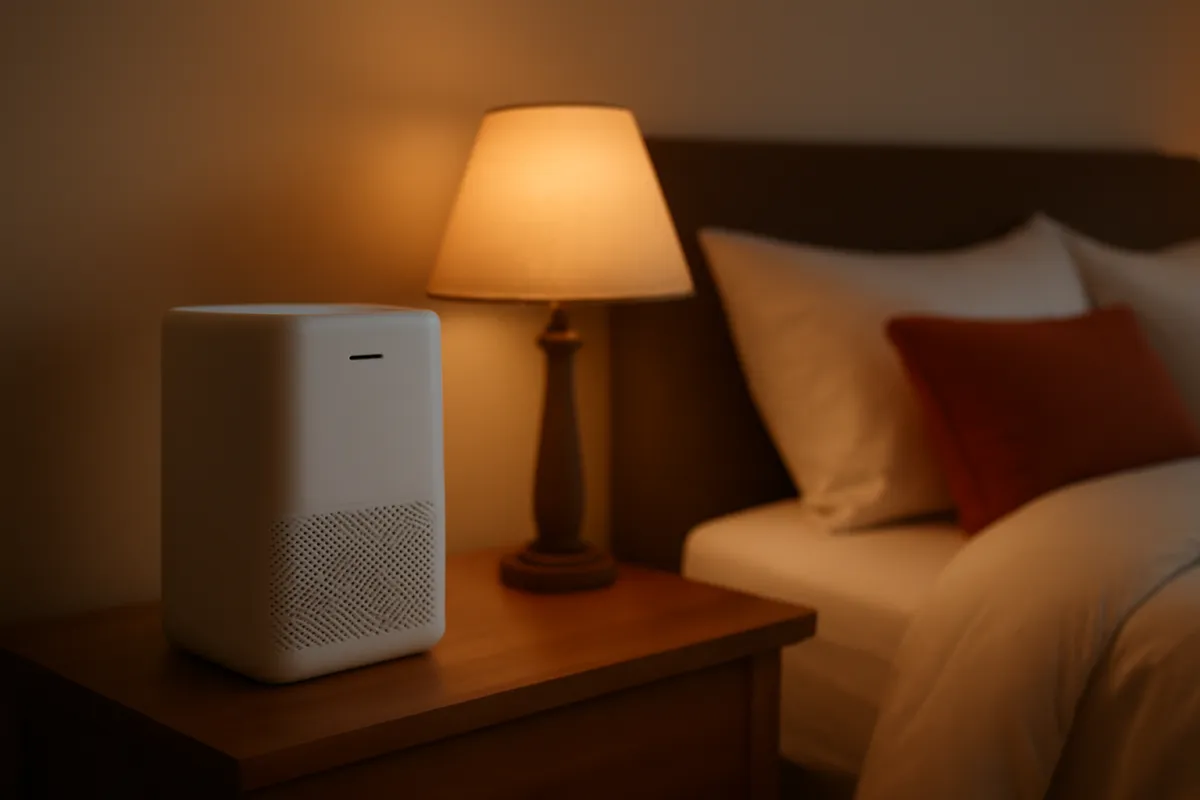
Size it by the room, not the price tag. Most dorm rooms fall between roughly 100 and 200 square feet, which a small unit rated for that range covers with the headroom to spare, and the sizing logic, matching the unit’s clean-air delivery rate to the square footage, is walked through in our air purifier selection notes. Skip anything marketed as an ionizer-only or filterless device, run the unit on its low or auto setting continuously rather than in bursts, and budget one replacement filter partway through the year, an illustrative $15 to $30 at dorm-unit sizes.
The quiet bonus is the hum. A purifier on low is a consistent, unobtrusive white noise, and in a building where the hallway hosts a conversation at 1 a.m. most nights, that steady sound floor is worth nearly as much as the filtration. For a light sleeper with allergies, this is the sleeper pick of the entire packing list.
What campus housing commonly bans, and why
The prohibited lists across campuses read like variations on one theme: nothing that makes serious heat in a room full of bedding. The commonly banned roster includes space heaters, hot plates and open-coil burners, toasters and toaster ovens, electric skillets and grills, deep fryers, candles and anything with a flame, halogen lamps, and, on many campuses, plain extension cords and daisy-chained power strips. Air conditioners typically require a documented accommodation rather than a shopping trip. Irons and hair tools are commonly fine but restricted to use away from bedding, and some halls confine them to designated rooms.
The reasoning is the wattage chart from earlier plus one factor the chart cannot show: attendance. A kettle demands your presence; you are standing there waiting for it. A space heater and a warming plate invite you to leave, and a device that runs hot while nobody watches, inches from curtains, in a building of hundreds of sleeping residents, is the scenario every housing policy is written against. Read the ban list in that light and it stops feeling arbitrary.
If your room genuinely runs cold, work the sanctioned channels: report it to facilities, since a broken radiator is their problem to fix, and upgrade the bedding, since a decent duvet solves overnight cold with zero watts. The space heater research can wait for your first apartment, where our space heater selection notes will actually be usable. Smuggling one into a dorm risks confiscation at best and disciplinary action at worst, and it is the single most commonly confiscated appliance for a reason.
The running-cost math on a student budget
Here is the whole electrical budget of a compliant dorm setup, priced with the same formula behind every cost-to-run report we publish: watts divided by 1,000, times hours used, times your electricity rate. Take an illustrative full loadout, a mid-size fridge averaging 0.85 kilowatt-hours a day, a purifier running most of the day for about 0.6, a fan through the warm months at about 0.3, and two kettle boils at roughly 0.1. That sums to a bit under 2 kilowatt-hours a day, which at a mid-teens-cents rate lands around $8 to $10 a month, or roughly $80 across a nine-month school year.
Where a dorm setup's electricity goes across a school year
Illustrative share of the roughly 1.9 kWh/day a full compliant setup uses at the loadout described above.
Shares are illustrative and shift with your habits: skip the purifier and the fridge dominates; boil constantly and the kettle slice grows but never gets large. The always-on machines own the total, not the high-watt ones.
The finding worth internalizing: the high-wattage device contributes the smallest slice, because it runs minutes a day, while the low-wattage always-on devices own the total. That inversion, duty cycle beating draw, is the core lesson of the whole wattage reference, and it is why the commonly allowed list is also, conveniently, the cheap-to-run list. Most halls bundle electricity into the housing fee, so treat these numbers less as a bill and more as proof that a compliant setup is a light load on the building.
Space planning: the constraint nobody budgets for
A typical shared dorm room offers each resident a strip of floor a few feet wide after the bed, desk, dresser, and closet take their cut, and every appliance competes for that strip against your laundry basket and your shoes. Planning the footprint before you shop matters more than any spec comparison, and the winning strategies are stacking and borrowing. The fridge top is a stand for the microwave or purifier. The under-bed void, especially with lofted or raised beds, swallows the fan in winter and the fridge year-round if the clearance allows. The desk hosts the lamp and the charging strip and nothing else.
Measure twice, literally. Before buying, get the room’s dimensions from the housing portal, which commonly publishes floor plans, and check three specific clearances: the height under the bed if you plan to slide the fridge there, the depth of the closet shelf if the fan summers in it, and the walking lane between the beds, which is the space every oversized purchase steals from first. A fridge that fits the room but blocks the lane will be resented by two people for nine months.
The corollary is that small, stackable, and multi-purpose beats big and dedicated in nearly every category. It is the same cost-per-use logic we apply to premium gear, with square footage standing in for dollars: an appliance’s real dorm price is its purchase price plus the floor it occupies, and the second term is the one that hurts. Run any borderline purchase through the cost-per-use calculator and then ask what the same footprint would hold instead.
Power strips, surge protectors, and outlet math
Dorm rooms are chronically outlet-poor, older halls especially, and the cord rules exist because of how students historically solved that: daisy chains of dollar-store extension cords running under rugs. The commonly cited modern pattern is specific: one surge-protected power strip per resident, with an internal circuit breaker, plugged directly into a wall outlet, and no plain extension cords, no strip-into-strip chains, and no cords under carpets or through doorways. Some campuses name the required strip spec in the handbook, so check yours before buying.
Use the strip for the low-draw desk cluster: laptop, monitor, phone, lamp, chargers. That whole cluster rarely exceeds 150 watts, well within any strip’s rating. Keep the fridge on its own wall outlet, both because compressor cycling is happier there and because it is the common policy expectation, and give any permitted heating device, microwave or kettle, its own wall outlet too, never a strip, since a 1,500-watt draw through a cheap strip is exactly the failure the rules are written to prevent. That allocation, heat and motors to the wall, electronics to the strip, is the entire discipline.
The surge protection itself is not theater: a residence hall’s wiring sees storms and load swings like any building, and the electronics on your desk are the most expensive things you own. A quality strip is an illustrative $20 to $30, which is cheap insurance for a laptop, and it satisfies the one appliance rule your inspection will definitely check.
Water: a filter pitcher and the kettle combo
The unglamorous workhorse of a dorm setup is not an appliance at all: a filter pitcher living in the mini fridge. Dorm tap water is safe but often tastes like the building’s pipes, and the taste is the reason students default to cases of bottled water that cost real money and claim real floor space all year. A pitcher fixes the taste for the illustrative price of a filter every couple of months, turns the fridge into a cold-water tap, and feeds the kettle better-tasting water that also scales it more slowly in hard-water buildings.

The pitcher-kettle-fridge triangle quietly covers most of a dorm’s food-adjacent needs: cold drinks from the fridge, hot water for tea, coffee, noodles, and oatmeal from the kettle, and the pitcher feeding both. Add the permitted microwave and the only thing the hall kitchen is truly needed for is actual cooking, which, by November, is a smaller share of student life than August plans assume.
One maintenance note ties the triangle together: change the pitcher filter on schedule, and descale the kettle each term, because both devices degrade invisibly and then all at once. Ten minutes of upkeep per semester keeps the water side of the room running like day one, and the payoff shows up every single day.
Roommate coordination: split the list, not the room
The most common appliance mistake in a shared dorm is not a banned item, it is duplication: two fridges humming against opposite walls, two microwaves, two kettles, in a room that barely holds one of each. A ten-minute conversation before move-in prevents it. Split the list: one resident brings the fridge, the other brings the microwave or kettle, the fan and purifier get assigned by whoever cares more, and both bring their own surge strip, the one item that genuinely should be per-person.
The split matters beyond floor space. Some campus policies cap appliances per room, not per resident, one fridge, one microwave, which makes the duplicate not just redundant but non-compliant. Shared items also want shared norms set early: who stocks the pitcher, whether fridge shelves are split or pooled, what happens to the shared kettle over winter break. None of these are hard conversations in August, and all of them are hard in February.
Plan the exit at the entrance, too. A shared fridge has to go somewhere in May, so decide upfront whose car it rides home in, or agree to sell it at year-end and split the proceeds. The used market on a campus in May is a buyer’s paradise and a seller’s compromise, which is worth knowing on both ends of the transaction, and it leads directly to the next question: whether to buy any of this new at all.
Buying used versus new for a two-semester life
Dorm appliances live a strange life: nine months of use, a summer in storage or a car trunk, and, for many students, retirement after two or three years when apartment living brings full-size everything. That lifecycle argues harder for buying used than almost any other category we cover. Every May, campuses shed lightly used mini fridges and microwaves at steep discounts through move-out sales, campus exchange groups, and the sidewalk economy, and every August those same machines are worth double again.
The used calculus favors simple machines. A mini fridge is a sealed compressor and a box; if a used one is cold inside, quiet, and clean, it has passed most of the test that matters, and an illustrative half-price used unit is usually the best value on the entire packing list. A used microwave that heats a mug of water quickly is similarly low-risk. The devices to buy new are the ones with wear items and safety roles: the kettle, whose shutoff mechanism you want factory-fresh, and the surge strip, whose protective components degrade invisibly with every surge they eat and whose history a used one cannot tell you.
Whichever route you take, run the numbers like a tester rather than a shopper: purchase price divided by expected months of service, via the cost-per-use calculator. A new fridge amortized over four years of college beats a used one that dies in March; a used one that survives beats everything. The math is boring and it is also the answer.
What to skip entirely
Every August a predictable roster of appliances gets packed, and every May the same roster gets hauled home unused. The blender leads the list: dorm smoothie ambitions run about two weeks, cleanup in a shared bathroom sink kills the habit, and the machine spends the year as a very loud bookend. The mini projector joins it, defeated by thin curtains and thinner walls. The clothes steamer, the sandwich press, the electric wax warmer, the desktop mini fridge for skincare, all fail the same test: a low-frequency use case paying a high-frequency rent in floor space.
The skip list has a policy wing, too. Anything on the commonly banned roster is an automatic skip regardless of how useful it would be, and a few gray-zone items are skips on practicality: a full drip coffee station where a kettle is allowed, a second monitor’s worth of desk appliances in a room with one outlet wall, a dehumidifier in a climate that does not need one. When in doubt, apply the April test: picture the item in April, and if the honest image is dust, leave it home in August.
The discipline is easier when you remember that skipping is reversible. A campus store, an online order, or the May used market can fill any genuine gap inside a week, all year long. Packing light and buying the gap you actually feel beats packing heavy and storing the guesses, and it is the single cheapest optimization in this entire breakdown.
A worked example: one dorm room, priced out
Put the whole report together on a single illustrative setup for one resident of a shared double, using round planning numbers rather than quotes. The buy list: a mid-size used mini fridge at $60, a new auto-shutoff kettle at $30 where policy allows one, a tower fan at $40, a small true-HEPA purifier at $70, a required-spec surge strip at $25, and a filter pitcher at $25 with two spare cartridges. Total outlay: about $250, with the fridge bought used doing the heavy lifting on the budget.
The running cost, from the earlier math: just under 2 kilowatt-hours a day, roughly $8 to $10 a month at a mid-teens-cents rate, folded invisibly into most housing fees. The consumables across the year: one purifier filter around $20, pitcher cartridges around $15, a descaling vinegar bottle at $3. Full-year cost of ownership lands near $290 for the setup, and the amortization is where it gets cheap: if the fridge, fan, and purifier serve three years of college, the per-year figure drops toward $130, and the cost-per-use calculator will happily show the per-day number, which is small enough to embarrass a single week of bottled water and vending machines.
The counter-scenario is instructive: the same room outfitted in August-panic mode, new everything, plus a blender, projector, and duplicate microwave, runs an illustrative $600 or more, with the extras appearing exactly once at move-out. Same room, same year, same comfort. The difference is entirely in reading the policy first, splitting the list with the roommate, and letting the used market do what it does every May.
Move-out day and summer storage
The dorm appliance year ends in a specific, predictable crunch: finals week, a deadline to vacate, and a car that holds less than it held in August. Plan the appliance exit in April rather than during it. The fridge needs a full defrost, twenty-four hours unplugged with the door open and a towel under it, before it can travel or store without growing a swamp; a fridge closed up wet in May is a biology experiment by September. The kettle gets a final descale, the purifier filter gets checked so a spent one is not stored for nothing, and the fan gets a dusting before it goes in a box.
The storage decision follows the same cost-per-use math as everything else. Campus-adjacent summer storage runs real money per month, so weigh three months of fees against the appliance’s replacement price: storing a $60 used fridge rarely pencils out unless the storage is shared or cheap, while storing a $250 setup across town from a distant home can beat re-buying everything by a comfortable margin. The May sell, September re-buy cycle is genuinely rational for students far from campus with cheap access to the used market on both ends.
Whatever the plan, leave the room’s own infrastructure the way inspection expects it, and get the shared-item settlement done before finals brain sets in: who takes the fridge, who gets paid out, who stores the fan. The August version of you, and of your roommate, will inherit whatever the May version decides, so decide it on purpose.
Your dorm appliance checklist
Run the whole breakdown as a sequence before the first shopping trip:
- Read your housing handbook’s appliance section first, and email the housing office about anything ambiguous, especially kettles and coffee gear, the rules that vary most.
- Split the list with your roommate before either of you buys: one fridge, one microwave or kettle per room, own surge strips each.
- Buy the anchor first: a mid-size mini fridge, around 3 cubic feet, used if a clean one is available, and confirm it fits your school’s stated cap.
- Add the comfort pair: a quiet fan for the warm months and a small true-HEPA purifier sized to the room’s square footage.
- Add hot water where allowed: an auto-shutoff, enclosed-element kettle, bought new, plus a filter pitcher to feed it and the fridge.
- Buy the required strip: one surge-protected, breaker-equipped power strip per person, electronics on the strip, fridge and heat devices on wall outlets.
- Skip the aspirational tier: blender, projector, sandwich press, and anything on the banned roster, and fill genuine gaps later instead of storing guesses.
- Calendar the maintenance: descale the kettle each term, swap the purifier and pitcher filters on schedule, defrost the fridge before move-out.
Eight lines, one afternoon of shopping, and the room is equipped like someone who read the policy, because you did.
The bottom line
A dorm room rewards the same thinking as any gear category we test: a short list of boring, high-frequency machines, sized to the space, bought at the right point in their lifecycle, beats a car full of aspirational purchases every time. The anchor is a mid-size mini fridge, the comfort layer is a fan and a small true-HEPA purifier, the quality-of-life layer is a kettle and filter pitcher where rules allow, and the compliance layer is one proper surge strip and a clean conscience at inspection. The whole setup draws under 2 kilowatt-hours a day, illustratively $8 to $10 a month, precisely because everything a dorm commonly permits is low-draw by design, and everything high-draw is banned for reasons the wattage chart makes obvious. The one non-negotiable step is reading your own housing policy before spending a dollar, because every rule in this report is a commonly cited pattern and your campus’s handbook outranks all of it. Do that, split the list with your roommate, let May’s used market subsidize August, and the appliance side of college becomes what it should be: a few quiet machines doing their jobs while you get on with the actual point of being there. Price any lingering debate with the wattage reference and the cost-per-use calculator, and pack the car light.
A note on scope before you load the car: this breakdown describes commonly cited dorm-policy patterns gathered across many campuses, and none of them is a statement of your school’s actual rules, which are set locally, change between years, and are enforced by your housing office alone, so read your own handbook and ask before you buy. Every wattage, price, and running-cost figure here is an illustrative planning number rather than a measurement or quote for any specific model, and electricity rates vary widely by region and season. Nothing here is safety, electrical, or professional advice: follow your campus’s rules and every manufacturer’s instructions, and when a policy and this report disagree, the policy wins without argument.
Frequently asked questions
What appliances are allowed in a dorm room?
Policies differ by school, so the only reliable answer comes from your own housing handbook, but the commonly allowed pattern is consistent: a mini fridge under a stated size cap, a low-wattage microwave or a school-approved combo unit, a fan, a small air purifier, lamps, chargers, and a surge-protected power strip. Devices with automatic shutoff, enclosed heating elements, and modest wattage tend to pass; devices with open coils or high heat output tend not to. Kettles and coffee makers sit in the gray zone that varies most from campus to campus. Read your specific policy before buying anything, because a banned item can be confiscated at inspection.
Are mini fridges allowed in dorms?
A mini fridge is the most widely permitted dorm appliance there is, which is why it anchors nearly every packing list. The common policy pattern is a size cap, often somewhere around 3 to 4.5 cubic feet, sometimes paired with an amperage or wattage limit, and some campuses instead require you to rent an approved fridge or combo unit through the school. A compact fridge draws a modest 60 to 100 watts while its compressor runs and cycles on and off, so its running cost is small. Confirm your school's exact cap before buying, since an over-size fridge is one of the most common items flagged at move-in.
Are electric kettles allowed in dorms?
This is the rule that varies most between campuses, so treat any general answer as a starting point only. A commonly cited pattern permits kettles with automatic shutoff and a fully enclosed heating element, because that design removes the two failure modes housing offices worry about: a unit left boiling dry and an exposed hot coil. Other campuses ban all open-top water boilers in rooms and point students to a shared kitchen instead. If your policy allows one, an auto-shutoff kettle is among the most useful items in the room, brewing tea, coffee, instant noodles, and oatmeal for a few cents of electricity per boil. Check the handbook, then check it again at move-in, because kettle rules change more often than fridge rules.
Why are space heaters banned in dorms?
The ban shows up almost universally, and the wattage explains it. A typical space heater draws about 1,500 watts, roughly the entire safe load of a standard circuit, in a building where dozens of rooms share wiring and every room is furnished with bedding, curtains, and paper. High heat output close to fabric, a device that is dangerous to leave unattended, and a load that can trip or overheat shared circuits is the exact profile a housing office exists to keep out of the building. If your room runs cold, the sanctioned fixes are a report to facilities and warmer bedding. Save the heater research for a future apartment, where our space heater notes can help.
Is an air purifier worth it in a dorm room?
A dorm is close to the ideal purifier scenario: one small room where you sleep, study, and often eat, shared air with a roommate, and a building full of dust from constant traffic. A small true-HEPA unit sized for roughly 100 to 200 square feet handles most dorm rooms with headroom, draws only about 20 to 40 watts, and runs quietly enough to double as white noise. For allergy sufferers it is one of the highest-value items on the list, and it is broadly permitted since it makes no heat. Size it by the room's square footage rather than price, and budget for a replacement filter partway through the year.
How much does it cost to run dorm room appliances?
Less than most students expect. An illustrative full setup, a mid-size mini fridge, a fan run through the warm months, a small air purifier running most of the day, and a couple of kettle boils daily, works out to roughly 1.5 to 2 kilowatt-hours a day, which at a typical mid-teens-cents electricity rate is in the neighborhood of $8 to $10 a month. Most residence halls fold electricity into the housing fee, so the figure matters less as a bill and more as a sanity check that nothing on the list is a heavy load. The heavy loads, heating and cooling appliances, are exactly the ones policies keep out.
What size mini fridge fits a dorm room best?
For one person, the mid tier around 2.7 to 3.3 cubic feet is the sweet spot: enough room for drinks, leftovers, and a week of snacks without dominating the floor plan, and comfortably under the common policy caps. The tiny 1.7 cubic foot cubes fit anywhere but fill up in two grocery trips, while the tall 4.4 cubic foot units hold real groceries but eat floor space and can exceed stricter caps. Check the height too if you plan to use the fridge top as a stand, and leave a couple of inches of breathing room behind it so the coils can shed heat. Your school's stated cap overrides all of this.
Do I need a surge protector in a dorm room?
The common policy pattern actually points the other way from what most students assume: many campuses require that any power strip be a surge-protected model with an internal circuit breaker, and ban plain extension cords and daisy-chained strips outright. One quality strip per resident, plugged directly into a wall outlet, covers the laptop, phone, lamp, and small electronics cluster around a desk. Keep the high-draw items, the fridge and anything with a heating element your school permits, on their own wall outlets rather than sharing a strip. It is a small purchase that satisfies the rule and protects the electronics that actually matter.