What's on this page
- How much does it cost to run a freezer? The short answer
- The running-cost formula: annual kWh times your rate
- Why a freezer is not just a colder fridge
- Reading the yellow EnergyGuide label on a freezer
- Illustrative running cost by freezer type and age
- Annual cost by freezer type and age
- Chest vs upright: why the lid wins on energy
- Manual defrost vs frost-free: what the defrost cycle costs
- Size and capacity: cost per cubic foot
- Your electricity rate is the biggest variable
- Garage and basement placement: ambient temperature drives the compressor
- Cold garages and the rated ambient minimum
- How full the freezer is, and what fullness actually does
- Where a household’s cold-storage electricity goes
- The old second freezer people keep running for a decade
- Temperature setting, lid habits, and frost
- Maintenance that actually moves the number
- Does a second freezer pay for itself in bulk buying?
- When replacing an old freezer pays for itself
- A worked example: two households, two freezers
- Ways to cut your freezer running cost
- How to shop: a freezer running-cost checklist
- The bottom line
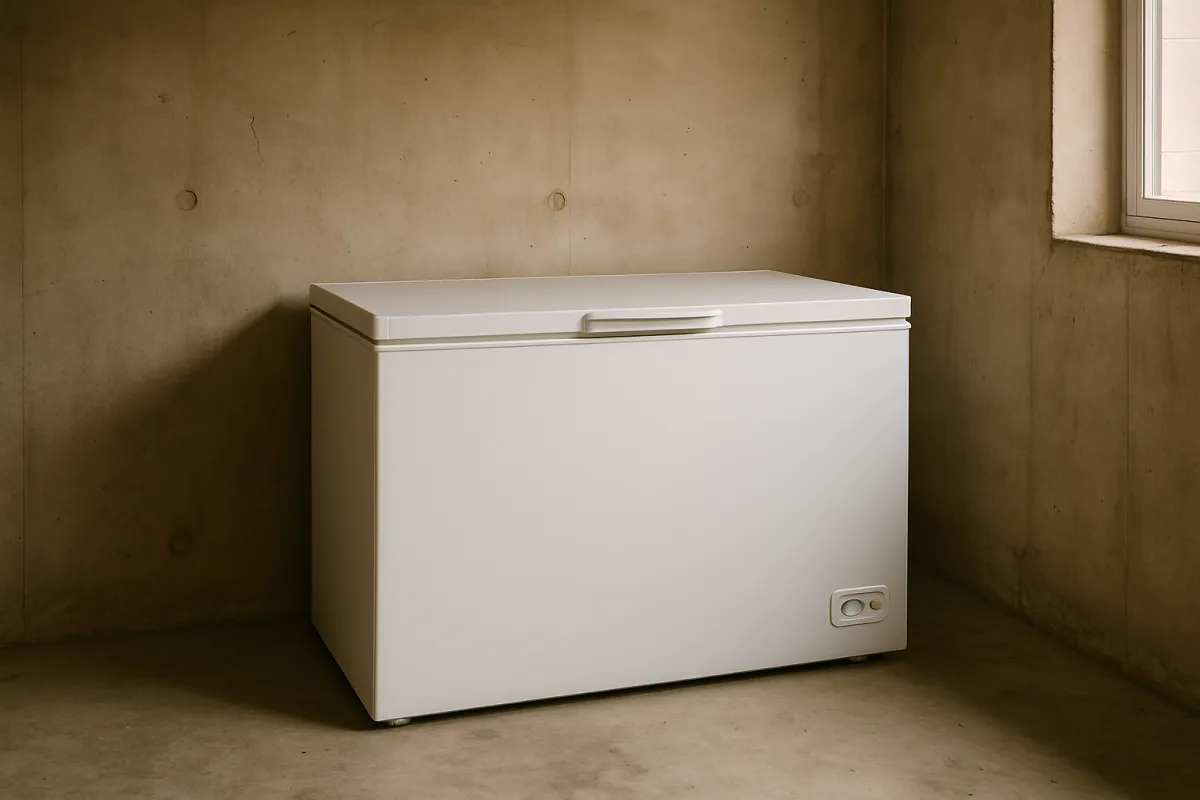
A standalone freezer is the appliance nobody prices. It goes in the garage or the basement, it gets filled with a bulk meat order and a summer’s worth of berries, and then it hums quietly for the next fifteen years without anyone ever asking what it costs. Unlike the machines in the rest of this running-cost series, there is no moment where you switch it on and think about the bill. It simply runs, every hour of every year, and the money it spends folds silently into a total you pay without ever seeing a line for it.
This lab report drags that number into daylight. It gives you the one formula that turns any freezer’s energy rating into dollars a month, then works through the things that actually move the figure: chest versus upright and why the lid design matters, manual defrost against frost-free and what the defrost cycle costs you, the garage and basement placement question that cuts both ways, how full the box is, and the old second freezer people keep running a decade past its efficiency. It shares its method with our refrigerator running-cost lab report and follows the kilowatt-hour conventions in our appliance wattage and running-cost reference. Put your own label figure and rate into our cost-per-use calculator as you read and watch the monthly number settle.
Key takeaways
- The whole formula is annual kilowatt-hours from the yellow EnergyGuide label, times your electricity rate in dollars per kilowatt-hour, divided by twelve for a monthly figure.
- A typical modern standalone freezer near 350 kilowatt-hours a year costs about $56 a year, roughly $4.67 a month, at an illustrative $0.16 rate.
- Chest beats upright on energy because cold air sinks and stays in the box when you open the lid, and most chest models skip the frost-free defrost heater.
- Placement is a real cost lever: a hot garage pushes the compressor past what the label assumed, and a freezing garage can fall below the unit's rated ambient range.
- An old second freezer at 900 kilowatt-hours costs near $144 a year, about $12 a month, which is the grocery saving bulk buying has to clear before it breaks even.
How much does it cost to run a freezer? The short answer
A freezer costs its annual kilowatt-hours times your electricity rate, and for a typical modern standalone unit that lands near $56 a year, about $4.67 a month, at an illustrative $0.16 per kilowatt-hour. Divide that yearly figure by 365 and it is roughly 15 cents a day, which is why nobody notices it. The honest range is wider than the headline: an efficient chest model can sit near $3.33 a month, while an old unit in a hot garage can run $12 a month or more for the same job.
Every figure in this report is illustrative. The rate is the one number no article can supply for you, and the annual kilowatt-hours are set by the specific unit sitting in your basement, not by an average. What this lab report can give you is the method and the shape of the answer: a good modern freezer is a few dollars a month, a bad old one is triple that, and the difference between them is worth more than any habit you could change.
The reason so many households get this wrong is that a freezer presents no decision point. You buy it once, you plug it in once, and after that it never asks for anything. The cost accrues in the background at a rate you chose implicitly on the day you picked the model and the spot to put it in. The rest of this article is about making those two choices deliberately.
The running-cost formula: annual kWh times your rate
Here is the entire calculation, and it is the same watts-to-dollars logic behind every cost-to-run report we publish: take the energy the freezer uses across a year, expressed in kilowatt-hours, and multiply it by your electricity rate expressed in dollars per kilowatt-hour. The result is the cost for the year. Divide by twelve for a month, by 365 for a day.
Written out: annual kilowatt-hours times rate equals yearly cost. A freezer rated at 350 kilowatt-hours a year, at a rate of $0.16 per kilowatt-hour, costs 350 times 0.16, or about $56 for the year. That is roughly $4.67 a month and about 15 cents a day. Nothing else in this report changes that arithmetic; everything else changes one of the two inputs to it.
The convenience of a freezer, compared to a heater or a dryer, is that you do not have to estimate hours. A freezer runs all 8,760 hours in a year, so the annual kilowatt-hour rating already spans a full year of the compressor cycling on and off. There is no usage assumption for you to get wrong. If you would rather work from power draw, the long way is average watts times hours divided by 1,000 times your rate, but the average draw of a freezer is not its nameplate wattage, because the compressor is idle much of each hour. The annual figure sidesteps that entirely, which is why it is the number to use. Our cost-per-use calculator holds the annual kilowatt-hours and your rate and does the arithmetic live.
Why a freezer is not just a colder fridge
It is tempting to treat a standalone freezer as a refrigerator with the dial turned down, but the two behave differently enough that the cost math does not transfer cleanly. A freezer holds roughly forty degrees Fahrenheit below a fridge compartment, so the temperature gap between the inside of the box and the room around it is far larger. Heat leaks across a bigger gap faster, which means more of each hour spent running the compressor to push it back out.
Against that, a freezer has advantages the fridge does not. It is opened a fraction as often. Nobody browses a deep freezer the way they browse a fridge at nine in the evening. It holds dense frozen mass that buffers temperature between cycles rather than mostly air. And a chest design in particular is built with thick insulation on all six sides and a lid that keeps its cold in when opened. Those factors partly cancel the larger temperature gap.
The result is that a good standalone freezer often uses less electricity per year than a full-size refrigerator, despite running much colder. Our refrigerator running-cost lab report prices a typical modern fridge near 500 kilowatt-hours a year against roughly 350 for a typical standalone freezer here, both illustrative. That surprises people who assume colder always means costlier. Temperature is only one term; insulation, door habits, and defrost design are the others, and a freezer wins on most of them.
Reading the yellow EnergyGuide label on a freezer
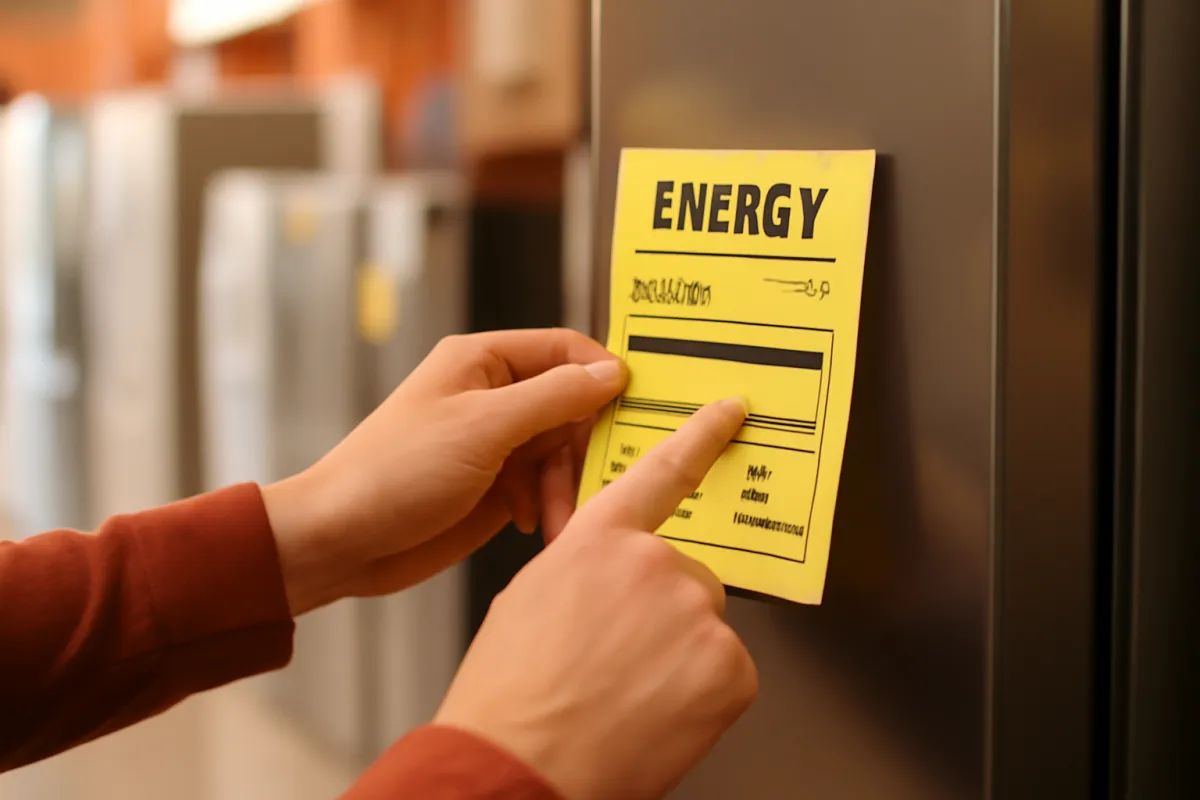
The easiest way to price any freezer is to read the number someone already computed. Freezers sold in the United States carry a yellow EnergyGuide label, and the large figure on it is the estimated energy use in kilowatt-hours per year. That single number is the input to the whole formula, and it already blends the compressor’s on and off cycles into one realistic annual total.
Treat the estimated yearly dollar figure printed alongside it with more care. It is calculated at a national average electricity rate that may bear no resemblance to yours, so it prices someone else’s power, not yours. The kilowatt-hour figure is the rate-independent, honest number: take it, apply the rate off your own bill, and you get a figure that reflects your meter. The same reasoning applies to every appliance in our energy-efficient appliance buying notes, where the label is the one comparison that survives marketing.
For an older freezer whose sticker vanished a decade ago, you have two options. You can look up the model’s rating if it is recent enough to appear in a database, or you can measure it directly. A plug-in energy meter sits between the outlet and the plug, accumulates real kilowatt-hours, and after a full week you multiply by 52 for an annual figure that includes the actual duty cycle in your actual room. For an old garage unit, measuring is usually more honest than any assumption, because the difference between a guess and reality on those units is often larger than the entire cost of a new efficient one.
Illustrative running cost by freezer type and age
Put realistic numbers to the spread so the range stops being abstract. A compact freezer around 5 cubic feet might use 200 kilowatt-hours a year. A new efficient chest freezer around 15 cubic feet, manual defrost, sits near 250. A modern frost-free upright around 16 cubic feet lands near 400. A ten-year-old upright, worn a little and built to older standards, is often near 600. And an old unit fifteen or more years into its life, especially one living in a hot garage, can reach 900 kilowatt-hours a year or beyond.
At an illustrative $0.16 per kilowatt-hour, those become annual costs of about $32, $40, $64, $96, and $144 respectively. In monthly terms that is roughly $2.67, $3.33, $5.33, $8.00, and $12.00. The whole subject lives inside that spread, and the gap between the cheapest and the most expensive is more than four to one for what is fundamentally the same service: holding food at zero degrees.
What should strike you is that capacity is not the main driver of the ranking. The 15 cubic foot chest costs less to run than the 16 cubic foot upright, and far less than the older unit that may hold no more food. Design and age do more work than size. That is the recurring lesson of running-cost math across our whole appliance series, and it is why a bigger, newer, better-insulated unit often beats a smaller old one on the bill as well as on usefulness.
Annual cost by freezer type and age
The chart below makes that spread visual. It prices each unit at an illustrative $0.16 per kilowatt-hour and derives every bar’s length from that unit’s annual dollar cost, so the longest bar is the most expensive freezer to run for a year.
Illustrative annual running cost by freezer type and age
Each unit priced at $0.16/kWh across a full year. Bars scale with the annual dollar figure. Illustrative planning numbers, not measured results.
The old garage unit's bar is four and a half times the compact one, and three and a half times the new chest freezer that holds three times as much food.
Read the chart from the bottom up rather than the top down. The most expensive freezer here is not the biggest; it is the oldest and the worst placed. The new 15 cubic foot chest at $40 a year holds three times the food of the compact unit at $32 and costs only eight dollars a year more to run. That is the argument against squeezing into a small freezer to save money: you rarely save much, and you lose the capacity that made the purchase worth it. Run your own label figure through the cost-per-use calculator to see where your unit sits on this scale.
Chest vs upright: why the lid wins on energy
The chest versus upright choice is usually decided on convenience, and there is a real cost attached to that decision. A chest freezer at a comparable capacity generally carries a lower annual kilowatt-hour rating than an upright, and two separate mechanisms are responsible.
The first is the lid. Cold air is denser than warm air, so it sinks and pools. When you open a chest freezer, the cold sits in the box like water in a bathtub; very little of it leaves, and warm room air does not rush in to replace it. When you open an upright, the cold air spills out of the bottom of the opening and across your feet while warm air pours in at the top, and the compressor has to remove that heat all over again. Every door opening on an upright costs more than every lid opening on a chest.
The second is insulation and shape. A chest freezer is a simple insulated box with no shelving to route around and no through-the-door hardware, so the walls can be thicker and the joins simpler. An upright trades some of that for shelves, drawers, and a full-height door seal that has more perimeter to leak through.
In an illustrative pairing, a 15 cubic foot chest at 250 kilowatt-hours a year costs about $40 at a $0.16 rate, while a 16 cubic foot frost-free upright at 400 kilowatt-hours costs about $64. That is a difference near $24 a year, or two dollars a month. Whether that is worth stooping over a chest to dig for a bag of peas is a genuinely personal call, and the honest answer is that $24 a year does not force anyone’s hand. The reason to know the number is so you choose the upright knowing what convenience costs rather than assuming it is free.
Manual defrost vs frost-free: what the defrost cycle costs
Part of that chest-versus-upright gap is not about the lid at all; it is about defrost design, and it deserves separating out because you can buy either design in either shape.
A manual defrost freezer has no automatic frost management. Moisture that enters when you open it condenses and freezes onto the interior walls and the evaporator, and over months it builds into a layer you eventually chip and melt away by hand. Nothing in that process consumes extra electricity, but a thick frost layer does: frost insulates the coil from the air it is supposed to be chilling, so the compressor runs longer for the same result. A manual defrost freezer is cheapest when you actually defrost it.
A frost-free freezer solves the chore with hardware. On a timer or a demand signal, a small heater near the evaporator warms up and melts accumulated frost, which drains away. The freezer then has to remove the heat that heater just added, on top of the heat that leaked in normally. So the defrost cycle costs twice: once for the heater, once for the compressor undoing it. That is a real and recurring energy cost, and it is the main reason frost-free units carry higher label figures than otherwise comparable manual models.
The honest limit on this comparison is that you cannot cleanly separate the lid effect from the defrost effect using label figures alone, because the models that differ in one usually differ in the other. What you can do is compare label figures directly between the specific units you are considering, which already bundles every effect into one number. If you are weighing convenience against cost, remember what you are actually buying with frost-free: not colder food, but never scraping ice out of a box again, at a running-cost premium that shows up on the label.
Size and capacity: cost per cubic foot
Bigger freezers use more electricity in absolute terms and less per unit of storage, and the second half of that sentence is the one people miss. Convert the illustrative figures into cost per cubic foot per year and the picture inverts.
- A 5 cubic foot compact at 200 kilowatt-hours costs about $32 a year, which is $6.40 per cubic foot
- A 15 cubic foot chest at 250 kilowatt-hours costs about $40 a year, which is $2.67 per cubic foot
- A 16 cubic foot frost-free upright at 400 kilowatt-hours costs about $64 a year, which is $4.00 per cubic foot
The compact unit is the cheapest freezer on the list and by far the most expensive way to freeze a given amount of food. Small compressors are less efficient, thin cabinets carry less insulation, and the surface area of the box does not shrink as fast as its volume does. This is the same pattern our refrigerator report finds with mini-fridges, and it matters for the same reason: a compact freezer is the right answer when you genuinely need a little frozen storage, and the wrong answer when you need a lot and are trying to be frugal about it.
The practical rule that falls out of this is to buy the capacity you will actually fill, not the smallest box you can tolerate. Under-buying pushes you toward a second unit later, and two small freezers cost meaningfully more to run than one properly sized one. Over-buying wastes floor space and leaves you cooling air. Fill rate is the thing to estimate honestly before you shop, because it decides both the size and, as the next sections show, part of the running cost too.
Your electricity rate is the biggest variable
The freezer’s energy use is fixed by the unit, its age, and where it lives. The electricity rate is the wild card, and it swings the dollar figure more than any choice you make about the appliance itself. Residential rates vary widely by region, utility, and season, which is why every figure in this report is quoted with its rate attached.
Find your rate on your electricity bill, where it is usually printed in cents per kilowatt-hour. Then hold a typical standalone freezer at 350 kilowatt-hours a year and watch the annual cost track the rate:
- At 10 cents per kilowatt-hour: about $35 a year, near $2.92 a month
- At 16 cents per kilowatt-hour: about $56 a year, near $4.67 a month
- At 24 cents per kilowatt-hour: about $84 a year, near $7.00 a month
- At 32 cents per kilowatt-hour: about $112 a year, near $9.33 a month
That is more than a threefold spread from the identical appliance doing the identical job. It is also why a blanket claim that freezers are cheap to run means nothing without a rate attached. On a high rate, an inefficient old freezer becomes genuinely expensive and the replacement math tips toward acting sooner; on a low rate, the same unit is an annoyance rather than a problem. The rate is also the lever behind most of the advice in our notes on lowering your electric bill, because knowing it turns every appliance decision into arithmetic. Enter your exact rate in the cost-per-use calculator and every figure in this report reprices itself.
Garage and basement placement: ambient temperature drives the compressor
Where you put a freezer is a running-cost decision, and it is the one most households make on the basis of floor space alone. The mechanism is straightforward: a compressor moves heat from inside the box to the room around it, and the harder that room pushes back, the longer the compressor must run to shift the same heat.
The label figure is measured in a controlled test environment near normal indoor temperature. A freezer in a conditioned basement or a utility room off the kitchen lives in roughly those conditions, so its real consumption tends to track the label. A freezer in an attached garage that reaches the nineties on a July afternoon does not. The same box, holding the same food at the same setpoint, spends more of each hour running because it is dumping heat into a hot room. Real consumption climbs above the rated figure, and neither the label nor any calculator can tell you by how much, because it depends on your garage, your climate, and your summer.
That is the honest version of the answer: hot placement costs more, the direction is certain, and the magnitude is specific to you. If you want the number, a plug-in energy meter left on the freezer through a hot week and a mild week shows you the difference directly. The general principle worth acting on is that a basement or interior utility room is the cheaper home for a freezer than an uninsulated garage, and that shading, ventilation, and a few inches of clearance around the unit all help it shed heat instead of re-absorbing its own exhaust.
Cold garages and the rated ambient minimum
The garage question cuts the other way too, and this half surprises people. Common sense says a freezer in a cold garage should be nearly free to run, since the room is already close to freezing. Sometimes it is. But cold ambient temperatures create problems that have nothing to do with the bill.
Many freezers carry a rated ambient temperature range in the manual, with a stated minimum. Below that range, behavior gets unreliable. Compressor lubricant thickens in the cold, which is hard on the machine at startup. Some units have controls that respond to ambient conditions in ways that leave the compartment warmer than the setpoint, because the surrounding room is no longer telling the system what it expects to hear. The failure mode people report from unheated garages is not a high bill; it is food that softened over a cold snap in a freezer that seemed to be running fine.
Some models are explicitly built and rated for unconditioned spaces, and manufacturers say so plainly in the specifications. If a freezer is going into a garage, a shed, or an unheated basement in a cold climate, the rated ambient range is a specification worth checking before purchase rather than after. It costs nothing to read and it is the difference between a unit that will be fine for fifteen years and one that will quietly fail its job every winter. The same durability thinking runs through our rundown of how long appliances last: the environment an appliance lives in shapes its lifespan as much as its build quality does.
How full the freezer is, and what fullness actually does
“Keep your freezer full to save money” is one of the most repeated pieces of appliance advice, and it is true in a smaller way than it is usually told. Understanding the mechanism tells you how much to expect.
Frozen food is thermal mass. Once a pound of food is at zero degrees, it stays there without any further energy input; it only warms when heat reaches it. A freezer packed with frozen mass therefore holds its temperature steadily between compressor cycles, and when you open it, the small volume of air that exchanges carries far less heat than a whole cabinet of air would. So the compressor tends to run in fewer, longer cycles rather than many short ones.
What that does not mean is that a full freezer draws meaningfully less power over a year. The heat still leaks in through the same walls at the same rate, because the walls, the room temperature, and the setpoint have not changed, and heat leakage through the cabinet is the dominant load in an appliance you open a couple of times a week. Fullness mostly changes the timing of the work, not the total.
Where fullness genuinely pays is resilience. A full freezer recovers faster after being opened and survives a power outage far longer than an empty one. Commonly cited food safety guidance puts a full freezer at roughly 48 hours and a half-full freezer at roughly 24 hours with the door kept shut, and the food safety authorities publish the current version of that guidance, so confirm it there rather than trusting any number quoted online. Filling gaps with jugs of water is a sensible outage precaution. Just do not expect it to show up on your bill.
Where a household’s cold-storage electricity goes
The most useful way to see a second freezer is not on its own but as a share of everything in the house that runs a compressor around the clock. The chart below splits an illustrative household’s annual cold-storage electricity across three units: a modern main fridge at 500 kilowatt-hours, a modern standalone freezer at 350, and an old second freezer in the garage at 900. That totals 1,750 kilowatt-hours a year, about $280 at an illustrative $0.16 rate.
Where a household's cold-storage electricity goes
Share of 1,750 kWh a year across a modern fridge, a modern standalone freezer, and an old garage freezer. Illustrative.
The unit nobody thinks about is more than half the total. It costs about $144 a year on its own against $280 for all three.
The shape of that chart is the whole argument of this report. The appliance the household uses constantly, the kitchen fridge, is the smaller share because it is modern and efficient. The freezer people bought deliberately and think of as an expense is a fifth of the total. And the unit that arrived free from a relative, lives in the garage, and holds four bags of ice and a turkey is more than half the bill. Cold storage is one of the few areas of a home’s electricity where the money is concentrated in the thing you pay least attention to.
The old second freezer people keep running for a decade
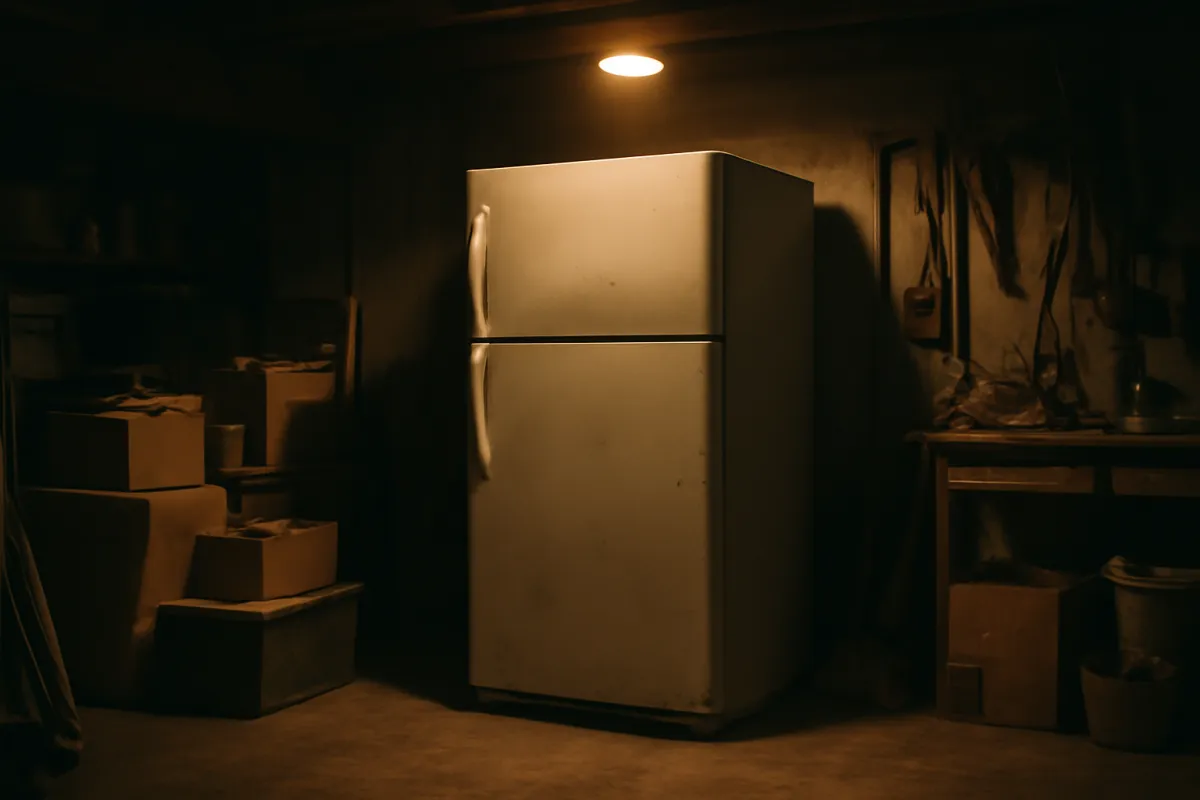
Almost every household that has an energy problem in its cold storage has the same specific problem: a freezer that is fifteen or twenty years old, inherited or held over from a previous house, running at maybe a third capacity in a space nobody visits. It never breaks, so it never prompts a decision. It just quietly spends about $144 a year at an illustrative $0.16 rate, roughly $12 a month, or about $1,440 over the ten years it will probably keep going.
That figure is worth sitting with, because $1,440 buys several new efficient freezers. The unit is not doing anything wrong; it is doing exactly what it did when it was new, which was already less efficient than a current model, and it has since accumulated a hardened door gasket, dusty condenser coils, and a compressor that has run continuously for two decades. Every one of those makes it run a larger share of each hour.
There are only three sensible outcomes, and the right one depends on how much you use it. If it is genuinely full and genuinely used, replacing it with a modern unit is the move, and the payback section below shows how to price that. If it is half empty and you could consolidate into your main freezer, unplugging it is the single best-value energy action available to most households, because it costs nothing, takes two minutes, and removes more than half of your cold-storage bill. And if you cannot decide, put a plug-in meter on it for a week before you argue with anyone about it. A measured number ends the debate faster than an estimate ever will.
Temperature setting, lid habits, and frost
Because a freezer’s cost is set by how much of each hour the compressor runs, the levers you have are the ones that change that share, and the setpoint is the first of them. The commonly cited target for frozen storage is 0 degrees Fahrenheit. Colder than that does not make food safer in any way you will notice; it simply widens the gap between the box and the room, which means more heat leaking in and more compressor hours removing it. If your freezer has an unlabeled dial rather than a temperature readout, an inexpensive freezer thermometer left inside overnight tells you where you really are, and a lot of dials are set colder than anyone intended.
Lid and door habits matter more on an upright than on a chest, for the density reason covered earlier, but they matter on both. Know roughly where things are before you open the lid, organize with baskets or bins so digging is fast, and keep the opening short. Freezing warm food adds a burst of heat the compressor has to remove, so cool anything hot before it goes in, and freeze in reasonably flat packages so the heat comes out of them faster.
Frost is the third lever, and it is the one specific to freezers. On a manual defrost unit, frost accumulates on the walls and coil, and once it thickens it insulates the surfaces that are supposed to be pulling heat out of the air. A quarter inch of frost is the commonly cited point to defrost, and doing it on schedule is the difference between a manual freezer being the cheapest type to run and being no better than a frost-free one. On a frost-free unit the machine handles this for you, and the energy it spends doing so is already inside the label figure.
Maintenance that actually moves the number
Two pieces of maintenance genuinely change a freezer’s running cost, and both are about helping it shed heat and stop leaks. Neither takes long, and neither needs a technician.
The first is the door or lid gasket, the flexible seal around the opening. Over years it hardens, takes a set, and stops making full contact, so cold leaks out at the edges continuously and the compressor runs to make it up. The paper test is quick: close the lid on a slip of paper and pull. If it slides out with no resistance, the seal at that point is not sealing. Walk the whole perimeter that way and you will find the weak spots. Gaskets are replaceable on most units, and on a chest freezer a lid that no longer sits square is often just a levelling problem, since a chest cabinet that has settled on an uneven floor can twist enough to break the seal.
The second is the condenser coil, the tubing that releases the heat the freezer pulled out of the food. On many units it sits at the back or underneath, and on some chest models it is bonded to the outer skin of the cabinet, which is why those get warm to the touch and why crowding them against a wall hurts. Dust, pet hair, and lint blanket a coil and turn it into an insulator, so the compressor runs longer and hotter for the same result. Pull the unit out twice a year and vacuum or brush the coil clean. The cleaning approach is the same one we walk through for a fridge in our refrigerator cleaning walkthrough, and it pays back on a freezer for the same reason. Give the unit clearance on all sides so it is not breathing its own exhaust, and keep it out of direct sun.
Does a second freezer pay for itself in bulk buying?
This is the question that actually sells freezers, and it deserves a straight answer rather than an encouraging one. A second freezer pays for itself only when the grocery saving it enables genuinely clears its running cost plus its purchase price spread over its life. Both sides of that are calculable before you buy.
Start with the bar it has to clear. A new efficient chest freezer at 250 kilowatt-hours a year costs about $40 a year to run at an illustrative $0.16 rate, roughly $3.33 a month. That is a low bar; almost any real bulk-buying habit clears $3.33 a month. An old inherited unit at 900 kilowatt-hours costs about $144 a year, roughly $12 a month, and that is a genuinely harder bar. A household saving $10 a month buying meat in bulk is losing money running the old freezer and making money running the new one, on identical grocery habits. The freezer, not the shopping, decides it.
Then subtract the losses honestly. Food that goes into a chest freezer and is never found again is a real cost, and so is freezer burn on packages wrapped in a hurry. Bulk purchases you would not otherwise have made are not savings at all. The households for whom a second freezer clearly pays are the ones with a genuine seasonal or wholesale supply, a garden harvest, a share of an animal, a warehouse-store habit they already have, and a system for rotating stock so nothing is forgotten. The households for whom it does not pay are the ones who bought the freezer first and hoped the habit would follow.
Work it as arithmetic: monthly grocery saving, times twelve, minus the annual running cost, equals the net yearly benefit. If that is negative, the freezer is a convenience, not a saving, which is a perfectly fine thing to buy as long as you know that is what you bought. Our cost-per-use calculator runs both sides of that comparison together.
When replacing an old freezer pays for itself
Replacement is the other decision worth doing arithmetic on rather than guessing, and the method is the same one our refrigerator report uses. The annual saving is the difference between what the old unit uses and what a new efficient one would use, priced at your rate. The payback is the new freezer’s purchase price divided by that annual saving.
Work an example. An old freezer at 900 kilowatt-hours a year costs about $144 to run at an illustrative $0.16 rate. A new efficient chest model at 250 kilowatt-hours costs about $40. The annual saving is $104. Against a replacement priced near $500, that is a payback around 4.8 years on energy alone, before you count the extra usable capacity and the fact that the new unit will not fail in the middle of a heatwave with a hundred dollars of food inside it.
Now change the inputs and watch the answer move. On a 32 cent rate the same swap saves about $208 a year and pays back in under two and a half years. On a 10 cent rate it saves $65 a year and takes nearly eight. If the old unit is not actually that bad, say 600 kilowatt-hours rather than 900, the saving drops to $56 a year and the payback stretches past eight years, at which point the new freezer is itself aging and replacing purely for efficiency stops making sense.
The pattern is consistent: replacement is compelling for the oldest, thirstiest units on the highest rates, marginal in the middle, and pointless for a unit under about ten years old that is running normally. And the free option always beats both. If the old freezer is lightly used, consolidating the food and unplugging it saves the entire $144 a year for nothing, which no purchase can match.
A worked example: two households, two freezers
Numbers land better attached to people, so here are two households with identical grocery habits and very different freezer bills, both illustrative and both at a $0.16 rate.
Household A bought a 15 cubic foot chest freezer, manual defrost, and put it in a conditioned basement next to the laundry. The yellow label reads 250 kilowatt-hours a year. That is 250 times 0.16, which is $40 a year, about $3.33 a month, or roughly 11 cents a day. Over ten years, about $400. They defrost it each spring, the gasket still seals, and it holds a bulk meat order and a summer’s berries with room left over.
Household B inherited a twenty-year-old upright freezer from a relative and put it in an attached garage because that was where it fit. There is no label left on it, so they ran a plug-in meter for a week and scaled the result, landing near 900 kilowatt-hours a year. That is 900 times 0.16, which is $144 a year, about $12 a month, or roughly 39 cents a day. Over ten years, about $1,440. It is about a third full.
The gap is $104 a year, $1,040 over ten years, for a unit that stores less food. Household B has three options and all of them beat the current state. Replacing the old upright with a chest like Household A’s, at a $500 purchase, pays back in about 4.8 years and then keeps saving. Moving it out of the hot garage into the basement cuts consumption by an amount only a meter can tell them, but the direction is certain. And consolidating a third of a freezer’s worth of food into their kitchen freezer and unplugging the old unit saves the whole $144 a year immediately, at a cost of one afternoon. Put both households’ figures into the cost-per-use calculator and the comparison takes about thirty seconds.
Ways to cut your freezer running cost
Sorted roughly by how much they move the number, from the ones worth acting on today to the ones worth remembering.
- Retire a freezer you do not need. Consolidating into one unit and unplugging the other removes its entire running cost, which on an old garage unit is about $144 a year in these illustrative terms. Nothing else on this list comes close.
- Move it somewhere cooler. A conditioned basement or utility room is a cheaper home than a hot garage, because the compressor is dumping heat into a room that pushes back less hard.
- Set it to 0 degrees, not colder. An unlabeled dial cranked to maximum spends real money for no benefit. A cheap thermometer settles where you actually are.
- Defrost a manual unit before the frost thickens. A quarter inch of frost on the walls is the commonly cited trigger. Frost insulates the surfaces that are supposed to be doing the cooling.
- Clean the coil and check the seal twice a year. A dust-blanketed coil and a hardened gasket both push the compressor to run a larger share of each hour, and both are free to fix.
- Give it clearance. A few inches on every side and out of direct sun means the unit is not re-absorbing its own exhaust heat.
- Keep the lid opening short and organized. Bins and a rough inventory list mean less time standing with the freezer open, which matters most on uprights.
- Buy on the label next time. The annual kilowatt-hour figure is the only comparison between two units that is not marketing, and it is printed right there.
Notice what is not on the list: nothing exotic, nothing you have to buy, and nothing that requires changing how you cook. The savings on a freezer live in which units you run, where they sit, and whether the seals and coils are in shape.
How to shop: a freezer running-cost checklist
Before you buy a freezer, or decide what to do with the one humming in your garage right now, run it through these checks.
- Read the annual kilowatt-hours, not the printed dollar estimate. The kilowatt-hour figure is rate-independent and honest. The dollar figure beside it is priced at an average rate that is probably not yours.
- Apply your own rate. Pull it off your bill in cents per kilowatt-hour. Without your rate, no cost claim about any appliance means anything.
- Decide chest or upright on convenience, then price the difference. In illustrative terms a comparable upright runs roughly $24 a year more. Know the number, then choose freely.
- Check the rated ambient range if it is going anywhere unconditioned. A garage, shed, or unheated basement in a cold climate needs a unit rated for it. This is a specification, not a marketing claim.
- Size it to what you will actually fill. Cost per cubic foot falls sharply with capacity, so two small freezers are worse than one right-sized one, and a compact unit is the most expensive way to freeze a lot of food.
- Count every compressor in the house. The kitchen fridge, the standalone freezer, the old one in the garage, the mini in the den. The forgotten ones are usually the expensive ones.
- Price the bulk-buying case before you buy the freezer, not after. Annual grocery saving minus annual running cost is the number. If it is negative, you are buying convenience, which is fine as long as you know it.
- Do the ten-year math, not the daily. Fifteen cents a day sounds like nothing. Multiply it out across every unit you run and a decade of running, and the decision looks different.
Clear those and you are buying and running on numbers rather than on the reassuring hum of a box that never asks for attention, which is the whole point of putting a freezer on the bench.
The bottom line
The cost of running a freezer is never a mystery, because the formula is fixed: the annual kilowatt-hours the unit is rated for, times your electricity rate, divided by twelve for a monthly figure. For a typical modern standalone freezer that is roughly $56 a year, about $4.67 a month, at an illustrative $0.16 rate, with your own rate swinging it from about $35 to $112. The choices that actually move that number are the ones made once and then forgotten: chest or upright, manual defrost or frost-free, the size you picked, and the room you put it in. A hot garage pushes real consumption above the label; a freezing one can fall outside what the unit was rated for. Fullness helps you survive an outage more than it helps your bill. And the single biggest number in most households’ cold storage is the old second freezer nobody thinks about, at roughly $144 a year, more than half of everything the home spends on keeping things cold. Read the label, apply your own rate, put the unit somewhere reasonable, keep the seal and coil honest, and price a second freezer against the groceries it actually saves you rather than the ones you imagine it will.
From the bench: this lab report exists to hand you the running-cost arithmetic for a standalone freezer, not to talk you into or out of buying one. Every kilowatt-hour rating, electricity rate, purchase price, and dollar amount above is an illustrative planning figure built from typical ranges rather than measured on any specific model, and your real rate, your unit’s age and condition, the temperature of the room it lives in, and how you load and open it will each move the answer enough to matter. None of this is professional electrical, appliance-repair, or food-safety advice. A freezer is a sealed refrigerant system that is not do-it-yourself territory, so follow the manufacturer’s instructions for placement, ambient limits, defrosting, and cleaning, confirm frozen-food storage and outage guidance with the official food safety authority rather than with any figure quoted here, and bring in a qualified appliance technician or a licensed electrician for repairs, wiring, or any doubt about whether an old unit is still safe to run.
Frequently asked questions
How much does it cost to run a freezer per month?
Take the freezer's estimated annual kilowatt-hours from its yellow EnergyGuide label, multiply by your electricity rate in dollars per kilowatt-hour, then divide by twelve. A typical modern standalone freezer near 350 kilowatt-hours a year costs about $56 a year at an illustrative $0.16 per kilowatt-hour, which is roughly $4.67 a month or about 15 cents a day. An efficient chest model nearer 250 kilowatt-hours lands around $3.33 a month, while an old unit around 900 kilowatt-hours climbs to about $12 a month. Those are illustrative planning figures; your own rate and the age of the unit move them more than anything else.
Does a chest freezer use less electricity than an upright?
At a similar capacity a chest freezer usually carries a lower annual kilowatt-hour rating than an upright, for two reasons that stack. Cold air is denser than warm air, so when you lift a chest lid the cold sits in the box instead of pouring out at your feet the way it does from a vertical door. Most chest models are also manual defrost, so they skip the periodic heater a frost-free upright runs to keep its coil clear. In an illustrative pairing, a 15 cubic foot chest at 250 kilowatt-hours costs about $40 a year while a 16 cubic foot frost-free upright at 400 kilowatt-hours costs about $64, a difference near $24 a year at a $0.16 rate.
How many kWh does a freezer use per year?
A standalone freezer commonly falls somewhere between roughly 200 and 900 kilowatt-hours a year, and the spread is driven by capacity, defrost type, age, and where the unit sits. Compact models in the 5 cubic foot range often sit near the bottom of that range, mid-size chest freezers a little above it, and frost-free uprights higher again. Old units built to earlier standards can double or more what a new equivalent uses for the same cold. The reliable number is the estimated annual kilowatt-hours printed on the yellow EnergyGuide label, and for a label-less older unit a plug-in energy meter left in place for a week and scaled up gives you a real figure instead of a guess.
Is it cheaper to run a freezer in the garage?
Usually the opposite. The label figure is measured in a controlled test room near normal indoor temperature, so a garage that swings hot in summer pushes the compressor to run longer than the label assumed and real consumption rises above the rated number. A conditioned basement or utility room is generally the cheaper place to put a freezer than an uninsulated attached garage. Cold garages create a different problem: many freezers carry a rated minimum ambient temperature in the manual, and running one below that range can leave the compartment warmer than you expect or shorten the unit's life. Check the manufacturer's stated ambient range before committing a freezer to an unconditioned space.
Does a full freezer use less electricity than an empty one?
A full freezer holds its cold better than an empty one, but the effect is more modest than the internet suggests. Frozen food is thermal mass: once it is cold it stays cold, so it buffers the compartment between compressor cycles and after the lid opens, which tends to produce fewer and slightly longer cycles rather than a dramatically smaller bill. The bigger practical benefits are that a full freezer recovers faster after you open it and survives a power outage far longer. Filling gaps with water jugs is a reasonable trick for outage resilience, but treat it as insurance rather than as a meaningful cut to your monthly running cost.
Does a second freezer pay for itself in bulk buying?
Only if the grocery saving genuinely clears the running cost, and that is arithmetic you can do before you buy. An old second freezer using 900 kilowatt-hours a year costs roughly $144 a year to run at an illustrative $0.16 rate, which is about $12 a month you must save on food before the freezer breaks even. A new efficient chest model near 250 kilowatt-hours costs about $40 a year, roughly $3.33 a month, a much lower bar. Then subtract the food you freeze and never eat, because freezer burn and forgotten packages are the hidden cost that quietly turns a bulk-buying win into a wash.
When is it worth replacing an old freezer?
Run the payback rather than guessing. The saving is the difference between what the old unit uses and what a new efficient one would use, priced at your rate; the payback is the new freezer's price divided by that annual saving. An old unit at 900 kilowatt-hours costs about $144 a year at an illustrative $0.16 rate against about $40 for a 250 kilowatt-hour replacement, an annual saving near $104. Against a $500 purchase that is a payback around 4.8 years on energy alone, and shorter if your rate is above the illustrative figure used here. If the old freezer is lightly used, the free move is to consolidate the food into your main freezer and unplug it entirely.
What temperature should a freezer be set to?
The commonly cited target for frozen food storage is 0 degrees Fahrenheit, cold enough to hold food safely for long periods without the compressor working harder than it needs to. Setting a freezer colder than that does not preserve food better in any way you will notice; it simply lengthens the share of each hour the compressor spends running, which is exactly where the running cost lives. If the unit has a numbered dial rather than a temperature readout, an inexpensive freezer thermometer left inside overnight tells you where you actually sit. Confirm current food-storage guidance with the official food safety authority rather than relying on any figure quoted online.