
What's on this page
- Why is my refrigerator making noise? Start by naming the sound
- Normal refrigerator sounds, named plainly
- Before you touch anything: the safety part
- Cause one: dust on the condenser coils and fan, the most common real answer
- Cause two: a condenser or evaporator fan starting to fail
- Cause three: the compressor start relay, the click-with-no-hum signature
- Cause four: an unlevel refrigerator and vibration against the floor
- Cause five: loose items resting against or on top of the refrigerator
- Cause six: the defrost system, heard rather than seen
- When louder noise means the compressor itself, and why that changes the math
- Ice maker noise: a special case worth separating out
- Which refrigerator styles run louder, and why
- How to tell if the noise is actually above normal
- Common mistakes when diagnosing refrigerator noise
- Where refrigerator noise complaints actually come from
- Which checks are genuinely DIY
- Repair or replace: the honest math
- A worked example: one buzzing kitchen corner, two checks
- Prevention: the habits that keep a refrigerator quiet
- What a technician actually checks during a diagnostic visit
- When to call a pro, and what to tell them
- The bottom line
Short answer: A refrigerator making noise is usually dust built up on the condenser coils or fan, which makes the fan work harder and louder than normal, or the unit sitting unlevel on its feet, which lets ordinary compressor vibration rattle against the floor or anything touching the cabinet. Both are free to check. A clicking sound with no following hum points at a failing start relay, and a noise that has clearly gotten louder alongside weaker cooling points at the sealed system rather than at dust.
A refrigerator making noise is unsettling in a specific way other appliance faults are not, because this is the one machine in the house that is supposed to run constantly, quietly, in the background, for years without anyone thinking about it. A new sound from the kitchen corner, a hum that has gotten louder, a click that was not there last month, or a rattle that starts and stops with no obvious pattern, reads as a warning even when the underlying cause is something as simple as a dusty fan.
These notes sort the fault by the sound itself, since a refrigerator’s noises are genuinely diagnostic: a hum tells a different story than a click, and a click tells a different story than a rattle. Our refrigerator cleaning walkthrough covers the coil-cleaning job in more hands-on detail, our refrigerator not cooling report covers the related but separate complaint of a fridge that has stopped keeping food cold, and our refrigerator running-cost breakdown prices the appliance once it is running normally.
Key takeaways
- A steady hum, an occasional click at start or stop, and a brief whoosh during a scheduled defrost are all normal. A loud buzz, a rattle, a squeal, or a thump are not.
- Dust and pet hair built up on the condenser coils and fan is the single most common cause of a loud hum or buzz, and clearing it is usually a five minute job behind a bottom kick plate.
- A click with no following hum points at a failing compressor start relay, which can leave the compressor trying and failing to start while food slowly warms.
- Rattling and vibration most often come from an unlevel refrigerator or loose items resting against the cabinet, both free to check and fix.
- A noise that has clearly worsened alongside weaker cooling points at the sealed system itself, which is the one group of causes here that needs a licensed technician rather than a cloth and a vacuum.
Why is my refrigerator making noise? Start by naming the sound
Before anything else, identify which of four broad sounds you are actually hearing, because each one points toward a different group of causes and most of this report is organised around exactly that split.
A low, steady hum or a louder buzz. The compressor or the fans are running, and the question is whether the volume is normal or elevated. This is the most common complaint and the one most often caused by dust.
A click, either once or repeating, with or without a following hum. Something is switching, and whether the compressor actually starts running afterward tells you whether the switching succeeded.
A rattle, a buzz that comes and goes, or a vibration you can feel through the floor or the cabinet. Something is loose, unlevel, or resonating against something else.
A squeal, a grind, or a noise that has clearly changed character or gotten louder over recent days or weeks. This is the pattern most worth taking seriously, and it is covered in its own section further down.
Normal refrigerator sounds, named plainly
A surprising share of this search is resolved by knowing what a healthy refrigerator actually sounds like, since many of the sounds people notice for the first time have been happening all along and were simply never paid attention to until now.
A steady, low hum while the compressor is running is the compressor and the fans doing their job, and it should be audible but not intrusive from a few feet away. A single click when the compressor starts or stops, or when the defrost heater or a relay switches, is normal switching noise. A brief gurgling or hissing a few seconds after the compressor stops is refrigerant settling and pressure equalising in the lines, which is completely normal and often the most alarming-sounding noise a healthy fridge makes. A whoosh of water or a trickle, once or twice a day, is the scheduled defrost cycle melting frost off the evaporator coil and draining it away.
None of those four needs any action. What follows is the list of sounds that do.
Before you touch anything: the safety part
A refrigerator combines a sealed, pressurised refrigerant system with a compressor that draws real current, and a few rules apply before any of the checks below.
Unplug before reaching anywhere near the back panel, the compressor compartment, or the condenser fan. The compressor cycles on without warning, and a fan blade or a hot compressor housing is not something to have your hand near while it could start.
Never open the sealed refrigerant system. No cause in this report requires it, and doing so yourself is both a safety risk from the pressurised refrigerant and, in many places, a legal requirement that only a certified technician handle refrigerant at all.
Treat an unusually hot compressor housing, a burning smell, or visible scorching as a reason to unplug the unit and call a technician, not as something to keep listening to while you decide what to do.
Cause one: dust on the condenser coils and fan, the most common real answer
This is the cause behind the largest share of noise complaints on this list, and it produces exactly the symptom most people describe: a hum that has clearly gotten louder, sometimes with a rough, buzzing edge to it, without the refrigerator failing to cool.
The condenser coils, usually located behind a kick plate at the bottom front of the refrigerator or on the back panel on older models, are where the refrigerant releases the heat it absorbed from inside the fridge. A fan blows air across those coils to carry that heat away. Dust, pet hair, and kitchen grease settle onto the coils and the fan blade over months of normal household air circulating past them, and a thick enough layer does two things at once: it insulates the coils, making the compressor and fan both work harder and run louder to move the same amount of heat, and it can physically catch on a fan blade, producing an uneven, buzzing note as the blade spins against resistance.
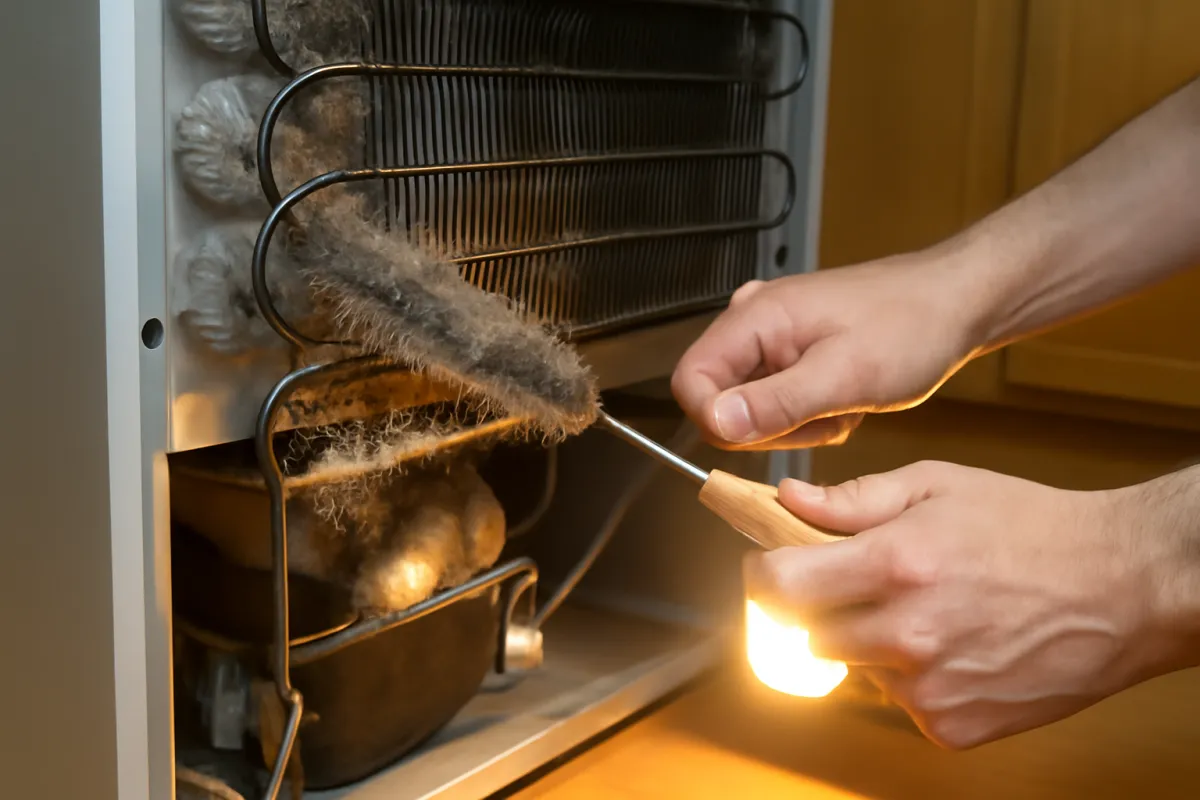
Clearing the coils and the fan area with a vacuum’s crevice tool and a long, narrow brush, with the unit unplugged, is usually a five to fifteen minute job and often resolves a buzzing or elevated hum completely. Our refrigerator cleaning walkthrough covers this task with full step by step detail, including how to access the coils on different refrigerator styles.
Cause two: a condenser or evaporator fan starting to fail
If clearing the coils does not resolve the noise, the fan itself may be the problem rather than what was sitting on it. Refrigerators typically have two fans: a condenser fan near the compressor, and an evaporator fan inside the freezer section that circulates cold air. Either can develop a worn bearing or a blade that has become slightly bent or unbalanced, producing a whirring, grinding, or rhythmic clicking sound that changes pitch with the fan’s speed rather than staying constant like the compressor’s hum.
A useful diagnostic: open the freezer door while the refrigerator is running. If the noise gets noticeably louder with the door open, the evaporator fan, which is normally muffled by the freezer door and insulation, is the more likely source. If opening the freezer door makes no difference, the noise is more likely coming from the condenser fan near the compressor at the bottom or back of the unit. Fan motors are a moderate but approachable DIY repair on many models, since the compartment is typically reached without disturbing the sealed refrigerant system at all.
Cause three: the compressor start relay, the click-with-no-hum signature
A refrigerator compressor needs a meaningful jolt of extra current to overcome its own resistance at the moment it starts spinning, and a small device called a start relay, working alongside an overload protector, provides that jolt and then gets out of the circuit once the motor is running at speed. When the relay fails, the compressor can be commanded to start but never actually receive the push it needs, which produces a distinctive symptom: an audible click, sometimes repeating every few minutes as the overload protector resets and tries again, with no compressor hum following it.
This is a meaningfully more urgent cause than the dust and fan issues above, because while the compressor is failing to start, the refrigerator is not cooling at all, and food can begin warming within hours even though the unit is clearly making noise and appears to be trying. If you hear repeated clicking with no following hum, check the interior temperature promptly and treat this as closer to our refrigerator not cooling report in urgency than to a simple noise annoyance.
Cause four: an unlevel refrigerator and vibration against the floor
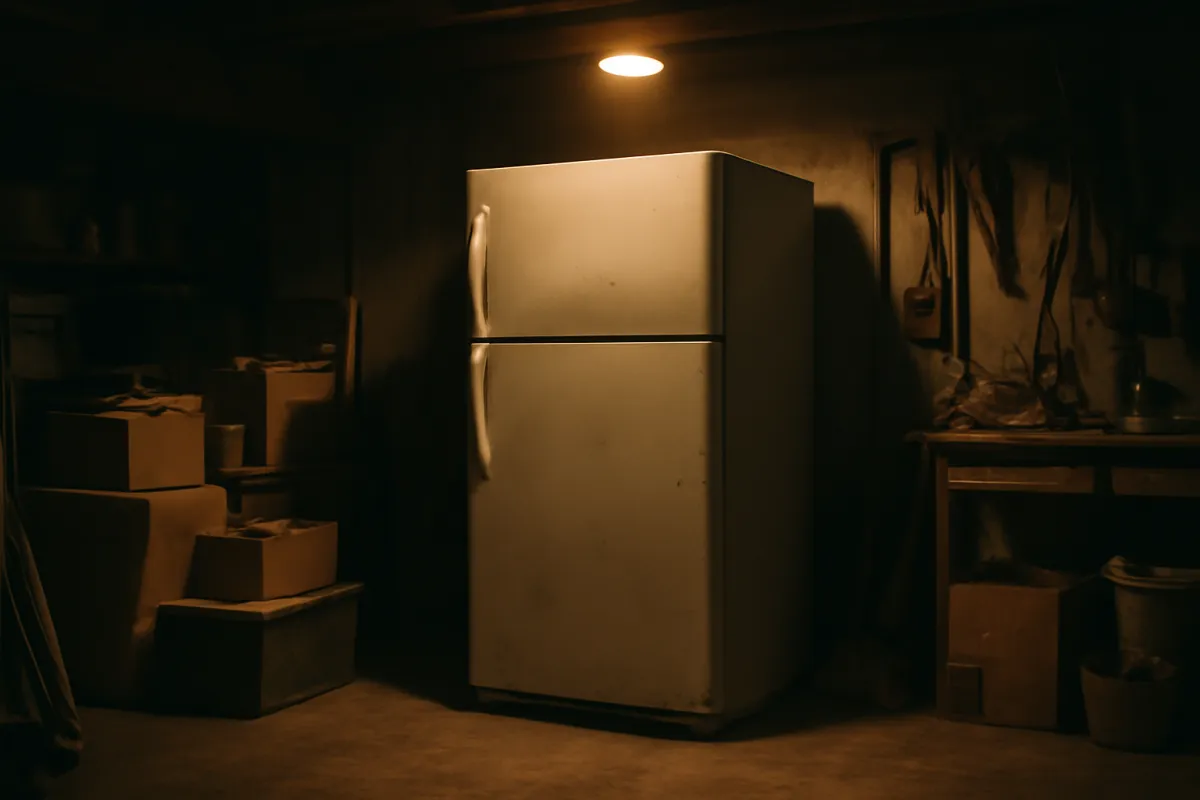
Every refrigerator has adjustable leveling feet at the front, and most rely on small rear rollers or feet with no adjustment at all. A unit that is not sitting level, or that is rocking slightly on an uneven floor, lets the normal vibration from the compressor and fans transmit into the cabinet and the floor rather than being absorbed quietly, which produces a rattle, a buzz, or a hum that seems to pulse rather than stay steady.
The test is simple: with the unit running, gently push down on each top corner in turn. A refrigerator that rocks under light pressure is not sitting on all four points evenly, and adjusting the front leveling feet, usually with a wrench or by hand depending on the model, until the unit sits firmly and does not rock, often resolves this kind of noise immediately and completely for free.
Cause five: loose items resting against or on top of the refrigerator
Related to leveling but worth its own mention, since it is a different mechanism with the same symptom. A refrigerator cabinet itself vibrates very slightly during normal operation, far too subtly to notice on its own, but anything touching the cabinet without being firmly attached to it, a cookbook leaning against the side, bottles stored on top, a cabinet panel installed too tightly against the side wall, or even the wall itself if the unit sits too close, can pick up that subtle vibration and amplify it into an audible rattle or buzz.
The fix here is purely process of elimination: remove items from on top of and against the sides of the refrigerator one at a time while it is running, and listen for the noise to stop. This single check resolves a surprising share of rattling complaints that have nothing at all to do with the refrigerator’s internal components.
A related and easily missed culprit is the water line feeding an ice maker or a door dispenser. If the flexible supply line is touching the cabinet wall, a nearby pipe, or runs behind the unit without enough slack, the same subtle vibration that rattles a loose cookbook can buzz against a plastic or copper line in a way that is surprisingly loud for how small the contact point is. Pulling the unit out slightly, with it unplugged, and confirming the supply line has a little clearance along its run is worth doing before assuming the rattle is coming from inside the cabinet at all.
Cause six: the defrost system, heard rather than seen
Every frost-free refrigerator runs a scheduled defrost cycle, typically once or twice a day, where a heating element briefly melts any frost that has built up on the evaporator coil so it does not eventually block airflow. This produces a short sequence of sounds, a sizzle or hiss as the heater runs, followed by water trickling into a drain pan, that is completely normal but can sound alarming to someone hearing it for the first time, especially in the middle of the night.
What is not normal is a defrost cycle that produces a loud banging, a prolonged hissing well beyond a minute or two, or a smell of burning, any of which points at a defrost heater or timer fault rather than ordinary operation, and is worth mentioning specifically if you do call a technician, since it narrows their diagnosis considerably.
Timing helps confirm this one too. Most refrigerators run their defrost cycle at a fixed interval, commonly once every eight to twelve hours of compressor run time rather than on a strict clock schedule, so the noise will not necessarily happen at the same time each day. If you can correlate the sound to a short window followed by a faint trickle toward the back of the freezer section, you have effectively confirmed the cause without opening a single panel.
When louder noise means the compressor itself, and why that changes the math
The one pattern in this report worth taking more seriously than the others is a noise, often a grinding, knocking, or straining sound distinct from a normal hum, that has clearly gotten louder or changed character over a period of days or weeks, particularly when it arrives alongside food that is not staying as cold as it used to.
That combination, worsening noise plus worsening cooling, points at the compressor itself or the sealed refrigerant system rather than at dust, a fan, or leveling, none of which affect cooling performance on their own. A compressor in the early stages of mechanical failure can run noisier and less effectively for a period before failing outright, and this is the one cause on this entire list that is not a reasonable DIY repair, since it requires certified handling of the refrigerant system.
Ice maker noise: a special case worth separating out
If the noise is specifically a loud clunk, a grinding, or a buzzing that coincides with ice being made or dispensed, rather than a constant background sound, the ice maker itself is a more likely source than anything else in this report. A fill valve buzzing as it opens to add water, a motor module grinding as it rotates the harvest mechanism to release cubes, or a clunk as cubes drop into the bin are all specific to the ice maker assembly and have their own common causes and fixes, covered in detail in our ice maker troubleshooting report.
The distinguishing test is timing: a noise that happens every few minutes regardless of the ice maker’s activity is more likely the compressor or a fan, covered throughout this report, while a noise that happens specifically during or right after a visible ice-making or dispensing event points at the ice maker assembly specifically.
Which refrigerator styles run louder, and why
Door configuration has a smaller effect on noise than most buying guides suggest, but it is not zero. A side-by-side or French-door refrigerator typically places the compressor and condenser fan in a similar bottom-rear location regardless of door style, so the core noise sources covered in this report apply equally across styles. Where style does matter is accessibility: a bottom-freezer or French-door model commonly makes the condenser coils easier to reach behind a simple kick plate, while some older top-freezer designs route the coils across the entire back panel, which is a bigger job to clear and, anecdotally, a design more prone to a visibly loud dust buildup simply because it goes unnoticed longer.
A larger refrigerator, which needs a bigger compressor and higher airflow fans to manage a larger cooled volume, is not inherently louder than a smaller one when both are clean and level, since manufacturers generally size the fan and sound insulation to match the compressor’s output. Age correlates with noise far more reliably than size or door style does, mostly because an older unit has had more time to accumulate dust, develop a slightly worn fan bearing, or settle unevenly on its feet, all covered above as the leading causes.
How to tell if the noise is actually above normal
A genuinely useful, free diagnostic that most people never think to try: compare the sound to another working refrigerator, ideally the same brand and a similar age, if one is available to you, such as at a friend’s or family member’s house, or even a demo unit at an appliance store. Refrigerator noise is easy to normalize to once you live with it daily, and a side by side comparison often resolves the “is this normal” question faster than any written description can.
If no comparison unit is available, a simple phone voice recorder app captures a baseline you can replay later to judge whether the sound has genuinely changed, which is more reliable than memory alone, especially for a slow change that happens gradually enough that nobody in the household notices until it has become loud.
Common mistakes when diagnosing refrigerator noise
Five patterns that send people toward the wrong conclusion about a noisy fridge.
Assuming any new sound means the compressor is dying. The coil, fan, and leveling causes above account for the large majority of complaints and have nothing to do with the compressor’s health.
Cleaning the coils once and assuming that rules the cause out permanently. Dust reaccumulates continuously, and a coil cleaned a year ago on a heavy-shedding household’s schedule may already need it again.
Ignoring a click-with-no-hum pattern because the fridge is “still running.” The compressor not starting is the one noise cause on this list with a real time pressure attached to it, covered specifically above.
Blaming the refrigerant or coolant level for a noise. A correctly sealed system does not lose refrigerant under normal operation, and a noise is virtually never a sign of low refrigerant on its own; weakening cooling performance alongside the noise is the more reliable signal of a sealed system issue.
Overlooking the ice maker as a separate, specific source, covered in its own section above, and treating every noise as a compressor or fan question when the timing points elsewhere.
Where refrigerator noise complaints actually come from
Pulling the whole list together shows the pattern this site’s troubleshooting reports usually find: the loud, worrying symptom is most often the cheap, free-to-fix cause.
Where a refrigerator noise complaint usually starts
Illustrative share of noise complaints by cause. Bars scale to the largest slice.
Illustrative shares drawn from the shape of the complaint rather than any survey. Over half of this chart is free to fix: a vacuum, a brush, and checking that the unit sits level.
Which checks are genuinely DIY
Genuinely do it yourself, no special skill. Clearing dust from the condenser coils and fan area with the unit unplugged. Checking and adjusting the leveling feet. Removing items resting against or on top of the cabinet to test whether they are the source of a rattle. Opening the freezer door to narrow a whirring or grinding sound to the evaporator fan versus the condenser fan.
Do it yourself with patience and research. Replacing a condenser or evaporator fan motor on a model where the compartment is reached without disturbing the sealed system, which is true of many common refrigerator designs.
Not do it yourself for most households. Anything involving the sealed refrigerant system, including diagnosing or replacing the compressor. Defrost heater or timer replacement if it requires accessing the evaporator coil assembly behind the freezer’s interior panels, which varies by model and is sometimes approachable and sometimes not.
Repair or replace: the honest math
When a noise points at a genuine paid repair, usually a fan motor, a start relay, or in the more serious case a compressor, apply the same two tests this site uses for every appliance.
The first is the 50 percent test: if a repair quote exceeds roughly half the price of a comparable new refrigerator, replacement usually wins. The second is age weighting against the commonly cited planning window for a refrigerator, which sits near 13 years according to our appliance lifespan reference. A fan motor or start relay repair is almost always worth doing at any age, since both are inexpensive relative to a new refrigerator. A compressor replacement, the most expensive repair on this list, is the one case where the math genuinely can tip toward replacement, particularly on a unit already past ten years old.
Run an illustrative case. An eight-year-old refrigerator develops a loud click with no following hum, confirmed by checking that interior temperature is rising, and a technician diagnoses a failed start relay with a quote of 180 dollars including labor. A comparable new refrigerator would run about 1,100 dollars. That quote is roughly 16 percent of replacement on a unit with about five typical years left, working out to around 36 dollars a year of repair against about 85 dollars a year for a new unit. Repair wins clearly. Put your own quote, price, and age into our cost-per-use calculator above for your own numbers.
Thirteen years of one refrigerator, with one mid-life relay repair
Illustrative split: an $1,100 unit, about $1,430 of electricity across 13 years at roughly $110 a year, and one $180 relay repair. Segments sum to 100 percent.
A relay repair is a small slice on the lifetime chart, which is the arithmetic behind why this particular noise cause is almost always worth fixing rather than replacing the refrigerator over.
A worked example: one buzzing kitchen corner, two checks
A household notices the refrigerator has been noticeably louder for about a week, a buzzing hum rather than the usual quiet background sound, with food still cold and no other symptoms.
Check one, the coils. The unit is unplugged, the bottom kick plate removed, and the condenser coils found coated in a thick, felted layer of dust and pet hair, with the fan blade visibly catching on some of it as it is turned gently by hand. The area is cleared with a vacuum and a long brush.
Check two, confirm. The refrigerator is plugged back in and run for ten minutes. The hum returns to its normal, much quieter level, with no buzzing edge.
Total cost: nothing beyond the time spent cleaning. Had the noise persisted after clearing the coils, the next step would have been opening the freezer door to narrow the sound to the evaporator fan specifically, rather than assuming a part needed replacing.

Prevention: the habits that keep a refrigerator quiet
Clean the condenser coils on a schedule rather than waiting for a noise to prompt it. Our refrigerator cleaning walkthrough suggests an interval based on your household’s dust and pet hair load, and a coil cleaned on schedule rarely gets dirty enough to cause a noticeable noise change at all.
Recheck leveling after moving the unit, even slightly, for a floor cleaning or a kitchen remodel, since a refrigerator that was level can shift out of level from being pulled out and pushed back without the feet being readjusted.
Keep a few inches of clearance around the sides and top where your model’s manual recommends it. Beyond helping the condenser coils dissipate heat efficiently, clearance also reduces the chance of the cabinet vibrating against a wall, a cabinet panel, or stored items.
Do not ignore a click-with-no-hum pattern. Unlike most of the causes in this report, that specific signature means the unit may not be cooling at all, and checking the interior temperature promptly is worth the two minutes it takes.
What a technician actually checks during a diagnostic visit
Knowing the shape of a thorough visit helps you judge a quote. A competent diagnosis for this complaint typically starts by listening to the unit running, with the technician identifying whether the sound is coming from the compressor compartment, the freezer section, or the cabinet itself, since that alone narrows the list to roughly a third of this report’s causes before a single tool comes out. They will usually check the coils and clean them as a matter of course if they are dusty, since that resolves a large share of visits on its own and costs almost nothing in labor time.
If the noise persists after cleaning, a technician will typically test the start relay and overload protector with a meter, check the condenser and evaporator fans for free rotation and listen for bearing wear with the unit running, and confirm the unit is level. Only if all of that comes back clean, and especially if cooling performance has also weakened, does a competent diagnosis move toward the sealed system and the compressor itself, following the same elimination order this report has walked through.
Ask whether coil cleaning and a leveling check are included in the standard visit, since on many service calls this alone resolves the complaint. If a fan motor or relay is condemned, ask to see or hear the specific test result rather than taking a verbal diagnosis on faith, the same way you would for the flame sensor test on a furnace visit.
When to call a pro, and what to tell them
Call a technician for anything involving the compressor or the sealed refrigerant system, for a click-with-no-hum pattern that persists after confirming the unit is plugged in and the outlet has power, and for any noise accompanied by weakening cooling performance. Call one for a defrost cycle that produces banging, prolonged hissing, or a burning smell.
What you tell them changes what the visit costs. Describe the exact sound as specifically as you can: a steady hum that got louder, a click with or without a following hum, a rattle that changes with light pressure on the cabinet, or a grinding sound tied to the freezer door being open or closed. Mention whether cooling performance has changed at all. And have the model number, usually on a sticker inside the fresh food compartment, ready, since fan motors and relays are model specific parts.
The bottom line
Why is my refrigerator making noise usually has a far cheaper answer than the sound itself suggests. Start by naming the sound: a hum or buzz points at dust on the condenser coils, which a vacuum and a brush resolve in minutes; a click with no following hum points at a start relay and genuinely deserves a quick check of the interior temperature; a rattle points at leveling or loose items against the cabinet, both free fixes; and a sound that has clearly worsened alongside weaker cooling is the one pattern that points at the sealed system and genuinely needs a technician.
Handle the safety part properly: unplug before reaching near the back panel or the compressor compartment, and never attempt to open the sealed refrigerant system yourself. Worked in that order, the large majority of refrigerator noise complaints resolve for the cost of a few minutes with a vacuum, and the buzzing corner of the kitchen that started this search is usually a dusty coil, not a dying appliance.
A note on scope: these notes describe how refrigerators commonly produce noise and how to work the fault in a sensible order. They are general information, not professional appliance repair advice, and every share, interval, and dollar figure in them is an illustrative planning number rather than a measurement or a quote for any specific brand or model. Never open the sealed refrigerant system yourself; that work requires certified handling and belongs with a licensed technician. Where the manufacturer’s manual for your specific refrigerator contradicts a general principle written here, the manual is the authority and this report is not.
Frequently asked questions
Is it normal for a refrigerator to make noise?
Yes, to a point. A low, steady hum while the compressor is running, an occasional click when the compressor or a relay switches on or off, and a brief whoosh or trickle of water during a scheduled defrost cycle are all normal sounds a healthy refrigerator makes throughout a typical day. What is not normal is a loud buzz, a rattle, a squeal, or a thump, any of which points at a specific mechanical cause covered in this report rather than ordinary operation.
Why is my refrigerator making a loud buzzing or humming noise?
The most common cause is dust and pet hair built up on the condenser coils or the condenser fan, which makes the fan work harder and louder than it should, or occasionally a condenser fan blade that is starting to wear and vibrate against its housing. Both are commonly resolved by clearing the coils and the fan area, which most refrigerators make accessible behind a bottom kick plate or grille without needing a technician.
Why does my refrigerator click but not start?
A single click with no following hum or run often points at the compressor's start relay or overload protector, which is a small device that is supposed to give the compressor the extra push it needs to start and then get out of the way. A relay that has failed can click repeatedly, trying and failing to start the compressor, without the compressor ever actually running, which over time risks warming food even though the refrigerator sounds like it is doing something.
Why does my refrigerator rattle or vibrate?
Vibration and rattling most commonly come from the refrigerator not sitting level and firmly on all four feet, which lets the cabinet itself resonate against the floor or against anything touching its sides, or from loose items on top of or inside the refrigerator picking up and amplifying normal compressor vibration. Checking the leveling feet and clearing anything resting directly against the cabinet resolves a large share of this complaint for free.
Is a noisy refrigerator about to fail?
Not necessarily, and most of the common noise causes in this report are maintenance issues rather than signs of impending failure. A genuinely concerning signature is a noise that has clearly gotten louder or changed character over a short period, particularly a grinding or straining sound from the compressor itself, combined with food that is not staying as cold as it used to, which together point at the sealed system rather than at dust or leveling.
How much does it cost to fix a noisy refrigerator?
It depends heavily on the cause. Clearing dust from the condenser coils and fan costs nothing beyond your time. Leveling the feet costs nothing. A condenser or evaporator fan motor replacement runs illustratively 80 to 200 dollars including labor. A compressor start relay runs illustratively 100 to 250 dollars. A full compressor replacement, the most expensive and least common cause, runs illustratively 400 to 800 dollars, at which point the repair-or-replace math covered in this report usually favors a new refrigerator instead.
Why is my old garage refrigerator so much louder than my kitchen one?
Age, dust accumulation, and the floor it sits on all compound in an older refrigerator kept in a garage or basement. Concrete floors transmit vibration more readily than a kitchen floor, the unit has usually gone years between any coil cleaning, and a motor or fan bearing that is simply older is more likely to be in the early stages of wear. None of that means the fridge is failing, but it does mean the free fixes, cleaning the coils and checking the leveling, are worth doing before assuming the unit itself needs replacing.
Can I fix a noisy refrigerator myself?
Several of the most common causes are genuinely approachable: clearing dust from the condenser coils and fan area, checking and adjusting the leveling feet, and removing anything resting against the cabinet that could be vibrating. A fan motor replacement is a moderate DIY job on many models since the fan sits in an accessible compartment. Anything involving the sealed refrigerant system, including the compressor itself, is not a homeowner repair and needs a licensed technician.