What's on this page
- Does a smart thermostat save money? The short answer
- What a smart thermostat actually changes
- Setback scheduling: the biggest lever
- Geofencing and occupancy sensing
- Learning algorithms: what they add on top of a schedule
- The realistic savings range, and why it is a range
- Where the setback guidance comes from
- Illustrative annual savings by household pattern
- Where the savings actually come from
- When a smart thermostat does not pay off
- If you already set back the temperature by hand
- Renters and the smart-thermostat problem
- Already-efficient homes and low HVAC bills
- The device cost and payback math
- A worked example: one household’s numbers
- What can go wrong: overrides and forgotten schedules
- Heat pumps and deep setbacks: the caveat
- Comfort and humidity: tradeoffs beyond dollars
- Smart thermostat vs a programmable thermostat
- How to estimate your own savings
- Shopping and setup checklist
- Common mistakes that erase the savings
- The bottom line
Short answer: A smart thermostat typically saves an illustrative 5 to 15 percent on the heating and cooling share of a utility bill, mainly by automating setback scheduling and adding geofencing for the days a manual schedule misses. On a household spending $1,500 to $2,000 a year on heating and cooling, that is roughly $75 to $300 a year. The savings shrink toward zero if you already set the temperature back by hand, and they can vanish entirely in a rental with a lease-controlled schedule or a home whose heating and cooling bill was already small.
A smart thermostat is sold on a simple promise: install it once, and it quietly trims your heating and cooling bill from then on. That promise is often true, but the size of the saving is nowhere near as fixed as the marketing suggests, and it depends far more on your own prior habits than on which device sits on the wall.
This breakdown separates the mechanism from the number. It explains exactly what a smart thermostat changes about how your HVAC system runs, where the commonly cited savings figures come from, and walks through the specific situations where the payback is fast, slow, or does not exist at all. You can run your own numbers through our running-cost calculator as you read.
Key takeaways
- Illustrative savings run 5 to 15 percent of the heating and cooling portion of the bill, driven almost entirely by automated setback scheduling and geofencing, not by any special efficiency in the hardware.
- If you already turn the temperature back by hand every day, a smart thermostat mostly buys convenience, not savings, because you were already capturing most of the benefit manually.
- Payback is commonly six months to three years for a household with a large heating and cooling bill and no prior setback habit, and it can take far longer, or never arrive, otherwise.
- Renters, already-efficient homes, and homes with a very small heating and cooling bill are the three cases where the device is least likely to pay for itself.
- Heat pump households should use a shallower setback than furnace or standard air conditioning households, because deep setbacks can trigger costly backup heat on recovery.
Does a smart thermostat save money? The short answer
Yes, for the majority of households, but the size of the saving is a range rather than a fixed number, and it depends more on what you were doing before the thermostat arrived than on the device itself. The commonly cited illustrative range for automated setback scheduling is 5 to 15 percent off the heating and cooling portion of a utility bill, a figure that traces back to the U.S. Department of Energy’s long-standing general guidance that a 7 to 10 degree setback held for about eight hours a day can cut heating and cooling costs by roughly 10 percent a year.
A smart thermostat does not invent new savings that a manual schedule could not also achieve. What it does is make the schedule automatic, add geofencing so the setback kicks in the moment the house is actually empty rather than on a fixed clock, and, on some models, nudge the schedule over time based on observed patterns. Those are real, useful mechanisms. They are also the entire story, which is why the rest of this breakdown treats the savings as a function of your prior habits rather than a fixed dollar figure stamped on the box.
What a smart thermostat actually changes
Strip away the app and the touchscreen, and a smart thermostat controls exactly one thing a plain manual thermostat also controls: when your furnace, heat pump, or air conditioner turns on and off, and at what target temperature. It does not make the equipment behind it more efficient at converting fuel or electricity into heat or cold air. A furnace rated at a given efficiency burns gas at that same efficiency whether a smart thermostat or a dial on the wall tells it to fire.
What changes is the pattern of when the system runs. Three mechanisms do essentially all of the work: an automated setback schedule that reduces conditioning during hours nobody needs it, geofencing that detects when the home is actually empty using a phone’s location, and, on some models, a learning or adaptive algorithm that adjusts the schedule based on observed comfort and occupancy over time. Every dollar of savings this article discusses traces back to one of those three mechanisms reducing the hours the system spends running at full demand.
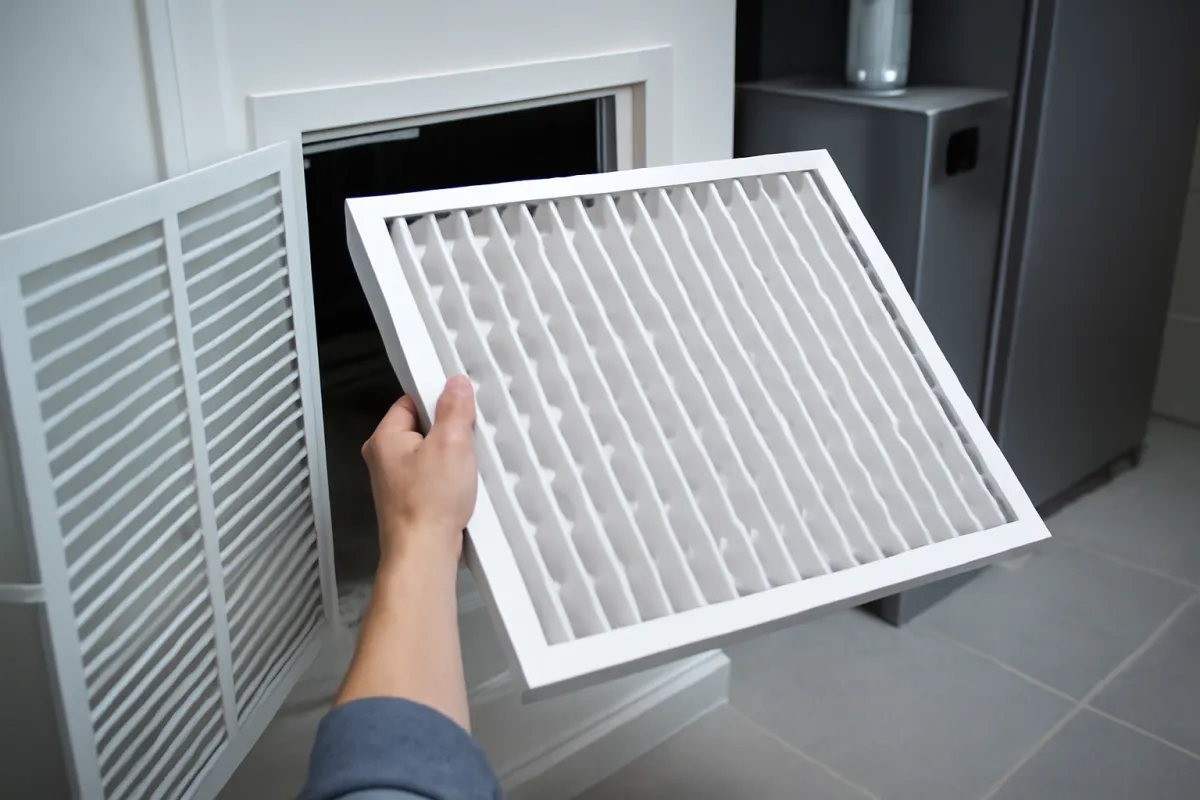
A dirty filter, a clogged coil, or an aging system running past its efficient years all keep costing the same regardless of what schedule the thermostat holds. Our note on how often to change a furnace filter covers the maintenance side of the equation a thermostat cannot touch.
Setback scheduling: the biggest lever
Of the three mechanisms, setback scheduling accounts for the largest share of the typical saving by a wide margin. The idea is simple: heating or cooling an empty house or a sleeping household to the same temperature demanded when everyone is awake and present wastes conditioning that nobody benefits from. Letting the house drift a controlled amount during those hours, then recovering the temperature before anyone needs comfort again, removes running hours without anyone noticing a difference in comfort.
The Department of Energy’s general guidance, a 7 to 10 degree setback held for about eight hours, translates well to two reliable daily windows in most households: the workday, when the house sits empty, and overnight, when everyone is under blankets and tolerates a cooler bedroom easily. Because a thermostat’s running cost tracks the hours it spends actively heating or cooling, and a setback directly reduces those hours, the relationship between setback depth, duration, and savings is close to linear across the ranges most households use.
What a smart thermostat adds here is not a better setback, it is a setback that actually happens every single day without anyone remembering to set it. A programmable thermostat can do the same thing on a fixed schedule; the practical gap between programmable and smart is mostly about whether the schedule gets set correctly once and left alone, which is where many households quietly fail with either device.
Geofencing and occupancy sensing
Geofencing uses a phone’s location to detect when everyone has left the home or is heading back, and adjusts the setpoint accordingly without a fixed clock schedule. Its value over a plain time-based schedule is narrow but real: it catches the days a schedule cannot. A sick day home from work, an early return from a trip, or a weekend spent at home instead of the usual weekday-away pattern are all cases where a rigid clock schedule either over-conditions an empty house or under-conditions an occupied one, and geofencing corrects both directions automatically.
The savings contribution from geofencing alone is smaller than from scheduling, because most households already have a fairly regular weekly rhythm that a decent schedule captures well. Geofencing’s real value shows up as avoided waste on the irregular days, plus a comfort benefit of not walking into a too-hot or too-cold house, which is worth something even when it is not directly a dollar saving. Households with unpredictable schedules, multiple people coming and going at different times, or long unplanned absences see the largest share of their total saving from this mechanism rather than from the base schedule.

Learning algorithms: what they add on top of a schedule
Some smart thermostats include an adaptive or learning feature that observes manual adjustments over the first weeks and nudges the automated schedule toward what it infers you actually prefer. Marketing sometimes presents this as the primary source of savings. In practice it is a secondary refinement on top of the setback and geofencing mechanisms above, not an independent source of comparable size.
The honest way to think about a learning algorithm is as automated fine-tuning: it narrows the gap between the default schedule the device ships with and the schedule that best fits your actual routine, without you manually editing settings. That fine-tuning captures real but modest additional savings, mostly by avoiding the small inefficiencies of an unadjusted default schedule, such as recovering the temperature earlier than necessary or holding a setback longer than the household tolerates comfortably. Do not expect a learning feature to multiply the savings from scheduling and geofencing; expect it to trim the edges.
The realistic savings range, and why it is a range
The 5 to 15 percent figure this article uses throughout is illustrative and intentionally wide, because the true number for any specific household depends on variables a single average cannot capture: local climate, how many hours the home already sits empty, the efficiency and type of the HVAC system, insulation quality, and, most of all, whether the household already practiced manual setbacks before the device arrived.
Two households can install the identical thermostat and see very different results. One that ran a constant 70 degrees around the clock, in a leaky older home, in a climate with a long heating season, has enormous room for a schedule to cut running hours, and can land at or above the high end of the range. One that already turned the thermostat down every night and every workday by hand, in a well-insulated newer home, has very little room left to capture, because the manual habit already did the work a smart thermostat automates. Treat any specific percentage you see quoted as a midpoint of a wide range, not a guarantee, and use the calculator below to size your own case rather than trusting a single average.
Where the setback guidance comes from
The 7 to 10 degree, eight-hour setback figure that anchors most savings estimates, including the 5 to 15 percent range used throughout this piece, comes from the U.S. Department of Energy’s long-standing general guidance on thermostat setbacks, published as part of its consumer energy-saving guidance. It predates smart thermostats entirely and was originally written for anyone willing to manually turn a dial back before leaving for work and before going to bed.
Smart thermostat manufacturers commonly cite savings studies of their own devices that report broadly similar percentages, generally in the same single-digit-to-mid-teens range, though methodologies, baseline assumptions, and the households studied vary between them and are not independently reproduced here. Because vendor-sponsored study results are difficult for a reader to independently verify, this article anchors on the Department of Energy’s general mechanism-based guidance rather than repeating a specific vendor’s claimed percentage as fact. The mechanism, fewer running hours during unoccupied or sleeping periods, is what actually produces the saving, whichever device automates it.
Illustrative annual savings by household pattern
The chart below sketches four illustrative household patterns and where each might land on annual heating and cooling savings after adopting a smart thermostat, holding a household’s underlying heating and cooling spend roughly constant across the comparison and varying only the starting habit and how consistently the schedule is followed.
Illustrative annual HVAC savings by starting habit
Same rough household heating and cooling spend, different prior habits. Illustrative figures, not a guarantee for any specific home.
The largest saving belongs to the household with the most room to close, a high heating and cooling bill run at a constant temperature before the change. The smallest belongs to the household that already did the work by hand.
Find the row closest to your own starting point before you estimate your own payback. A household near the top of this chart should expect a fast payback; a household near the bottom should treat the device as mostly a convenience purchase and budget the savings accordingly.
Where the savings actually come from
Within whatever total saving a household achieves, the three mechanisms described earlier do not contribute equally. The chart below is an illustrative breakdown of a typical total saving by mechanism, showing scheduling doing the majority of the work.
Illustrative breakdown of a typical smart thermostat saving
Shares of a typical total saving, illustrative. Individual households will vary, especially with irregular schedules.
Scheduling is the majority of the saving because it covers the predictable week. Geofencing and learning refinements matter most for households with irregular routines.
This breakdown is also a useful shopping filter. If your routine is extremely regular, a basic programmable thermostat set once and left alone can capture most of the first bar’s worth of saving for a fraction of a smart thermostat’s price, and you are mainly paying for the smaller geofencing and refinement slices plus the convenience of remote control.
When a smart thermostat does not pay off
The device does not save money in every situation, and it is worth naming the cases plainly rather than assuming the marketing applies universally. A smart thermostat is least likely to pay for itself when a household already practices manual setbacks consistently, when the heating and cooling bill is already small, when the home is a rental with lease restrictions or a landlord-set schedule, or when the schedule set up on the device is never actually followed because the household keeps overriding it back to a constant temperature.
None of these cases mean the device is defective or the mechanism does not work. They mean the specific household has little room left for a schedule to close, or cannot actually run the schedule the device is capable of. The next several sections walk through each case in more detail, because recognizing which one applies to you is the single most useful step before spending on a smart thermostat for the savings alone rather than for its other conveniences.
If you already set back the temperature by hand
This is the most common reason a smart thermostat under-delivers on its promised savings. If you already turn the temperature down before bed and before leaving for work every single day, without fail, you have already captured the majority of the setback saving described earlier in this article manually. Automating a habit you already perform consistently does not create new savings; it mostly removes the small chance you forget on a given day, plus whatever geofencing adds for the irregular days a manual routine misses.
Be honest with yourself about consistency here, because most people who believe they set back the temperature reliably actually miss more days than they realize, particularly on weekends, holidays, or days that break the normal routine. If that describes you, the geofencing slice of the savings chart above is a realistic estimate of what you stand to gain, not the full range. If you genuinely never miss a day, budget for convenience and remote control as the purchase’s real value, and treat any dollar savings as a pleasant bonus rather than the reason to buy.
Renters and the smart-thermostat problem
Renters face a specific set of obstacles that shrink both the achievable savings and the practical payback window. Many rentals already run a moderate, landlord-set schedule or a shared HVAC system where an individual tenant’s thermostat changes have limited effect, narrowing the gap a smart thermostat can close from the start. Lease terms frequently restrict permanent hardware changes, and even where a swap is allowed, a renter typically needs to keep the original thermostat to reinstall before moving out, adding friction and a second installation cost to the calculation.
The payback math itself changes for a renter, too. A homeowner can amortize the device cost over many years of ownership. A renter has to amortize it over however long the current lease or living situation is expected to last, which can turn an otherwise reasonable two-year payback into a loss if a move happens in year one. If you are renting and considering a smart thermostat primarily for its savings, run the payback math in the section below against your actual expected time in the unit, not against an assumed multi-year homeowner timeline.
Already-efficient homes and low HVAC bills
A household whose heating and cooling bill is already small, because of a well-insulated newer home, a mild climate, or a small living space, has less absolute dollar savings available no matter what percentage a smart thermostat captures. Five to fifteen percent of a $400 annual heating and cooling bill is $20 to $60 a year, a real number but one that takes many years to offset even a modest device cost.
This is a case where the percentage-based marketing claim is not wrong, it is just applied to a small base. The lesson is to look at your own annual heating and cooling spend before assuming a smart thermostat’s savings will be meaningful in dollar terms. A household with a genuinely small HVAC bill may find that a smart thermostat is a reasonable purchase for convenience, remote control, or as part of a broader smart-home setup, but should not expect the device to pay for itself quickly on energy savings alone.
The device cost and payback math
Smart thermostat devices commonly run an illustrative $100 to $250 before installation, with self-installation on a straightforward system adding little beyond the device price and professional installation typically adding a service call fee on top. Against an illustrative annual saving of $75 to $300, drawn from the household patterns chart earlier in this article, the payback period spans a wide range depending purely on which end of both ranges applies to your situation.
At the fast end, a $100 device against $260 in annual savings pays back in well under six months. At the slow end, a $250 device against $40 in annual savings takes more than six years to break even, and if that household is a renter who moves before then, it may never break even at all. The device cost itself is fairly narrow across the market; the annual savings figure is what actually decides whether the purchase makes financial sense, which is why the starting-habit chart earlier in this article matters more than any single product’s price tag.
A worked example: one household’s numbers
Put the pieces together on a single realistic case. A household spends an illustrative $1,800 a year on heating and cooling combined, previously ran a roughly constant setpoint with no consistent manual setback, and buys a smart thermostat for an illustrative $150 installed.
The savings estimate. Using the illustrative 5 to 15 percent range for a household with no prior setback habit, expect toward the upper half of that range, call it 12 percent. That is $1,800 times 0.12, or $216 a year, illustratively.
The payback period. A $150 device against $216 in annual savings, or $18 a month, pays back in roughly 8 months. From month nine onward, the saving is a genuine net gain rather than money recovering the purchase.
The five-year picture. Five years of $216 in annual savings is $1,080, against the one-time $150 device cost, for a net saving of roughly $930 over five years, before accounting for any electricity rate changes, equipment replacement, or a change in the household’s own habits during that time. Swap in your own annual heating and cooling spend and starting habit using the running-cost calculator to see your version of this example.
What can go wrong: overrides and forgotten schedules
A smart thermostat only saves money if its schedule is meaningfully different from how the house was run before it arrived, and several common behaviors quietly erase that difference. The most frequent is manual override: a household member walks past the thermostat and bumps it back to a comfortable constant temperature, and if that happens often enough, the automated setback effectively stops happening even though the schedule is technically still programmed.
A second failure mode is an away or vacation mode set too aggressively, one that lets the house drift so far from the normal setpoint that recovering it on return takes a long, expensive burst of full-power heating or cooling that offsets some of the savings from the setback itself. A third is simply never checking the schedule after initial setup, letting a default configuration run indefinitely without confirming it actually matches the household’s real routine. None of these problems are hardware defects. They are the same discipline gap that undermines a manual setback habit, just relocated into an app instead of a hand on a dial. Check the actual schedule after the first week or two, and watch for repeated manual overrides, which are the clearest sign the automated schedule is not doing its job.
Heat pumps and deep setbacks: the caveat
Households heating with a heat pump need to apply the setback guidance in this article more carefully than a furnace or standard air conditioning household. A heat pump moves heat rather than generating it directly, and most models include electric resistance backup heat that kicks in automatically when the system needs to recover the temperature quickly, such as after a deep setback. That backup heat is significantly more expensive to run than the heat pump’s normal compressor-driven operation.
The practical result is that a very deep setback, held for many hours and then demanding a fast recovery, can trigger enough backup heat on the way back up to offset or even exceed the saving from the setback itself. The common guidance for heat pump households is a shallower setback, often just a few degrees rather than the full 7 to 10 degree range, or a gradual, heat-pump-aware recovery rather than a steep one. Many smart thermostats include a heat-pump-specific mode designed to manage this tradeoff, and heat pump owners should confirm that mode is active and configured correctly rather than assuming the default schedule behaves the same way it would for a furnace. For the full running-cost picture of the equipment behind the thermostat, our heat pump running-cost breakdown works the compressor-versus-backup-heat math in detail.
Comfort and humidity: tradeoffs beyond dollars
Savings are not the only variable worth weighing, and a purely dollar-focused view can miss real tradeoffs. A deep setback in a humid climate can let indoor humidity climb during the unconditioned hours, since air conditioning removes moisture as a side effect of cooling, and a system that runs less also dehumidifies less. Coming home to a noticeably muggier house is a common complaint in humid regions and is worth weighing against the dollar savings if comfort matters more to your household than the marginal saving.
There is also a comfort cost to recovery time itself: walking into a house that has drifted several degrees from comfortable and waiting for the system to catch up is a real inconvenience that a purely financial calculation does not capture. Geofencing helps here by starting the recovery before you arrive rather than when you walk in the door, which is one of the genuine, non-financial reasons to prefer a smart thermostat’s occupancy detection over a purely time-based programmable schedule, independent of whether it changes the dollar figure much.
Smart thermostat vs a programmable thermostat
It is worth separating the two purchases plainly, because they are often compared as if a smart thermostat is simply a better version of a programmable one, when the financial relationship is narrower than that. A programmable thermostat, the kind with a small screen and a handful of buttons, can run the identical weekday and weekend setback schedule that drives the majority slice of the savings breakdown earlier in this article, for a fraction of a smart thermostat’s price, with no app, no account, and no ongoing connectivity required.
What a programmable thermostat cannot do is geofencing or a learning algorithm, the two smaller slices of the savings pie. It also depends entirely on someone actually programming it correctly once and never needing to override it, which in practice is where a meaningful share of programmable thermostats underperform their potential: surveys and field studies of programmable thermostat households have repeatedly found that many never get properly programmed at all, or get overridden back to a constant temperature so often that the schedule stops mattering.
That gap, a schedule that exists in the hardware but is not actually followed in practice, is arguably the single best argument for a smart thermostat’s convenience even when the pure percentage-savings case is thin. An app that is easy to check, remote control from a phone, and a schedule that is simple to adjust without standing at the wall all make it more likely the schedule survives contact with a real household. If you are choosing between the two options purely on the size of the financial saving, a correctly programmed and consistently respected programmable thermostat gets you most of the way there for less money. If you are choosing based on the odds that the schedule actually gets set up right and stays that way, the convenience case for a smart thermostat is real, separate from, and arguably more reliable than, the raw percentage-savings pitch.
How to estimate your own savings
Rather than trusting a generic percentage, walk through four questions specific to your own household. First, what do you actually spend annually on heating and cooling, which you can estimate from a year of utility bills or from the heating and cooling portion your utility itemizes if it does so. Second, how consistently did you already practice manual setbacks before considering the device, honestly rather than optimistically. Third, how irregular is your household’s schedule, since more irregularity shifts more of the savings toward the geofencing mechanism rather than the base schedule. Fourth, what will the device and installation actually cost you, including professional installation if your system is not a simple swap.
With those four answers, you can place yourself on the household-pattern chart earlier in this article and choose a realistic percentage from the 5 to 15 percent range rather than defaulting to a marketing average. Feed your own annual heating and cooling spend, an honest savings percentage, and the device cost into the companion calculator on this page to get a payback estimate sized to your actual situation. A thermostat schedule is one line item in a bigger bill; our broader walkthrough on how to lower your electric bill covers the other seven.
Shopping and setup checklist
Before you buy, or before you judge whether the one you already own is earning its keep, run through these checks.
- Know your annual heating and cooling spend. Without a real starting number, no savings percentage means anything in dollar terms.
- Be honest about your prior habit. If you already set back the temperature by hand consistently, expect savings toward the low end of the range, not the high end.
- Confirm the schedule is actually programmed. A smart thermostat with no real setback programmed into it saves nothing over a constant setpoint.
- Enable geofencing if your routine is irregular. It is the mechanism that catches the days a fixed schedule cannot.
- Use a heat-pump-aware setting if you have a heat pump. A deep setback with a fast, expensive recovery can offset the saving it was supposed to create.
- Check the schedule again after two weeks. Confirm it survived contact with real household behavior rather than assuming the initial setup still holds.
Clear those six and the device is positioned to deliver whatever savings your household’s starting point genuinely has available, rather than losing them to an unprogrammed schedule or a habit of manual overrides.
Common mistakes that erase the savings
A handful of mistakes show up repeatedly in households that end up disappointed by a smart thermostat’s actual savings. The first is buying the device expecting it to fix an inefficient HVAC system, a leaky home, or a dirty filter, none of which a thermostat touches; those are separate maintenance and efficiency issues that a schedule cannot solve. The second is setting an unrealistic, uncomfortable schedule that gets overridden constantly, which quietly reverts the household to something close to the old constant-setpoint pattern. The third is ignoring the heat pump caveat and applying a furnace-style deep setback to a heat pump system, triggering expensive backup heat on recovery.
The fourth is expecting the percentage-based marketing claim to apply to a household that already practiced manual setbacks, then feeling misled when the actual saving is much smaller. The fifth is a renter who does not account for the shortened effective ownership window in the payback calculation. Each of these is avoidable once named, which is the point of listing them plainly rather than letting a new owner discover them one disappointing bill at a time.
The bottom line
A smart thermostat saves money for most households, typically an illustrative 5 to 15 percent off the heating and cooling portion of the bill, and the mechanism is straightforward: automated setback scheduling handles the predictable week, geofencing catches the irregular days, and a learning feature fine-tunes the edges. None of that is a special efficiency trick in the hardware; it is automation of the same setback habit the Department of Energy has recommended by hand for decades. The size of your own saving depends far more on where you started, a constant setpoint with no prior discipline sees the most, a household that already set back by hand sees the least, than on which specific device you buy. Renters, already-efficient homes, and small heating and cooling bills are the cases where the payback is slowest or may not arrive. Price the device against your own annual heating and cooling spend and your own honest starting habit, not against a generic marketing percentage, and you will know before you buy whether this is a savings purchase or a convenience one.
A note on scope: every percentage, dollar figure, and payback estimate in this breakdown is an illustrative planning figure built from general, publicly documented mechanisms, principally the U.S. Department of Energy’s long-standing thermostat setback guidance, rather than a measurement of any specific product, model, or household. Your own climate, HVAC system, insulation, prior habits, and electricity rates will move the real number, sometimes substantially. This is not professional HVAC, electrical, or financial advice; consult your system’s manufacturer documentation or a qualified HVAC technician before making setback or configuration changes, particularly on a heat pump system.
Frequently asked questions
Does a smart thermostat actually save money?
For most households that were previously running heating and cooling at a constant temperature, yes, typically an illustrative 5 to 15 percent off the heating and cooling share of the electric bill. The savings come from automated setback scheduling and geofencing, not from any special efficiency in the hardware itself. If you already turn the temperature back by hand every day, the savings shrink toward the low single digits, because you were already capturing most of the benefit manually.
How much money does a smart thermostat save per year?
There is no single dollar figure, because the answer depends on your climate, your system, and your starting habits. As an illustrative range, a household spending around $1,500 to $2,000 a year on heating and cooling that switches from a constant setpoint to an automated schedule might see roughly $75 to $300 a year in savings, using the commonly cited 5 to 15 percent range. Plug your own annual heating and cooling cost into a savings calculator using that same percentage range to get a figure sized to your home rather than a generic average.
How long does it take a smart thermostat to pay for itself?
At an illustrative device and installation cost of $100 to $250 and illustrative annual savings of $75 to $300, the payback period commonly lands somewhere between six months and three years. A household with a high heating and cooling bill and no prior setback habit pays it back fastest. A household that already set the temperature back by hand, or that has a small heating and cooling bill to begin with, can take many years to break even, if it ever does.
Is a smart thermostat worth it if I already use a programmable one?
The financial case is much weaker. A programmable thermostat that is actually programmed and left alone delivers most of the same setback savings for a fraction of the price. What a smart thermostat adds on top is geofencing, which catches the days your schedule does not, and a learning or adaptive feature that nudges the schedule over time. Those are real but secondary savings, not a second helping of the same discount. Weigh the added convenience and remote control against the price gap honestly.
Does a smart thermostat save money in an apartment or rental?
Often less than the marketing implies. Many rentals already run a moderate, landlord-set schedule, shrinking the gap a smart thermostat can close. Renters frequently cannot own the HVAC system's full runtime data, may face lease restrictions on hardware changes, and lose the device and any savings history when they move. If a lease allows a swap, keeping the original thermostat to reinstall at move-out is common practice, and the payback math should assume a shorter time horizon than a homeowner would use.
Do smart thermostats save more on heating or cooling?
Both respond to the same setback logic, so the bigger dollar saving usually shows up wherever your bill is bigger. A hot climate with heavy air conditioning use often sees more dollars saved on cooling; a cold climate with a long heating season often sees more on heating. Homes with a heat pump need a gentler setback than furnace or standard air conditioning homes, because a heat pump can trigger expensive backup heat if it has to recover from too deep a setback too quickly.
What actually makes a smart thermostat save money, the hardware or the habit?
The habit. A smart thermostat is a delivery mechanism for a setback schedule and occupancy detection, not a more efficient way to make heat or cold air. The furnace, heat pump, or air conditioner behind it works exactly the same either way. All the savings come from running that equipment fewer hours by matching its schedule to when the home is actually occupied, which is also why a person who is already disciplined about manual setbacks sees the smallest gain from automating it.
Can a smart thermostat make my bill go up instead of down?
Yes, if it is set up wrong. A schedule with no real setback, an aggressive away mode that heats or cools the house back up too fast and trips inefficient backup heat, or a household that overrides the schedule back to a constant temperature every day can erase or reverse the savings. The device only saves money when its schedule is genuinely narrower than how the house was run before it arrived. Check the schedule after the first week rather than assuming it is working.