
What's on this page
- Water softener cost: the short answer
- What actually goes into the price: unit plus install
- Cost by softener type: salt-based, salt-free, and dual-tank
- Cost by grain capacity: sizing drives the number more than the brand
- The control valve: metered vs timer, and what it adds to price
- Installation cost: the plumbing and electrical work
- Whole-house vs point-of-use: cost comparison
- Hidden costs: bypass valves, drain lines, and code requirements
- Running cost after purchase: salt, water, and electricity
- Repair or replace: when a new unit is worth it
- DIY vs professional installation: the real cost comparison
- How to save on a water softener purchase
- A worked example: pricing a 48,000 grain system for a family of four
- Common mistakes that waste money when buying
- Regional and water-hardness factors that move the price
- Water softener basics before you price one
- Financing and the lifetime cost picture
- Signs you may be paying too much
- Warranty terms and what they typically cover
- Apartment and rental considerations
- When a whole-house system is clearly worth the price
- The bottom line
Short answer: A water softener unit commonly runs a few hundred dollars for a basic single-tank salt-based system up to well over a thousand for a high-capacity or dual-tank unit, with salt-free conditioners priced similarly or higher. Add professional installation, including a bypass valve, drain line, and any new wiring, and the full installed cost for a typical home spans roughly a thousand to several thousand dollars depending on capacity and plumbing complexity. Get a specific quote rather than trusting one number.
Water softener cost is a different question from what a softener costs to run, and the two get mixed up constantly. Running cost, the salt, the regeneration water, the trickle of electricity the control valve draws, is a modest, ongoing bill once the unit is installed, and our walkthrough on how to choose a water softener works that math in detail. This breakdown is about the upfront decision: what the unit itself costs by type and capacity, what a professional installation adds, where DIY genuinely saves money, and how to budget the whole project honestly before you sign anything.
The price spread in this category is wide, and most of that spread is explainable once you separate the variables that actually drive it: the softening technology, the grain capacity your household needs, the control valve type, and whether your home needs new plumbing or wiring to accommodate the unit. Work through those in order and a confusing range of listings resolves into a number you can defend. You can run your own household’s figures through the cost-per-use calculator as you read.
Key takeaways
- The unit price and the installation cost are two separate line items, and both vary enough on their own that a single "softener cost" number without context is close to meaningless.
- Grain capacity, not house size directly, is the biggest driver of unit price, and capacity should be sized from your water hardness and household usage, not guessed from square footage.
- A metered control valve costs modestly more than a basic timer valve and typically pays that difference back within a few years through reduced salt and water waste.
- DIY installation can save the entire labor charge on a straightforward swap, but a first-time install with new plumbing and wiring is a harder job to do yourself well.
- Salt-free conditioners are not reliably cheaper to buy, and they change how scale behaves rather than removing hardness minerals, which is a different result worth understanding before comparing on price alone.
Water softener cost: the short answer
Expect three line items on any honest budget: the unit itself, the professional installation if you are not doing it yourself, and the recurring running cost that starts once the system is working. The unit price alone, for a basic single-tank salt-based softener sized for an average household, commonly lands in the low-to-mid hundreds, climbing toward four figures for higher grain capacity, a metered valve, or a dual-tank design. Installation adds a labor charge that varies by region and by how much new plumbing or wiring your home needs, and DIY removes that charge entirely for anyone comfortable with the work.
The number that actually matters for your home is not a generic average, it is your household’s grain capacity need, which depends on your water’s hardness and how much water you use daily. Our water softener sizing walkthrough works that calculation in full; this breakdown assumes you have, or can get, that grain target and focuses purely on what it costs to buy and install the unit sized to it.
What actually goes into the price: unit plus install
Two decisions drive the unit price before you even look at a specific model: the softening technology (salt-based, salt-free, or a hybrid) and the grain capacity, which is the amount of hardness the resin can remove before it needs to regenerate. Within salt-based systems, a metered control valve that regenerates based on actual water use costs modestly more than a basic timer valve that regenerates on a fixed schedule, and a dual-tank design, which keeps one tank in service while the other regenerates so you never run out of soft water mid-cycle, costs more again than a comparable single-tank unit.
Installation is the second major line item, and it is where “cost” questions most often go wrong, since a buyer who only prices the unit is pricing roughly half the real project in many cases. A straightforward swap of an existing softener for a new one, using the same bypass valve and drain connection, is the cheapest installation scenario. A first-time install where no softener existed before typically needs a new bypass valve assembly, a drain line run to a suitable discharge point, and sometimes a dedicated outlet for the control head’s power, all of which add labor and materials beyond a simple swap.
Cost by softener type: salt-based, salt-free, and dual-tank
Salt-based softeners are the traditional, proven technology and the baseline this whole category is priced against. A single-tank model sized for an average household’s grain load commonly runs from the low hundreds for a basic timer-valve unit to several hundred more for a metered valve and a higher capacity resin bed.
Salt-free conditioners use a different mechanism, typically a template-assisted crystallization or similar media that alters how hardness minerals behave in the water so they resist forming scale, rather than removing the minerals the way true ion-exchange softening does. Their unit price is often comparable to, or higher than, an equivalent salt-based system, so they are not a reliable way to save money upfront, and it is worth understanding that the end result is genuinely different, scale control rather than measured hardness removal, before comparing the two purely on price.
Dual-tank systems add a second resin tank so one is always in service while the other regenerates, which means the household never experiences a window of hard water during a regeneration cycle. This continuity comes at a real price premium over a comparable single-tank unit, and it is most often chosen by larger households or anyone who finds even an occasional regeneration cycle genuinely inconvenient.
Illustrative unit price by type, comparable capacity
Typical ranges for a mid-capacity system; your region and specific model will vary. Bars scaled to the highest typical price.
Illustrative relative positioning rather than exact figures. A metered valve's extra cost over a basic timer typically pays itself back through reduced salt and water waste within a few years.
Cost by grain capacity: sizing drives the number more than the brand
Grain capacity, the amount of hardness the resin bed can remove before needing to regenerate, is the single biggest driver of unit price within any given technology type, more than brand name or cosmetic design. A small household on moderately hard water might size comfortably on a lower capacity unit, while a larger household or genuinely hard well water pushes the sizing math toward a meaningfully bigger, pricier tank.
The trap here is sizing from house size or bedroom count rather than from the actual grain math, since two households of the same size can need very different capacities depending on their water’s hardness, which our sizing walkthrough converts into grains per gallon and a daily grain load. Buying a larger capacity than your math calls for wastes money on resin and tank size you do not need; buying smaller than your math calls for means frequent regenerations that waste salt and water on a unit working harder than it should.
Watch out: a retailer or installer who quotes a capacity without asking about your water hardness and household size is guessing. Insist on sizing from your own numbers, ideally from a real water test, before accepting a specific grain capacity recommendation.
The control valve: metered vs timer, and what it adds to price
The control valve is the component that decides when the unit regenerates, and the choice between the two common types affects both the purchase price and every regeneration afterward. A timer-based valve regenerates on a fixed schedule, say every few days, regardless of how much water the household actually used in that window, which is simpler and cheaper to manufacture but wastes salt and water during lighter-use periods.
A metered valve tracks actual water flow through the unit and triggers regeneration only once a calculated amount of hardness has genuinely been removed, which matches the regeneration schedule to real usage rather than a guess. The metered valve costs more upfront, typically a modest fraction of the whole system’s price, but it pays that difference back over a few years through reduced salt consumption and less wasted regeneration water, a trade our running cost breakdown quantifies for a worked household.
For most buyers, the metered valve’s modest price premium is one of the easiest upgrades to justify in this entire category, since the payback period is short and the daily operation becomes more efficient for the life of the unit.
Installation cost: the plumbing and electrical work
A professional installation quote bundles several pieces of work that are worth understanding individually so you can evaluate whether a quote is reasonable for your home. The bypass valve assembly lets you route water around the softener entirely for maintenance or if the unit ever needs servicing, and it is standard on any proper installation. The drain line connection carries regeneration discharge water to an approved drain point, typically a floor drain, a standpipe, or a utility sink, and running that line is more involved if your softener’s location is far from an existing drain. Electrical work is usually minor, a nearby outlet for the control head, but it adds cost if none exists near the install location. And cutting into the main water line to plumb the softener inline is the core plumbing task every installation requires regardless of type.
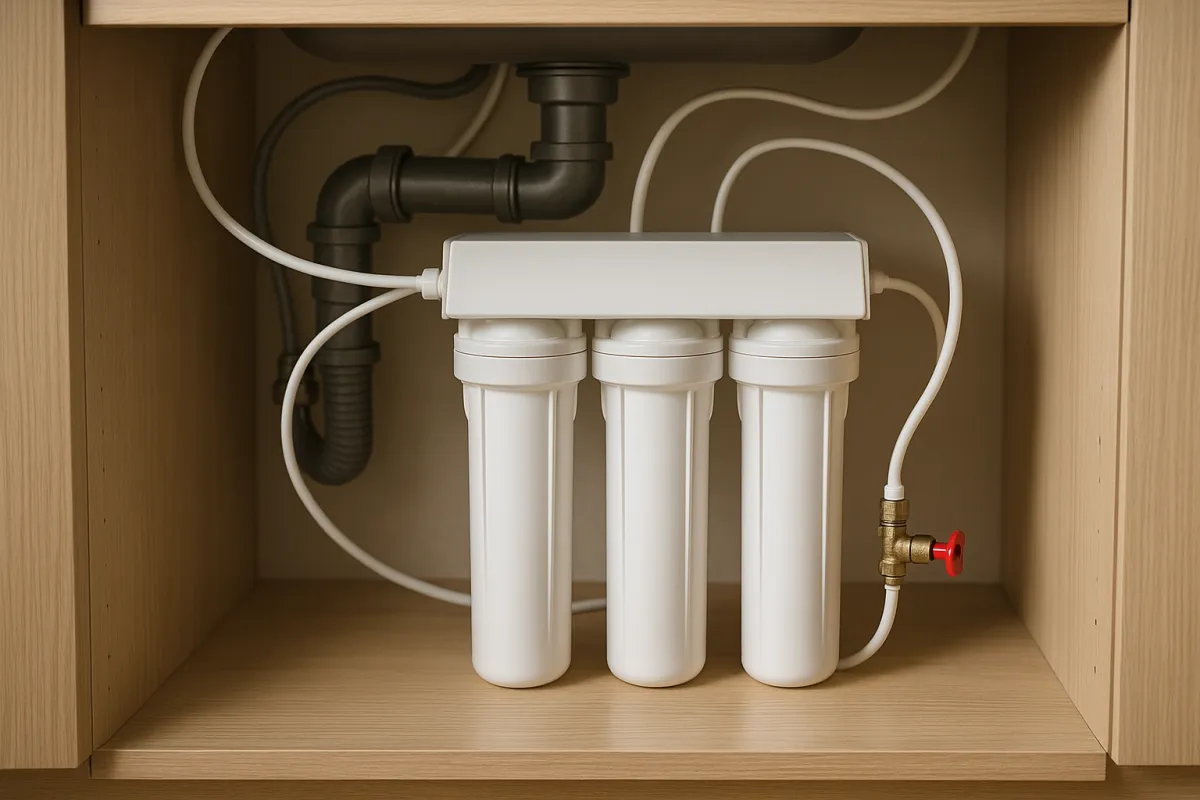
Some homes need additional work beyond this baseline: a dedicated unsoftened line run to the kitchen cold tap for drinking water, relocating the unit from where an old one sat, or rerouting pipe to fit a larger tank’s footprint. Ask for each of these itemized separately on a quote rather than accepting one bundled total, so you can see exactly what your home’s specific situation is adding to the baseline job.
Whole-house vs point-of-use: cost comparison
A water softener is, by design, a whole-house system, since softening every tap is the entire point of removing hardness before it reaches your pipes, fixtures, and appliances. This differs from a point-of-use filter, like an under-sink carbon or reverse osmosis unit, which treats only the water at one tap and costs considerably less to buy and install precisely because it is doing a smaller job.
It is worth being clear that these are not competing options for the same job; a household often runs both, a whole-house softener protecting plumbing and appliances from scale, plus a point-of-use filter or softener bypass at the kitchen tap for anyone who prefers unsoftened drinking water. Pricing a softener against a point-of-use filter and concluding one is simply cheaper misses that they solve different problems for different parts of your home’s water.
Hidden costs: bypass valves, drain lines, and code requirements
A few costs catch first-time buyers specifically because they rarely appear on the sticker price of the unit itself. Local plumbing code in some areas restricts where regeneration discharge water can drain, occasionally requiring a dedicated line rather than tying into an existing drain, which adds labor. Water pressure and flow rate through your home needs to be adequate for the unit’s rated capacity, and a home with unusually low pressure may need additional work to get satisfactory performance. A pre-filter is sometimes recommended or required ahead of the softener if your water carries sediment or iron that would otherwise foul the resin bed prematurely, which is an additional unit and installation cost beyond the softener alone.
Watch out: ask your installer directly whether any of these three apply to your specific home before you finalize a budget, since each one can add a meaningful amount to a quote that otherwise looked complete.
Running cost after purchase: salt, water, and electricity
Once installed, a salt-based softener’s ongoing cost comes from three sources: salt, which is the dominant expense and scales with how much hardness you are removing rather than with tank size; regeneration water, a usually small slice of your total water bill; and electricity for the control valve, which is close to a rounding error. Our water softener sizing and running cost walkthrough works a complete worked example landing near a modest annual total for salt, water, and power combined, a genuinely cheap appliance to operate once the purchase and installation are behind you.
Salt-free conditioners largely skip this recurring cost category, since they need no salt and typically no regeneration water, which is their main argument on long-term running cost even when their purchase price is not meaningfully lower than a salt-based alternative. Weigh that running-cost saving against the different result a salt-free system delivers before deciding it is simply the cheaper choice overall.
Repair or replace: when a new unit is worth it
A control valve or motor fault on an aging softener is the usual trigger for this decision, and the same half-price rule used across other appliances applies reasonably well here: skip a repair quote above roughly half the price of a comparable new unit, and weight that against the resin bed’s own remaining life, since resin itself degrades over many years of regeneration cycles and eventually loses capacity even with a perfectly functioning control valve.
A unit with failing resin, evident from needing to regenerate far more often than its grain capacity and your usage should require, is often better replaced outright rather than repaired, since fresh resin at that point is close to a full system cost anyway. A control valve fault alone on an otherwise sound tank and resin bed is a more straightforward repair call, since control heads are often sold and serviced as standalone parts.
DIY vs professional installation: the real cost comparison
A straight swap, same bypass valve type, same drain connection point, is realistically within reach of a confident DIYer, saving the full labor charge a plumber would otherwise bill. The job involves shutting off the main water supply, disconnecting the old unit at the bypass valve, positioning and leveling the new tank, reconnecting the plumbing, and running the manufacturer’s startup and regeneration sequence to confirm it works.
A first-time install where no softener existed before raises the difficulty meaningfully: a new bypass valve assembly to plumb in correctly, a drain line to route to an approved discharge point, and possibly new electrical work, all of which carry a higher risk of a costly mistake, a leak at a poorly sweated joint or a drain line that backs up during regeneration, for a first-time attempt. Weigh the labor savings against your actual plumbing comfort and the complexity of your specific install before deciding DIY is the right call for a first-time system.
Illustrative installed cost split, a first-time softener install
Professional installation of a mid-capacity salt-based system where no softener existed before. Shares sum to 100.
Illustrative split rather than an exact quote. A DIY install removes most of the labor slice entirely, while a straightforward swap of an existing unit shrinks the labor slice considerably even if you do hire out the work.
How to save on a water softener purchase
A few honest levers actually move the total cost without compromising the result. Size accurately rather than buying extra capacity “to be safe,” since an oversized unit costs more upfront for a resin volume you will not use before it regenerates anyway. Compare an itemized installation quote against DIY for a straightforward swap, where the labor savings are largest relative to the job’s difficulty. Choose a metered valve even though it costs more upfront, since the running-cost payback is genuinely fast. And get multiple quotes for installation specifically, since labor pricing varies more by region and by installer than unit pricing does, especially if you are buying the unit separately from a retailer rather than as part of a package. Run your own grain capacity, valve choice, and labor quote through the cost-per-use calculator to see your illustrative total before you commit.

A worked example: pricing a 48,000 grain system for a family of four
Run the whole method on one realistic case. A family of four on moderately hard well water has sized to a 48,000 grain system using the grain math in our sizing walkthrough, and they are comparing a straightforward purchase against a full-service package.
Unit price. A salt-based system at this capacity with a metered valve, which they have decided is worth the upgrade for the running-cost savings, illustratively prices in the mid-hundreds to around a thousand dollars depending on the specific brand and resin quality chosen.
Installation. Their home has no existing softener, so this is a first-time install needing a new bypass valve, a drain line run to a nearby floor drain about eight feet away, and a dedicated outlet for the control head. They get two itemized quotes from licensed plumbers, which illustratively land several hundred dollars apart once each line item is accounted for, and they choose the clearer, better-itemized quote even though it is not the cheapest headline number.
Total. Combining the unit and the chosen installation quote, their all-in cost lands in a broad illustrative range typical for a first-time mid-capacity install, and they budget separately for the modest annual running cost our other walkthrough works out for a household at their size and hardness level.
Common mistakes that waste money when buying
- Pricing the unit without pricing installation. A cheap unit paired with an expensive first-time install can cost more total than a pricier unit that drops into existing plumbing from a prior softener.
- Oversizing “to be safe.” Extra grain capacity beyond what your actual hardness and usage math calls for is money spent on resin volume you will rarely use before a regeneration cycle anyway.
- Choosing the cheapest timer valve and skipping the metered upgrade. The upfront saving is modest and the running-cost waste over several years typically exceeds it.
- Assuming salt-free is simply the cheaper option. It is often priced comparably or higher than salt-based, and it delivers a different result, scale control rather than measured hardness removal, which is worth understanding on its own terms rather than assuming it is a budget version of softening.
- Accepting one bundled installation number without an itemized breakdown. Line items hide inside a single total, and you cannot evaluate whether a quote is fair without seeing what it actually covers.
Regional and water-hardness factors that move the price
Your region affects this cost in two separate ways worth untangling. Labor rates for licensed plumbers vary meaningfully by region and by local cost of living, which moves the installation half of the total independent of anything about your water. Water hardness and iron content vary by region and by whether you are on municipal supply or a private well, and harder water or meaningful iron content pushes you toward a higher grain capacity, a pre-filter, or both, which moves the unit price half of the total.
A household on genuinely hard well water with iron should expect to budget toward the higher end of this category’s typical range on both the unit and any pre-filtration needed, while a household on moderately hard municipal water in a lower-labor-cost region can reasonably expect to land toward the lower end of the typical installed range.
Water softener basics before you price one
A softener works through ion exchange: hard water passes through a resin bed that swaps calcium and magnesium ions, the minerals that cause scale and soap scum, for sodium or potassium ions, which do not cause the same buildup. Over time the resin’s capacity to perform that swap is exhausted, and the unit regenerates by flushing the resin with a concentrated salt brine, which recharges its exchange capacity for the next cycle. Grain capacity describes how much hardness the resin can remove between regenerations, which is the number that most directly drives both the unit’s physical size and its price.
Understanding this mechanism clarifies why the cost drivers in this breakdown behave the way they do: bigger resin beds for higher grain capacity cost more in raw material, a metered valve that tracks real usage costs more in electronics but saves on the salt and water spent regenerating unnecessarily, and a dual-tank design costs more because it is, functionally, two complete systems sharing a single control scheme.
Financing and the lifetime cost picture
A softener is one of the pricier single appliance purchases in a typical home, and many retailers and installers offer financing or a monthly payment plan as part of the sale, which is worth evaluating on its own merits rather than accepting reflexively because it is offered. A financed purchase at a meaningful interest rate can add a real amount to the total cost over the loan’s term, and that extra cost is worth comparing honestly against simply saving for a few months and paying cash, especially since a softener is rarely an emergency purchase the way a failed water heater is.
Looking at the lifetime picture rather than just the purchase moment also clarifies where your money actually goes over the unit’s service life. A resin bed and control valve, with reasonable maintenance, commonly serves somewhere around 10 to 15 years before resin capacity degrades enough to justify a rebuild or replacement, illustratively. Spread the purchase and installation cost across that span alongside the modest annual running cost, and the true cost of soft water per year is considerably smaller than the upfront number alone suggests, which is a useful reframe when the purchase price feels steep in isolation.
Illustrative 10-year cost of ownership, mid-capacity system
Purchase plus installation amortized over 10 years, alongside typical annual running cost. Shares sum to 100.
Illustrative split rather than a guaranteed result. The upfront purchase dominates even across a decade, which is the honest argument for sizing and buying carefully once rather than cutting corners and replacing sooner.
Signs you may be paying too much
A handful of patterns in a quote are worth a second look before you sign. A single bundled number with no itemization makes it impossible to tell whether you are paying a fair labor rate or an inflated one, and a reputable installer should have no trouble breaking the total into unit, labor, and parts. A capacity recommendation given without asking about your water hardness or household size is a sizing guess, not a calculation, and guesses tend to err toward a bigger, pricier unit than you need. Pressure to decide same-day, common in some direct-to-consumer sales models, works against your interest in comparing quotes, which is the single best lever you have against overpaying on the installation half of this purchase.
On the unit side, a steep price gap between a “basic” and a “premium” model from the same seller with no meaningful spec difference, same grain capacity, same valve type, similar resin volume, is a margin play rather than a genuine upgrade, and it is worth asking directly what the extra money buys before paying it.
Warranty terms and what they typically cover
Warranty length and scope vary enough between brands and sellers to matter for the total cost of ownership, even though it rarely appears as a line item on the initial quote. Most softeners carry separate warranty terms for the resin bed (often the longest-covered component, since it is the simplest with no moving parts) and the control valve (typically a shorter term, since it contains the electronics and moving parts most likely to eventually need service). Some sellers offer an extended labor warranty covering the cost of a technician visit, separate from the parts warranty itself, which matters more than it might seem, since a part covered under warranty but requiring a paid service call to install still costs you something.
Read the actual terms rather than assuming “warranty” means the same coverage across brands, and weigh a longer or more comprehensive warranty as a real, if hard-to-price, factor when two units are otherwise close on cost and specification.
Apartment and rental considerations
Renters face a genuinely different cost calculation than homeowners, since a permanent, plumbed-in softener is rarely a reasonable investment in a property you do not own and may leave within a year or two. Landlords occasionally install a whole-building or whole-unit softener as part of a property upgrade, in which case the cost question becomes moot for the tenant entirely, but absent that, a renter facing hard water has a narrower set of reasonable options.
A portable, no-install exchange tank softener, which connects temporarily to a washing machine hookup or an outdoor spigot and is swapped out periodically rather than regenerated in place, avoids any permanent plumbing modification and is a realistic option for a renter who wants whole-apartment softening without installing anything. A simpler and cheaper route many renters choose instead is a point-of-use solution: a showerhead filter for the hardness-related skin and hair complaints, and a pitcher or under-sink filter for drinking water, neither of which touches the building’s plumbing at all. Neither point-of-use option removes hardness from water used in laundry or dishwashing, which is the honest tradeoff against a true softener, but both are inexpensive, require no landlord approval, and travel with you at the end of a lease.
Watch out: always confirm with your landlord or lease terms before installing any permanent water treatment equipment, even something that seems reversible, since plumbing modifications in a rental commonly require written permission and a botched DIY softener install you are not authorized to perform can become a security deposit dispute rather than a cost-saving move.
When a whole-house system is clearly worth the price
Stepping back from the itemized costs, a few household situations make the case for a full whole-house softener clearly enough that the price becomes secondary to the problem it solves. Genuinely hard well water that leaves visible scale on faucets within weeks, soap that will not lather properly, or laundry that comes out stiff and gray over time are all signs that the cost of not softening, shortened appliance life, more frequent plumbing fixture replacement, and more detergent and soap used to compensate, is itself a real ongoing expense that a softener’s price should be weighed against, not compared to a baseline of zero cost.
Conversely, a household on already-soft municipal water with no visible scale, lathering issues, or appliance buildup is spending real money solving a problem that may not meaningfully exist in their home, which is exactly why a water hardness test before any purchase decision, covered in our sizing walkthrough, is worth the small effort it takes. The cost of the test is trivial next to the cost of a softener bought on assumption rather than on a measured number.
The bottom line
Water softener cost is really three numbers, not one: the unit price, which climbs with grain capacity, technology type, and valve sophistication; the installation cost, which depends heavily on whether your home already has the bypass valve, drain line, and wiring a softener needs or is getting all of that for the first time; and the modest recurring running cost, covered in depth elsewhere, that starts once the system is working. Size the unit from your actual water hardness and household usage rather than a guess, get installation quoted separately and itemized, and weigh a metered valve’s upfront premium against the salt and water it saves over the system’s life. Illustratively, a mid-capacity salt-based system with professional installation lands in a broad but budgetable range for most single-family homes, and a straightforward DIY swap on an existing setup can meaningfully undercut that. The number that matters is the one built from your own water test and your own quotes, not a headline figure borrowed from someone else’s house.
A note on scope: this breakdown is a cost-planning method, not a product recommendation or a plumbing code reference. Every dollar figure, grain capacity range, and cost split above is an illustrative planning number drawn from typical ranges, not a quote for any specific model or region, and your own water hardness, local labor rates, and plumbing layout will change the real numbers meaningfully. None of it is professional plumbing, electrical, or water-quality advice. Get a real water hardness test and specific, itemized quotes for your home before committing to a capacity, a technology type, or an installer.
Frequently asked questions
How much does a water softener cost?
The unit itself commonly ranges from a few hundred dollars for a small, single-tank salt-based softener to well over a thousand for a high-capacity or dual-tank system, with salt-free conditioners and specialty systems often priced toward the higher end of that range. Add professional installation and the total installed cost for a typical single-family home softener illustratively lands in a broad range from under a thousand dollars for a straightforward swap to several thousand for a larger system with new plumbing, a bypass valve, and electrical work. Get a specific quote for your home's grain capacity need and plumbing layout rather than trusting a single number, since capacity and install complexity move this figure more than the brand does.
Is a salt-free water conditioner cheaper than a salt-based softener?
The unit price for a salt-free conditioner is often comparable to or higher than an equivalent salt-based softener, so it is not reliably the cheaper purchase upfront. Where salt-free can save money is in the running cost after purchase, since it needs no salt deliveries and no regeneration water, though it is worth being clear-eyed that a salt-free conditioner changes how scale behaves rather than removing hardness minerals the way a true softener does, which is a different result, not just a cheaper version of the same one. Compare the two on what they actually do to your water, not purely on price.
Does a bigger house need a more expensive water softener?
Usually yes, because a larger household uses more water and needs a higher grain capacity to avoid regenerating too frequently, and higher capacity units cost more. The driver is really your daily grain load, which depends on your water's hardness and your household's water usage, not square footage directly. A small, hard-water household can need a larger, pricier unit than a large, soft-water household, so size by the grain math in our water softener sizing walkthrough rather than assuming house size alone sets the price tier.
Can I install a water softener myself to save money?
Many experienced DIYers successfully install a softener themselves, particularly when replacing an existing unit with a comparable bypass valve setup, and doing so saves the entire labor charge a plumber would otherwise bill. A first-time install where no softener existed before is more involved, typically requiring a bypass valve, a drain line for regeneration discharge, and sometimes a dedicated electrical outlet for the control head, all of which raise the difficulty for a first attempt. If your plumbing skills are modest, a botched installation that leaks or regenerates incorrectly can cost more to fix than the labor you were trying to save.
What is included in a typical water softener installation cost?
A professional installation quote typically bundles the bypass valve and fittings that let you route around the softener for maintenance, the drain line connection for regeneration discharge, any new wiring for the control head's power, cutting into and reconnecting your main water line, and the labor itself. Some installs also need a dedicated water line to a kitchen tap left unsoftened, or a reconfigured layout if the softener is relocating from where a previous unit sat. Ask for an itemized quote so you can see which of these line items apply to your specific home rather than accepting one bundled number.
Do I need a plumber or can an installer from the softener company do it?
Either can do competent work, and the choice usually comes down to price and scheduling rather than skill. Many water treatment companies that sell softeners also offer installation as part of the purchase, which can be convenient and sometimes discounted as a package, while an independent licensed plumber may offer more flexibility on timing and is a reasonable choice if you are buying the unit separately online or from a hardware retailer. Confirm whichever option you choose is licensed for the plumbing and, if applicable, electrical work involved, and get the installation cost itemized separately from the unit price so you can compare apples to apples.
Why do water softener prices vary so much between retailers?
The unit itself is only part of what varies: grain capacity, control valve type (a basic timer versus a metered valve that regenerates based on actual water use), resin quality and volume, and whether the system is single-tank or dual-tank for uninterrupted soft water all move the price meaningfully within what looks like the same general category. Big-box retail, specialty water treatment dealers, and online direct sellers also price similar specs differently based on their own overhead and whether installation and warranty service are bundled in. Compare specs line by line, not just sticker price, before assuming one listing is simply a better deal than another.
Is it worth paying more for a metered water softener valve?
For most households, yes. A metered valve regenerates based on actual water passing through the unit, so it uses salt and water only when the resin is genuinely close to exhausted, while a basic timer-based valve regenerates on a fixed schedule whether or not you actually used that much water that week, wasting salt and water on a cycle you did not need. The price difference between a timer and a metered valve is usually a modest fraction of the whole system's cost, and it pays for itself over a few years in reduced salt and water use, which our running-cost breakdown covers in detail.