
What's on this page
- What a washing machine actually has to do
- Before you start: what to measure and what to know
- Step 1: Measure the space, the doorway and the hookups
- Step 2: Choose front load or top load
- Step 3: Size the capacity to your household
- Step 4: Decide high-efficiency or standard
- Step 5: Pick the cycles and features worth paying for
- Step 6: Price the running cost before the sticker price
- Step 7: Check noise, vibration and the installation surface
- Hookups, drainage and venting in detail
- Step 2 revisited: stacking, laundry centers and combo units
- What drum capacity really means in a washing machine
- Reliability, repairability and the electronics trade
- A worked example: choosing for a family of four
- Common mistakes when choosing a washing machine
- Troubleshooting the decision when it will not resolve
- Choosing for an apartment, a rental or a tight laundry closet
- Reading a washing machine spec sheet without getting lost
- Delivery day, installation and the first wash
- Your washing machine choosing checklist
- The bottom line
Short answer: Choose a washing machine by measuring the space, the doorway and your water and drain hookups first, since those eliminate models before type or capacity does. Pick front load for capacity and efficiency or HE top load for easier loading, size the drum to your household with margin for bulky items, and budget HE detergent and a water-heating cost that depends almost entirely on the wash temperature you actually use.
How to choose a washing machine sounds like a straightforward swap, the old one dies and a new one of roughly the same shape arrives, but the category has changed more in the last two decades than almost any other appliance in the house. Agitators have mostly disappeared, spin speeds have climbed, water use has dropped by more than half on efficient models, and the detergent aisle now has a whole section a shopper from fifteen years ago would not recognize. None of that shows up clearly on a showroom floor, where every machine looks similar and the differences only become obvious once it is installed and running your actual laundry.
These notes give a seven-step method for how to choose a washing machine, ordered so each step narrows the field before the next one asks you to compare specifics. The first step is measurement, the one people skip because the old machine already fits, which is a bad assumption the moment the new one is a different type or a different depth. For what a new machine costs to run, see our washing machine running-cost notes, and for the cleaning routine that keeps any machine smelling right, our washing machine cleaning notes. Set your household size, machine type and loads per week in the sizing planner as you read, and it will size the decision to your laundry room rather than to a showroom floor.
Key takeaways
- Measure the space, the doorway and the hookups before anything else. A front loader that will not fit through a hallway or a top loader with no room for its lid to open eliminates itself instantly once you know to check.
- Front load generally wins on capacity, efficiency and spin speed; HE top load keeps easy waist-height loading without an agitator. Either beats an old agitator machine on gentleness and water use.
- Drum capacity is sized to household and habits, with a workable planning rule of about 2.8 cubic feet for one or two people plus roughly 0.6 more per additional person, and margin added for bulky loads.
- Running cost is almost entirely about wash temperature. The motor itself costs a few cents a load; heating water for a warm or hot wash can be ten times that.
- HE detergent is not optional on a high-efficiency machine. Regular detergent over-suds in a low-water cycle and works against the machine rather than with it.
What a washing machine actually has to do
Every machine on the floor washes clothes. That part of the job has been solved for decades, which is exactly why the spec sheet is such a poor predictor of whether you will be happy with the one you bring home. What actually decides satisfaction is physical and behavioral: whether it fits the space and the doorway, whether loading and unloading suit your back and your routine, whether it is quiet enough for a laundry closet near a bedroom, and whether the detergent and cycle choices you make match what the machine expects.
The chart below is an illustrative split of where washing machine regret tends to come from, drawn as a shape to plan against rather than a measured survey. It explains why these notes put measurement and type ahead of features.
Where washing machine regret actually comes from
An illustrative split of post-purchase complaints. Segments sum to 100 percent. A shape to plan against, not a survey result.
Almost half the shape is capacity and type, both of which are settled before you ever compare a feature list. Illustrative proportions, not measured data.
Read that shape and the shopping order follows. If more than a quarter of the trouble is a drum too small for how the household actually washes, capacity deserves a real calculation rather than a guess. If a fifth is the wrong type, front load versus top load is worth more thought than the trim level. And if installation surprises account for another seventh, the hookups belong on the measuring list alongside the doorway, not discovered on delivery day.
Before you start: what to measure and what to know
This is a shopping decision, and the preparation is measurement and honesty about your laundry habits rather than tools. Half an hour now prevents the two expensive outcomes: a machine that does not fit the space or the route to it, and a machine that fits but is the wrong type for how your household actually does laundry.
Gather these before opening a single product page.
- The space, measured width, height and depth, at the floor and at any point where plumbing or a vent pipe projects into the alcove.
- The doorway and the whole delivery path, from the entrance to the laundry space, including any turn, stair or low overhead point.
- The water supply. Hot and cold shutoff valves, their condition, and whether the connection is a standard hose thread.
- The drain. A standpipe with a trap, a floor drain, or a laundry sink, and its height relative to the machine.
- The electrical outlet, its type and distance from where the machine will stand.
- Whether you plan to stack a dryer on top, which rules out top load entirely and adds a height and ceiling clearance question.
- Your real laundry pattern, honestly: loads per week, how many are bulky items like comforters, and how many run warm or hot rather than cold.
- Your electricity and water rates, from a real bill, so the running-cost step means something. Our notes on lowering an electric bill cover where to find the rate.
Two ground rules before you start. Download the installation manual for any model you are seriously considering, since it lists the exact clearance, leveling and hookup requirements the product page leaves out. And write every measurement down, because laundry closets are often built to minimum dimensions and the numbers that matter are frequently within an inch of each other.
Step 1: Measure the space, the doorway and the hookups
This step eliminates more of the market than any other, which is what makes the rest of the shopping trip quick.
Start with the alcove or closet itself. Measure width, height and depth at the floor, since baseboards, pipe stub-outs and a vent duct can all intrude into the nominal opening. Then check the height specifically if a dryer will sit on top, because a stacked pair commonly stands somewhere in the range of 74 to 80 inches tall, and a low ceiling or a shelf above the space can rule stacking out before you compare a single model.
Then walk the delivery path exactly as the earlier refrigerator-style rule goes: the narrowest doorway, the tightest turn, the stair width, any handrail, and the lowest point overhead, compared against the appliance’s boxed dimensions rather than its finished ones. A washing machine is heavy and awkward on stairs, so confirm with the retailer whether delivery includes carrying it to a non-ground-floor laundry space, since some delivery services stop at the door.
Finally the hookups. Confirm hot and cold shutoff valves are present, reachable and not seized from years of disuse, since a stiff or leaking valve is a plumbing job you want to know about before delivery day rather than during it. Check the drain, whether it is a standpipe with a trap, a floor drain, or a laundry sink, and its height, since a washer’s drain pump can only push water up so far. And confirm the outlet type and location, since some high-capacity machines want a dedicated circuit.
Step 2: Choose front load or top load
This is the decision with the most daily consequences, and it is a question about your body, your space and your routine rather than a quality ranking between the two.
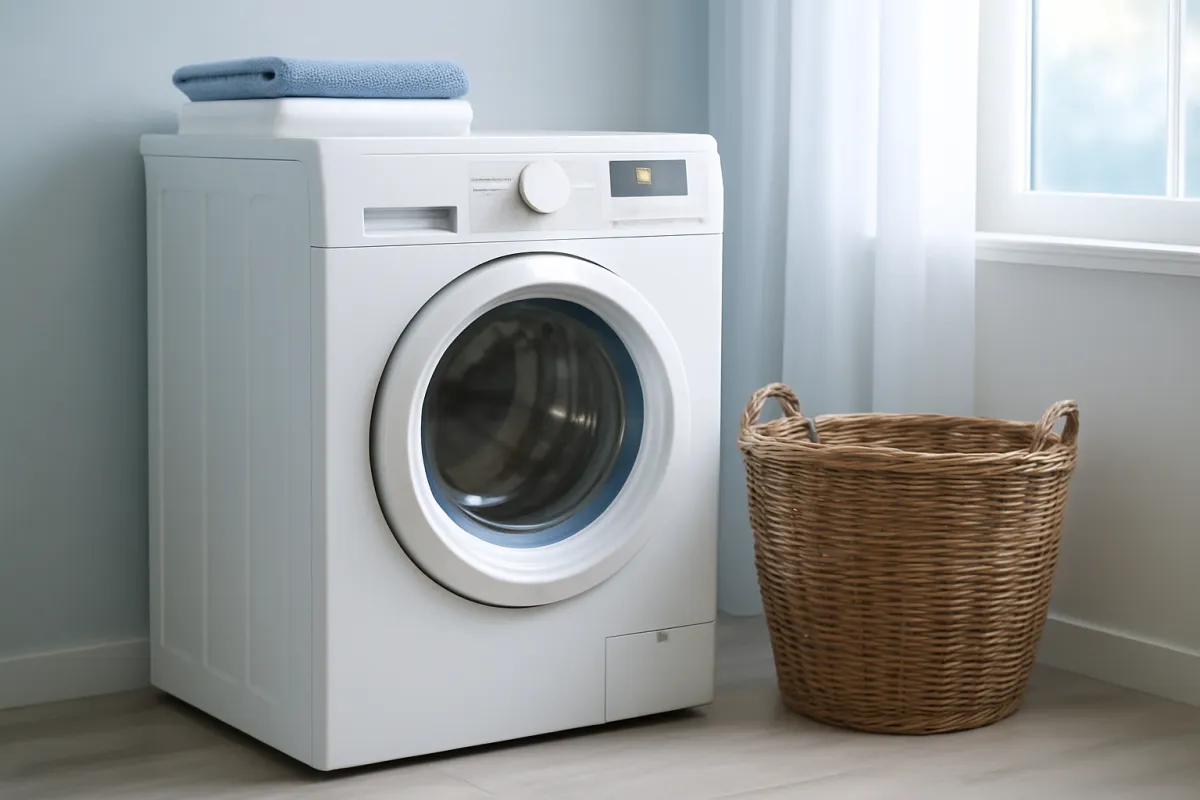
Front load machines open through a door on the front, hinge and run on a horizontal drum, and generally deliver the highest capacity and the lowest water use for a given footprint, along with the fastest spin speeds, which means less water going into the dryer afterward. They are also the only type that can be stacked with a dryer, which matters in a tight laundry closet. The costs are a loading height low enough that some people find it hard on the back or knees, a rubber door gasket that needs a regular wipe to avoid trapped-water odor, and cycle times that commonly run longer than a top loader’s.
Top load without an agitator keeps the familiar waist-height loading that does not require bending, while replacing the center post with an impeller or plate at the bottom of the tub, which is gentler on fabric than an agitator and usually gives more usable drum space for the same footprint. It typically runs a shorter cycle than a front loader and often costs less for a comparable capacity, though spin speeds and water efficiency usually trail the best front loaders.
Top load with an agitator is the traditional design, the cheapest option available, and the hardest on clothes and on water, since an agitator physically rubs fabric against a center post to clean it rather than tumbling it through a shallow pool of water. It is becoming less common as efficiency standards push manufacturers toward impeller and front-load designs, but it remains the simplest machine mechanically and the easiest to repair.
The honest way to decide is to rank your own priorities rather than borrow someone else’s: capacity and efficiency point to front load, easy loading without an agitator points to HE top load, and lowest price with the simplest mechanism points to a conventional agitator machine if you can still find one. If stacking a dryer is part of the plan, front load is the only option on the table, which settles the question before any other factor gets a vote.
Step 3: Size the capacity to your household
Showroom capacity numbers look abstract until a comforter will not fit, which is usually the moment people discover they sized wrong.
The workable planning rule is roughly 2.8 cubic feet of drum capacity for one or two people, plus about 0.6 more for each additional person beyond two. That puts a single person or a couple near 2.8, a family of four near 4.0, and a larger household nearer 5.0, which is close to where common large-capacity machines top out. Treat it as a starting figure rather than a precise answer, because capacity in a washing machine is driven as much by what you wash as by how many people wash it.
Correct for your real pattern. A household that regularly washes comforters, sleeping bags, dog beds or large area rugs benefits from sizing up a class regardless of headcount, since a bulky single item can fill a mid-size drum on its own and still wash poorly if it cannot tumble freely. A household doing frequent small loads of work clothes or school uniforms can run comfortably at or below the rule, since the constraint there is frequency rather than volume. The sizing planner takes your household size, machine type and loads per week and estimates both a target capacity and the water cost that follows from it.
One more correction worth making deliberately: a drum that is slightly larger than the rule suggests is rarely a mistake, since a full-but-not-overstuffed load washes better than a crammed one, while a drum that is slightly small is a mistake you discover every time you own a comforter.
Step 4: Decide high-efficiency or standard
High efficiency is not a trim level, it is a different wash mechanism, and understanding what changes helps the rest of the decision make sense.
An HE machine, front load or top load without an agitator, washes with a shallow pool of water and tumbling or impeller action rather than fully submerging and agitating the load. The practical result is real: an efficient front loader uses roughly 15 gallons per full load, an HE top loader a little more, while an older conventional agitator top loader commonly uses 30 to 40 gallons for the same size wash. Less water also means less water to heat on a warm or hot cycle, which is where a meaningful share of a laundry bill actually sits.
Water used per full load, by machine type
Illustrative gallons per load for a comparable full-size wash. Bars scale to the thirstiest machine.
Illustrative midpoints: 35 gallons for an older conventional top loader, 20 for an HE top loader, 15 for an HE front loader. Real models and load sizes vary.
That gap is roughly 20 gallons a load between the thirstiest and the most efficient option, which at a modest water and sewer rate adds up across a year of laundry, and it compounds further on any load washed warm or hot, since every gallon not used is a gallon that did not need heating either. The tradeoff is a real but modest price premium for HE machines and, on nearly all current models, a requirement to use HE-labeled detergent, since standard detergent foams too much in a low-water cycle and works against the machine’s own design.
If you are replacing a machine that still works, the payback period from switching early to save water rarely justifies the cost on economics alone. Replace an aging or failing machine with an HE model and the efficiency gain is close to free, since you were buying a new machine anyway. Our notes on whether ENERGY STAR appliances are worth it and our certification explainer cover how the labeling works across appliance categories.
Step 5: Pick the cycles and features worth paying for
Cycle lists on modern machines run long, and most households use a handful of them regularly while the rest sit unused, which is exactly the 16 percent slice of regret in the chart above.
The cycles worth having on almost any machine: a normal or everyday cycle for most loads, a delicate or hand-wash cycle for anything that cannot take full agitation, a bulky or bedding cycle sized for comforters and large items, and a quick or express cycle for small, lightly soiled loads that do not need a full wash time. Beyond that, evaluate honestly against how you actually do laundry rather than against what sounds useful in a showroom.
Steam cycles can help with set-in odors and light wrinkle reduction, and they are a genuine extra rather than a marketing label on most machines that offer them, but they add cycle time and are not a substitute for stain pretreatment.
Sanitize or allergen cycles run hotter water for longer to target bacteria and allergens, which is useful for households managing an illness in the home or heavy allergy sensitivity, and largely unnecessary for routine laundry.
Extra rinse options matter more than their modest description suggests for anyone with sensitive skin or detergent sensitivity, since they are the direct fix for residue left in fabric.
Load sensing and auto water level adjust water use to the size of the load automatically, which is a genuine efficiency and convenience feature on a machine you will run with mixed load sizes.
Wifi connectivity and app control are the feature most likely to sit unused. Ask honestly whether you will check a laundry app weekly before paying for it, using the same test that applies to any appliance electronics: will I use this often enough to accept its added cost and its own potential point of failure.
Step 6: Price the running cost before the sticker price
The purchase price is the smallest number in a decade of ownership, and the running cost is driven almost entirely by one choice you make every single load: the wash temperature.
The motor and controls use very little electricity on their own, typically around 0.1 to 0.2 kilowatt-hours to fill, tumble and spin a full cycle, which is only a few cents at a typical rate. The large swing in cost comes from water heating, because most washing machines draw hot water from the home’s water heater rather than heating it themselves. Warming the water for a warm wash can take roughly 1.3 kilowatt-hours, and a hot wash roughly 2.6, which is ten to twenty times what the motor alone uses. A cold wash, by contrast, uses almost nothing beyond the motor and the water itself.
Water is a real cost too, and it is paid on every load regardless of temperature: an efficient front loader at around 15 gallons a load costs only a few cents at a typical combined water and sewer rate, while an old conventional top loader at 30 to 40 gallons costs noticeably more even on a cold wash, before any heating enters the picture. Our dedicated running-cost notes work the full arithmetic for cold, warm and hot washing at your own rates, and the sizing planner on this page estimates the water-cost side of the comparison for the type and household size you are considering.
The practical takeaway for choosing a machine rather than running one you already own: if most of your loads run warm or hot, the efficiency gap between machine types matters more to your bill than it would for a household that washes almost everything cold, because heating is where the real money sits.
Step 7: Check noise, vibration and the installation surface
The last step is the set of small things that decide whether you like living with the machine, and they are the ones a feature comparison handles worst.
Noise and vibration matter enormously in a laundry closet near a bedroom or on an upper floor over a living space. Front loaders generally vibrate less at speed because the drum spins around a horizontal axis balanced on springs, but any machine on an uneven or unsupported floor will walk and bang regardless of design. Manufacturers increasingly publish a decibel figure, and comparing those is more reliable than a showroom listen, where the ambient noise floor is high and most floor models are not actually running a spin cycle.
The installation surface matters more than people expect. A washing machine on a wood-frame upper floor needs a level, adequately supported subfloor, and an unlevel machine is the single most common cause of walking and excess noise during spin, independent of how well built the machine is. Leveling feet exist for a reason; use them, and check level again after the first few loads since a leveled machine can settle.
Vibration-dampening pads or a stand help on a marginal floor, and a dedicated stand or pedestal under a front loader both raises the loading height and adds isolation from the floor, though it is a convenience and comfort purchase rather than a requirement, as the FAQ above covers.
The reliability trade closes the step. Each added electronic feature, a touchscreen, app connectivity, advanced sensors, is another component with its own failure mode. Ask whether you will use a feature weekly, and whether its failure would stop the machine from washing or only disable the extra. Prefer the second kind of feature, and prefer mechanical simplicity where you can get it without giving up capacity or efficiency you actually need.
Hookups, drainage and venting in detail
This deserves its own section because a hookup problem discovered on delivery day is the most common reason an installation gets rescheduled.
The water supply needs two functioning shutoff valves, hot and cold, with standard hose threads. If the valves have not been touched in years, have a plumber check them before delivery day rather than discovering a seized or leaking valve while a delivery crew waits. The supply hoses themselves are a cheap, overlooked upgrade: braided stainless hoses resist bursting far better than the plain rubber hoses some machines still ship with, and a burst supply hose behind a washing machine is one of the more damaging plumbing failures a home can have.
The drain is either a standpipe with a trap, a floor drain, or a laundry sink, and the machine’s drain pump has a limited lift height it can push water up to, which the installation manual specifies. An undersized or improperly vented standpipe can cause gurgling, slow draining, or siphoning that pulls water back out of the machine mid-cycle, which looks like a machine fault and is actually a drain plumbing issue. Our drainage hose setup notes cover the standpipe height, trap, and hose routing questions in more detail.
Electrical needs are usually simpler but still worth confirming: most residential washing machines run on a standard outlet, though some larger or feature-heavy models specify a dedicated circuit, which the installation manual will state plainly. Confirm the outlet is within reach of the power cord without an extension cord, since running a washing machine on an extension cord is both a manual violation on most machines and a genuine fire risk given the current an electric motor and pump draw.
Step 2 revisited: stacking, laundry centers and combo units
If your space constraints point toward something other than a standalone washer and separate dryer, three distinct options exist and they solve different problems.
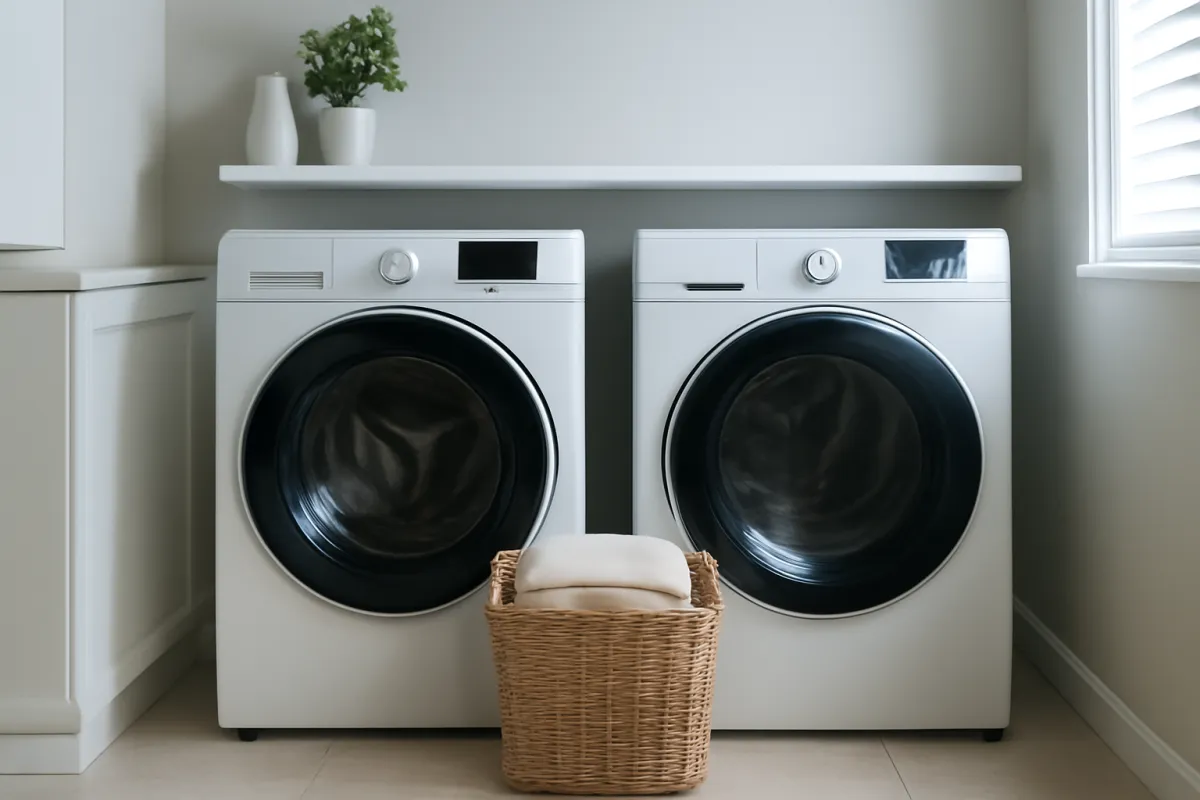
A stacked pair is two separate full-size machines, a front-load washer with a matching dryer from the same manufacturer and usually the same series, joined by a stacking kit made for that specific pairing. Each machine is independently replaceable and typically full capacity, which makes this the best long-term option when the floor space allows the roughly 74 to 80 inch height.
A laundry center is a single cabinet with washer and dryer built in as one unit, generally cheaper and narrower than a stacked pair but with smaller capacity on both ends and more basic features, and a failure in either half means servicing or replacing the whole appliance rather than one machine.
A washer-dryer combo washes and dries in a single drum, needs only one set of connections, is normally ventless, and fits spaces nothing else will, which makes it the right call for a small apartment or a closet with no dryer venting at all. The cost is time: a combined cycle commonly runs considerably longer than washing and drying separately, and drying capacity is usually smaller than washing capacity, so a full wash load may need splitting across two dry cycles. Our stacking and laundry center notes cover the measurements for each option in detail.
What drum capacity really means in a washing machine
Advertised cubic feet describe the drum’s empty volume, and the usable share of that volume depends on load type more than on the machine itself, which is a different relationship than it is for a refrigerator or a freezer.
A washing machine’s capacity is meant to be filled loosely enough that water and detergent can circulate through the load, so a drum packed to its advertised limit with dense items like towels or jeans actually washes worse than a moderately full load, while the same drum can comfortably take more of something light and bulky like a comforter precisely because air and water move through it easily. This is the opposite intuition from a refrigerator, where more mass inside generally helps efficiency, and it is worth internalizing before you judge a machine’s capacity by cramming it the way you would a suitcase.
The practical consequence is that the sizing rule in step three is a starting point for frequency and routine load size, while bulky single items are judged separately against the drum’s dimensions rather than its cubic-foot badge. A household that washes a king-size comforter regularly should check that specific capability on a shortlisted model, since manufacturers increasingly publish a bedding or bulky-item capacity callout precisely because the general cubic-foot number does not answer that question well.
Reliability, repairability and the electronics trade
Every added system in a modern washing machine is something that can fail, and the honest position is that some additions earn their place while others are a maintenance liability wearing a touchscreen.
Features that generally help the core job: a direct-drive or inverter motor that runs efficiently and quietly across a range of speeds, load sensing that adjusts water automatically, and an unbalanced-load detection system that slows or pauses a cycle rather than letting a lopsided spin walk the machine across the floor. These all serve the washing and spinning job directly.
Features that deserve more scrutiny: a large touchscreen interface, which is a display and a small computer bolted onto an appliance that has to keep working for a decade; app connectivity, which depends on a manufacturer continuing to support software for as long as you own the machine; and elaborate cycle counts with dozens of specialized settings most households never explore past the first month. None of these are wrong to buy, but none of them are free either, in dollars or in added points of failure.
Ask the same three questions that apply to any major appliance purchase. Will you use this weekly. If it fails, does the machine stop washing or does only the feature stop. And is there a simpler, mechanical way to accomplish the same thing. A feature that survives all three is worth having.
A worked example: choosing for a family of four
A household of four in a ground-floor laundry closet with a 32 inch wide opening, standard hot and cold valves, and a floor drain already in place. They do six loads a week, about a third of them warm, and own two sets of bedding they wash regularly. Every figure below is illustrative.
Step 1, measurement. The closet opening is 32 inches wide and 78 inches tall with the door removed from its hinges, which rules out stacking at this specific height once clearance for the dryer’s own controls is counted, so they plan for a standalone washer instead. The delivery path has no narrow turns. The water valves test fine and the drain is a floor drain rated for the expected flow.
Step 2, type. No stacking need, a ground-floor location, and no one in the household has back trouble with loading, so either front load or HE top load is viable on comfort grounds. They choose front load for the higher spin speed and the capacity per dollar.
Step 3, capacity. The rule gives 2.8 plus 0.6 times two, which is 4.0 cubic feet of drum capacity. With two regular bedding sets, they size up slightly to 4.3 cubic feet to comfortably handle a comforter without crowding it.
Step 4, efficiency. At 15 gallons a load for their chosen HE front loader against 35 for an old conventional top loader, six loads a week works out to 90 gallons a week on the efficient machine against 210 on the old type, a difference of 120 gallons a week, or 6,240 gallons across a year. At an illustrative water and sewer rate of 1.5 cents a gallon, that is about 94 dollars a year in water alone, before counting the heating savings on their warm loads.
Step 5, cycles. They want normal, delicates, bulky bedding and a quick cycle for school uniforms, and skip the steam and sanitize options as features they are unlikely to use weekly.
Step 6, running cost. With about a third of six weekly loads run warm, that is two warm loads and four cold. At their rate, the warm loads add a real but modest heating cost on top of the water and motor cost, which their household budgets as part of the laundry line rather than a surprise.
Step 7, the small things. The laundry closet backs onto a bedroom wall, so they compare published decibel ratings and confirm the floor under the closet is a slab rather than a wood-frame upper floor, which settles the vibration question without needing a stand or dampening pad.
The decision. A standard-depth HE front loader at 4.3 cubic feet, HE detergent bought alongside it, a floor-mounted installation with no pedestal, and a known annual water saving near 94 dollars against the old machine it replaced. Nothing about the decision was dramatic, which is what a well-measured appliance choice looks like.
Common mistakes when choosing a washing machine
Measuring the old machine’s footprint instead of the new one’s. A different type or brand can have a meaningfully different depth or door swing, and assuming the old spot just works is the single most common delivery-day surprise.
Skipping the hookup check. A seized valve or an undersized drain discovered on delivery day turns a simple swap into a rescheduled delivery and an unplanned plumbing call.
Buying a conventional agitator machine out of habit. It is usually the cheapest option up front and the hardest on both clothes and water over the life of the machine.
Sizing to today’s household rather than to real load patterns. A couple who washes a king comforter monthly needs the capacity for that load regardless of headcount.
Using regular detergent in an HE machine. It over-suds in a low-water cycle, reduces cleaning performance, and can trigger wasteful extra rinses.
Comparing noise in a showroom. The ambient noise floor is high and most display models are not spinning. Compare published decibel ratings instead.
Adding every feature by default. Each one costs money and adds a potential point of failure. Add a feature because you will use it, not because it is on the box.
Letting a sale pick the model. Timing should choose among a shortlist that already fits your space and hookups, never build the shortlist itself.
Troubleshooting the decision when it will not resolve
What if nothing fits the laundry space? Check whether a narrower-depth model exists in the type you want, since manufacturers increasingly offer compact or slim-depth versions of both front-load and HE top-load designs. If the space truly cannot take a full-size machine, a compact or stackable-only option may be the honest answer rather than forcing a standard-size machine into a space built for something smaller.
What if the household disagrees between front load and top load? Weight the decision toward whoever does the loading and unloading most often, and toward anyone with back or knee issues that make a low front-load door genuinely difficult, since that is a daily physical cost rather than a preference.
What if I want HE efficiency but the premium feels too large? Compare an HE top loader rather than defaulting to front load, since it typically costs less than an equivalent front loader while still delivering real water savings over a conventional agitator machine.
What if the old machine just died and I need one immediately? Buy the sensible like-for-like replacement that fits the space and hookups you already have, and resist changing type or capacity class under time pressure, since those changes are the ones that run into stacking, plumbing or delivery complications.
What if I cannot tell whether a model is reliable? Reduce your exposure rather than trying to predict the unpredictable: fewer added electronic systems, a warranty that addresses the motor and drum assembly specifically, and a preference for mechanical simplicity over software-dependent features.
Choosing for an apartment, a rental or a tight laundry closet
In a rental, the machine is often not yours to choose, and where you are buying your own for a rental unit, favor a standard width and a widely available size class over anything unusual, since you may be moving it to a different building eventually. Avoid any installation that requires permanent plumbing changes you would not be allowed to make.
In an apartment with shared or in-unit laundry, noise and vibration deserve extra weight, since the walls and floors separating units are rarely as forgiving as a detached house’s. A front loader on a solid floor with leveling feet properly set is usually the quieter choice.
In a very tight laundry closet, compact or slim-depth models exist specifically for this situation, and a washer-dryer combo is worth serious consideration if venting a separate dryer is not possible at all, despite the longer combined cycle time it trades for that flexibility.
Reading a washing machine spec sheet without getting lost
Specification sheets run long, and a handful of lines decide the purchase. Read these and skim the rest.
Drum capacity in cubic feet, and whether a bedding or bulky-item capacity is called out separately from the general figure.
Machine type, front load, HE top load without an agitator, or conventional agitator top load, which the listing states plainly even when the marketing copy does not emphasize it.
Spin speed in RPM, since a higher top spin speed pulls more water out before drying, which shortens dryer time and its running cost.
Water use per cycle, increasingly published directly, and worth comparing against the illustrative figures in step four.
Dimensions including the door, and specifically whether the model is described as stackable, since not every front loader is.
Decibel or sound rating, if published, more reliable than a showroom listen.
HE detergent requirement, stated in the manual even when not prominent on the box, and relevant to your ongoing detergent cost.
Warranty terms, with the motor and drum assembly called out, since that is the expensive repair that decides whether a future fault is worth fixing.
Delivery day, installation and the first wash
The purchase is not finished at checkout, and a few details on delivery day protect the decision already made.
Confirm in writing what the delivery service includes: whether the crew connects the water and drain lines or only places the machine, whether they haul the old one away, and what happens if it does not fit through the doorway on the day. Clear the path and the laundry space yourself before the crew arrives, and have the shutoff valves accessible rather than hidden behind stored items.
Once the machine is in place, level it carefully using the adjustable feet, and check level again after a few loads, since a machine can settle slightly once it has run a few spin cycles. An unlevel washing machine is the leading cause of excess noise, vibration and walking during spin, independent of how well the machine itself is built.
Run an empty test cycle before loading real laundry, to confirm the water connections do not leak and the drain handles the discharge without backing up. Then load the first real wash at a normal size rather than a very small or very large one, so you get an honest first impression of how the machine performs at the capacity you will actually use most weeks.
Your washing machine choosing checklist
Work it in order. The first three items eliminate most of the market, which is what makes the rest quick.
- Space measured at the floor, including any pipe or vent intrusion, plus the full delivery path and its narrowest point.
- Hookups checked: functioning hot and cold valves, a drain that can take the discharge, and an outlet within reach.
- Stacking decided, which rules front load in or out before any other comparison starts.
- Type chosen between front load, HE top load, and conventional top load, weighted by loading comfort and your priorities.
- Capacity set from household size and real load patterns, with margin for bulky items, using the sizing planner on this page.
- Efficiency class decided, with HE detergent budgeted as an ongoing cost if you choose an HE machine.
- Cycles and features audited against which ones you will actually use weekly.
- Running cost estimated honestly for your mix of cold, warm and hot washing.
- Noise and floor support checked, with leveling and, if needed, a stand or dampening pad planned.
- Delivery terms confirmed in writing: hookup connection, haul-away, and what happens if it will not fit.
The bottom line
Choosing a washing machine is a measuring and habits exercise that most people treat as a simple swap, which is why so many laundry rooms contain a machine that is slightly the wrong type or slightly too small for what actually gets washed in it. Measure the space, the doorway and the hookups first, because those decide what is even possible before type or capacity does. Pick front load for capacity, efficiency and spin speed, or HE top load for easy loading without an agitator, and know that either beats an old conventional agitator machine on water use and gentleness, by roughly 15 to 20 gallons a load against 30 to 40. Size the drum with the household rule as a floor and real load patterns, especially bedding, as the correction. Then remember that running cost is mostly about temperature, not the machine badge: the motor is a few cents a load and water heating is where the real money sits on anything warm or hot. Buy HE detergent if you buy an HE machine, check noise and floor support before delivery day, and audit every feature against whether you will actually use it weekly. Get those right and the finish and the control panel, which is what a showroom shows you first, become exactly what they should be: the last thing you decide.
A note on scope: these notes set out a general method for choosing a home washing machine and are educational rather than professional plumbing, electrical or appliance-installation advice. Every capacity figure, gallon amount, kilowatt-hour number and dollar amount above is an illustrative planning figure chosen to make the arithmetic followable, not a measurement of any particular model, and your own household, rates and habits will move the real numbers. The installation manual for the specific machine you are considering outranks everything written here, particularly on required clearances, leveling, drain standpipe height and electrical requirements. Water and drain connections, and any electrical alteration, belong with a qualified plumber or electrician if you are not confident doing them yourself, and a leak, a burning smell, a tripping circuit or a machine that will not level means stop using it and have it looked at.
Frequently asked questions
Front load or top load: which washing machine should I buy?
Front load typically wins on capacity per dollar, water use, and spin speed, which means less water to pay to heat and a drier load going into the dryer, and it is the only option if you plan to stack a dryer on top. The cost is a lower loading height that some people find hard on the back, a rubber door gasket that needs regular wiping to avoid odor, and usually a longer cycle time. Top load without an agitator keeps the easier waist-height loading and a shorter cycle while still giving up the center post that used to tangle and wear fabric, at a usually lower price than an equivalent front loader. A traditional agitator top loader is the cheapest option and the hardest on clothes, and it is becoming less common as efficiency rules push manufacturers away from it. Choose front load for capacity and efficiency, HE top load for easy loading without an agitator, and know that either modern option beats an old agitator machine on gentleness and water use.
What size washing machine do I need for my household?
A workable planning rule is roughly 2.8 cubic feet of drum capacity for one or two people, plus about 0.6 more for each additional person beyond two, which puts a couple near 2.8, a family of four near 4.0, and a larger household nearer 5.0, where common large-capacity machines top out. Treat that as a floor rather than an exact target, because bulky items change the math: a household that regularly washes comforters, sleeping bags, or large towels loads benefits from sizing up a class regardless of headcount, while a household that does frequent small loads can run comfortably below the rule. The sizing planner on this page converts your household size and loads per week into a target capacity and an estimated water cost so you can check a model's listed capacity against your own numbers rather than against a stranger's household.
Is a high-efficiency (HE) washing machine worth it?
For most households, yes, because the water and energy savings compound over years of ownership and the newer designs are also gentler on clothes. An HE machine uses roughly half to two-thirds the water of an old conventional top loader for the same size load, which lowers both the water bill and the cost of heating any warm or hot wash, and the higher spin speed pulls more water out before the dryer ever starts, which shortens drying time and its own running cost. The tradeoffs are a real but modest price premium, a cycle that commonly runs longer than an old agitator machine, and a hard requirement for HE-labeled detergent, since regular detergent foams too much in a low-water HE cycle. If your current machine still works and is not close to failing, the payback period from replacing it early is usually too long to justify on economics alone; buy HE when you are replacing anyway.
Do I need special detergent for a high-efficiency washer?
Yes. HE machines use far less water per load than older designs, and a detergent formulated for a full tub of water will over-suds in that smaller volume. Excess suds cushion the drum against the clothes, which reduces cleaning action, can trigger extra rinse cycles that waste the water the machine was designed to save, and in persistent cases can affect the pump and sensors over time. Look for the HE symbol on the bottle, which every major detergent brand now carries alongside its regular formula, and use the manufacturer's recommended dose for your water hardness and soil level rather than a generous free pour, since HE detergent is typically concentrated and a standard-size cap is already calibrated for a small amount of water.
How much does it cost to run a new washing machine?
Illustratively, at a typical electricity rate the motor itself uses only a few cents a load, because it draws roughly 0.1 to 0.2 kilowatt-hours to fill, tumble and spin. The real cost swings with water heating: a cold wash stays near that few-cents figure, while a warm or hot wash adds the energy to heat several gallons of water, which can be ten times the motor's own draw. Water itself is a smaller but real cost too, with an efficient front loader using around 15 gallons a load against 30 to 40 for an old conventional top loader. Our dedicated running-cost notes work the full arithmetic for cold, warm and hot washing with your own rate.
Do I need a pedestal under a front-load washer?
No, a pedestal is a convenience purchase rather than a requirement. It raises the machine by roughly 12 to 15 inches, which puts the low front-load opening at a far easier height for loading and unloading and usually adds a storage drawer underneath, and it is worth considering if a low front load door bothers your back. What it is not is a stability or performance requirement. A front loader sits and runs perfectly well directly on the floor, and a pedestal adds cost, height that can complicate a tight laundry closet, and, on some models, a small amount of installation work to attach it correctly. Skip it unless the loading height is a genuine daily annoyance or you specifically want the storage drawer.
What is the difference between a stacked pair, a laundry center and a washer-dryer combo?
A stacked pair is two separate full-size machines, a front-load washer with a matching dryer joined on top by a stacking kit, and each machine can be serviced or replaced independently. A laundry center is a single cabinet with a washer below and a dryer above built as one unit, usually cheaper and narrower but with smaller capacity and more basic features, and a fault in either half means dealing with the whole appliance. A washer-dryer combo washes and dries in one drum using a single set of connections, which is normally ventless and fits spaces nothing else will, at the cost of a much longer combined cycle and a drying capacity typically smaller than the washing capacity, so a full wash load sometimes needs splitting to dry. Our stacking notes cover the measurements and fit questions for each option in more detail.
Should I buy a washing machine during a holiday sale?
Timing can save real money, but it should never pick the model, because fit, capacity and type are physical and behavioral questions a discount does not change. Work the measuring, type and capacity steps first and arrive at a shortlist of machines that genuinely fit your laundry space, your hookups and your household, then let price and timing choose among that shortlist rather than the other way round. Buying a steeply discounted machine that is the wrong type or will not fit the space is the more expensive outcome, since a washing machine that is wrong stays wrong for a decade. Our seasonal appliance deal notes cover how to tell a real reduction from a reset sticker price.