What's on this page
- Why is my humidifier not working? The short answer
- How a humidifier works, in one minute, by type
- Start here: five checks before you open anything
- Why is my humidifier not producing any mist at all
- Why is my humidifier leaking water
- Why is my humidifier blowing white dust
- Why does my humidifier smell musty or moldy
- Why is my humidifier’s light blinking or showing an error
- Why does my humidifier keep shutting off
- Ultrasonic vs evaporative vs steam: which faults belong to which type
- It will not turn on at all
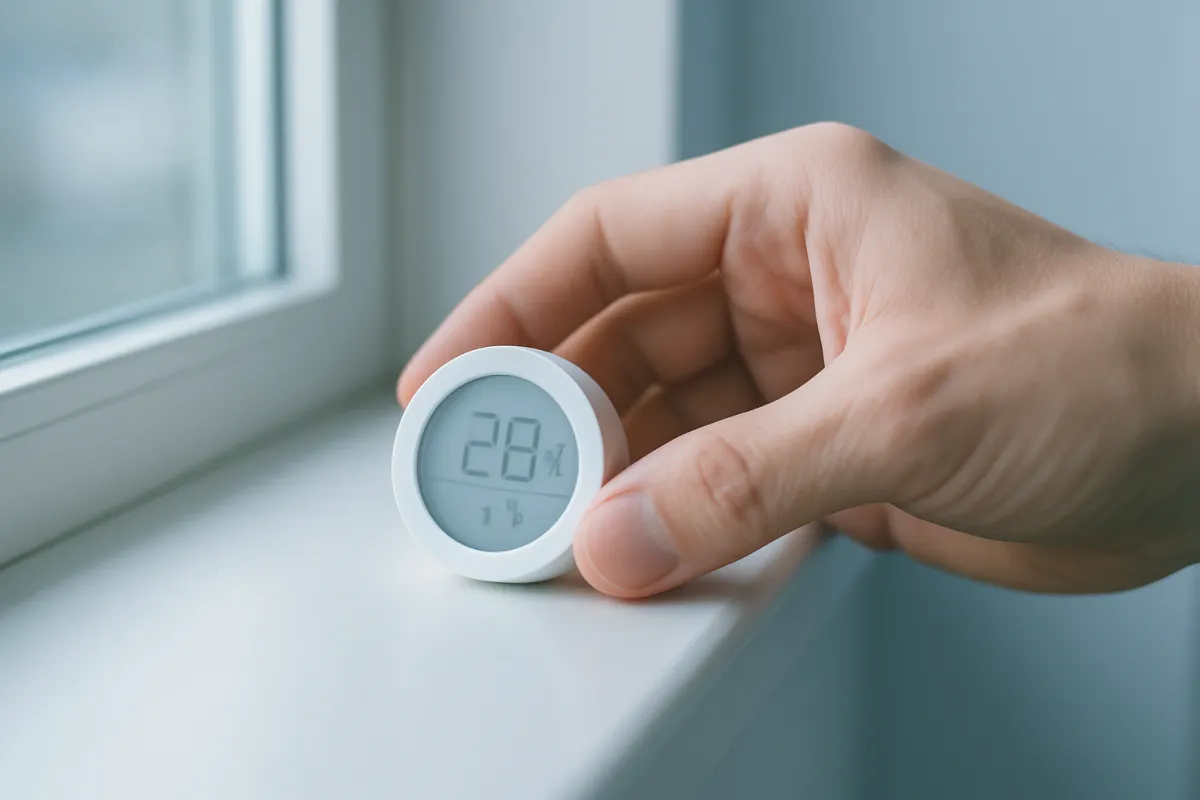
- It runs but the room humidity will not rise
- Noises: gurgling, rattling, and clicking
- Where the faults usually trace back
- The 15 minute clean that fixes most of it
- Repair or replace: the honest math
- When to replace a humidifier outright
- The maintenance routine that prevents round two
- What a broken humidifier costs you in wasted water and wicks
- A worked example: one bedroom humidifier, two symptoms
- The bottom line
Short answer: A humidifier that is not working usually has one of three cheap causes: an empty or misread tank, mineral scale fouling the part specific to its type (the transducer, the wick, or the heating element), or a float sensor that cannot tell the unit water is present. Check the tank and its seating first, then clean or descale the type-specific part. White dust and a short auto shutoff are usually normal, not faults. Skip repairs above roughly half the price of a comparable new unit.
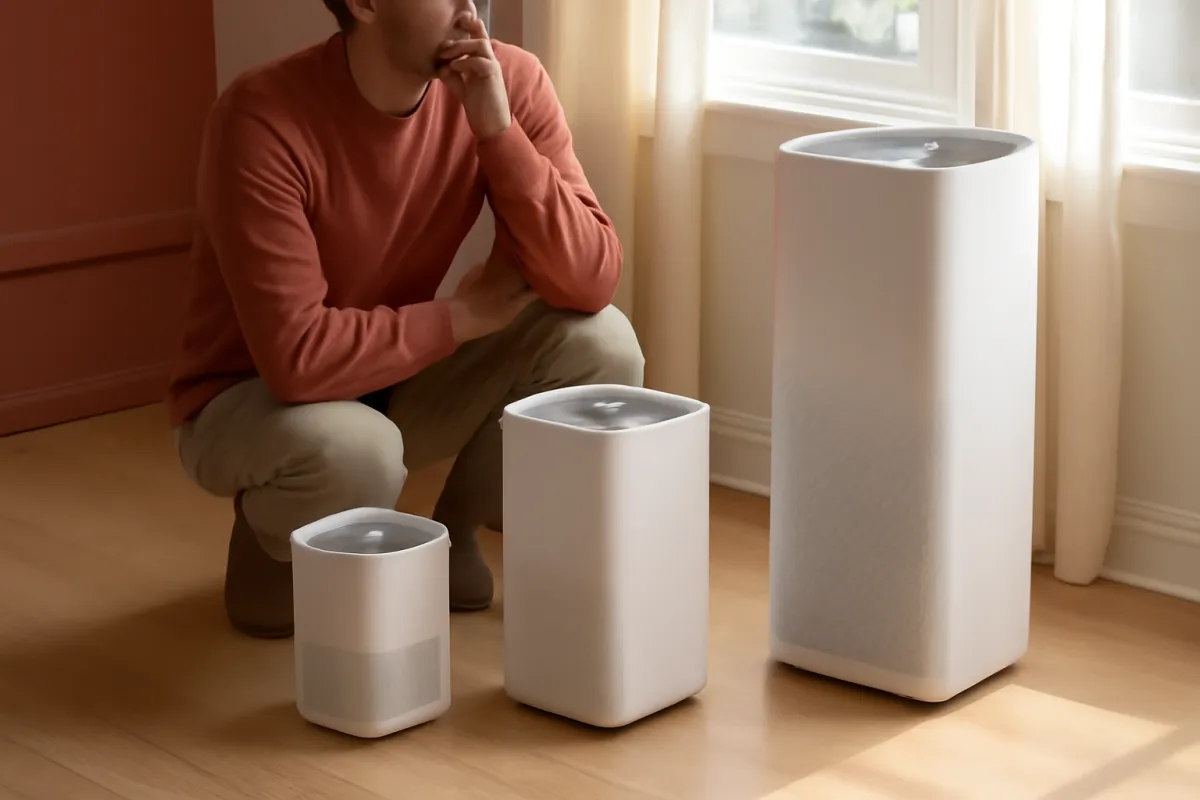
Why is my humidifier not working is really five or six different complaints sharing one name: the mist has stopped, the unit leaks onto the nightstand, a white film is settling on every dark surface in the room, the thing will not turn on at all, or an indicator light blinks in a color nobody explained. Each symptom has a short list of causes, and which ones apply depends heavily on which of the three common humidifier types you own.
This breakdown walks every symptom in turn, by type where it matters, in the order that makes diagnosis fastest. It covers what to check before you blame the machine, the exact causes and fixes behind each complaint, the repair-or-replace math when nothing free fixes it, and the small maintenance routine that keeps round two from happening. If the real answer turns out to be a new unit, our walkthrough on how to choose a humidifier picks up from here, and our cleaning routine covers the maintenance side in depth; this report focuses on the fault rather than repeating either one. You can price a repair quote against a comparable new unit with the cost-per-use calculator as you read.
Key takeaways
- Most "broken" humidifiers are victims of two cheap causes: an empty or misread tank, or mineral scale fouling the transducer, wick, or heating element. Check those before anything else.
- Which part to suspect depends on the type: ultrasonic units fail at the transducer disc, evaporative units fail at the wick, warm mist and steam units fail at the heating element.
- White dust and a reasonably short runtime on a full tank are usually normal operation, not a fault, especially on hard tap water.
- A musty smell means stop using it and clean it, because the unit is aerosolizing whatever is growing in the water path directly into your room.
- A commonly cited replace test: skip repairs above roughly half the price of a comparable new unit, and lean toward replacement once the unit passes the midpoint of a typical 3 to 5 year life.
Why is my humidifier not working? The short answer
Check the cheap and likely causes before the rare and expensive ones. In practice that means, in order: confirm the tank actually has water and is seated correctly, identify which of the three common types you own, then inspect and clean the part specific to that type, the transducer disc, the wick, or the heating element. Those checks resolve the large majority of complaints without a single tool beyond a cloth and maybe some white vinegar.
The order matters because symptoms overlap across causes. A scaled transducer and an empty tank both look like “no mist,” so chasing the wrong one first wastes time. Mineral scale is the single most common root cause across every humidifier type, which is exactly why it comes before any assumption about a failed motor or electrical fault, both of which are comparatively rare in this category.
One framing that saves grief up front: a humidifier that runs and produces mist but never seems to raise the room’s humidity may not be faulty at all. It may be undersized for the space, a mismatch our how to choose a humidifier walkthrough covers in its sizing steps. A working machine losing a fair fight against a large, drafty, or very dry room looks a lot like a broken one.
How a humidifier works, in one minute, by type
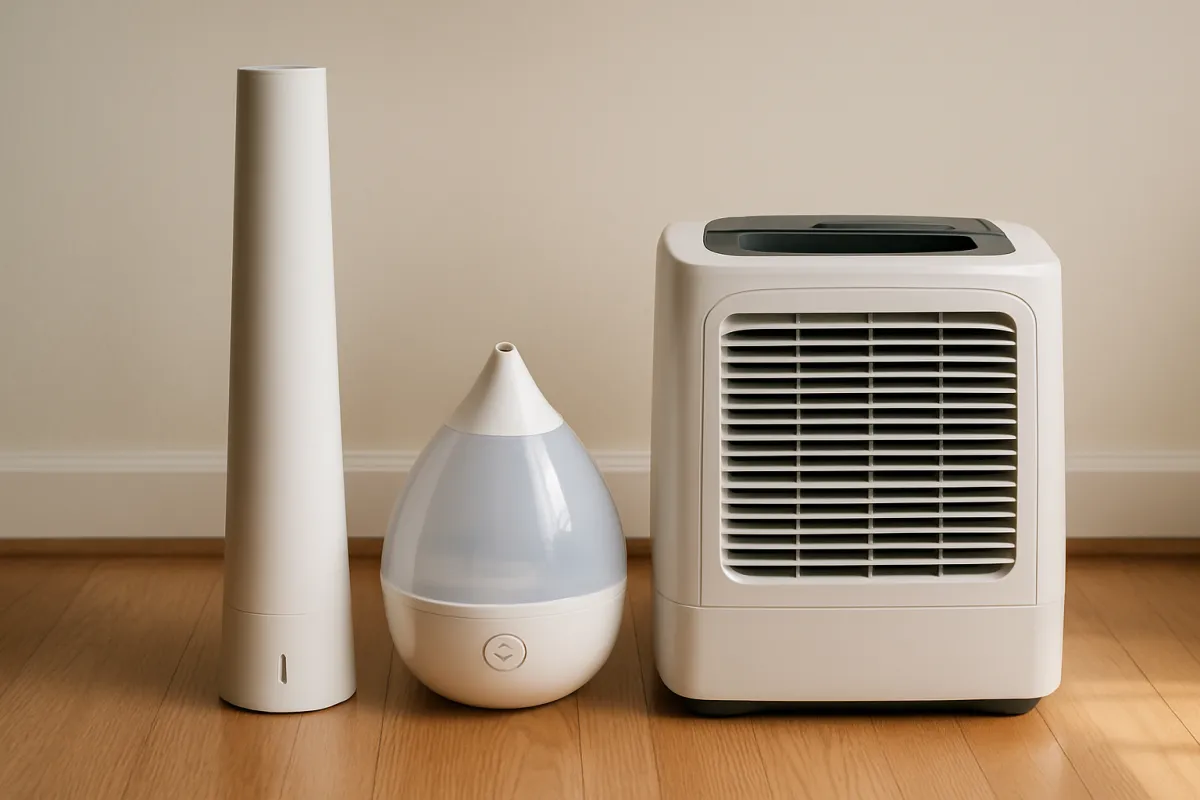
Every symptom below makes more sense once you know which mechanism your unit uses, since the three common types fail in genuinely different places.
An ultrasonic humidifier vibrates a small ceramic disc, the transducer, at a frequency fast enough to shake water into a fine mist without any heat, which a small fan then blows into the room. It is quiet and energy-light, but the transducer is a precision part that mineral scale coats and deadens over time.
An evaporative humidifier draws water up through an absorbent wick, usually a replaceable foam or paper filter, and a fan blows room air across the wet wick, picking up moisture through plain evaporation. It naturally self-regulates, since a drier room evaporates more and a more humid room evaporates less, but the wick itself hardens with scale and needs periodic replacement as a normal consumable.
A warm mist or steam humidifier boils water with a heating element, then releases the resulting steam, sometimes cooled slightly before it leaves the unit. It kills more waterborne organisms than the other two types by virtue of boiling, but the heating element scales up exactly like a kettle’s does, and a badly scaled element eventually fails to heat at all.
Start here: five checks before you open anything
Before touching a screwdriver or a bottle of vinegar, run this sequence. It takes about ten minutes and resolves an outsized share of complaints.
Check the water level honestly. Lift the tank and judge its weight, or look through a clear tank directly, rather than trusting a low-water indicator alone, since those sensors are themselves a common point of failure.
Check that the tank is seated correctly. Pull it off and reseat it firmly, listening or feeling for the valve engaging at the base. A tank sitting even slightly crooked can fail to release water or fail to trigger the unit’s water-present sensor.
Identify your type. Ultrasonic, evaporative, or warm mist, since the next check depends on which one you own.
Check the type-specific part for scale. A cloudy or crusted transducer disc, a stiff or white-crusted wick, or a heating element with visible mineral buildup are all diagnostic at a glance.
Check your water source. Hard tap water accelerates every failure mode in this list. If you have never tried distilled or demineralized water in this unit, that alone resolves a meaningful share of recurring complaints.
Why is my humidifier not producing any mist at all
A silent, dry unit has a strict hierarchy of causes, and the common ones cost nothing to fix.
The tank is empty or nearly empty. Confirm by weight or sight rather than trusting the indicator alone, since a failed sensor can report full when the unit is actually dry.
The transducer is scaled (ultrasonic units). A film of mineral buildup on the ceramic disc dampens its vibration enough to stop atomizing water even with a full tank. Wipe it gently with a soft brush or cotton swab dipped in white vinegar, rinse thoroughly, and test again.
The wick is dried out or hardened (evaporative units). A wick that has sat dry for a while, or one coated in enough scale to stop absorbing water, cannot wick moisture up to the airflow. Soak it in a vinegar solution per your unit’s instructions, or replace it if it has gone stiff and will not soften.
The heating element has failed (warm mist and steam units). Heavy scale insulates the element from the water it is supposed to heat, which both slows the unit down and, in advanced cases, trips a thermal safety cutoff before the water ever boils. Descale per the manual, and if heating still fails to resume, the element itself may be at end of life.
The fan or motor has failed. This is genuinely rare by comparison with the causes above. Listen for any motor sound at all when the unit is powered on; total silence with a confirmed power source and a clean, wet type-specific part points toward the fan motor or the control board rather than scale.
Why is my humidifier leaking water
Water outside the tank, around a unit whose entire job is holding water, is almost always a seating or seal problem rather than a crack you caused.
The tank is not seated squarely. The valve at the bottom of most removable tanks only seals fully when the tank sits exactly centered and level on its base. Lift it off, wipe the valve and the seat dry, and reseat it with a firm, even push rather than a tilt-and-drop.
The tank cap gasket is worn or missing. The rubber seal around the fill cap degrades over years of use, and a weepy, slow leak from around the cap itself, rather than from underneath the unit, points here. Replacement gaskets are usually inexpensive and widely available for popular models.
The tank has a hairline crack. Fill it in a sink and set it on dry paper towels for ten minutes, checking for a growing damp spot. Over-tightening a fill cap, or a drop from counter height, are the usual causes.
The base reservoir overflowed (evaporative units). Some evaporative designs hold a small standing reservoir that the wick sits in, and overfilling it during a refill sends water over the edge during operation. Check your unit’s fill line and avoid topping it past the mark.
Why is my humidifier blowing white dust
White dust is not a malfunction, it is mineral content from your water left behind in the air after the tiny droplets an ultrasonic unit produces evaporate. The water carried dissolved minerals, mostly calcium and magnesium from ordinary tap water, and those minerals do not disappear with the water, they settle as a fine film on nearby surfaces. This symptom is specific to ultrasonic units, since evaporative and steam types do not aerosolize whole droplets the same way.
The fix lives in your water source, not the machine. Switching to distilled or demineralized water removes nearly all of the dissolved mineral content that creates the dust in the first place, and most owners who make the switch see the problem disappear within a day or two of continuous use. If switching water sources is not practical, a demineralization cartridge sold for some ultrasonic models filters minerals from tap water before it reaches the transducer. Our humidifier cleaning routine covers the full descaling process for buildup that has already accumulated from past use.
Why does my humidifier smell musty or moldy
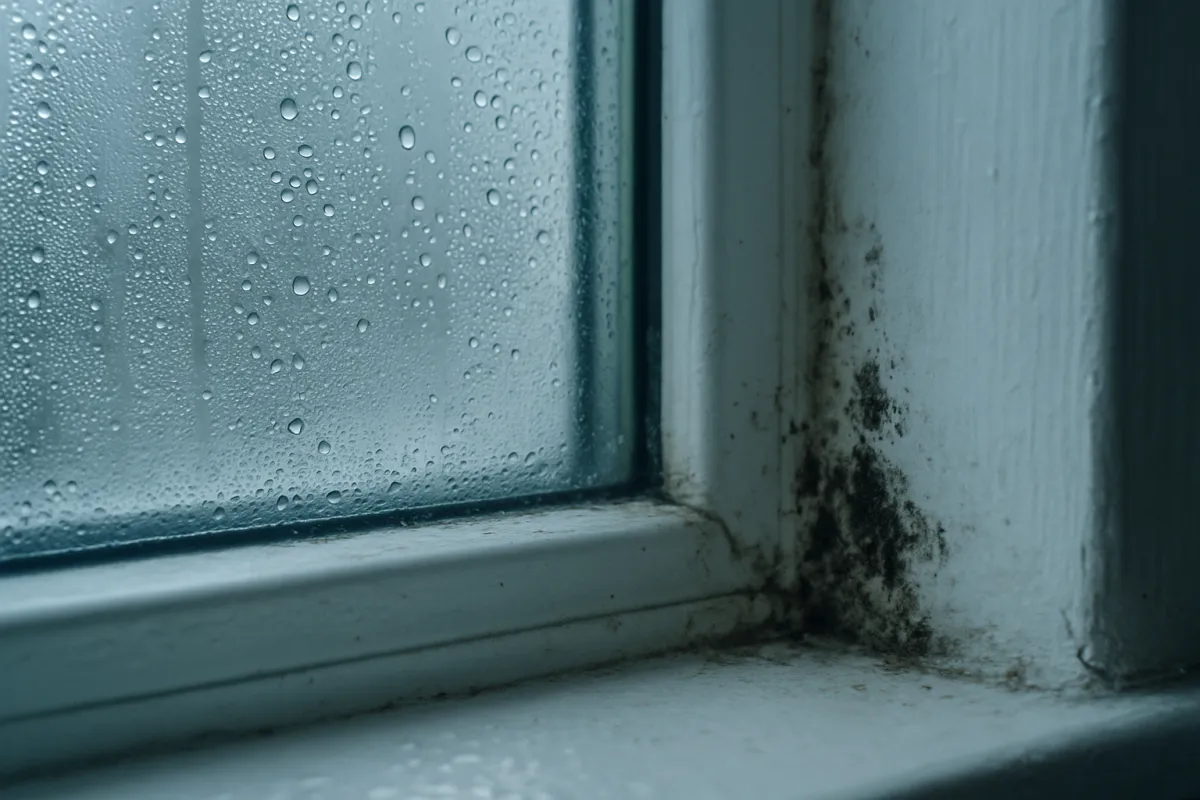
A musty or mildew smell from a humidifier is a signal to stop and clean, not to ignore and hope it fades, because the smell means something is growing in the water path and the unit is actively blowing that air into your room. Standing water left in a tank or reservoir for days between uses is the most common cause, since warm, still water is exactly the environment microbial growth favors.
Empty and fully disassemble every removable part, then work through a complete clean with an approved disinfecting solution, not just a rinse, since a visible clean does not confirm a biologically clean one. If the smell returns quickly after an honest full clean, suspect the wick or a foam component that has absorbed growth into material you cannot fully reach or see, which usually means replacing that part rather than attempting another clean. Running the unit dry between uses, and never leaving standing water in it for more than a day or two, is the single habit that prevents this symptom from recurring.
Why is my humidifier’s light blinking or showing an error
Indicator lights communicate specific statuses that vary meaningfully by manufacturer, so the first useful step is checking your exact model’s manual rather than guessing from the color alone. That said, three causes account for the large majority of blinking-light complaints across brands.
A low or empty tank is the most common trigger, and it is simply the unit doing its job correctly. A tank seated incorrectly can trip the same light even with water present, since many units detect water through the same connection that a crooked tank disrupts. And a filter or wick flagged as due for replacement triggers a maintenance reminder on many mid-range and higher units, which is a scheduling nudge rather than a fault.
Watch out: do not assume a blinking light means an electrical fault until you have ruled out all three of the causes above, since they account for the overwhelming majority of real-world cases and none of them require a repair.
Why does my humidifier keep shutting off
Most humidifiers include an auto shutoff as a designed safety feature, and distinguishing the normal version from the faulty version is straightforward once you know what to check.
Shutting off with a genuinely low or empty tank is normal, intended behavior, protecting the transducer or heating element from running dry. Shutting off with a full tank points at a stuck, misaligned, or scale-fouled float sensor, the small component that physically tells the unit water is present; clean the float and its housing, work it gently by hand to confirm it moves freely, and test again. Shutting off when nudged or on an uneven surface may be a tilt-safety feature doing exactly what it is designed to do, in which case the fix is simply a stable, level surface rather than a repair.
A unit that shuts off mid-cycle repeatedly despite a full tank, a clean float, and a level surface, especially if it also runs hot to the touch, may be tripping a thermal protection feature due to scale buildup restricting normal operation, which sends you back to the type-specific descaling steps above.
Ultrasonic vs evaporative vs steam: which faults belong to which type
Pulling the fault list together by type clarifies which checks are worth your time on your specific unit.
Where each humidifier type's complaints actually come from
Illustrative share of "not working" complaints by root cause, grouped by type. Bars scale to the largest slice within each type.
Illustrative pattern rather than a measured statistic: the type-specific part fouled by mineral scale dominates every category, and an electrical or motor fault is the rare exception, not the typical case.
The practical takeaway: whichever type you own, the part that most needs your attention is the one unique to that mechanism. Buying a different type will not avoid this pattern, since every type scales somewhere, it just moves which component you need to clean.
It will not turn on at all
Dead silence gets a short, strict sequence. Confirm the outlet works with a lamp or phone charger first, since a dead outlet is indistinguishable from a dead unit. Check for a tripped breaker or GFCI upstream, particularly in a bathroom or kitchen installation.
Next, confirm the tank is seated correctly, since many units will not power on at all without detecting water present, which looks identical to a dead unit from the outside. Check for a child lock engaged, a delay timer set, or a power switch that is separate from the control panel buttons, all small details that get missed under the assumption something more serious has failed.
If the unit truly has no response on a confirmed working outlet with the tank correctly seated, the control board or power cord has likely failed, which on most consumer humidifiers is not an economical repair given the unit’s original price, and points toward the replace side of the decision below.
It runs but the room humidity will not rise
A unit producing visible mist and a stubborn hygrometer reading together mean the machine is healthy and the match is wrong, not broken. Three mismatches cover it.
Undersized capacity for the room. A small tabletop unit in a large or drafty bedroom can run constantly and lose the race. Compare your square footage against the sizing steps in our how to choose a humidifier walkthrough; moving up a size class matters more than any setting.
Air exchange is winning. An open window, a door left cracked to a hallway, or a forced-air furnace constantly pulling in cold, dry outside air can resupply dryness faster than a tabletop unit replaces it. Closing the room helps the unit compete on more even terms.
Placement is fighting the airflow. A unit tucked in a corner or behind furniture humidifies its corner. Centralize it and give the outlet clear airspace, ideally elevated slightly off the floor where mist can disperse rather than pooling.
Noises: gurgling, rattling, and clicking
Most humidifier sounds are innocent, and knowing which is which saves an unnecessary worry. A soft gurgle from an evaporative or tank-style unit is usually just air bubbling into the reservoir as the tank empties, which is normal. A faint high-pitched whine from an ultrasonic unit is the transducer itself, inaudible to some ears and mildly noticeable to others, and is simply how the mechanism works. A click at power-on or shutoff is a relay doing its job.
The sounds that mean something: a rattle that changes with fan speed usually traces to a loose grille or a buildup of mineral dust on a fan blade, both reachable with the housing open. A grinding sound from an evaporative unit’s fan, or a sudden silence where there was previously a quiet hum, points at a failing fan motor, which on most consumer units is a repair not worth pursuing economically. A sizzling or popping sound from a warm mist unit beyond the normal gentle boiling simmer deserves immediate attention and a power-off, since it can indicate the heating element or its wiring has developed a real electrical fault.
Where the faults usually trace back
Pull the whole symptom list together and the pattern is unmistakable: mineral scale, not electronics, dominates this category’s complaints, which is the opposite of what the word “appliance” might suggest.
What is actually wrong, when a humidifier "stops working"
Illustrative share of complaints by root cause across all humidifier types. Bars scale to the largest slice.
Illustrative split rather than a formal survey, but it matches the shape of what this category's complaints look like: nearly three in four cases trace to scale, seating, or water level, all owner-fixable in minutes.
The practical lesson sits right in the chart: before any repair decision, you can personally rule out roughly 85 percent of the causes with a cloth, some white vinegar, and an honest look at the tank. Scale is the single highest-value thing to check first on any humidifier complaint, regardless of type.
The 15 minute clean that fixes most of it
Since scale tops the fault chart across every type, the highest-value fix in this category is a thorough clean. Unplug the unit first, every time, before you touch any water inside it.
Empty the tank completely and disassemble every part the manual says is removable. Soak the type-specific part, the transducer, the wick, or the heating element, in a white vinegar solution per your unit’s recommended ratio and time, which dissolves mineral scale without harsh chemicals. While that soaks, wash the tank and base in warm soapy water, paying particular attention to any corner or seam where water sits still, since that is where microbial growth starts.
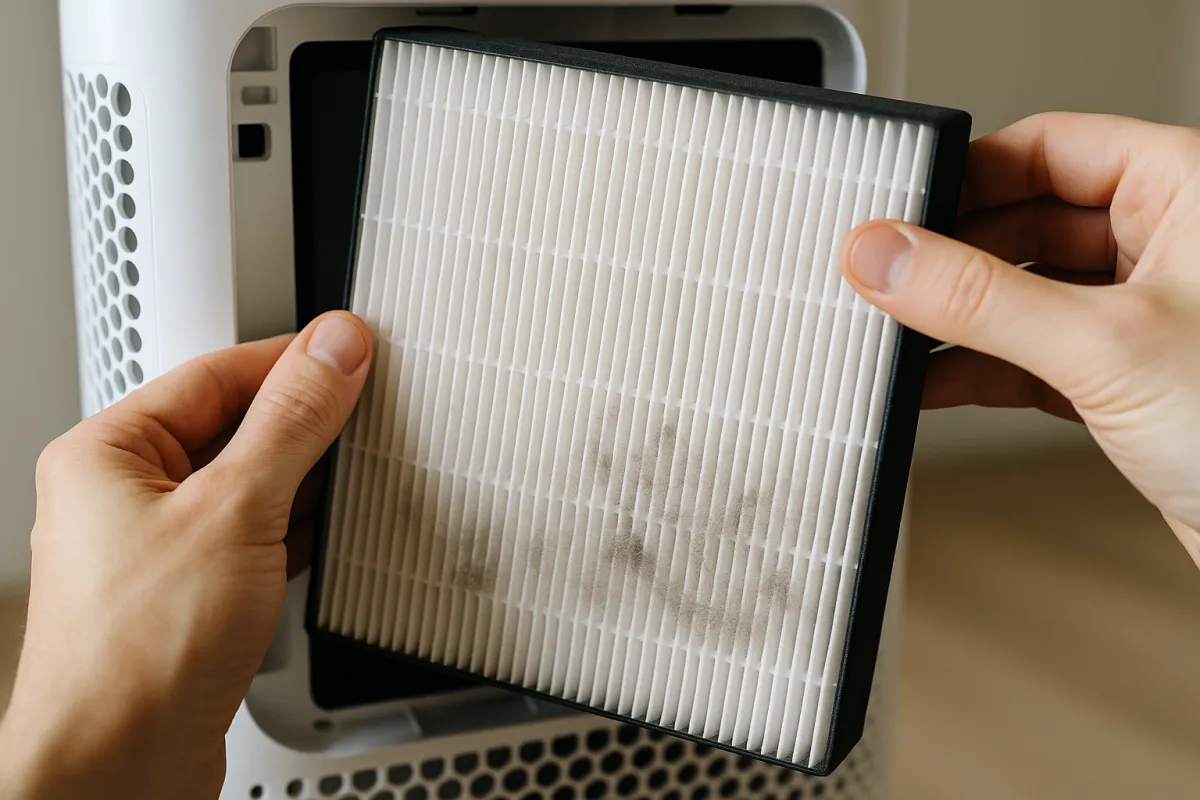
Rinse every part thoroughly, since residual vinegar left in the water path is a genuine, if mild, air quality complaint of its own. Let everything dry completely before reassembly, particularly a wick, which mats and mildews if reassembled damp. Refill with distilled or demineralized water if you have access to it, and run the unit for a few minutes before trusting a bedroom overnight with it.
Do this every one to two weeks during heavy winter use, and immediately at the first sign of reduced output or a smell. Our broader routine in how to maintain your appliances puts this on the same calendar as the rest of the house.
Repair or replace: the honest math
When a fault survives the free fixes, a repair quote or replacement part price decides the unit’s fate, and the framework is the same cost-per-use discipline used across every appliance here. A commonly cited rule: skip any repair costing more than about half the price of a comparable new unit. Weight that against remaining life, since a typical portable humidifier serves somewhere around 3 to 5 years, so a repair in year one buys considerably more future than the same repair in year four.
Run an illustrative case. A mid-size ultrasonic unit cost $45 new; at year two, the transducer has degraded past what cleaning restores, and a replacement part plus the time to source and fit it is quoted at $25. That is 56 percent of replacement, just over the line, and on a unit this inexpensive to begin with, replacement is the more sensible call even though the dollar amount is small. The math shifts on a pricier whole-house or console unit, where a $40 part replacement against a $220 unit sits comfortably under the half-price line and is worth doing. Run your own unit age, price, and quote through the cost-per-use calculator to see which side of the line your situation falls on.
Where a humidifier's lifetime cost actually goes
Illustrative split for a mid-range unit over 4 years: unit price, replacement wicks or filters, and electricity, which is close to negligible on this appliance.
Unlike a dehumidifier, a humidifier's lifetime bill is dominated by the unit and its consumables, not by power. That is why descaling and the right water source matter more here than wattage ever will.
When to replace a humidifier outright
Some verdicts should skip the repair quote entirely. A heating element that has failed completely on a warm mist unit, or an ultrasonic transducer that no longer atomizes after a full, careful clean, are both close to end-of-life signals on inexpensive consumer units, where the part and labor rarely beat the price of starting fresh. A unit that trips breakers, smells of hot electronics, or shows heat damage around the cord is an electrical retirement, full stop, not a repair candidate.
Recurring musty odor that survives a genuinely thorough disassembly and clean is also a legitimate retirement reason, particularly on a unit with foam or absorbent components that have likely absorbed growth beyond what cleaning can reach. If the fault chart above ends at a failed type-specific component on a unit near or past its typical 3 to 5 year mark, the productive next step is our how to choose a humidifier walkthrough, which covers sizing, type selection, and the features worth paying for in the replacement.
The maintenance routine that prevents round two
The fixes in this report share a common ancestor: mineral scale and standing water, compounding quietly through a heavy winter season. The prevention schedule is short enough to actually keep.
Every fill, or at least every few days: empty any standing water rather than topping off a stale tank, and wipe the tank interior dry before refilling.
Weekly in heavy use: a vinegar soak of the type-specific part, transducer, wick, or element, per your unit’s instructions.
Always: distilled or demineralized water if at all practical, since it is the single biggest lever against both scale and white dust. A unit run exclusively on hard tap water will need this routine far more often than one run on distilled water.
At the season’s end: a full clean and complete dry-out before storage, since a damp unit stored for months is a mold culture waiting to happen by the time you pull it out again next winter.
What a broken humidifier costs you in wasted water and wicks
A brief word on cost while you diagnose, because a faulty humidifier wastes more in water and consumables than in electricity, the reverse of most appliances covered on this site. A unit running constantly because it cannot raise the room’s humidity, due to undersizing or a scaled part limping along at reduced output, burns through tank refills and wick replacements faster than a healthy unit doing the same job efficiently.
The failure modes bend the consumable cost upward in a quiet way: a partially scaled wick that still passes some moisture runs longer for less output, so you refill more often and replace the wick sooner for the same humidity result a clean unit would have delivered on less water. Treat frequent refilling and short wick life as symptoms worth investigating, not just as the normal cost of running a humidifier.
A worked example: one bedroom humidifier, two symptoms
Here is the whole method compressed into one plausible evening. A two-year-old ultrasonic tabletop unit in a bedroom presents two complaints: the mist output has visibly weakened over the past week, and a thin white film has started appearing on the nightstand each morning.
The five checks run first. The tank is full and seated correctly, ruling out the simplest cause. The type is confirmed ultrasonic from the model, which points the investigation at the transducer. A look at the disc through the tank opening shows a faint white crust across its surface, the telltale sign. The water source has always been straight tap water, never distilled.
The fix follows directly: unplug the unit, empty the tank, and soak the transducer area per the manual’s vinegar ratio for the recommended time, then wipe gently with a soft cotton swab rather than anything abrasive that could scratch the disc. Rinse thoroughly, dry, reassemble, and refill with distilled water sourced from here forward. Within one evening, the mist output visibly strengthens, and over the following week the white dust on the nightstand stops reappearing entirely, confirming the water source, not the unit, was the deeper cause behind both symptoms at once.
Total cost: a few cents of white vinegar and about fifteen minutes of attention, against a symptom pair that looked like the beginning of a dying unit. That outcome is the fault chart doing its job: the two most common causes, scale and water source, were checked before anything more serious was even considered.
The bottom line
Why is my humidifier not working almost always has a cheaper answer than it first appears. Check the tank’s water level and seating, identify your type, and inspect the transducer, wick, or heating element for mineral scale before assuming anything electrical has failed. White dust and a full-tank auto shutoff that behaves normally are usually not faults at all; a musty smell is a signal to stop and clean, not a reason to keep running the unit.
When the free fixes fail, let the math rule: repairs above roughly half the price of a comparable new unit, a failed heating element or transducer on an inexpensive unit, and any unit past the midpoint of a typical 3 to 5 year life all point toward replacement. Choose the next one carefully with our buying breakdown, and spend fifteen minutes every week or two during heavy use making sure this report never needs to apply to it again.
This breakdown is for general information about appliance troubleshooting and is not professional repair or electrical advice. Every dollar figure, lifespan, and percentage in it is illustrative rather than a quote or a measured statistic, and your unit, water, and repair prices will differ. Unplug any appliance before opening, cleaning, or descaling it, and treat water near electrical components with caution. If a manufacturer’s manual disagrees with a general rule here, the manual wins, and anything involving a persistent electrical smell or heat damage belongs with a qualified technician rather than a home fix.
Frequently asked questions
Why is my humidifier not producing any mist?
Work through causes in order of how common they are. An empty or low tank is the first check on every type. On an ultrasonic unit, a transducer disc coated in mineral scale cannot vibrate properly, so it stops atomizing water even with a full tank. On an evaporative unit, a wick that has dried out, hardened with scale, or is seated wrong against the water reservoir cannot wick moisture up to the fan. On a warm mist or steam unit, a heating element coated in scale takes much longer to boil water and can eventually fail to heat at all. Clean or replace the type-specific part before assuming the motor or fan has failed, since that is rare by comparison.
Why is my humidifier leaking water?
Leaks trace to a short list of places on nearly every unit. A tank that is not seated squarely on its base is the most common cause, since the valve at the bottom only seals when the tank sits exactly right. A cracked tank, usually from being dropped or over-tightened, leaks continuously once filled. A worn or missing rubber gasket on the tank cap lets water weep out slowly. And on evaporative units, an overfilled base reservoir can overflow during operation. Empty the unit, dry everything, reseat the tank carefully, and refill gradually while watching for the first drip.
Why does my humidifier keep shutting off?
Most units include an auto shutoff that trips when the water tank runs low, which is normal and simply means it is time to refill. If it shuts off with a full tank, suspect a float sensor that is stuck, misaligned, or fouled with mineral buildup, since that sensor is what tells the unit whether water is present. A unit that shuts off specifically when it tips slightly, or when set on an uneven surface, may have a tilt-sensing safety feature doing exactly what it is designed to do. Clean the float or sensor area first, then set the unit on a level, stable surface before suspecting a deeper electrical fault.
Why is my humidifier blowing white dust?
White dust is mineral content from your water, left behind when the tiny water droplets an ultrasonic unit produces evaporate into the air and release the dissolved minerals they carried. It is most common with ultrasonic humidifiers run on hard tap water and is not a malfunction, it is the unit doing exactly what it does with the water you gave it. The fix is almost always water quality, not the machine: switch to distilled or demineralized water, which carries far less dissolved mineral content, and our humidifier cleaning routine covers the full descaling process that removes buildup already in the tank and transducer.
Is it safe to keep running a humidifier that smells musty?
No, not until you have cleaned it, because a musty smell from a humidifier almost always means microbial growth somewhere in the water path, and running the unit aerosolizes whatever is growing directly into the room's air. Stop using it, empty and disassemble every removable part, and work through a full clean with an approved disinfecting solution before refilling. If the smell returns quickly after a thorough clean, inspect the wick or filter for mold that has worked into material you cannot fully reach, which usually means replacing that part rather than cleaning it again.
How long should a humidifier last?
A typical portable humidifier lasts somewhere around 3 to 5 years with regular care, illustratively, and units run on hard water without a consistent cleaning and descaling routine tend to sit at the shorter end, since mineral scale is the single biggest driver of early failure across every type. Evaporative units may need a wick replacement well before the unit itself is due for retirement, which is a normal consumable rather than a sign of a dying machine. Running distilled water and cleaning on the schedule in our humidifier maintenance routine meaningfully extends the realistic lifespan.
Should I repair a broken humidifier or just replace it?
For most humidifiers the honest math favors replacement once the fault is in the heating element, ultrasonic transducer, or main control board, since these units cost relatively little new and a repair labor charge often approaches or exceeds that price. A commonly cited rule is to skip any repair quote above roughly half the price of a comparable new unit. Cheap fixes, a stuck float sensor, a worn gasket, a clogged wick, are worth doing at any age since they cost little beyond your time. A unit past the middle of its typical 3 to 5 year service life with any real repair quote is usually better replaced.
Why does my humidifier's light keep blinking or turn red?
An indicator light is almost always communicating a specific status rather than a generic fault, and the meaning varies by manufacturer, so the first move is checking your unit's manual or a quick search of your exact model and the color shown. The overwhelmingly common causes across brands are a low or empty water tank, a tank that is not seated correctly so the unit cannot confirm water is present, or a filter or wick that the unit is flagging as due for replacement. Rule out those three before assuming an electrical fault, since they account for the large majority of blinking or red indicator complaints.